
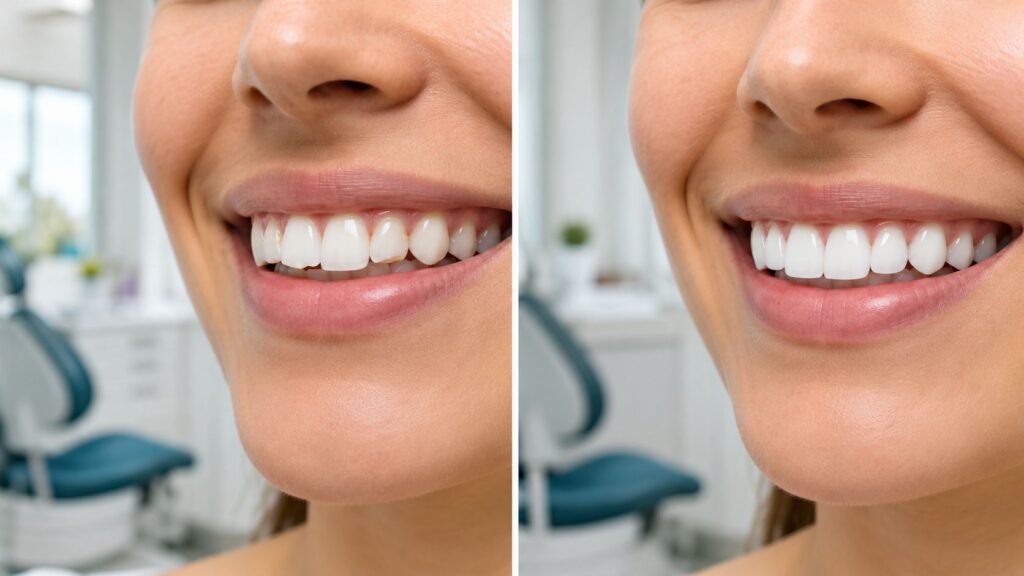
A chipped front tooth, a small gap, or a dark spot that whitening won't change can become surprisingly distracting, especially before a wedding, presentation, family gathering, or important photograph. Patients searching for a cosmetic dentist near me often want a natural improvement without extensive drilling, multiple appointments, or a commitment to permanent porcelain treatment. For Scottsdale patients, dental bonding can provide a conservative way to improve the shape, color, and symmetry of selected teeth while preserving much of the healthy enamel.
The most useful way to evaluate dental bonding before and after results is to look beyond the first photograph. The immediate change can be impressive, but the long-term outcome depends on enamel quality, bite forces, moisture control, resin placement, daily habits, and maintenance. A consultation with Eric Wiitala DDS can help determine whether bonding is appropriate or whether whitening, veneers, a crown, orthodontic care, or restorative treatment would provide a more predictable result.
Why Scottsdale Patients Choose Dental Bonding for Smile Repairs
A Scottsdale patient may notice a small corner missing from a front tooth while looking in the mirror, or see a stubborn space between the teeth in photographs. The concern may be cosmetic, but the decision is often practical. The patient wants a visible improvement without removing substantial tooth structure or arranging a lengthy sequence of appointments.
Dental bonding uses tooth-colored composite resin that's placed directly on the tooth, shaped, hardened, and polished. Modern bonding traces back to 1949, when Swiss chemist Oskar Hagger developed an early system for attaching acrylic resin to dentin. A major advance followed in 1955, when Michael Buonocore introduced acid etching to improve resin adhesion to enamel. Later work involving Rafael Bowen's bis-GMA and silica coupling helped establish the composite resins used in contemporary smile repairs. These milestones are summarized in the history of dental adhesives.
Common reasons for choosing bonding
Bonding may be considered for:
- Small chips: A dentist can rebuild a missing edge and restore a smoother contour.
- Limited spacing: Composite can reduce a small gap when tooth position and bite allow it.
- Localized discoloration: Resin may mask a spot that doesn't respond to teeth whitening.
- Uneven shapes: A narrow, short, or irregular tooth can sometimes be reshaped for better balance.
- Minor cracks or worn edges: Treatment may improve appearance when the tooth remains structurally sound.
Most cases are completed in a single office visit, and significant enamel removal usually isn't required. Cleveland Clinic describes bonding as reversible because enamel removal isn't required and reports that the material typically lasts between 3 and 10 years before touch-up or replacement may be needed. That conservative profile makes bonding an accessible entry point for patients exploring cosmetic dentistry, rather than an automatic step toward veneers.
Practical rule: A polished before-and-after photo shows the starting point and the immediate finish. It doesn't show how the tooth meets its opposing tooth, how the patient maintains the resin, or how the material responds to everyday habits.
Patients often feel more comfortable smiling after a visible front-tooth repair. That emotional benefit matters, but it shouldn't replace a clinical assessment. The right Scottsdale dentist will discuss what bonding can accomplish, what it may not correct, and whether the proposed shape will remain comfortable during chewing.
What Happens During a Dental Bonding Appointment
Dental bonding is direct treatment, which means the dentist builds the restoration on the tooth rather than sending it to an outside laboratory. The appointment is straightforward, but each stage affects the final appearance and the strength of the bond.
The clinical steps
The shade is selected. A color guide helps match the composite resin to the surrounding enamel. Shade planning matters because the material is intended to blend with adjacent teeth, not just look white in isolation.
The tooth is prepared. The surface is cleaned and kept as dry as possible. A mild acid gel etches the enamel, creating a more receptive surface for adhesion. A conditioning liquid and adhesive system are then applied according to the selected protocol.
The resin is placed. Tooth-colored composite is added in small amounts. The dentist sculpts the material to restore the missing corner, close a limited space, or adjust the tooth's contour.
The shape is refined. The restoration is smoothed and checked against neighboring teeth. Natural results depend on proportion, surface texture, translucency, and a contour that supports healthy cleaning around the gumline.
The composite is cured. A specialized LED or UV curing light hardens the resin in seconds. The dentist may cure the material in stages to support controlled placement and adequate hardening.
The bite and polish are checked. The bonded tooth is polished and the bite is evaluated so the restoration doesn't strike excessively against another tooth during normal movement.
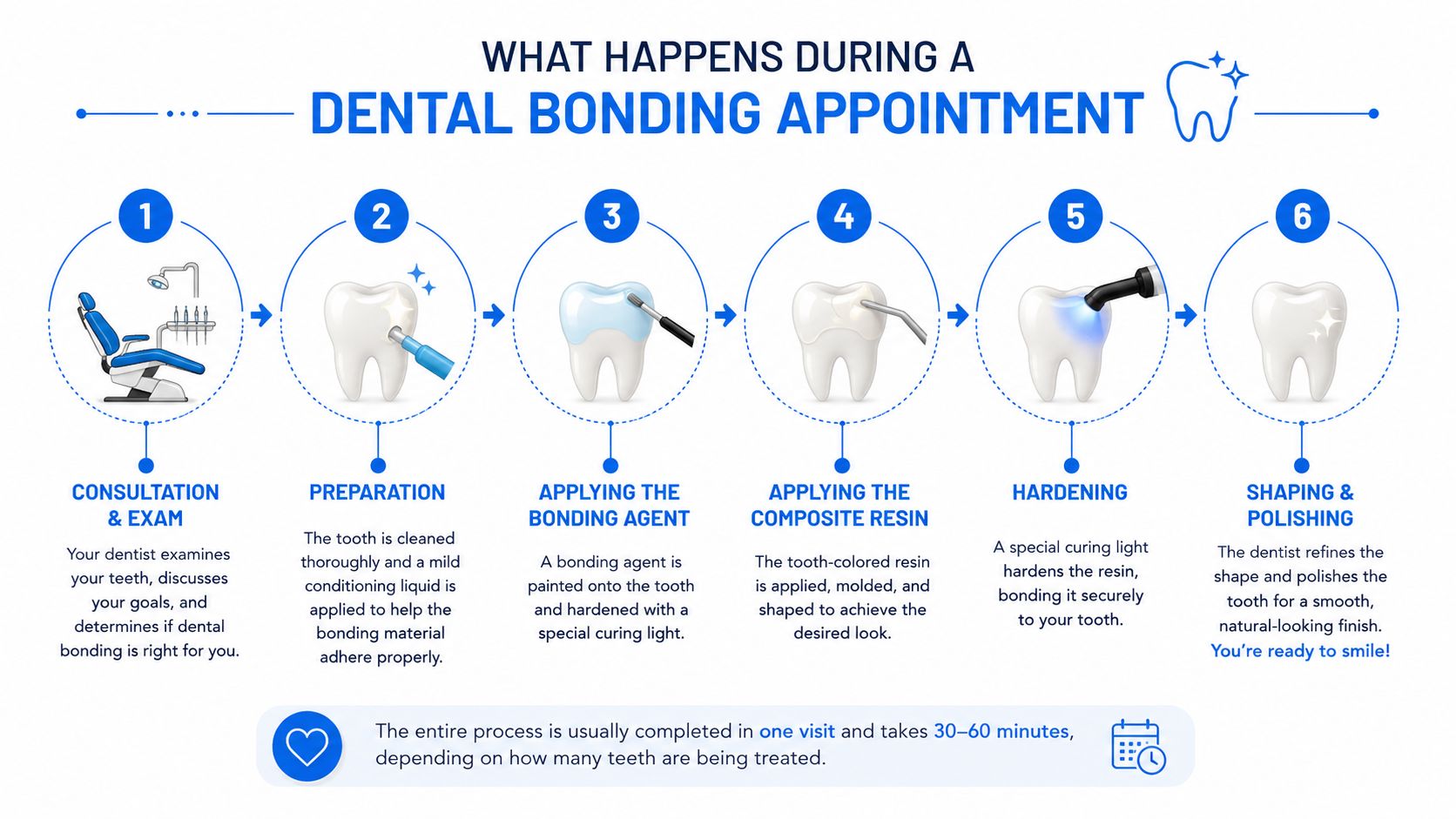
The procedure commonly takes 30 to 60 minutes per tooth, according to the planned treatment description for this service. Many patients need little or no anesthesia, particularly when the work is limited to the outer enamel and doesn't involve decay or sensitive dentin. Discomfort is uncommon, and normal activities can generally resume immediately after the material has been cured and the bite has been adjusted.
Why technique affects the result
Bonding is sensitive to moisture and operator technique. A PubMed study reported dentin bond strengths of 46.1 ± 21.4 for hydrated specimens and 40.9 ± 19.1 for dehydrated specimens, while water storage after bonding reduced bond strength regardless of the original hydration state. The clinical lesson is simple. Isolation, surface control, adhesive selection, and careful finishing all matter.
Enamel generally provides a more reliable bonding surface than dentin, so conservative designs that preserve enamel margins can improve predictability. Patients researching the difference between clinical care and online visibility may also find marketing services for dentists useful as a separate resource, but the dental outcome itself depends on diagnosis and execution inside the operatory.
Real Before and After Results You Can Expect
The strongest dental bonding before and after cases usually involve a focused problem. A small defect can produce a noticeable visual change when the dentist restores the original proportions without making the tooth look oversized or artificial.
A chipped front tooth
Before treatment, a central incisor may have a missing corner, a rough edge, or a shorter appearance that stands out whenever the patient smiles. Bonding can replace the missing portion, reproduce a natural edge, and smooth the transition into the existing enamel. The limitation is structural. A large fracture, deep crack, or tooth with insufficient remaining strength may need a different restoration, such as a crown.
A small gap between front teeth
A limited diastema can sometimes be reduced by adding composite to the sides of adjacent teeth. The dentist must consider tooth width, gum contours, speech, floss access, and the patient's bite. Adding too much material can make the teeth look broad or create areas that are difficult to clean, so the best result isn't always complete closure.
Localized discoloration
Bonding may help when one tooth has a stain or color irregularity that whitening can't correct. It can also even out a small area of discoloration while preserving the surrounding tooth. Severe intrinsic staining or a desire for a uniform color across many teeth may make veneers or a carefully planned whitening sequence more appropriate. Whitening should be discussed before bonding because the resin shade won't change in the same way as natural enamel.
Uneven edges or a peg lateral
A small lateral incisor or an irregular tooth edge can affect the balance of the entire smile. Composite can add width, length, or contour to make the tooth look more proportionate. The dentist still has to preserve natural cleaning spaces and avoid creating a bulky profile.

Before-and-after images can help patients understand the visual possibilities, but they can't establish candidacy. Active decay, untreated gum disease, a heavily loaded bite, significant grinding, extensive enamel loss, or major tooth rotation may make bonding less reliable. A 2025 animal-model study found that vital teeth showed better bonding durability and interface integrity than nonvital teeth, while nonvital teeth demonstrated microcracks and poorer sealing. That developing evidence is discussed in the clinical research on bonding durability and tooth vitality.
A digital preview can help patients assess proportion before treatment. Scottsdale patients considering a broader smile plan can review digital smile design as part of that conversation. The practical question isn't whether bonding can change a tooth. It's whether the proposed change will remain healthy, cleanable, comfortable, and visually balanced.
Dental Bonding vs Veneers and Crowns
Bonding, porcelain veneers, and crowns solve different clinical problems. Choosing among them requires more than comparing photographs or assuming the most extensive treatment will produce the best smile.
Bonding is usually the least invasive option. It can often be completed in one visit, preserves substantial natural tooth structure, and works well for small chips, limited spacing, modest reshaping, and localized color concerns. Its trade-offs include greater susceptibility to surface staining and chipping than ceramic, along with the possibility of future polishing, repair, or replacement.
Porcelain veneers cover the visible front surface of a tooth and are often considered when a patient wants coordinated changes across several teeth, consistent translucency, or a more uniform aesthetic design. They're more involved and generally require some enamel preparation. The decision depends on the amount of change desired, available enamel, bite forces, and whether the patient accepts a less reversible treatment.
Crowns cover the tooth more completely. They're typically reserved for teeth weakened by extensive decay, fractures, large restorations, or substantial structural loss. A crown may provide protection that bonding or a veneer cannot, but it also involves more tooth preparation and is not the appropriate response to a minor cosmetic imperfection.
| Factor | Dental Bonding | Porcelain Veneers | Dental Crowns |
|---|---|---|---|
| Typical role | Minor cosmetic or restorative repair | Coordinated visible-surface smile changes | Protection of a structurally compromised tooth |
| Enamel preservation | Usually preserves more enamel | Requires planned preparation | Requires greater tooth reduction for full coverage |
| Treatment time | Often completed in one visit | Usually requires planning and laboratory fabrication | Usually requires planning and laboratory fabrication |
| Durability | Can stain, chip, and require maintenance | Generally offers a more stable ceramic surface | Provides full-coverage protection when indicated |
| Aesthetic scope | Localized improvements | Broader shape, shade, and symmetry changes | Restoration of form and function, not simply whitening |
| Reversibility | Often reversible when enamel isn't removed | Typically not fully reversible after preparation | Not reversible after tooth preparation |
The practical framework is conservative but not simplistic. Bonding may be a definitive solution for a small chip, or it may serve as a cautious first step before a broader cosmetic plan. A detailed discussion of the clinical differences appears in this guide to veneers versus bonding teeth.
Bonded restorations can exceed 90% five-year survival in conventional composite restoration research, particularly with multi-step adhesives, as reported in a systematic review indexed by PubMed. The same evidence emphasizes that adhesive protocol and operator technique influence outcomes, so a material label alone doesn't predict longevity.
How Long Bonded Teeth Actually Last
The first day after bonding is when the result looks its freshest. The composite has just been shaped and polished, the shade has been selected for the current smile, and the patient hasn't yet exposed the surface to months of food, drinks, bite forces, or grinding. Cleveland Clinic reports a practical lifespan of 3 to 10 years before bonding may need touch-up or replacement, while its cosmetic dentistry overview gives an approximate benchmark of five to eight years for results. Both figures should be understood as ranges, not promises.
What changes after the photograph
Composite resin can absorb stains over time, particularly with repeated exposure to coffee, red wine, tobacco, and strongly colored foods. It may also chip when a patient bites fingernails, chews ice, opens packaging with the teeth, or clenches and grinds during sleep. Front teeth receive direct edge forces, so a restoration placed on an incisal corner may experience different stress from bonding placed on a less exposed lateral surface.
The interface can also change gradually. A 7.5-year clinical study of universal adhesive restorations reported retention rates of approximately 72.7% to 79.4%, depending on technique, with marginal staining and adaptation defects appearing over time. The results reinforce an important point. The “after” remains a maintained condition, not a permanent endpoint.
Maintenance that protects the finish
Cleveland Clinic recommends brushing at least twice daily with a soft toothbrush and fluoride toothpaste, flossing once daily, and attending regular dental checkups and cleanings to support oral health and the bonded restoration. Patients should also ask about a custom night guard when bruxism is present, avoid biting directly into hard foods, and choose a non-abrasive toothpaste rather than relying on aggressive whitening products.
Professional polishing can refresh a dull surface and remove some external staining. A small edge repair may be appropriate when the underlying tooth remains healthy and the bite is controlled. Replacement becomes more reasonable when the resin has repeated fractures, extensive staining, poor margins, or a changed bite.
Maintenance matters more than the gallery photo. A careful bite assessment, sensible home care, and timely touch-ups can protect the appearance and the natural tooth beneath it.
A dentist should also review the bond during routine cleaning and exams. Moisture control, enamel preservation, aging, adhesive chemistry, and technique all influence the result, which is why one patient's timeline can't be applied automatically to another.
Scheduling Your Cosmetic Consultation in Scottsdale
A cosmetic consultation at Eric Wiitala DDS begins with the patient's concern, not with a predetermined procedure. The conversation may focus on a chipped incisor, a small gap, a discolored tooth, or an uneven edge. A clinical examination then evaluates tooth structure, enamel quality, gum health, bite dynamics, existing restorations, and signs of clenching or grinding.
When appropriate, digital imaging or a mock-up can help clarify how changes in tooth length, width, and contour may affect the smile. The dentist can then explain whether bonding is suitable, whether teeth whitening should come first, or whether veneers, a crown, orthodontic clear aligners, or another restorative option would better match the patient's goals.
What Scottsdale patients can discuss
- Treatment planning: The office can outline the proposed number of teeth, preparation, appointment sequence, and maintenance needs.
- Financial details: Patients can request itemized cost estimates, ask whether insurance may apply when bonding repairs functional damage, and review available financing options for cosmetic treatment.
- Scheduling: The consultation can establish the expected timeline from evaluation to treatment completion, based on the condition being treated and the chosen restoration.
- Related care: A broader exam may identify decay, gum concerns, bruxism, TMJ symptoms, or missing teeth that should be addressed before cosmetic work.
Eric Wiitala DDS provides cosmetic, family, preventive, restorative, and implant dentistry at 9755 North 90th Street, Suite B250, Scottsdale, AZ 85258. The office can be reached at (480) 657-6981, with regular office hours Monday through Thursday and Friday appointments available by arrangement.
Patients shouldn't feel pressured to choose veneers or crowns when bonding can meet the aesthetic and functional objective. The right plan is the one that respects healthy tooth structure while offering a realistic result that can be maintained.
Eric Wiitala DDS offers dental bonding for minor repairs, reshaping, gaps, and localized discoloration, along with whitening, veneers, crowns, and restorative care when those options are more appropriate. Visit Eric Wiitala DDS to request a Scottsdale cosmetic consultation and discuss what your dental bonding before and after result can realistically achieve.