
A tooth can disappear from daily attention long before it disappears from the mouth. A Scottsdale resident may be avoiding apples, chewing on one side, covering a smile in photographs, or preparing for a tooth extraction and wondering whether anything will ever feel normal again. The practical question is often simple: how do dental implants work, and can they restore more than the visible gap?
For patients searching for a dentist near me, dental implants near me, or a restorative dentist in Scottsdale, the answer starts with biology rather than marketing. An implant replaces the missing tooth root, allows bone to bond with a carefully designed surface, and supports a custom replacement tooth. The process takes planning, healing, maintenance, and honest discussion of alternatives. Eric Wiitala DDS provides implant evaluations in Scottsdale alongside preventive, restorative, cosmetic, and general dental care.
What Dental Implants Are and Why Patients in Scottsdale Choose Them
A Scottsdale patient who has just lost a molar may have three immediate concerns. Will chewing steak or an apple feel different? Will the gap show when speaking or smiling? And if a tooth must be removed, will the replacement become another appliance that needs constant adjustment?
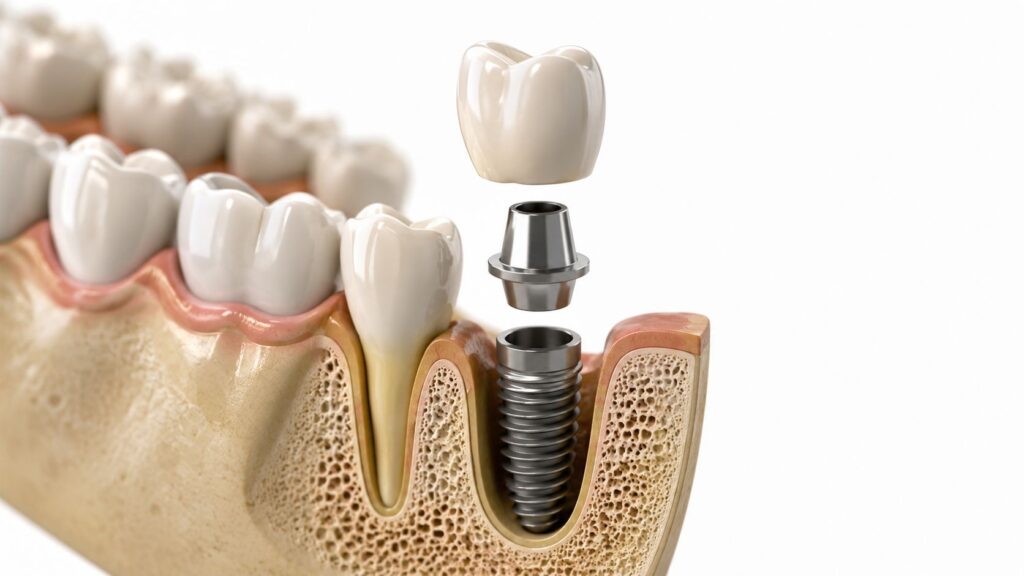
A dental implant addresses the part of tooth loss that fillings, bonding, and veneers can't reach. It consists of a small titanium or titanium-based fixture placed in the jawbone, followed by a connector and a custom crown. The fixture replaces the root, while the crown replaces the visible portion. That distinction matters because a filling repairs existing tooth structure, and a veneer changes the front surface of a tooth. Neither replaces a missing root.
Why the root matters
The fixture is designed to fuse with living bone through a process called osseointegration. That stable foundation can help support chewing and preserve the structure around the missing tooth. The historical foundation of modern implant dentistry traces to Per-Ingvar Brånemark, who placed the first osseointegrated dental implants in 1965. His work became more widely accepted in the early 1980s, and the Brånemark System was introduced commercially in 1982, helping accelerate implant-based tooth replacement. The history and mechanism are described in this review of modern implant dentistry and osseointegration.
Patients in Scottsdale often choose implants because they want a fixed replacement that doesn't rest on the gums or rely entirely on neighboring teeth. They may also value jawbone preservation, stable biting, and a solution intended for long-term use. Those benefits come with surgery, a healing interval, and ongoing hygiene, so implants aren't automatically the right choice for every person.
A practical expectation: An implant can feel like part of the smile, but it still needs professional monitoring. It isn't a maintenance-free tooth.
The rest of the decision involves the implant's three components, the bone-healing process, the treatment timeline, full-arch and bridge alternatives, recovery, risks, and financial planning. Patients concerned about general bone and joint wellness may also find this expert supplement breakdown from VitzAi useful as background, although supplements don't replace an implant evaluation or treatment plan.
The Three Parts of a Dental Implant and How Osseointegration Works
A simple screw-and-crown analogy makes the design easier to understand. The implant is not one piece that gets placed and immediately functions like a natural tooth. It is a coordinated system with a foundation, a connector, and a visible restoration.
The fixture, abutment, and crown
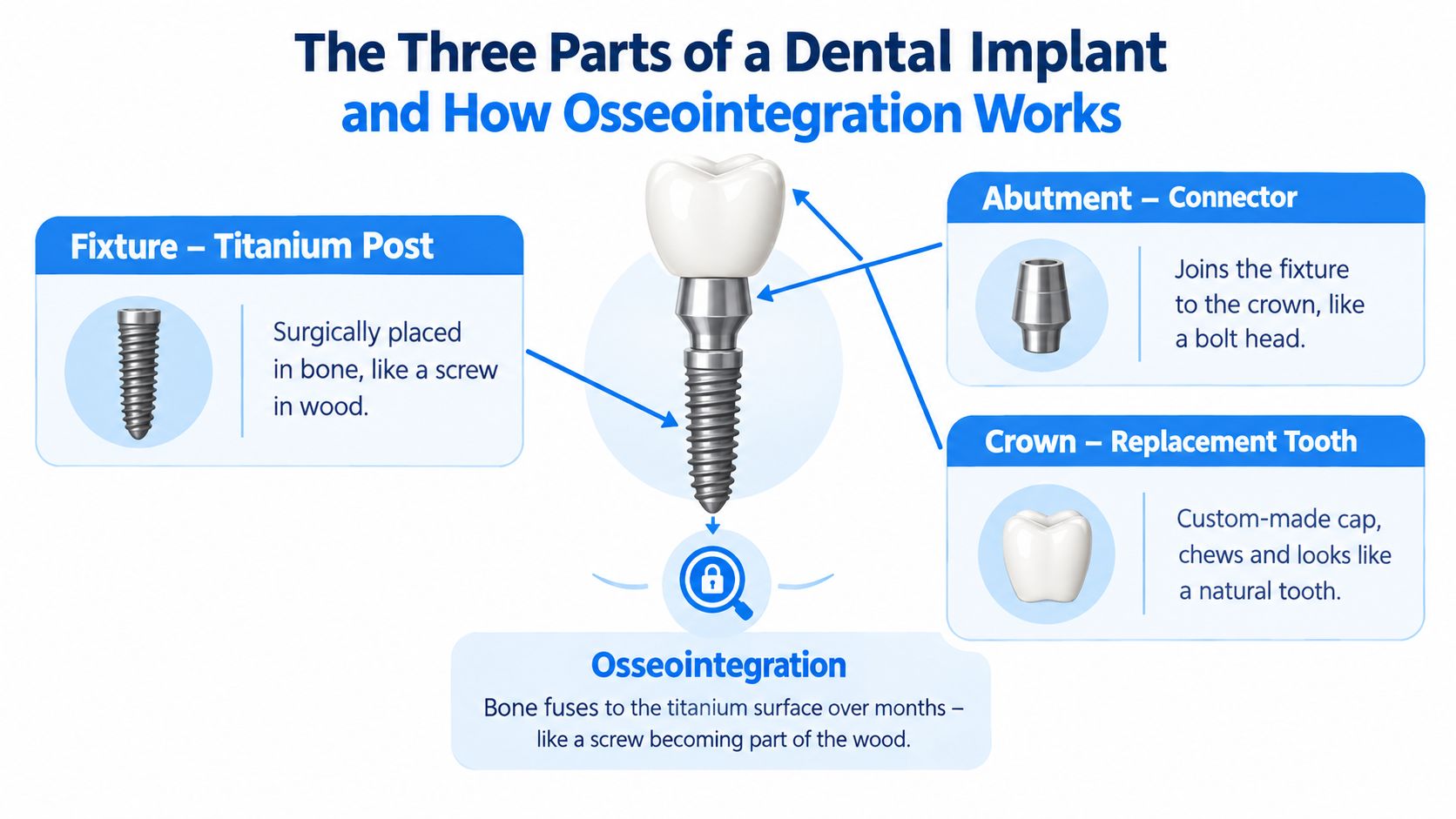
The fixture is the small post placed inside the jawbone. It commonly uses titanium or a titanium-based material, although zirconia fixtures may be considered in selected situations. Its job is similar to a screw set into a strong substrate. It provides the foundation, not the chewing surface.
The abutment is the connector attached to the fixture after appropriate healing. It extends through or just above the gumline and links the buried foundation to the replacement tooth. The crown is the visible, custom-made restoration. It is shaped, shaded, and adjusted to work with the surrounding bite.
The biological part is osseointegration. Bone doesn't just sit beside the fixture. Bone cells grow directly toward and onto the implant surface, creating a structural and functional connection between living bone and a load-bearing implant without intervening fibrous tissue. That bond is what allows the fixture to support a crown over time.
Why healing can't be rushed
Early bone activity begins within days of placement. A review reported bone-to-implant contact of 35.8% by day 7 and 46.3% by day 28, with mature lamellar bone connection developing by the end of 12 weeks. These figures come from the review of early bone formation and osseointegration.
Soft tissue and bone also heal on different schedules. Soft-tissue attachment becomes established about 6 to 8 weeks after surgery, while bone integration continues longer, as described in this clinical review of implant healing. A technical review explains that excessive micromotion at the bone-implant interface can interfere with integration, while appropriate stability supports new bone formation. The review identifies micromotion above roughly 50 to 100 micrometers as potentially compromising osseointegration. The biological rationale is also discussed in this technical overview of implant stability.
Bone remodeling can be difficult to understand from a patient chair. A visual resource such as this bone remodeling panel from Goodlabs may help explain why the jaw responds gradually rather than instantly.
The Dental Implant Treatment Timeline From Consultation to Final Crown
A missing tooth often starts with a practical question: how long will treatment take, and what happens between the first visit and the final tooth? Implant care follows several stages, and the schedule depends on the condition of the gums, jawbone, bite, health history, and treatment goals.
Consultation and diagnostic planning
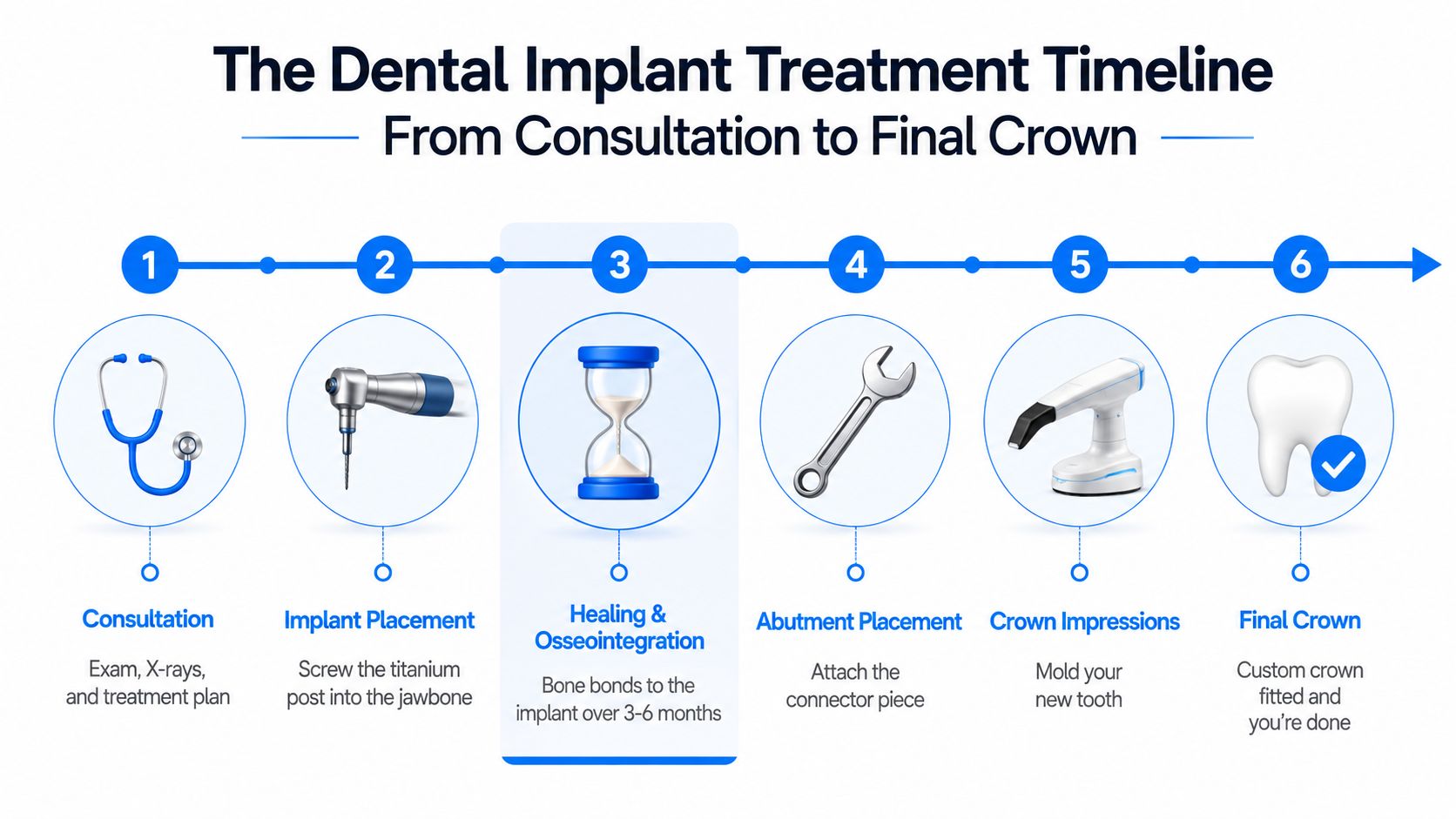
The first visit usually includes an oral examination, a review of medications and medical conditions, and dental x-rays or three-dimensional cone-beam imaging. These images show the available bone, nearby teeth, and important anatomy such as nerves and the sinus. The dentist uses that information to plan the implant's position rather than choosing a location by appearance alone.
Insufficient bone can change the sequence. Bone grafting may be recommended when the jaw cannot provide predictable support. A sinus lift may be considered in the upper back jaw when the sinus leaves limited vertical space. The grafted area must heal before placement, or heal alongside it, depending on the case.
Placement and healing
During placement, local anesthesia keeps the area comfortable. The dentist creates a small opening in the gum, prepares the site with controlled instruments, and places the fixture into the jawbone. A healing cap or temporary tooth may be used. Its design depends on appearance, bite pressure, and the implant's position.
Swelling and soreness are common during early recovery. Instructions cover food texture, brushing around the surgical site, and activity. Follow-up visits check gum healing and implant stability while the bone gradually bonds with the fixture. This healing period often takes about 3 to 6 months, as described in this systematic technical review of implant integration.
Healing is not the point when daily life returns to normal. The temporary tooth may look natural, but it may have limits on chewing until the foundation is ready. Following the dentist's instructions helps protect the developing connection.
After healing, the abutment is connected. Impressions or digital scans record the space, and a dental laboratory makes the crown. The dentist checks its fit, shade, contacts, and bite before securing it. Patients can review this explanation of the implant crown procedure before discussing their own plan.
A short educational video can help patients visualize the sequence before an appointment:
Types of Implant Solutions for Single, Multiple, and Full-Arch Cases
The best implant design depends on how many teeth are missing, where they are missing, how much bone remains, and whether the patient wants a removable or fixed restoration. A single missing front tooth calls for a different strategy than an entire unstable denture.
A single-tooth implant usually replaces one missing tooth without preparing the adjacent teeth. For several neighboring gaps, an implant-supported bridge may use implant fixtures at strategic positions with replacement teeth, called pontics, suspended between them. That can reduce the number of fixtures compared with placing one for every missing tooth.
Full-arch treatment uses a small number of strategically planned implants to support a complete upper or lower replacement. Conventional implant-supported dentures may be removable for cleaning. All-on-Four solutions use four implants to support a full arch of fixed teeth in appropriately selected cases, while some treatment plans use more fixtures. Bone volume, sinus anatomy, bite forces, and the condition of remaining teeth influence the recommendation. Zygomatic and mini implant approaches may change the plan in specific clinical circumstances and require careful evaluation.
Matching Implant Solutions to Your Situation
| Situation | Typical Solution | Implants Used | Key Trade-Off |
|---|---|---|---|
| One missing tooth | Single implant and crown | One | Fixed result without preparing adjacent teeth, but surgery and healing are required |
| Several adjacent missing teeth | Implant-supported bridge | Often fewer than the number of replacement teeth | May reduce surgery, while pontics share support across the span |
| Many missing teeth with removable preference | Implant-retained denture | Varies by arch and anatomy | Improved retention, but the prosthesis is still removed for cleaning |
| Most or all teeth missing | Full-arch fixed solution, including All-on-Four when suitable | Four or more, depending on the plan | Fixed function can require complex planning and sufficient implant support |
The choice shouldn't be made from the tooth count alone. A Scottsdale dentist also considers gum health, bone availability, the sinus or nerve position, oral hygiene, medical history, and whether staged grafting is appropriate.
Candidacy, Recovery, Aftercare, and Risks You Should Know
A strong implant candidate generally has a jawbone capable of stabilizing the fixture, healthy or treatable gums, and an oral hygiene routine that can be maintained after treatment. Controlled systemic conditions, willingness to avoid smoking during healing, and realistic expectations also matter.
Some patients need preparation before placement. Active periodontal disease, certain cancer treatments involving the jaw, recent use of some bone-modifying medicines, pregnancy, and uncontrolled medical conditions may require postponement or a different treatment approach. The dentist must review the full history rather than relying on a checklist.
What recovery feels like
The first days may include soreness, swelling, and tenderness around the surgical site. Soft foods can reduce pressure during early healing, and brushing or flossing instructions will be adapted to the location of the implant. The final crown isn't placed only because the gum looks better. Bone must provide adequate support, and that process commonly takes about 3 to 6 months.
Daily life after restoration is usually familiar, but the implant still needs deliberate cleaning. Floss, an interdental brush, or a water flosser may help remove plaque around the crown and gumline. Regular hygiene visits and dental examinations matter because the dentist can evaluate tissue health, bite forces, and bone levels before a small issue becomes a larger one.
Maintenance matters: A fixed implant doesn't mean a forgotten implant.
Risks that belong in the discussion
Complications can include infection, persistent inflammation, injury to a nerve, sinus-related problems, mechanical damage, or loss of the implant. Long-term implant survival is high, but it isn't guaranteed. A systematic review reported a 10-year implant-level survival estimate of 96.4%, with a 95% confidence interval of 95.2% to 97.5%, as reported in this long-term implant outcomes review.
Peri-implantitis deserves particular attention. Diagnosis involves bleeding on probing together with progressive bone loss, and treatment depends on individualized supportive care. Warning signs include bleeding, a persistent bad taste, swelling, discomfort, or looseness. A recent review also reported recurrence around 44% after surgical intervention in one analysis, reinforcing that improved materials and precise placement don't eliminate biological risks. Patients can read more in this review of implant complications and patient-facing gaps.
Comparing Dental Implants to Bridges and Dentures
Implants aren't the only way to replace missing teeth. A traditional bridge uses neighboring teeth for support, while a removable partial or full denture rests on oral tissues and may use remaining teeth or other retention features. Each option solves a different clinical and practical problem.
A bridge can be completed without implant surgery, but preparing it may require removing healthy enamel from adjacent teeth. Removable dentures usually have a lower initial cost, yet they can move during chewing, need periodic adjustments, and don't provide the same root-level stimulation to the jaw. An implant requires surgery and healing, but it can preserve bone around the missing-tooth site and avoid using neighboring teeth as bridge supports.
| Factor | Dental Implant | Bridge | Removable Denture |
|---|---|---|---|
| Bone preservation | Replaces the root and can help maintain bone at the site | Doesn't replace the root | Doesn't replace the root and may be associated with ongoing bone change |
| Neighboring teeth | Usually independent of adjacent teeth | Uses adjacent teeth for support | May use remaining teeth or tissue support |
| Stability | Fixed after restoration | Fixed | Removable, with stability varying by anatomy and design |
| Maintenance | Requires careful home cleaning and professional monitoring | Requires cleaning under and around the bridge | Requires removal, cleaning, and possible adjustment |
| Treatment path | Surgery and a healing period | Restoration without implant integration | Prosthesis without root replacement |
| Financial profile | Higher initial investment is common | Often lower initial cost | Often lower initial cost, with future maintenance needs |
Implant-retained partial dentures and snap-on full dentures can provide a middle ground. They use implants for retention while keeping the prosthesis removable. Patients comparing options can review this dental implants versus bridges guide and then discuss age, budget, tooth location, bone health, and long-term goals with a dentist in Scottsdale.
Long-term value shouldn't be judged by the first invoice alone. Comfort, maintenance, the condition of neighboring teeth, and the desire for a fixed result all belong in the decision.
Cost, Financing, and Scheduling Your Consultation in Scottsdale
Patients often ask for the price of a single implant before the first visit. An accurate figure can't be given responsibly without an examination, imaging, and a written treatment plan. The total can change based on the number of teeth involved, the type of restoration, bone grafting or sinus procedures, sedation needs, and whether treatment is completed in stages.
Dental insurance may contribute to some portions of care, but coverage varies by plan and may not pay for every implant-related service. A dental office can help review benefits, submit claims, and explain expected patient responsibility. Financing may include a third-party healthcare lender, an in-house payment arrangement when available, HSA or FSA funds, or phased treatment that separates surgical and restorative appointments.
What the Scottsdale consultation should answer
A useful implant evaluation should clarify:
- Clinical suitability: Whether the gums, bone, bite, and medical history support treatment.
- Treatment sequence: Whether extraction, grafting, placement, healing, and restoration need to be staged.
- Restoration options: Whether a single crown, bridge, removable implant-retained prosthesis, or full-arch solution fits the case.
- Financial expectations: Which services are included, what insurance may cover, and what payment choices are available.
Eric Wiitala DDS offers single-tooth and full-arch dental implants, All-on-Four treatment planning, restorative dentistry, periodontal evaluation, dental x-rays, and new patient care in Scottsdale. Patients seeking a cosmetic dentist near me, an emergency dentist for an urgent problem, or routine cleaning and exams can request the appropriate appointment rather than delaying a missing-tooth evaluation.
Patients considering tooth replacement can schedule an implant evaluation with Eric Wiitala DDS in Scottsdale to review imaging, candidacy, restorative options, recovery, and financing. The practice offers single-tooth and full-arch implant planning, All-on-Four solutions, and related restorative care, and a second-opinion consultation is welcome before treatment begins.