
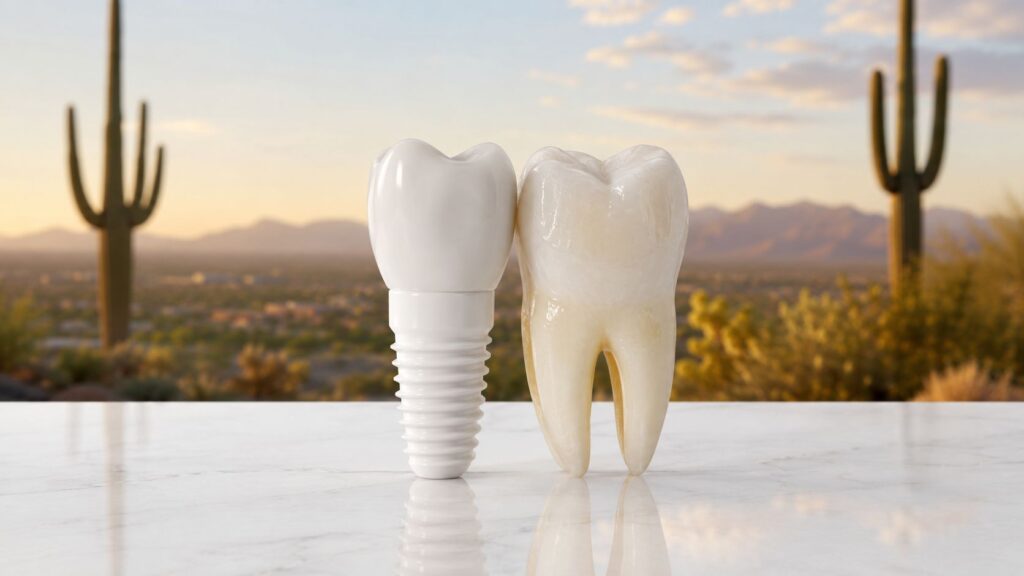
A patient in Scottsdale hears the word zirconia implant and usually has the same immediate reaction, a mix of relief and doubt. Relief, because a metal-free option sounds more natural. Doubt, because a dental implant is still a surgical device, and no one wants a softened sales pitch when the primary question is whether it will hold up for years.
That is the right way to think about ceramic dental implants. They are not a miracle material, and they are not a gimmick. They are a clinically credible option, especially for patients who care about esthetics in the smile zone, want to avoid metal, or have questions about sensitivity, while still needing an honest conversation about fracture risk, bite forces, and long-term predictability. In Scottsdale, that conversation belongs in a real consultation, not in a marketing headline.
Table of Contents
- Why Patients in Scottsdale Are Asking About Ceramic Dental Implants
- What Ceramic Implants Are Made Of and How They Bond to Bone
- Ceramic vs Titanium Implants, Compared Honestly
- Clinical Trade-offs and Where the Evidence Is Still Thin
- Who Is a Good Candidate and Who Should Consider Alternatives
- What the Treatment Timeline Actually Looks Like
- Cost, Insurance, and Long-Term Value
- Aftercare, Maintenance, and What to Expect at Dr. Wiitala's Scottsdale Office
Why Patients in Scottsdale Are Asking About Ceramic Dental Implants
A common consultation starts with a patient who has already accepted the main step, replacing a missing tooth. The next question is usually about the material. A metal post can make sense, but it does not always feel like the best match for a front tooth, especially when the goal is for the restoration to blend into the smile rather than draw attention.
Ceramic dental implants enter the conversation at that point. They are usually made from zirconia, a tooth-colored ceramic that appeals to patients who want a metal-free restoration and a more natural appearance near the gumline. In Scottsdale, that question comes up often because many patients are thinking about work, social settings, and how a front-tooth replacement will look in daylight, not just on a model.
Why the question keeps coming up
The interest in ceramic implants grows out of a few patient concerns that repeat in the chair. Some people are focused on appearance. Others have read about metal sensitivity or prefer to keep metal out of the body where possible.
A practical way to sort the discussion is this. If the concern is mostly cosmetic, ceramic may deserve a close look. If the concern is heavy bite force, the conversation has to be more careful.
Modern ceramic implants are no longer treated as an experimental idea. A systematic review and meta-analysis found that one-piece ceramic implants can achieve osseointegration similar to titanium implants, and that the risk of implant fracture is low for currently marketed devices, while longer-term analyses of all-ceramic single crowns have shown durable results in selected cases PubMed 37436947. That does not mean every case is a fit. It does mean the topic deserves a serious, balanced discussion at a Scottsdale implant consultation.
For patients searching for a dentist near me or dental implants near me, the question is not whether ceramic sounds better in theory. The question is whether it suits the mouth in front of the clinician.
What Ceramic Implants Are Made Of and How They Bond to Bone
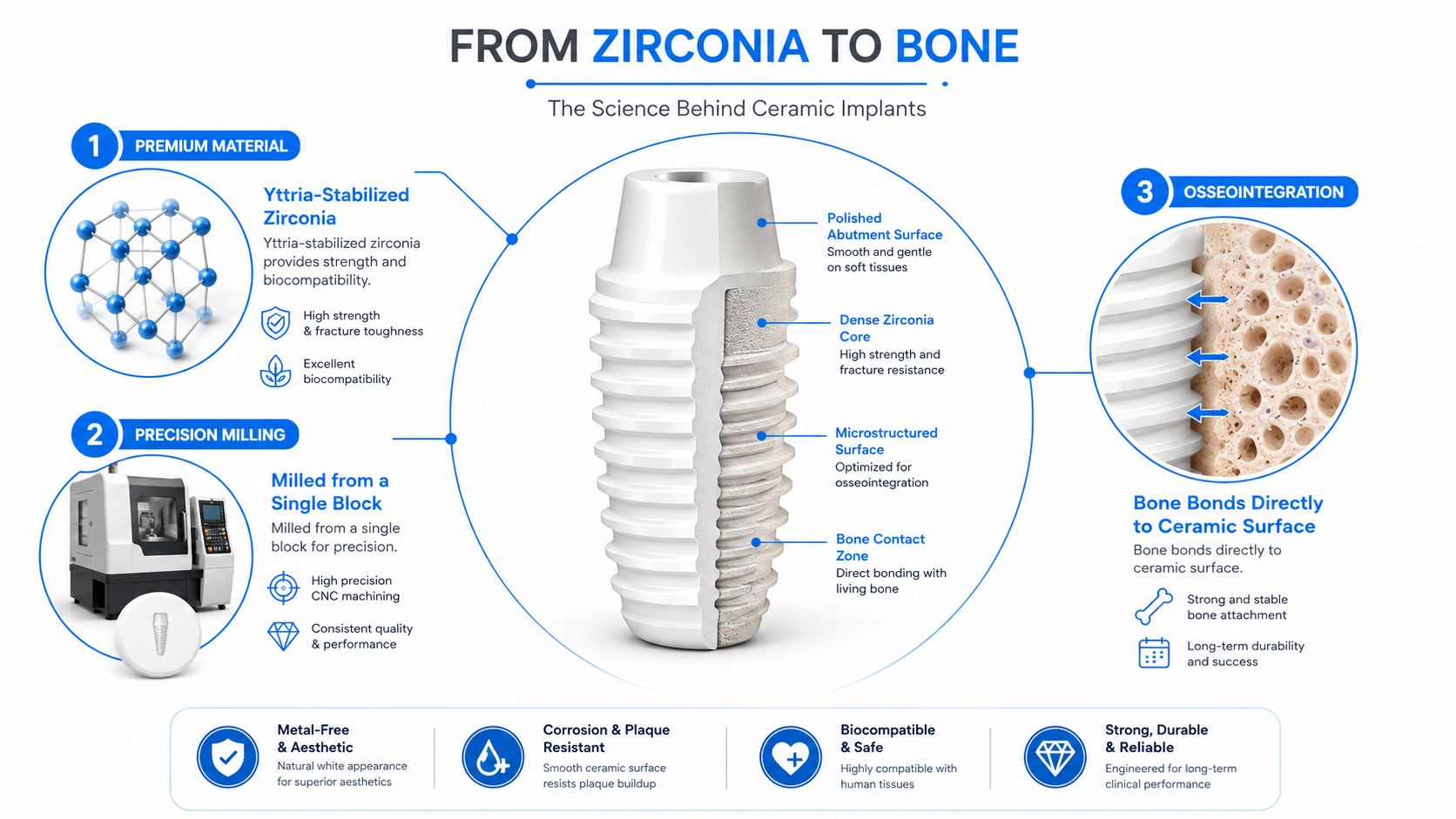
Ceramic implants are usually made from zirconium dioxide, more commonly called zirconia. A practical way to picture the material is as a dense, tooth-colored ceramic that is machined to fit the jaw and support the restoration above it. The implant starts as a solid block, then it is shaped to match the planned position in the bone.
The material in plain English
Zirconia is used because it is biocompatible, white, and strong enough for implant use when the design and placement are appropriate. That is a big reason patients hear the phrase metal-free so often. In the front of the mouth, the white color can matter because it reduces the chance of a gray shadow showing through thin gum tissue. Reviews in the dental literature describe those esthetic and material advantages, along with the fact that zirconia is bioinert and non-conductive PubMed 36170627.
Those material traits can be appealing, especially for patients worried about metal or visible hardware. They do not replace the need for good diagnosis. A material can look ideal on paper and still be the wrong choice if the bite is heavy, the bone volume is limited, or the implant position is unforgiving.
How the implant bonds with bone
The key biological process is osseointegration. That means bone grows onto and around the implant until it becomes anchored in place. The goal is the same whether the implant is titanium or ceramic, and the surface design and healing protocol guide how well that bond develops. Clinical reviews of zirconia implant surfaces report osseointegration outcomes that can be comparable to titanium when the case is selected and managed carefully PubMed 37436947.
Bone does not respond to marketing terms. It responds to surface texture, stability, healing conditions, and how much force reaches the implant during recovery.
Ceramic implants also come in different designs. One-piece systems combine the implant body and the post in a single unit. Two-piece systems separate those parts, which can give more restorative flexibility but also adds complexity. That design choice affects the surgery, the healing sequence, and what the final crown can do.
Ceramic vs Titanium Implants, Compared Honestly
A patient in Scottsdale can hear both options and still feel stuck. Titanium has the deeper clinical history, while ceramic implants answer a different set of concerns, mainly esthetics, metal avoidance, and some soft-tissue questions. That makes the decision less about which material is universally better and more about which one fits the bite, the bone, and the smile line in front of us.
Where ceramic tends to shine
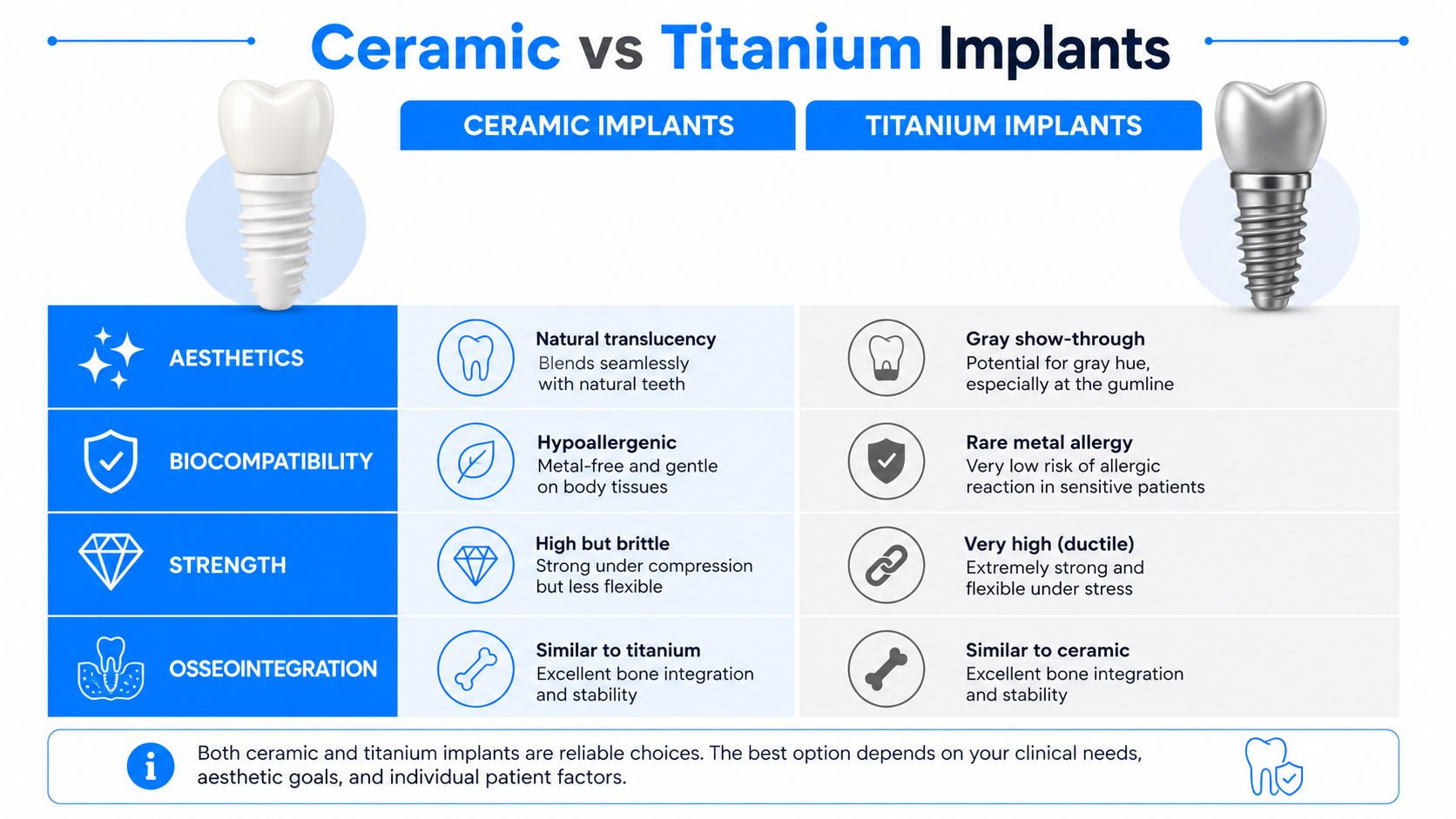
Ceramic's most obvious strength is appearance. Its tooth-like color can help in the anterior zone, especially when the gum tissue is thin enough that a gray shade might show through. Patients who care a lot about a natural look usually notice that difference right away.
Ceramic also appeals to people who want to reduce metal in the mouth. The literature describes it as a metal-free restoration option, which can matter most for someone with a documented sensitivity concern or a strong personal preference. A review focused on zirconia implant applications supports that kind of patient-centered use, especially where esthetics and biocompatibility are part of the goal PubMed 36170627.
Where titanium still has the edge
Titanium's main advantage is not appearance. It is the long clinical record behind it and the way it tolerates everyday realities more predictably. Ceramic has been more fracture-sensitive in harder bites, especially for people who clench or grind. That is why a careful implant discussion has to include bite forces, implant position, gum thickness, and how the final restoration will be designed.
The German S3 guideline reflects that caution. It says one-piece zirconia implants can be used as an addendum or alternative to titanium implants, but it could not reach a final conclusion for two-piece ceramic implant systems because the available data were not sufficient German S3 guideline. That is a more useful way to look at the material choice than treating ceramic as automatically superior.
A side-by-side way to think about it
- Aesthetics: ceramic is often stronger in the smile zone.
- Evidence depth: titanium still has the longer track record.
- Material feel: ceramic fits patients who want metal-free care.
- Flexibility: titanium usually gives more room for restorative planning.
For patients searching for a cosmetic dentist near me or dental implants near me, the right answer usually depends on where the tooth sits, how the bite loads that area, and how much esthetic pressure the case carries. Dr. Eric Wiitala's Scottsdale practice offers both implant pathways, including single-tooth and full-arch care, and that makes it easier to decide based on the mouth instead of a one-size-fits-all menu. The same planning mindset is what guides implant planning for restorative teams, because the implant choice has to work with the restoration, not against it.
Clinical Trade-offs and Where the Evidence Is Still Thin
The hardest part of the ceramic implant conversation is also the part patients usually need most. The material has real strengths, but it also has areas where the evidence base is still growing. Ceramic implants can be a strong option, yet they do not behave exactly like titanium under load, and that difference matters in daily chewing and long-term maintenance.
A useful way to approach the science is to separate what has been shown from what still needs more follow-up. A recent systematic review of all-ceramic implant-supported single crowns reported implant survival of 95.3% at 5 years and 96.2% at 10 years, while crown survival was 93.0% at 5 years and 94.4% at 10 years PubMed 37436947. Those numbers are reassuring, but they also make clear that ceramic is durable rather than flawless.
The same review also reported the kinds of technical issues that matter in real life. Chipping was estimated at 9.0% after 5 years and 2.7% after 10 years, framework fractures at 1.9% and 1.2%, and screw loosening at 3.6% and 5.2% over the same periods PubMed 37436947. In plain English, that means the implant can function well for years, but the restoration still needs careful design, follow-up, and a bite that does not overload the system.
Bite force is where the discussion gets more practical. Ceramic is strong, yet it is less forgiving than titanium in some high-load situations. A patient who grinds at night, chews hard on one side, or has a back tooth doing heavy work needs that force pattern evaluated before choosing material. A ceramic implant can still fit that case, but only if the plan accounts for those pressures from the start.
Earlier literature also shows why dentists have stayed careful with ceramic. Researchers once said the evidence was too thin to recommend ceramic implants for routine use PubMed 19663947. The field has moved forward since then, but that older caution still has value. It reminds patients that material choice should be based on the mouth in front of us, not on a slogan about being metal-free.
An honest treatment team looks at the whole picture, not just the implant body itself. That means checking where the tooth is located, whether the patient clenches or grinds, which design is being used, and how much room exists for the final restoration. Those details shape whether ceramic is a good fit or whether another approach gives more predictability.
For patients who want to understand candidacy before they commit, the clearest next step is a careful evaluation. A dentist can look at the bite, the bone, and the esthetic demand, then explain whether ceramic is a good match or whether another path makes more sense. If you want a structured starting point, this dental implant candidacy evaluation can help frame the same questions before treatment begins.
For restorative teams, the same planning logic applies. A case works better when the implant, the restoration, and the bite are planned together, which is why implant planning for restorative teams matters so much. Ceramic can be an excellent material in the right setting, but the material alone does not decide the outcome.
| Outcome | 5-Year Rate | 10-Year Rate |
|---|---|---|
| Implant survival | 95.3% | 96.2% |
| Crown survival | 93.0% | 94.4% |
| Chipping | 9.0% | 2.7% |
| Framework fracture | 1.9% | 1.2% |
| Screw loosening | 3.6% | 5.2% |
Who Is a Good Candidate and Who Should Consider Alternatives
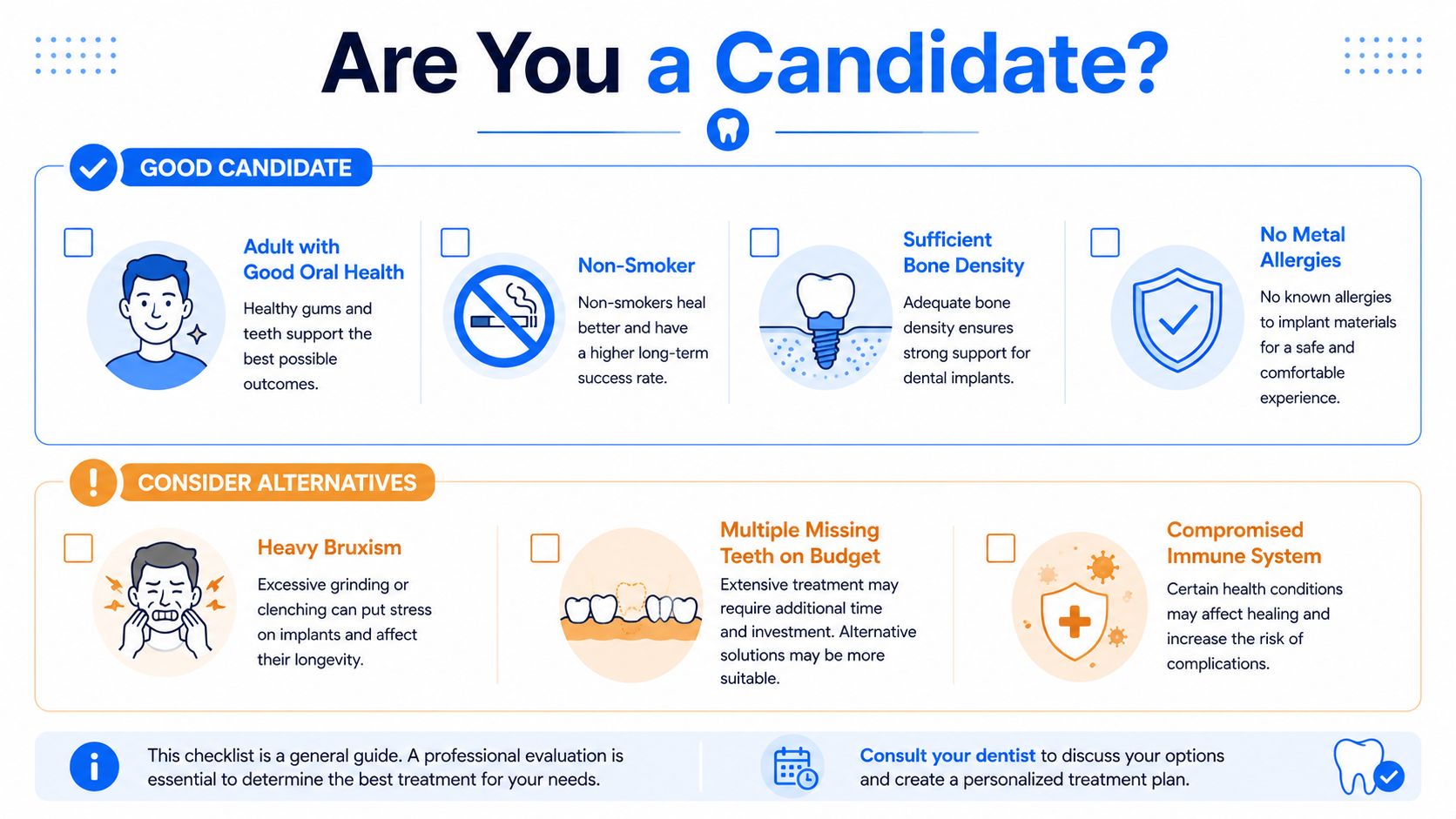
The best ceramic implant candidate is usually easy to describe. It's an adult in generally good health, with enough bone at the implant site, and a clear reason to want a metal-free or more esthetic solution. That could be a single front tooth, a visible premolar, or a patient with a known metal hypersensitivity concern.
Signs that ceramic may fit well
Ceramic can make sense when the goal is a more natural-looking restoration in the smile zone. It also makes sense when the person is looking for a metal-free restoration and is comfortable with a treatment plan that puts more weight on case selection. Patients who are non-smokers, or who are willing to pause smoking during healing, tend to have an easier path.
A few practical signs point in the same direction:
- Healthy gum tissue around the missing tooth site.
- Adequate bone volume for stable placement.
- A single-tooth replacement goal, especially in the front.
- A documented sensitivity concern or strong preference for metal-free materials.
Straight rule: if the bite is calm and the esthetic need is high, ceramic becomes more interesting.
When another path may be smarter
Heavy bruxism is a major red flag because clenching loads the implant and the crown repeatedly. Severe bone loss can also change the plan, especially if grafting is needed before an implant can be placed. Very thin gum tissue, unresolved periodontal disease, and multiple complex restorative needs can all push the conversation toward titanium or a staged approach first.
That's where a Scottsdale dentist will usually lean on the broader diagnostic workup, including dental x-rays, periodontal evaluation, and bite assessment. Those steps matter because a patient can't be labeled a candidate just by asking for the metal-free option. The mouth has to agree with the request.
A useful first step is the practice's implant candidacy review, which is outlined on this implant evaluation page. That kind of screening helps separate a good ceramic case from a case that needs more preparation first.
What the Treatment Timeline Actually Looks Like
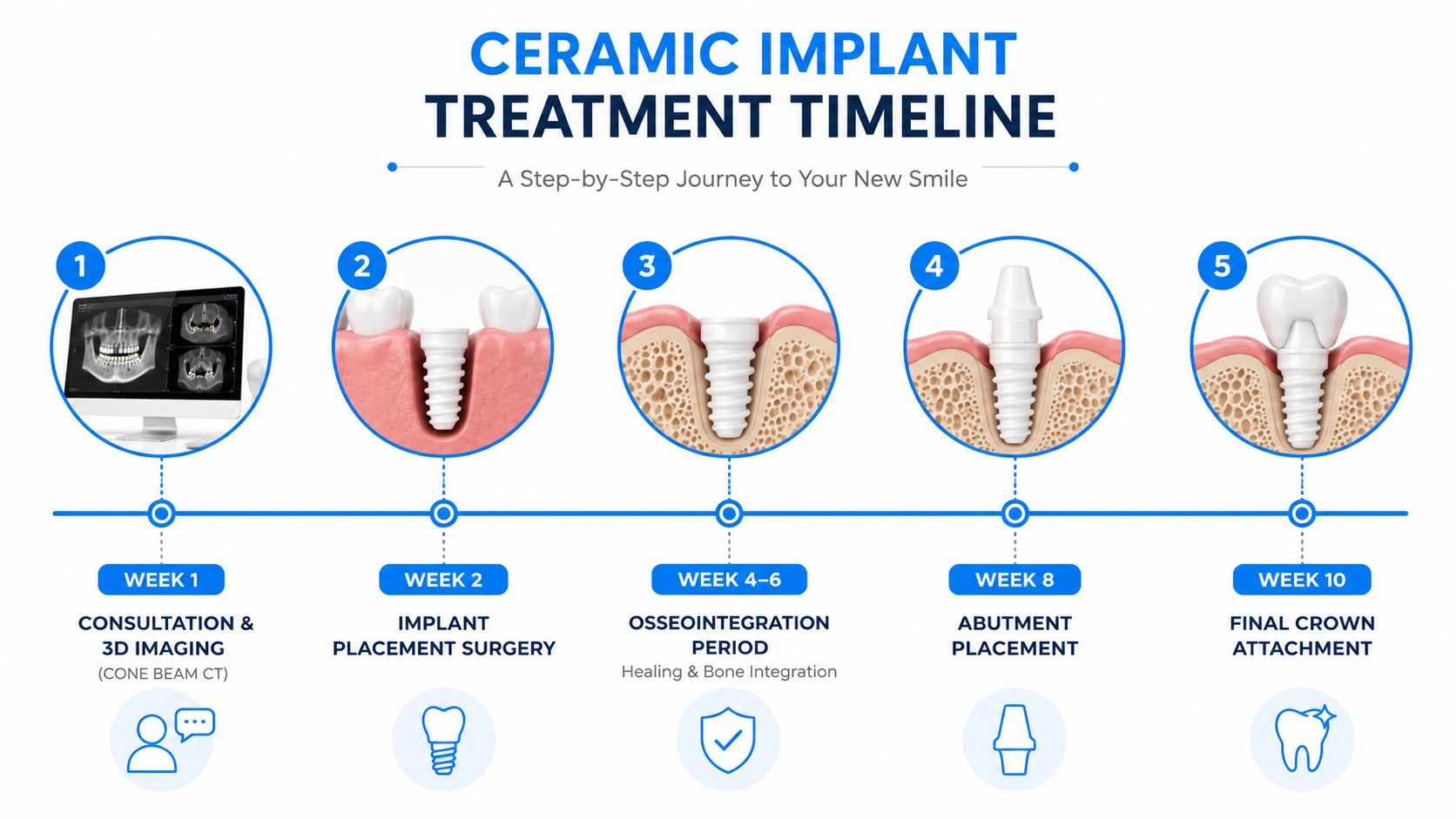
A ceramic implant case usually starts with diagnostics, because the mouth has to be measured before anyone starts talking about surgery. A Scottsdale office will typically begin with a consultation and clinical exam, then add 3D imaging if the case calls for it. That gives the dentist a clear view of bone shape, spacing, and nearby anatomy, the same way a builder checks the foundation before setting a post.
The sequence from planning to crown
Once the records are reviewed, the implant is placed during a surgical visit. In a one-piece design, the healing portion is built into the implant itself, so the early restorative steps are simpler. In a two-piece design, there may be a later uncovering or connection step, depending on the system used.
Healing is not idle time. It is the period when osseointegration happens and the bone settles around the implant. The timing depends on site and anatomy, but healing is often measured in months rather than weeks, especially in the upper jaw or after grafting.
- Consultation and imaging: the team evaluates space, bone, and bite.
- Placement surgery: the zirconia implant is inserted.
- Healing phase: the bone bonds to the implant.
- Impression and restoration: the crown is designed to fit the final position.
- Final delivery and follow-up: the bite is checked and the implant is monitored.
Good planning rule: a faster schedule is not a better schedule if the bone is not ready.
The final crown step depends on the overall restorative plan. A single missing tooth may only need one implant crown. Multiple missing teeth may call for bridges anchored to implants or a full-arch approach such as All-on-Four in edentulous or near-edentulous cases. For readers who want a closer look at that restorative phase, the practice outlines the implant crown procedure.
For a visual summary, the timeline below shows the usual flow from consultation to final crown.
Cost, Insurance, and Long-Term Value
Money matters here, and patients shouldn't have to decode it alone. Ceramic implants often cost more than titanium, mainly because the manufacturing tolerances are demanding and the clinical base is smaller. Insurance coverage can be limited, so the actual price conversation usually happens during a consultation, not in a generic online estimate.
What usually gets discussed at the visit
A transparent treatment plan should separate the pieces so the patient can see where the cost is coming from. That typically includes the implant itself, the abutment or connection component, the crown, imaging, and any extra procedures such as grafting. If the case is more complex, the treatment team should explain the sequence before anything is booked.
Insurance often treats implants as a major procedure, and pre-authorization is common. That means the office has to coordinate paperwork, benefits review, and billing support along the way. For patients, that's less about finding a bargain and more about avoiding surprises.
How to think about value
The right question is not “what's cheapest?” It's “what fits the mouth and the goal?” For a front tooth where gray show-through would be unacceptable, ceramic may carry a strong value case. For a back molar under heavy load, titanium may be the more practical value choice because the restorative margin is wider.
Ceramic's value is tied to a mix of priorities, not a single number:
- Esthetics in visible areas.
- Metal-free preference for the patient's peace of mind.
- Longevity expectations based on the site and bite.
- Repair risk if the restoration is exposed to high force.
If the treatment plan includes follow-on care, many offices also discuss financing options during the new-patient process. That keeps the decision grounded in both clinical reality and household planning.
Aftercare, Maintenance, and What to Expect at Dr. Wiitala's Scottsdale Office
Once the crown is on, success comes down to habits and follow-up. Daily brushing still matters, and flossing or a water flosser around the implant helps keep the tissue healthy. Professional hygiene visits stay important too, because implants need monitoring just like natural teeth.
Protecting the implant after the crown is placed
Ceramic crowns can chip under extreme force, so patients who clench or grind often do better with a custom occlusal guard. That's not a sign the implant failed. It's a smart way to protect the restoration from repetitive load.
A few maintenance basics deserve attention:
- Brush twice daily with care around the gumline.
- Clean between the teeth with floss or a water flosser.
- Wear the guard if clenching or grinding is part of the picture.
- Keep check-ups regular so small issues are caught early.
At Eric Wiitala DDS in Scottsdale, the office is located at 9755 North 90th Street, Suite B250, Scottsdale, AZ 85258, with consistent Monday through Thursday hours and Friday appointments by request. The practice describes an approach that emphasizes nutritional health, mercury-free tooth-colored materials, and patient education. It also notes more than 20 years of clinical experience and recognition among the Valley's Top Dentists by PHOENIX magazine.
For a patient who has been searching for a dentist in Scottsdale, AZ, the first visit should feel organized, direct, and calm. The team should review the mouth, discuss whether ceramic, titanium, or another restorative option fits best, and explain the next steps in plain language.
Call (480) 657-6981 to schedule a consultation and get a candid answer about whether a ceramic implant, titanium implant, or different restorative plan makes the most sense for the tooth, the bite, and the smile.
A CTA for Eric Wiitala DDS.