

A Thursday morning coffee meeting in Old Town, a Friday dinner on a Scottsdale Quarter patio, and a long weekend flight from Sky Harbor can all fit around clear aligners orthodontic treatment. The trays are discreet, removable, and designed to move selected teeth without the visible brackets and wires associated with traditional braces.
For Scottsdale adults considering a cosmetic dentist near me, the appeal is practical as much as aesthetic. Clear aligners can come out for meals, photographs, brushing, flossing, and important conversations. A local dentist evaluates the bite, plans each stage, monitors progress, and manages retention in the same practice.
The important question isn't whether aligners look convenient. It's whether they can deliver the movements a particular patient needs, and whether the daily routine can support consistent wear. The sections below explain the clinical pathway, realistic timing, maintenance, costs, and the questions to ask during a Scottsdale consultation.
Straightening Smiles With Clear Aligners in Scottsdale
Clear aligners are made from transparent, BPA-free plastic and shaped to fit over the teeth. Each tray applies carefully planned pressure, and a series of trays gradually repositions teeth. The modern treatment has roots in orthodontic development that reach back to Harold D. Kesling's 1945 description of rubber-based tooth positioners made from wax setups of a patient's dentition. Commercial clear aligner systems entered the market in the late 1990s, after digital planning, materials, and manufacturing had matured sufficiently for routine clinical use. A 2022 review projected the global market to rise from USD 3.1 billion in 2021 to USD 11.6 billion by 2027, reflecting the category's commercial growth (review of clear aligner development and market history).
For a Scottsdale professional, the practical difference appears during ordinary moments. The aligners can be removed before a presentation, placed safely in a case during dinner, and reinserted after brushing. A patient traveling for work can bring the next trays along, while a parent can manage treatment without avoiding family meals or photographs.
The tray is only one part of care
A dentist doesn't hand over a box of plastic trays. The process begins with an examination of tooth position, gum health, bite relationships, existing restorations, and any signs of grinding or jaw strain. The treatment plan must match the movements the appliance can predictably produce.
Clinical evidence supports aligners for dental alignment, particularly selected mild-to-moderate cases, but it also identifies limits for some front-to-back and vertical corrections. A systematic review found that aligners were effective for alignment, while fixed appliances could be more suitable for certain complex movements (systematic review of clear aligner effectiveness).

The Scottsdale dentist prescribing treatment remains responsible for deciding whether aligners are appropriate, checking that the trays fit, and responding when a tooth doesn't track as planned. That local continuity matters for patients who want a dentist in Scottsdale, AZ rather than a remote, one-size-fits-all process.
Clear aligners can fit around a real Scottsdale routine without making the trays the center of every day. A patient can imagine the same meetings, meals, travel, and family events continuing while the smile changes in the background.
How Clear Aligner Treatment Works Step by Step
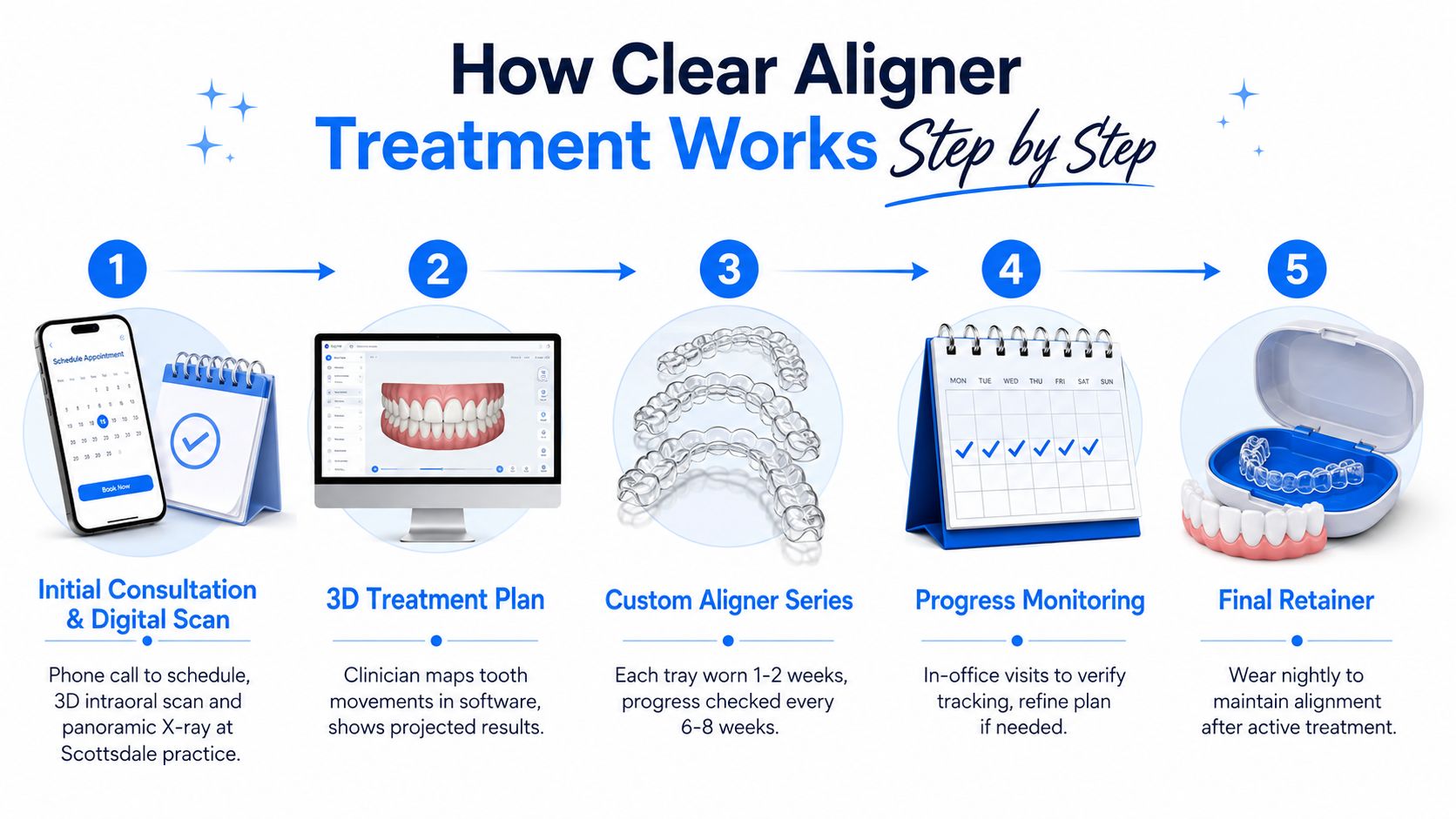
A clear aligner journey begins with a phone call to the Scottsdale dental office. The scheduling team records the concern, whether it involves crowding, spacing, relapse, or bite changes, then reserves time for a detailed consultation rather than a brief cosmetic screening. That first conversation helps fit the clinical process around work schedules, meals, travel, and other parts of daily life.
The first visit creates the clinical starting point
At the consultation, the dentist examines the teeth and gums and reviews the bite. The practice may take clinical photographs, a panoramic or three-dimensional cone-beam X-ray when indicated, and an intraoral digital scan. The scan replaces traditional goopy impressions and creates a precise digital model of the current smile.
The dentist checks for decay, gum inflammation, worn or missing teeth, and jaw symptoms before orthodontic movement begins. Patients who also need dental cleaning and exams, dental X-rays, restorative dentistry, or evaluation for TMJ symptoms can have those needs considered within the same overall plan. Addressing these findings first gives the aligners a healthier foundation for movement.
Digital planning makes the proposed movement visible
The digital model is uploaded into planning software. The dentist maps tooth movements stage by stage, checking whether the proposed result fits the patient's bite and available anchorage. A projected before-and-after simulation gives the patient a visual way to discuss goals before trays are manufactured.
Good planning depends on anchorage, continuous force, and intimate tray-to-tooth contact. Review literature notes that the difference between predicted and achieved movement can be around 50% or more, while broader summaries place accuracy for many movements between 55% and 82% (review of aligner biomechanics and movement accuracy). These figures describe general movement accuracy, not a guaranteed result for one patient. Biological response, tray wear, fit, and the type of movement all affect progress.
Patients seeking background on improving care with structured plans can review how planning frameworks support clinical decisions. A digital smile design service can also help connect orthodontic changes with the broader appearance of the smile, especially when a patient wants to discuss how the teeth will show during conversations, photographs, or social events.
Tray delivery begins active movement
At the delivery visit, the first aligner set is tried in. The dentist checks seating and explains how to insert, remove, store, and clean the trays. Small tooth-colored attachments may be bonded to selected teeth to improve grip and help express planned movements.
Most protocols prescribe 20 to 22 hours of daily wear, with many systems calling for a change to the next aligner every 7 days. The tray needs consistent seating to deliver its planned force (clinical review of aligner wear schedules). Patients receive instructions for eating, drinking, cleaning, and contacting the office if a tray is lost or no longer fits. That guidance matters during a client meeting, dinner out, or a trip, when carrying the case and knowing when to remove the tray prevents avoidable interruptions.
Monitoring protects the plan
Progress visits are commonly arranged at intervals of roughly 10 to 12 weeks for patients showing good compliance, compared with 4 to 6 weeks often used for fixed appliances (review of aligner compliance and appointment intervals). Individual practices may schedule checks more frequently, particularly early in treatment or when a complex movement needs closer observation.
At each check, the dentist assesses tracking, attachment condition, bite changes, and oral hygiene. If one tooth is lagging, the dentist can adjust staging, order refinement trays, or discuss an auxiliary approach. These visits also give the patient a chance to report pressure, difficulty wearing the trays during travel, or fit changes after a missed wear period.
The final visit removes attachments, confirms the result with new scans, and begins retention. A removable clear retainer or bonded lingual wire may be recommended, depending on the patient's teeth, bite, and tendency toward relapse. Retention becomes part of the routine after active movement ends.
Clear Aligners Compared With Traditional Braces
A Scottsdale patient choosing between aligners and braces is weighing two different daily routines. Both systems move teeth, yet they differ in removability, cleaning demands, appointment needs, and control of difficult movements. The better fit depends on how the treatment must function during work meetings, dinners, travel, and ordinary home care.
| Factor | Clear Aligners | Traditional Braces |
|---|---|---|
| Appearance | Transparent trays are designed to be discreet | Brackets and wires are visible, with ceramic options offering a less noticeable alternative |
| Meals | Trays come out for eating | Food choices require more care because brackets remain attached |
| Brushing and flossing | Trays are removed for normal brushing and flossing | Cleaning around brackets and wires requires extra attention |
| Comfort | Smooth plastic avoids many wire and bracket edges | Brackets and wires can cause irritation, especially after adjustments |
| Compliance | Success depends on consistent wear | The appliance remains attached, so treatment does not rely on tray wear time |
| Monitoring | Visits may focus on fit, tracking, and new trays | Visits include wire and bracket adjustments |
| Complex movement | Strong option for selected mild-to-moderate alignment | Often more predictable for difficult rotations, vertical movements, torque, and severe bite corrections |
| Retention | A retainer is needed after active treatment | A retainer is also needed after active treatment |
Where aligners make daily life easier
Clear aligners can come out before a work meeting, dinner, family photograph, or long flight. Brushing and flossing also follow the patient's usual routine because there are no fixed brackets to clean around. For someone traveling often or managing demanding workdays, avoiding broken-bracket concerns can make treatment easier to organize.
The convenience requires active participation. A tray left out during a long meal or repeated social event shortens the time available for force delivery. Patients reviewing malocclusion treatment options should discuss how their bite, schedule, and treatment goals affect the choice, rather than deciding from appearance alone.
Where braces may offer stronger control
Aligners suit many mild-to-moderate cases, but difficult movements require closer evaluation. A systematic review found that aligners could correct upper molar bodily movement of about 1.5 millimeters and anterior intrusion, while showing limitations with anterior extrusion, buccolingual inclination, and rotation of rounded teeth. The review is summarized in this systematic review of movement capabilities.
A separate review of clear aligner predictability reported approximately 88% predictability for limited upper molar distalization, compared with about 30% accuracy for extrusion and 33% for rotation in the cited evidence base.
The practical choice is clear. Aligners are often reasonable for mild-to-moderate crowding, spacing, and orthodontic relapse. Braces may provide more dependable control for complex rotations, vertical changes, torque, or major bite correction. A clinical examination, bite assessment, and discussion of daily routines determine which system fits the patient's anatomy and goals. Both approaches still require retention after active treatment ends.
Realistic Treatment Timelines and What Shapes Them
Treatment time follows case complexity and biology, not convenience alone. A tray may be easy to remove for a Scottsdale dinner, but teeth still need time to respond to controlled force and surrounding tissues need time to remodel.
A patient with mild crowding or one rotated tooth may finish in a shorter course. Moderate spacing or a bite correction usually requires more staging, attachments, and monitoring. Complex treatment may involve additional mechanics and refinements.
| Case Complexity | Typical Length | Approximate Aligner Sets |
|---|---|---|
| Mild crowding or limited rotation | 4 to 6 months | Determined after digital planning |
| Moderate spacing or bite correction | 9 to 14 months | Determined after digital planning |
| Complex bite change or significant rotation | 18 to 24 months | Determined after digital planning |
The table offers planning ranges rather than promises. Evidence syntheses don't show a universal duration advantage for aligners. A 2024 review found no significant treatment-duration difference between clear aligners and fixed appliances for mild-to-moderate crowding, while another review found that any apparent time advantage was concentrated in selected mild-to-moderate cases (review comparing aligner and fixed-appliance treatment duration).
Factors that move the finish date
- Starting alignment and bite severity: More crowded teeth and larger bite discrepancies require more staged movement.
- Root position: A crown can appear straighter before the root has reached its planned position, so final detailing may take longer.
- Attachments and interproximal reduction: These techniques may create the grip or space needed for a controlled result.
- Age and biology: Individual response varies, and the dentist must plan around that response.
- Daily wear: Inconsistent wear can leave teeth behind the digital plan and create the need for refinements.
Complexity can produce a wide range of outcomes. One review reported treatment durations from about 2.3 months for an anterior crossbite correction to 31 months for a Class III malocclusion (review of aligner treatment durations). Refinement near the end may add 1 to 3 months when final detailing is needed. Patients planning around a wedding, work travel, or a family event should discuss the desired date early and leave room for biological variability.
Daily Wear, Check-ins, and Keeping Results After Treatment
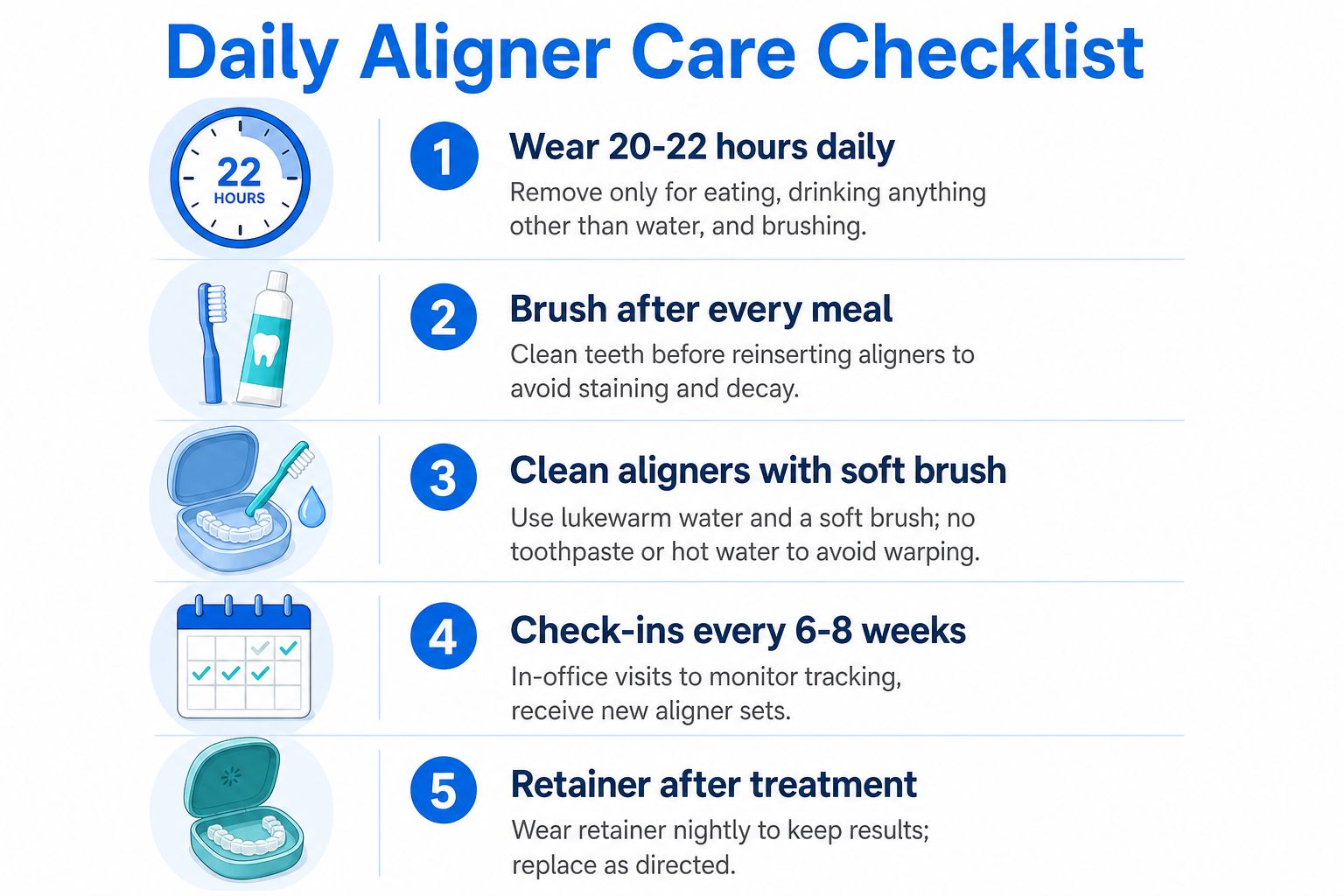
The active phase works best when aligners remain seated for 20 to 22 hours each day. Patients generally remove them for meals, hot drinks, brushing, and flossing, then place them back promptly. Water is the practical drink to keep with trays in place because colored, sugary, or hot drinks can stain the plastic or expose teeth to trapped sugars.
A simple routine prevents many avoidable problems:
- After eating, rinse the mouth and clean the teeth before reinserting the trays.
- Clean the aligners with a soft brush and lukewarm water.
- Store the trays in their case when they aren't in the mouth, rather than wrapping them in a napkin.
- Check the fit each day. A tray that no longer seats fully should prompt a call to the dental office.
- Bring the current trays to every appointment so the dentist can assess fit and progression.
Hot water can warp an aligner. A hot car can also expose the plastic to damaging heat, so a case should stay in a cooler, protected location.
What happens at check-ins
Many practices arrange progress checks every 6 to 10 weeks, combining in-person examinations with virtual photo reviews when appropriate. The dentist checks whether the teeth are tracking, whether attachments remain secure, and whether the patient's bite is changing as planned.
The appointment can be brief when progress is straightforward, but the clinical purpose is important. If a tooth is not following the predicted path, the dentist can pause the sequence, repeat a scan, or create a refinement plan instead of allowing small errors to accumulate.
Practical rule: A tray that feels tight isn't automatically a problem, but a tray that won't seat fully deserves professional guidance before the next change.
Retention protects the finished alignment
Retention begins when active aligner treatment ends. A removable clear retainer or bonded lingual wire helps keep teeth in position while surrounding bone remodels, a process that takes 9 to 12 months. Long-term nightly retainer wear helps protect the result from natural tooth drift, aging, and grinding.
Retention isn't an optional final accessory. Teeth can shift after braces or aligners, even when the active treatment result looked excellent. The dentist will explain the recommended retainer schedule and when replacement is needed.
Clear Aligner Costs, Insurance, and Financing in Scottsdale
Clear aligner fees in the Scottsdale area generally fall between $3,500 and $7,500 for treatment. Mild, short-term cases may cost less, but the only reliable estimate comes after the examination, scan, and treatment plan.
A patient comparing a quoted fee should ask what it includes. Treatment commonly bundles:
- Diagnostic records: The consultation, photographs, X-rays when indicated, and three-dimensional scan.
- Planned aligners: The trays required for the initial sequence.
- Clinical mechanics: Attachments and interproximal reduction when part of the plan.
- Refinements: Additional trays if the original sequence needs adjustment.
- Retention: A set of retainers after active treatment.
The quote may not include every future dental need. Replacement trays for lost aligners can carry a separate fee, and restorative or cosmetic work such as bonding or whitening may be planned separately if the patient wants to refine tooth shape or color after alignment.
Insurance and tax-advantaged accounts
Many dental insurance plans contribute toward an orthodontic lifetime maximum, often $1,000 to $2,500, and that benefit generally applies to aligners and braces in the same way. Coverage varies by plan, age restrictions, waiting periods, and whether orthodontic treatment is included, so the office should verify benefits before treatment begins.
HSA and FSA funds can generally be applied to eligible orthodontic fees. Patients should confirm account rules and documentation requirements with the plan administrator.
Payment arrangements
Practices may offer third-party financing or in-house payment plans that spread the fee across the treatment period. A clear conversation should cover the deposit, monthly amount, financing charges if any, fees for lost trays, refinement policy, retainer replacement, and what happens if treatment pauses.
The best cost comparison is not the lowest initial number. It is a complete written estimate that shows what clinical support and retention are included.
Why Choose Dr. Eric Wiitala for Clear Aligner Care
Dr. Eric Wiitala provides clear aligner care through a Scottsdale dental practice that also handles preventive, restorative, cosmetic, implant, sleep, and TMJ-related services. The office lists SureSmile and other aligner systems among its orthodontic options, allowing the dentist to evaluate clear aligners alongside the patient's broader dental needs rather than treating tooth position in isolation.
Dr. Wiitala graduated from Indiana University School of Dentistry in 1999 and has more than 20 years in practice, according to the practice information. His reported training includes clear aligner therapy, cosmetic dentistry, sleep apnea care, and Botox therapies. Patients can discuss whether their goals involve mild crowding, spacing, relapse, or a more involved bite correction during an initial examination.
Digital tools support the conversation
The practice's digital workflow may include an iTero or comparable intraoral scanner, digital treatment simulation, and outcome-tracking software used during progress visits. Digital impressions avoid traditional impression material, while the simulation helps patients see the proposed sequence before committing to trays.
The technology doesn't replace diagnosis. It gives the dentist a clearer record of tooth position and gives the patient a more concrete way to discuss expectations, limitations, attachments, refinements, and retention.
Care designed around Scottsdale schedules
The practice is located at 9755 North 90th Street, Suite B250, Scottsdale, AZ 85258, with office hours Monday through Thursday and Friday appointments available by arrangement. Patients commuting from Old Town or nearby Scottsdale areas can ask about appointment timing, parking, scan visits, progress checks, and how virtual photo reviews may fit around travel and work calls.
A single treating provider can coordinate the stages of care, from candidacy and planning through tray delivery, refinements, and retainers. The same office can also address routine exams, dental cleaning, fillings, crowns, dental implants near me searches, cosmetic dentistry, teeth whitening, tooth extraction, and emergency dental services when those needs arise.
The right consultation answers two questions: Can clear aligners produce the needed movements, and can the treatment schedule fit the patient's actual life?
A consultation with Eric Wiitala DDS can confirm candidacy, identify any dental work needed first, and map a personalized timeline and fee. Patients considering a cosmetic dentist near me for clear aligners can call the Scottsdale office at (480) 657-6981 to discuss the first visit.
Eric Wiitala DDS offers personalized clear aligner orthodontic treatment, including SureSmile planning, digital scans, progress monitoring, and retainers for long-term stability. Visit Eric Wiitala DDS to request a Scottsdale consultation and discuss how a straighter smile can fit around work, travel, meals, and family life.