
A single dental implant in Scottsdale typically runs $5,000 to $6,000 for the full tooth replacement, while the Arizona average for a single tooth is often cited around $4,490. The gap usually comes down to what the quote includes, because one office may price only part of the treatment while another bundles the post, abutment, and crown into one number.
If a tooth is missing, chewing feels off, or an old bridge keeps failing, the price sheet can get confusing fast. Scottsdale patients deserve a straight answer, not a vague range, and the cost of dental implants in Arizona makes more sense once the line items are separated and read the right way.
What a Dental Implant Actually Costs in Scottsdale
A patient walks into a Scottsdale consult with two implant quotes in hand, one at $3,200 and another at $6,500, and leaves more confused than when the visit started. That reaction is normal, because a dental implant is not a single purchase, it's a treatment sequence, and the quoted number often depends on which parts of that sequence are included.
The headline price can hide the real scope
The most useful anchor for a fully restored single tooth in Scottsdale is still the $5,000 to $6,000 range, while Arizona pricing guides commonly place the completed single-tooth case around $4,490 Arizona dental implant cost guide. Those numbers are close enough to be realistic, but far enough apart to prove that a quote needs context before it can be judged.
Practical rule: a low number is only a bargain if it includes the same work as the higher one.
The smartest way to read any implant estimate is to ask what it covers, not just what it totals. Some offices quote the implant post alone. Others bundle the post, abutment, and crown into one completed restoration fee, which is what patients need when they want a tooth that looks and functions like a tooth.
A patient looking for a dentist near me or dental implants near me in Scottsdale should expect a direct conversation about the full case, not a teaser rate. The cleanest consults are the ones that show the surgery, the restorative steps, and any extra planning before the final crown is delivered.
A useful way to prepare is to bring a list of questions and, if helpful, spend a little time learning how implant training and treatment planning are taught. For patients who like to understand the framework before they sit in the chair, browse dental training options can be a practical way to see how the parts fit together.
The takeaway is simple. A dental implant quote is only useful when it clearly says whether it is a component price or a full restoration price, and that difference is exactly why the cost of dental implants in Arizona can look inconsistent from one office to the next.
Breaking Down the Four Parts of an Implant Bill
A single implant bill is really a bundle of four separate pieces, and each one affects the final number. When a quote is broken down clearly, patients can spot what's included, what's missing, and what could still be added later.
The post, the connector, the crown, and the overhead
The 2026 Arizona cost guide separates a single implant into implant materials at $1,111 to $2,063, surgeon dentist fee at $1,111 to $2,063, facility fee at $476 to $884, and anesthesia at $253 to $472, for a total estimated cost of $3,024 to $6,048 2026 Arizona implant cost breakdown. That range makes the key point very clear, a “single implant” is not a flat fee.
| Component | Typical Arizona Range | What It Covers |
|---|---|---|
| Implant materials | $1,111 to $2,063 | The implant fixture and related materials used to anchor the tooth |
| Surgeon dentist fee | $1,111 to $2,063 | The surgical placement and clinical time |
| Facility fee | $476 to $884 | The office or surgical setting where treatment is performed |
| Anesthesia | $253 to $472 | Sedation or anesthesia support during the procedure |
Why quotes can look so different
Two offices can quote the same clinical outcome and still arrive at very different numbers. One may lump the procedure into a single “all-in” fee, while another separates the diagnostics, surgery, and restoration into individual charges. Neither method is automatically wrong, but the patient needs to know which model is being used.
The post is the artificial root, the abutment connects that root to the visible tooth, and the crown is the part that shows when the patient smiles. The crown is what makes the implant feel like a tooth instead of a screw under the gums, so any quote that skips it is not a finished-treatment quote.
If a quote looks unusually low, the first question should be, “What part of the restoration is still missing?”
That simple habit saves time in the consult room. It also helps the patient compare apples to apples instead of guessing why one treatment plan looks cheaper on paper but ends up more expensive after the missing pieces are added back in.
How Scottsdale Pricing Compares Across Arizona
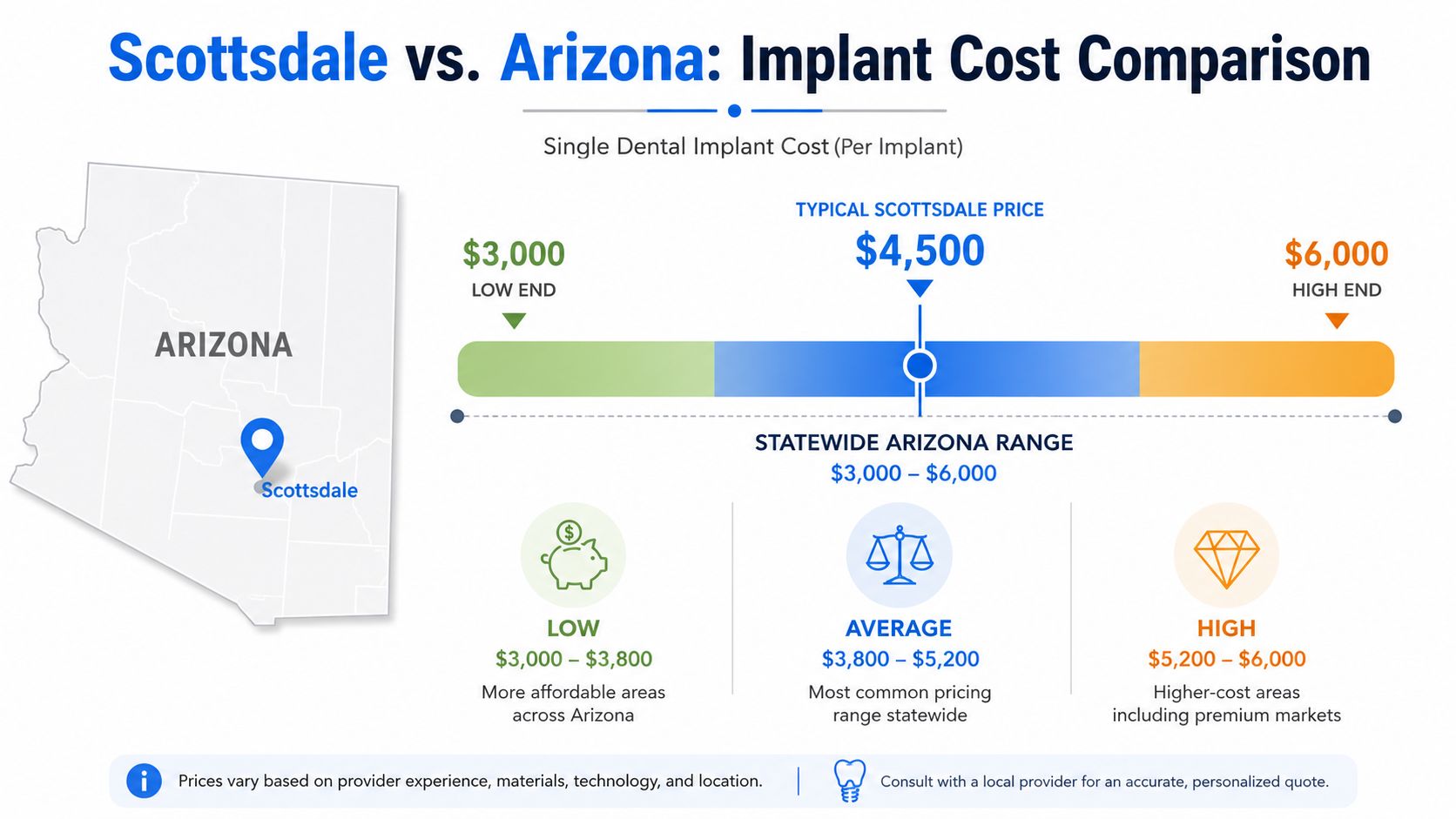
Scottsdale usually sits toward the upper end of Arizona implant pricing, and that isn't a surprise to anyone who works with local overhead, advanced restorative cases, and patients who expect careful cosmetic matching. The city doesn't have its own magic price, it just tends to reflect a more detailed style of treatment.
Where the numbers actually land
Across Arizona, full single-tooth implant treatment is frequently reported in the $3,000 to $6,000 range, with average completed cases clustering around $4,180 to $4,490 Arizona pricing comparison and Arizona market guide. Phoenix-specific estimates land closer to $4,200 Arizona pricing comparison, while Scottsdale-specific guides commonly place the completed single tooth at $5,000 to $6,000 Scottsdale implant cost guide.
That spread matters. It shows that a patient comparing offices in different Arizona cities is not always looking at the same treatment scope. Some quotes assume a very straightforward case, while others build in more advanced planning and a more polished final restoration.
A broader Arizona pricing summary also places the bundle of implant, abutment, and crown at roughly $2,700 to $6,300, which tells you how wide the market can be even before extra procedures are added Arizona implant pricing gap. That's why a quote that lands near the low end isn't automatically a deal, and a quote near the high end isn't automatically inflated.
How to judge the quote in front of you
A suspiciously low estimate usually leaves out something important, while a higher estimate may reflect a more complete plan. The right question isn't “Why is one cheaper?”, it's “What's missing from the cheaper plan?” If the answer includes imaging, surgical planning, grafting, or the final crown, the number was never a true comparison in the first place.
Single Implants, Bridges, and All-on-Four Compared
Implant pricing follows the size of the problem. One missing tooth, several adjacent missing teeth, and a full arch of failing teeth are three different cases, and they should not be priced or planned as if they're the same thing.
The ladder from one tooth to a full arch
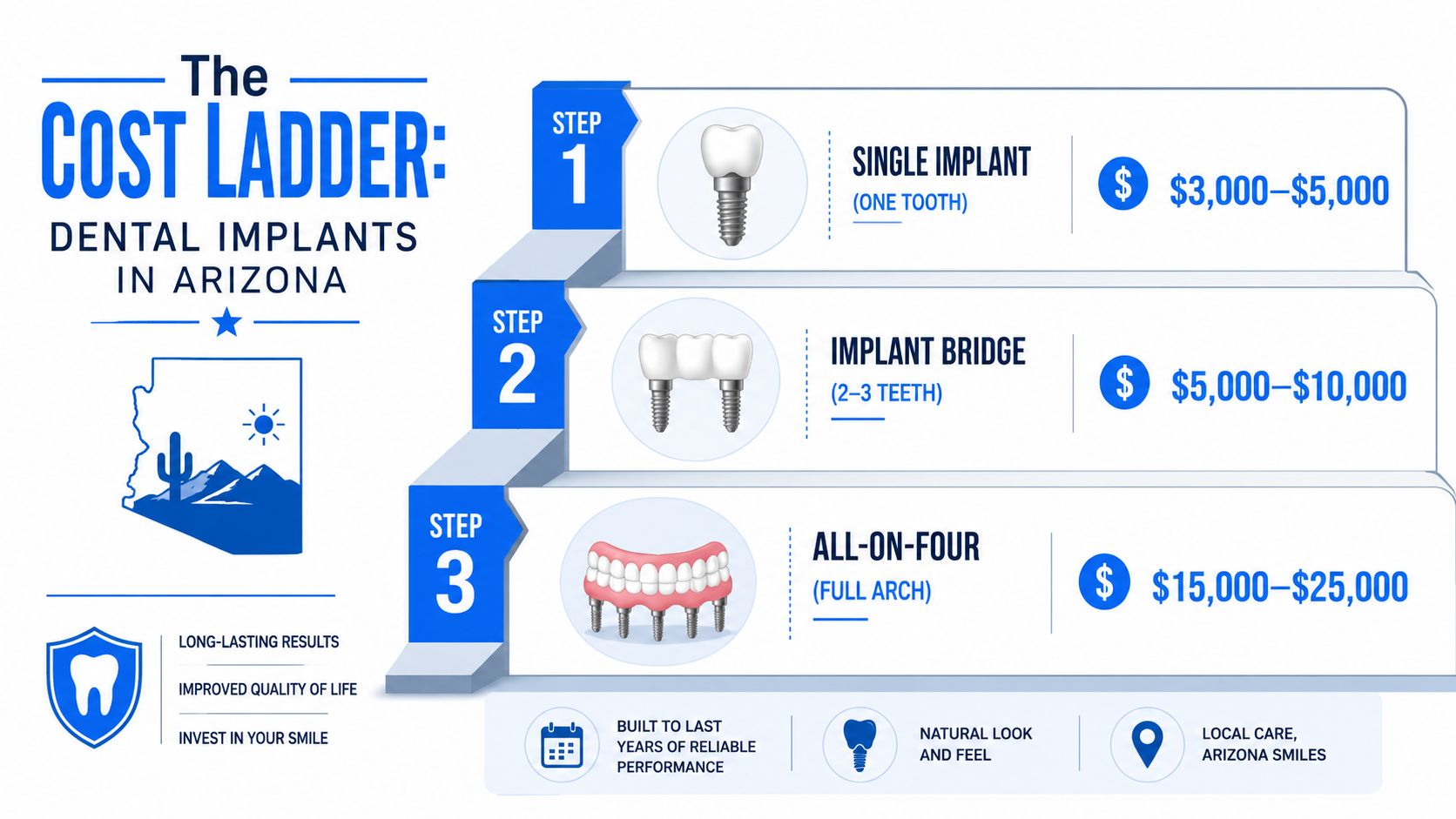
A single implant is the cleanest choice when one tooth is gone and the neighboring teeth are healthy. It replaces the missing root without asking the dentist to grind down good enamel, which is one reason many patients prefer it over a bridge. The price point fits the scale of the problem, with Arizona single-tooth treatment usually sitting in the low-to-mid thousands Arizona market guide.
An implant-supported bridge makes more sense when several adjacent teeth need replacement and the case can be shared across fewer posts. That approach can be more efficient in the right mouth, especially when neighboring teeth are already compromised. The conversation changes from “replace one tooth” to “rebuild a section cleanly and securely.”
All-on-Four sits at the far end of the ladder. Arizona estimates place it around $20,900 per arch on average, with a broader range of $11,400 to $33,250 Arizona market guide. That is not a bigger version of a single implant. It is a full-arch reconstruction with a very different surgical and prosthetic load.
Which option fits which patient
- Single implant: best when one tooth is missing and the rest of the arch is still strong.
- Implant bridge: useful when multiple adjacent teeth are already part of a larger repair.
- All-on-Four: appropriate when most or all teeth in an arch need replacement.
The trade-off is not just price. A single implant protects healthy neighboring teeth, a bridge can reduce complexity when several teeth are already in trouble, and All-on-Four gives a full-arch solution when the mouth has moved beyond patchwork repair. Patients searching for cosmetic dentist near me or restorative dentistry usually need help deciding where they sit on that ladder, not just what the total will be.
For patients comparing implants against fixed bridge options, this straightforward breakdown from implants vs. bridges helps frame the decision without making it feel abstract.
Add-On Procedures That Quietly Raise the Final Bill
The base implant price only tells part of the story. Many real patients need preparatory work before the post can go in safely, and those steps are not optional extras when the bone or surrounding structures need support.
What gets added when the mouth needs more preparation
Bone grafting rebuilds jawbone that has already shrunk after tooth loss. Sinus lifts make room for an upper implant when the sinus floor sits too close to the planned site. Tooth extraction comes first when the damaged tooth is still present and can't be saved. These are not cosmetic add-ons, they are the clinical steps that make the implant possible and predictable.
The Scottsdale pricing page is blunt about this point, noting that additional grafting or specialized procedures may be needed beyond the base $5,000 to $6,000 single-implant figure Scottsdale implant cost guide. Arizona cost summaries also note that add-ons like grafting and sinus work can add thousands of dollars to a case, which is exactly why a quote should never be read without the surrounding treatment plan.
Why these steps are worth paying for
A patient can think of grafting and sinus work as foundation work. If the foundation is weak, the implant is taking a risk before the crown ever goes on. That's why a quote that includes necessary preparation may be a better value than a cheaper one that skips the steps and creates a higher failure risk later.
Material choices can also move the total. Some patients want different restorative materials for aesthetic or durability reasons, and those choices can affect the final fee. The right question is not whether the add-on exists, but whether it matches the anatomy and the long-term goal.
Bottom line: if the mouth needs extra prep, that work is part of the treatment, not a sales tactic.
For patients dealing with tooth loss, a failing tooth, or a planned extraction before replacement, the cost conversation needs to include the full path from surgery to restoration. That's the only way to judge value.
The Implant Timeline From Consult to Final Crown
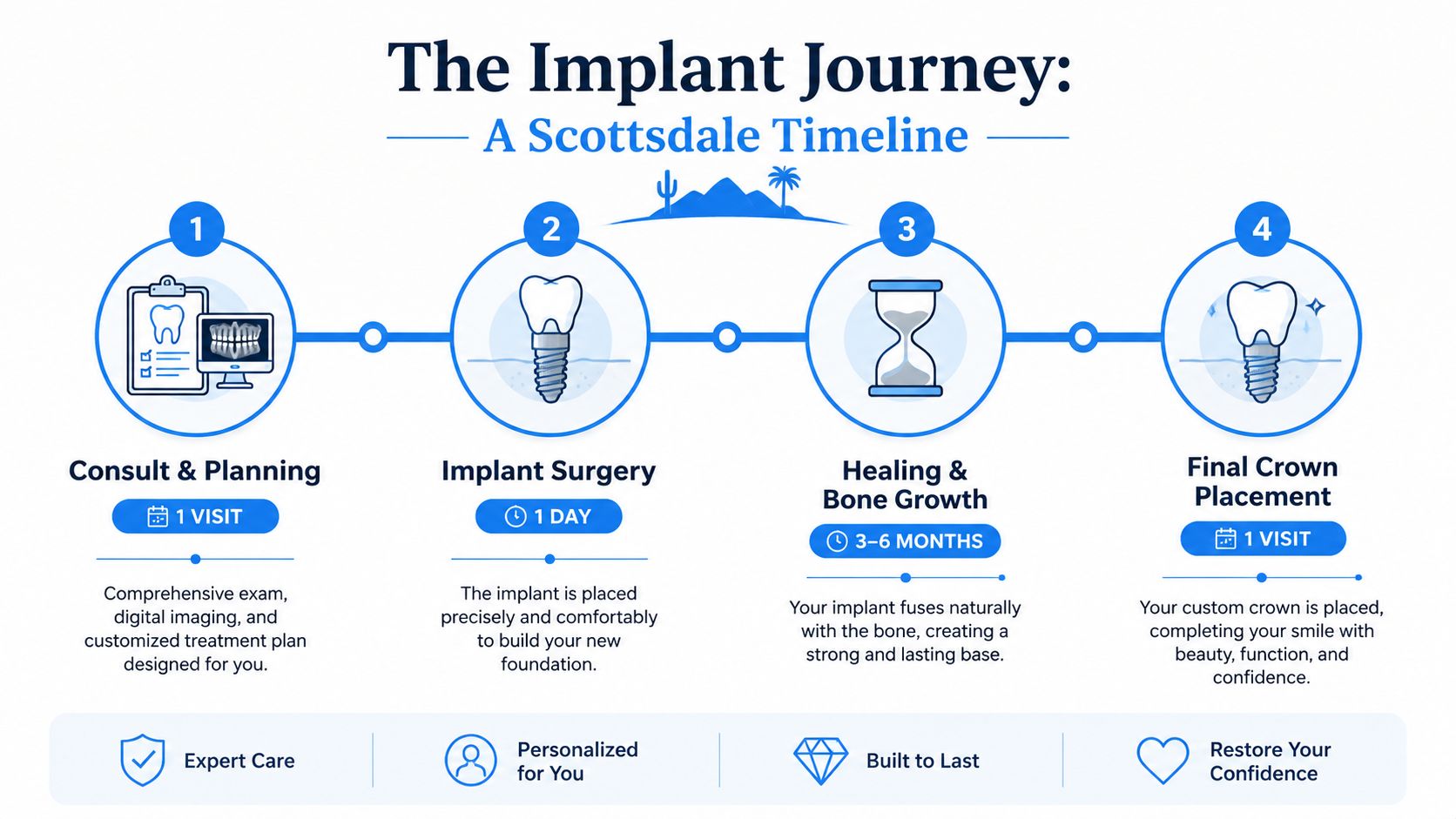
A dental implant in Scottsdale is usually a staged process, and the schedule matters as much as the price. The patient isn't just buying a tooth, they're committing to a sequence that includes planning, surgery, healing, and restoration.
What happens at each visit
The first visit usually starts with an exam, x-rays, and often CBCT imaging when the case needs 3D planning. That diagnostic work helps the dentist map bone volume, nearby anatomy, and the safest placement path. It also explains why the diagnostic phase can carry its own fee before the implant ever goes in.
The surgery itself is the biggest single clinical step. The implant post is placed, then the site heals while the bone fuses to the implant. That healing period is why a finished implant case cannot usually be rushed like a filling or a same-day crown.
The restoration phase closes the loop
Once the implant is ready, the abutment is attached and impressions are taken for the final crown. The crown delivery is the moment the treatment stops being a surgical site and starts being a functioning tooth again. Patients who ask about the implant crown procedure can see how that prosthetic step turns the post into a usable restoration, and the practice overview at implant crown procedure explains that restorative phase in plain terms.
The office's schedule helps make planning concrete. Appointments are held Monday through Thursday, with Friday by appointment. That kind of structure matters for patients who need staging, because the final result depends on timing as much as technique.
Staged treatment is not a delay tactic. It's what makes the result stable, and stable is what matters when a patient is paying for something that should last.
Insurance, Financing, and Your Real Out-of-Pocket Cost
The number on the estimate is not the number that always leaves the patient's wallet. Insurance design, treatment scope, and financing terms all change the final out-of-pocket amount, and Arizona implant content often glosses over that part.
The three things that change what gets paid
Most dental insurance plans treat implants as a major procedure, and many plans cap benefits well below the cost of a full case. Some plans exclude implants entirely while still covering alternatives like bridges or dentures. Medical insurance may contribute when tooth loss is tied to an accident or medical condition, but that depends on the situation and the policy language.
That is why the important question is not just “Does insurance cover implants?”, it's “What part of this case does insurance apply to?” A plan may help with diagnostics or related restorative work while leaving the surgical implant fee mostly on the patient.
Financing can make the plan workable
Many Scottsdale patients use financing to spread treatment over time, especially when the case includes surgery, restoration, and any needed preparation. The practice also offers new patient first-visit protocols, insurance and billing support, and financing options that help patients turn a large treatment plan into a manageable monthly decision.
Patients who keep family health paperwork organized tend to get through this part faster, because the estimate, insurance card, and prior treatment notes are easier to review when everything is in one place. A practical guide for that kind of organization is manage family health paperwork, which is useful context before a consult or benefits call.
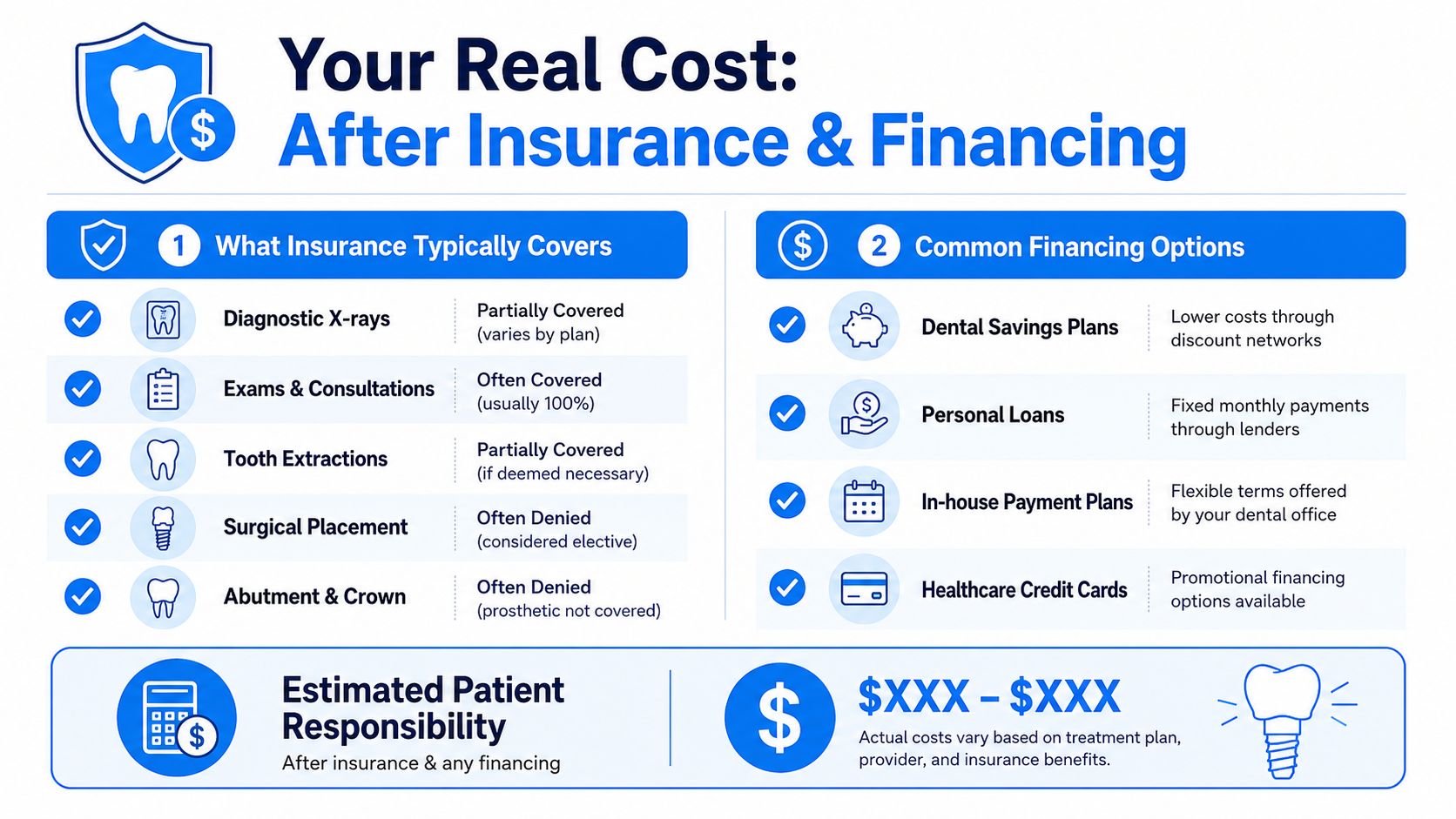
The cleanest way to protect the budget is to ask three questions at the consult. What exactly is included, what might still be added, and what does insurance or financing do to the final balance? If those answers are clear, the treatment plan is usable.
Choosing the Right Scottsdale Implant Team
Cost matters, but the cheapest quote is rarely the wisest choice if the planning is thin or the restoration is incomplete. The better Scottsdale implant team is the one that explains the bill in plain language, shows where Scottsdale pricing sits relative to Arizona averages, and tells the patient upfront whether grafting, extraction, or staging is likely.
Eric Wiitala DDS fits that model with more than 20 years in practice, recognition as one of the Valley's Top Dentists by PHOENIX magazine as cited on the practice site, and an approach that also emphasizes nutritional health. The practice's scope includes preventive, restorative, cosmetic, implant, orthodontic, and sleep and TMJ services, which matters when a case overlaps with bite, function, or aesthetics.
The local details are straightforward, and they matter. The office is at 9755 North 90th Street, Suite B250, Scottsdale, AZ 85258, the phone number is (480) 657-6981, and the schedule stays consistent Monday through Thursday, with Friday by appointment. For a patient comparing options, those are the signs of a practice that can manage a case from the first exam through the final crown.
A solid implant consult should do three things. It should show what's included, identify anything likely to change the price, and give the patient a plan that matches the mouth in front of them. That's the standard to look for when searching for a dentist in Scottsdale, AZ who can handle dental implants, tooth extraction, or a full restorative plan without guesswork.
If the goal is a clear implant estimate and a treatment plan that fits the actual case, schedule a consultation with Eric Wiitala DDS. Bring insurance information and any prior treatment records, and the team can translate the cost of dental implants in Arizona into a plan that makes sense for the mouth, the timeline, and the budget.