
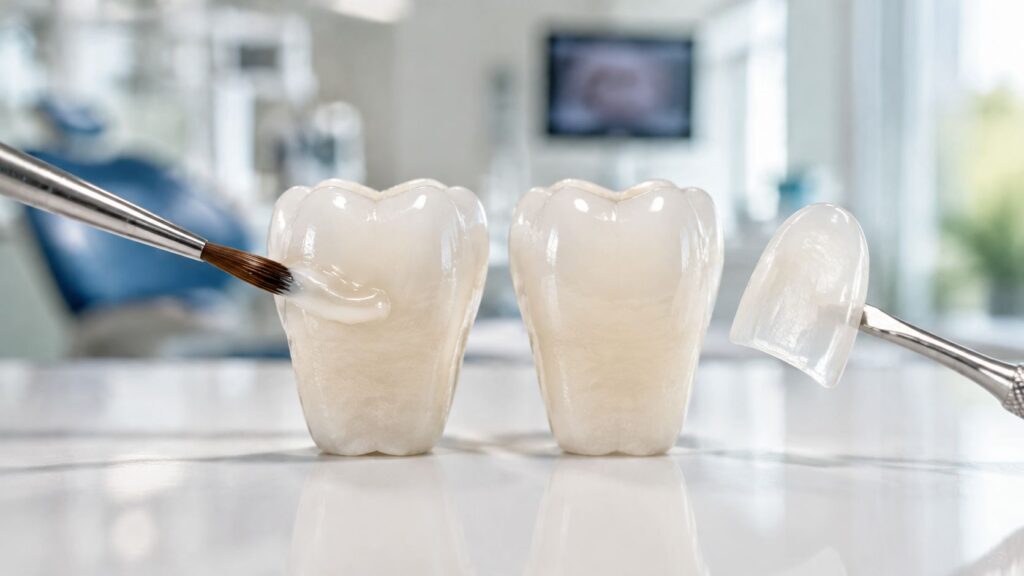
Dental bonding averages $431 per tooth nationally, while porcelain veneers average $1,765 per tooth, making veneers roughly four times more expensive upfront. Bonding typically lasts 3 to 7 years, while veneers commonly last 10 to 15 years or more, so the lower initial price isn't always the lower long-term cost. (U.S. bonding and veneer cost guide)
A Scottsdale patient searching for “cosmetic dentist near me” may be looking at a chipped front tooth, a small gap, or discoloration that no longer responds to ordinary whitening. Online price ranges can make the decision feel simple, but the question is more personal: does the smile need a conservative repair, or a broader change that justifies a larger investment?
Table of Contents
- Finding the Right Cosmetic Dentist Near You in Scottsdale
- Understanding Dental Bonding and Porcelain Veneers
- Dental Bonding vs Veneers Cost Breakdown
- Longevity and True Lifetime Cost
- Which Option Fits Your Specific Smile Goals
- Pros and Cons of Each Treatment
- Your Next Steps at Dr. Wiitala's Scottsdale Practice
Finding the Right Cosmetic Dentist Near You in Scottsdale
A patient in Scottsdale might notice a chip every time a phone camera opens. Another may feel self-conscious about uneven edges during work conversations, or wonder whether a brighter smile requires treating every visible tooth. Searching for a dentist near me, dentist in Scottsdale, AZ, or cosmetic dentist near me often leads to two immediate concerns: cost and commitment.
Those concerns are reasonable. Dental bonding can make sense when one or two teeth need a focused correction, while porcelain veneers may be more appropriate when several teeth need consistent changes in color, shape, or proportion. A low quote can be attractive, but it won't answer whether the material suits the bite, the amount of enamel available, or the patient's expectations for maintenance.
The question behind the price
A useful consultation separates three issues:
- The defect: Is the concern a small chip, a gap, staining, worn enamel, or a damaged tooth that also needs restorative care?
- The desired result: Does the patient want a discreet repair or a coordinated smile redesign?
- The future commitment: Is preserving natural tooth structure more important than maximizing stain resistance and service life?
Dr. Eric Wiitala's Scottsdale practice gives patients a local setting for that conversation. The office has served the Scottsdale community for more than 20 years, and patients can discuss cosmetic dentistry alongside general and restorative dental care rather than choosing from an online price list alone.
Practical rule: The cheapest treatment is only a bargain when it solves the right problem and fits the patient's expected timeline.
A new patient exam may include an evaluation of the teeth, gums, bite, existing restorations, and overall smile goals. Dental x-rays may be appropriate when the tooth has decay, trauma, or symptoms that aren't visible from the front. If the concern is broader than appearance, treatment could also involve whitening, a filling, a crown, orthodontic clear aligners, or another restorative option.
Patients comparing dental bonding vs veneers cost should bring specific questions to the consultation. Ask what the quoted fee includes, whether the plan is restorative or cosmetic, how the treatment will interact with the bite, and what maintenance may be needed later. That approach produces a more useful answer than comparing isolated numbers from different offices.
Understanding Dental Bonding and Porcelain Veneers
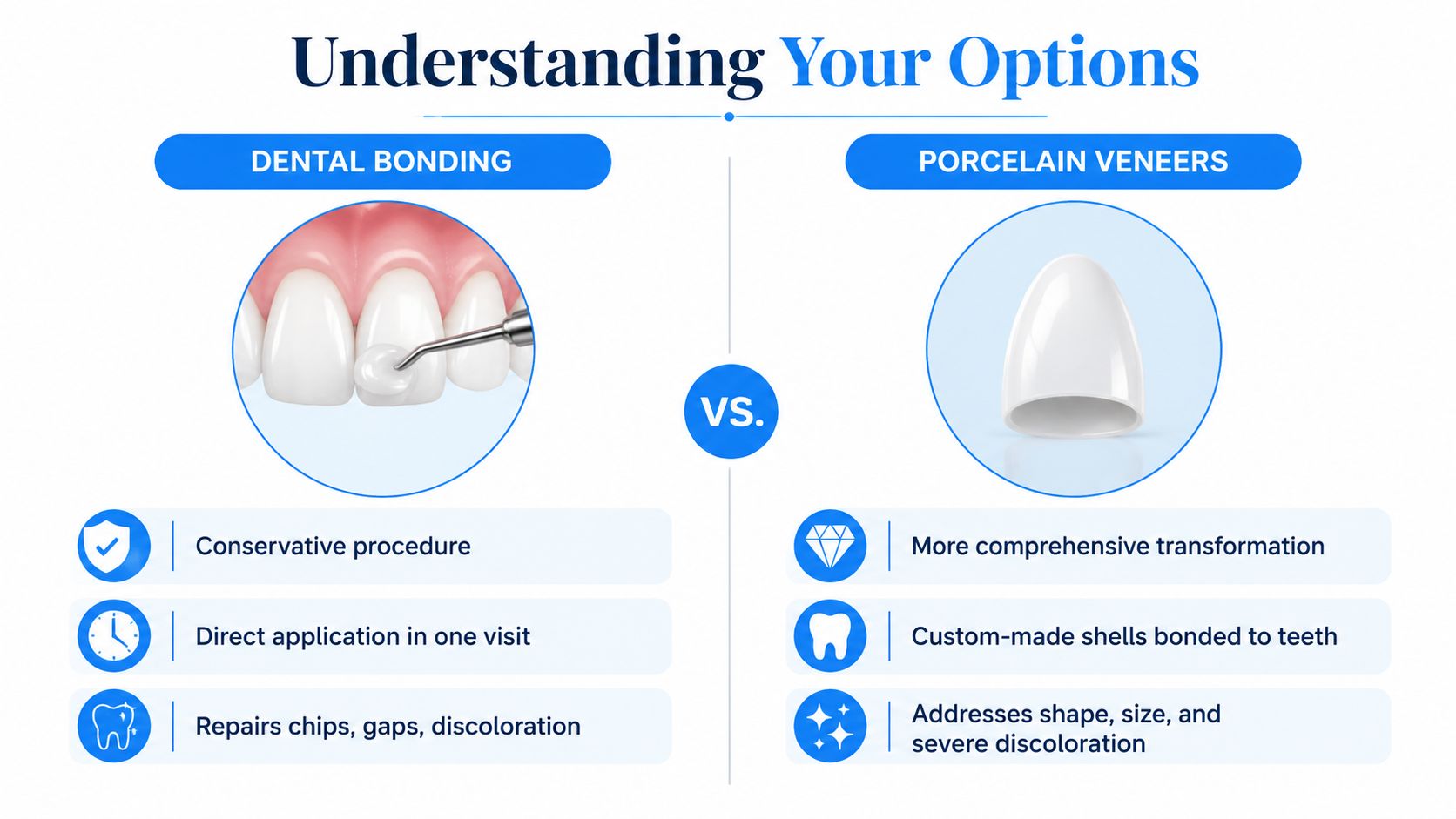
Dental bonding uses tooth-colored composite resin placed directly on the tooth. The dentist prepares the surface, applies the material, shapes it to restore the contour, and hardens it before refining the finish. Because the work is completed directly at the chair, bonding is often well suited to a small chip, a limited gap, minor discoloration, or subtle reshaping.
Bonding generally requires minimal preparation and preserves more natural tooth structure. It can often be completed in one visit, which reduces scheduling demands and avoids the laboratory fabrication required for porcelain work. The result can look natural, but composite resin can be more vulnerable to staining, wear, and chipping than porcelain.
Patients can review the practice's approach to dental bonding for minor repairs and reshaping before scheduling a consultation.
How veneers differ
Porcelain veneers are thin, custom-made shells fabricated for the front surfaces of selected teeth. Traditional porcelain veneers usually require some enamel reduction so the finished restoration can sit naturally within the smile, followed by impressions or digital records, laboratory fabrication, and final bonding. Those added steps contribute to the higher fee and longer treatment process. (Preparation and fabrication overview)
Veneers are designed for broader visual changes. They can help coordinate tooth color, length, shape, and apparent alignment across multiple teeth. Porcelain is also more resistant to staining than composite resin, although veneers still require normal brushing, flossing, professional cleanings and exams, and sensible bite protection.
The distinction is important. Bonding is usually a repair-focused, conservative option. Veneers are generally a long-term cosmetic option. Neither is automatically better, and a healthy smile doesn't need a more invasive treatment because it costs more.
Dental Bonding vs Veneers Cost Breakdown
A Scottsdale quote depends on the number of teeth, the condition of your smile, and whether treatment is restorative or cosmetic. National figures provide a useful starting point. Dental bonding averages $431 per tooth, with reported state-level pricing from $338 in Alabama to $717 in Hawaii. Porcelain veneers average $1,765 per tooth, while composite resin veneers average $1,373 per tooth. (Detailed bonding and veneer pricing)
| Treatment | Per Tooth Average | Full Set Estimate | Insurance Coverage |
|---|---|---|---|
| Dental bonding | $431 nationally | $1,500 to $9,000 for a six-to-ten-tooth bonding plan | Cosmetic bonding is commonly self-pay. Restorative bonding may qualify for partial coverage when it repairs decay or structural damage. |
| Porcelain veneers | $1,765 nationally | $5,400 to $15,000 for a six-veneer set | Cosmetic veneer treatment is rarely covered and is commonly self-pay. |
Per-tooth pricing can hide the overall cost of a smile makeover. Repairing one chipped tooth is a localized expense. Coordinating color, shape, length, and symmetry across six to ten teeth requires a different treatment plan and budget. The bonding range represents a six-to-ten-tooth plan, while the porcelain estimate represents a six-veneer set.
What creates the gap
Bonding is applied and shaped directly in the office. Veneers require custom design, laboratory fabrication, material selection, and a more involved delivery appointment. Treatment planning may also include temporary restorations when needed. Before recommending either option, the dentist evaluates the underlying teeth, bite, and forces that could affect the result.
Independent cost guides place composite bonding around $100 to $700 per tooth and porcelain veneers around $900 to $2,500 per tooth. Geography, laboratory fees, case complexity, and the number of teeth treated all influence the final fee.
Insurance classification matters. Restorative bonding used to repair decay, a fractured area, or lost tooth structure may receive different consideration from an insurance carrier than purely aesthetic bonding performed only to change appearance. Coverage depends on the policy and clinical documentation, so the billing team should verify benefits before treatment.
Patients can review the practice's financing information and ask how the proposed fee is divided among consultation, preparation, laboratory services, and final placement. A mixed plan may control the total cost, using bonding for localized defects and veneers for teeth that need broader visual coordination.
Longevity and True Lifetime Cost
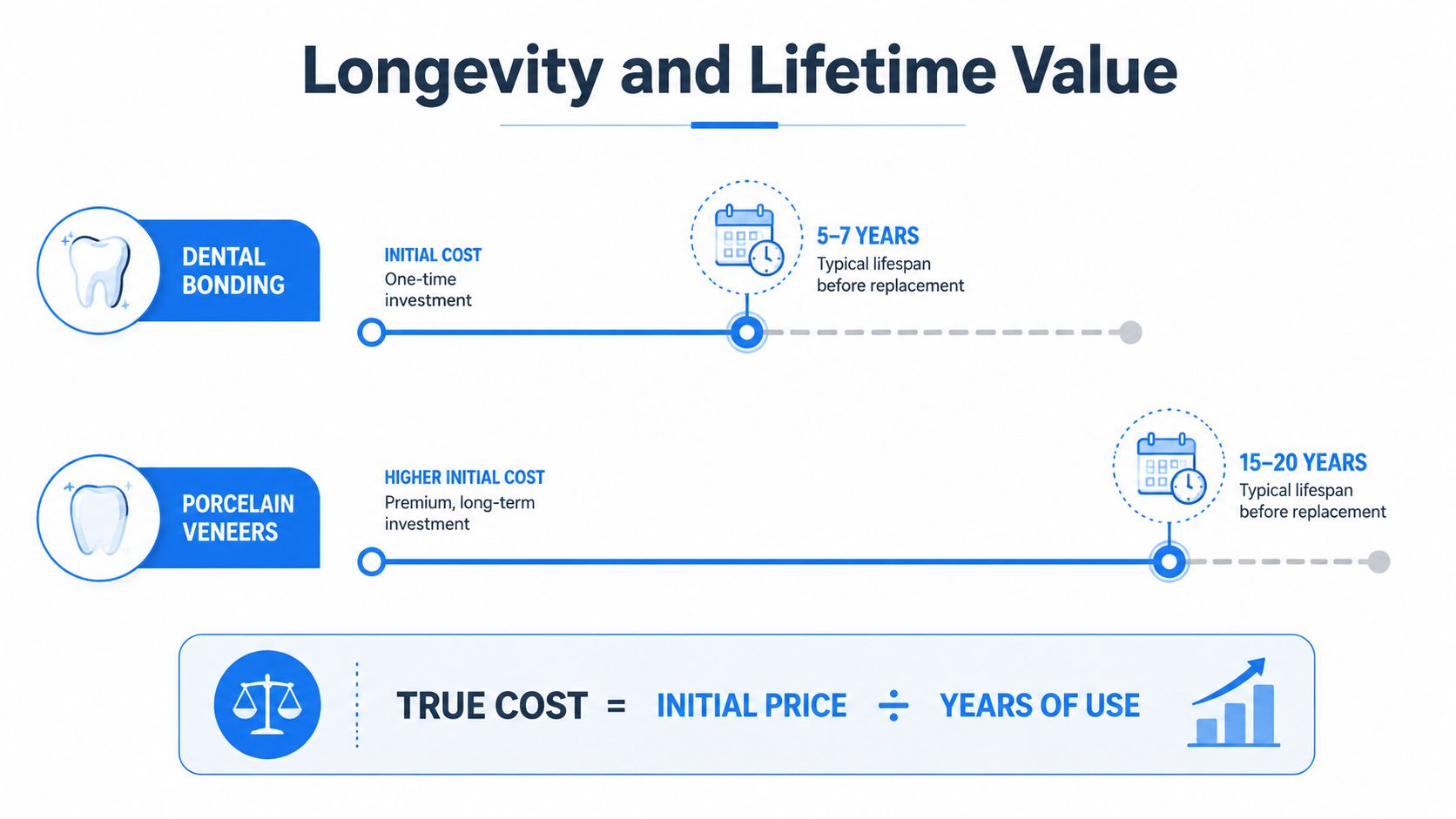
The lowest upfront fee is not always the lowest lifetime cost. Composite bonding commonly lasts about 3 to 7 years, while porcelain veneers commonly last 10 to 15 years, with some well-maintained cases lasting 20 years or more. Published clinical summaries also report porcelain veneer survival rates of 91% at 10 years and 73% at 20 years.
These ranges describe typical outcomes, not a guarantee for one patient. Bite forces, grinding, oral hygiene, dietary habits, trauma, the condition of the underlying tooth, and regular professional care all affect service life. A treatment plan should account for those factors before comparing long-term value.
Translating price into years of use
Using the national averages above, $431 spread over a 3-to-7-year bonding lifespan equals roughly $62 to $144 per year of initial service. $1,765 spread over a 10-to-15-year veneer lifespan equals roughly $118 to $177 per year of initial service. These calculations cover initial placement only. They exclude examinations, repairs, replacements, financing charges, and changes in treatment needs.
The comparison supports different choices for different smile plans. Bonding can be financially sound for a small repair, particularly when preserving enamel is the priority. Veneers may become the stronger long-term financial choice for a complete smile makeover when a patient wants coordinated changes across several visible teeth, greater stain resistance, and a longer expected replacement cycle.
Cosmetic bonding may need touch-ups or replacement after chipping, wear, or shade changes. Porcelain is not maintenance-free, yet its stain resistance and longer expected service life may reduce how often the smile needs cosmetic refreshes. Insurance treatment can also differ: restorative bonding used to repair damaged tooth structure may receive different consideration than cosmetic bonding performed only to change appearance.
Financial perspective: A higher placement fee can make sense when the restoration supports a broader cosmetic goal over a longer period. Veneers are not automatically the better value for a tooth that needs only a small, conservative repair.
Which Option Fits Your Specific Smile Goals
A single chipped front tooth with healthy surrounding enamel often points toward bonding. The dentist can add composite to the missing contour without redesigning adjacent teeth, and the patient keeps more natural tooth structure intact. This is especially practical when the goal is to make one tooth blend into the existing smile rather than create a new uniform appearance.
A small gap may also respond well to bonding when the teeth and gums are healthy and the bite is favorable. The treatment can change the apparent width and shape of the teeth, but the dentist must assess whether added resin would interfere with flossing, speech, or the way the teeth meet.

When a broader transformation makes sense
Porcelain veneers may fit a patient who wants several visible teeth to share a controlled color, length, and shape. They can be considered when discoloration is extensive, when multiple teeth have worn edges, or when the patient wants a more complete smile makeover than isolated resin additions can provide.
Preparation matters in this decision. Veneers usually involve some enamel reduction, so the patient must understand that the choice carries a greater and generally irreversible commitment than bonding. A careful cosmetic consultation should address the desired shade, tooth proportions, gum display, bite, and whether less invasive treatment could achieve an acceptable result.
Insurance changes the practical calculation
Coverage is not determined only by the material. Restorative bonding connected to decay, fracture, or structural repair may receive partial insurance consideration, depending on the policy and documentation. Cosmetic bonding performed only for appearance is commonly self-pay, while cosmetic porcelain veneers are rarely covered.
That distinction can change the effective price. Patients should ask the office to separate medically necessary treatment from elective smile enhancement and confirm benefits before scheduling. If a tooth needs a filling, crown, tooth extraction, or replacement with a dental implant, cosmetic planning should wait until the underlying health issue is addressed.
For patients searching for dental implants near me, tooth extraction, or an emergency dentist, pain or instability takes priority over elective veneer planning. A Scottsdale dentist can evaluate the whole mouth and coordinate restorative care before cosmetic work.
Pros and Cons of Each Treatment
Bonding's strongest advantage is control. The dentist can repair a localized defect with minimal preparation, often in a single visit, and the patient can preserve more of the original tooth. That makes composite attractive for a small chip, limited reshaping, or a patient who isn't ready for a permanent change.
The trade-off is that composite resin doesn't offer the same resistance to staining and wear as porcelain. A patient who frequently exposes the teeth to staining foods and drinks, clenches or grinds, or expects a dramatic multi-tooth transformation may need more maintenance than anticipated. Repairs can also become visible if the surrounding natural teeth change shade while the resin remains fixed.
Why veneers cost more
Porcelain veneers provide a coordinated surface for shape, size, shade, and apparent alignment. Their non-porous material is generally more stain resistant, and their longer service life can reduce replacement frequency when the case is properly selected and maintained.
The disadvantages are substantial enough to deserve plain language. Veneers cost more, require laboratory fabrication, involve more tooth preparation than bonding in most cases, and commit the patient to ongoing restoration care after enamel has been altered. The process also requires more planning and usually more than one appointment.
A conservative repair and a full smile redesign aren't competing versions of the same treatment. They solve different problems.
The right decision depends on the defect, the bite, the condition of the enamel, and the patient's priorities. A patient may reasonably choose bonding because reversibility and affordability matter most. Another may choose veneers because consistent shade, stain resistance, and fewer replacement cycles matter more. A mixed approach can sometimes avoid the cost and preparation of treating every tooth while still creating a balanced appearance.
Patients should also address habits before either treatment. Custom occlusal guards may be appropriate for bruxism, and routine cleaning and exams help the dentist monitor the gums, tooth structure, margins, and bite. Cosmetic treatment won't correct untreated decay or gum disease, and no restoration can compensate for unaddressed dental problems.
Your Next Steps at Dr. Wiitala's Scottsdale Practice
A cosmetic consultation at Dr. Eric Wiitala's Scottsdale office begins with assessment rather than a predetermined material. The team can examine the teeth and gums, review the bite, use appropriate dental imaging, and discuss whether the patient's concern is best addressed with bonding, veneers, whitening, a crown, orthodontic clear aligners, or restorative care.
Patients should bring a clear description of what they want changed. It helps to identify whether the priority is a single tooth, a small gap, overall brightness, symmetry, stain resistance, or a broader smile makeover. The dentist can then explain what each option involves, what preparation is required, how long the result may serve, and which costs belong to clinical treatment versus laboratory or cosmetic services.
Dr. Wiitala graduated from Indiana University School of Dentistry in 1999 and has more than 20 years in practice. The practice states that he has been recognized as one of the Valley's Top Dentists by PHOENIX magazine. Patients can also ask about insurance and billing support, financing options, and whether restorative treatment should be completed before elective cosmetic care.
The Scottsdale office is located at 9755 North 90th Street, Suite B250, Scottsdale, AZ 85258. Patients can call (480) 657-6981 to discuss a new patient exam or cosmetic consultation.
A consultation is particularly important when an online estimate feels too broad. Local pricing depends on the number of teeth, material, preparation, laboratory work, existing dental conditions, and the intended result. The office can provide a plan based on the patient's actual smile rather than a generic dental bonding vs veneers cost comparison.
Eric Wiitala DDS offers dental bonding, porcelain veneers, whitening, restorative dentistry, and broader dental care for Scottsdale patients comparing cosmetic options. Visit Eric Wiitala DDS to request a consultation, discuss the right treatment for the smile's goals, and receive clear guidance on cost, longevity, and financing.