
A cracked molar can turn a routine dental visit into a surprisingly personal decision. A patient may sit in the chair with hands folded, looking at two crown options and wondering which one will look natural, hold up during meals, and avoid another repair later. For adults searching for a dentist near me in Scottsdale, AZ, the right answer usually depends on more than appearance or price.
At Eric Wiitala DDS, patients can discuss dental crown materials in plain language and connect each clinical trade-off to daily priorities, whether that means smiling for photos, eating comfortably, protecting a tooth after a root canal, or managing nighttime clenching. The choice can also fit into broader restorative dentistry, cosmetic dentistry, dental implants, and preventive dental care.
Choosing the Right Dental Crown Material for Your Smile
A dental crown isn't a one-size-fits-all treatment. A front tooth that shows whenever someone speaks has different demands from a back molar that absorbs strong chewing forces. A patient who grinds at night also needs a different conversation from someone whose main concern is a lifelike shade match.
A chairside decision, not a guess
Consider a Scottsdale patient with a cracked molar. One option may offer exceptional fracture resistance, while another may provide a more natural light-reflecting appearance. Neither choice is automatically right for every mouth. The dentist must assess the remaining tooth structure, bite pattern, gum health, tooth position, and the patient's priorities before recommending a material.
That discussion should also include what happens after placement. A crown's success depends on preparation, bonding or cementation, occlusal design, daily cleaning, and follow-up. A beautifully matched crown can still develop problems if plaque collects at the margin or heavy clenching overloads the restoration.
What this guide helps clarify
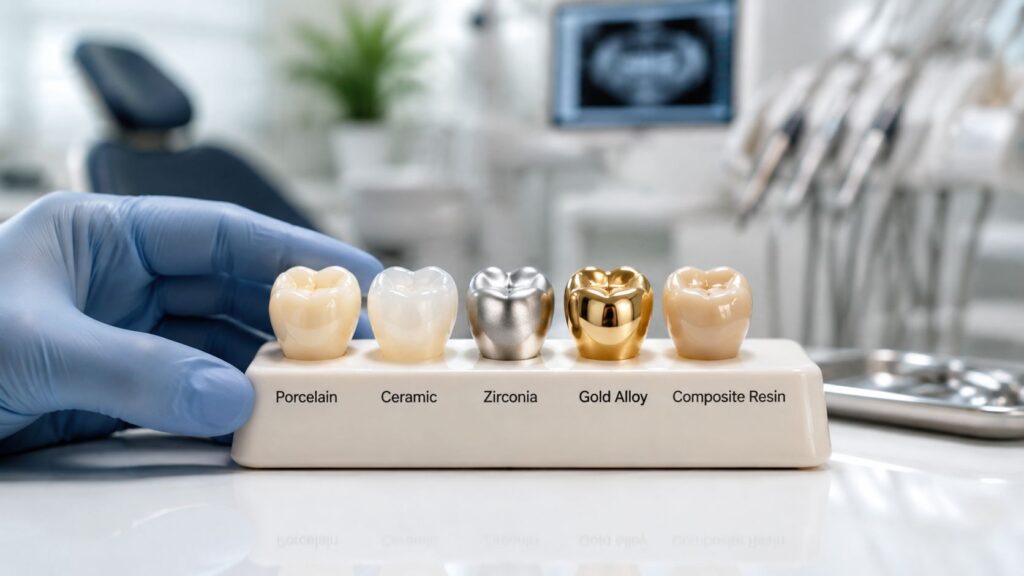
The main dental crown materials fall into five broad families:
- Porcelain and all-ceramic crowns, valued for lifelike translucency.
- Zirconia crowns, selected for high fracture resistance and broad use.
- Porcelain-fused-to-metal crowns, combining a metal foundation with a porcelain surface.
- Gold and other metal alloys, known for durability and conservative preparation.
- Composite or resin crowns, generally used when repairability, timing, or short-term value matters.
Clinical evidence shows that modern ceramic crowns can approach traditional metal-ceramic longevity in many settings. A systematic review reported five-year survival of 94.7% for metal-ceramic crowns, 96.6% for leucite- or lithium-disilicate-reinforced glass-ceramic crowns, 96.0% for densely sintered alumina crowns, and 92.1% for zirconia crowns (systematic review of single-unit crown outcomes). Those figures don't make one material universally superior. They show why the decision should be based on the tooth, bite, smile goals, and long-term maintenance plan.
What a Dental Crown Actually Does and Why Material Matters
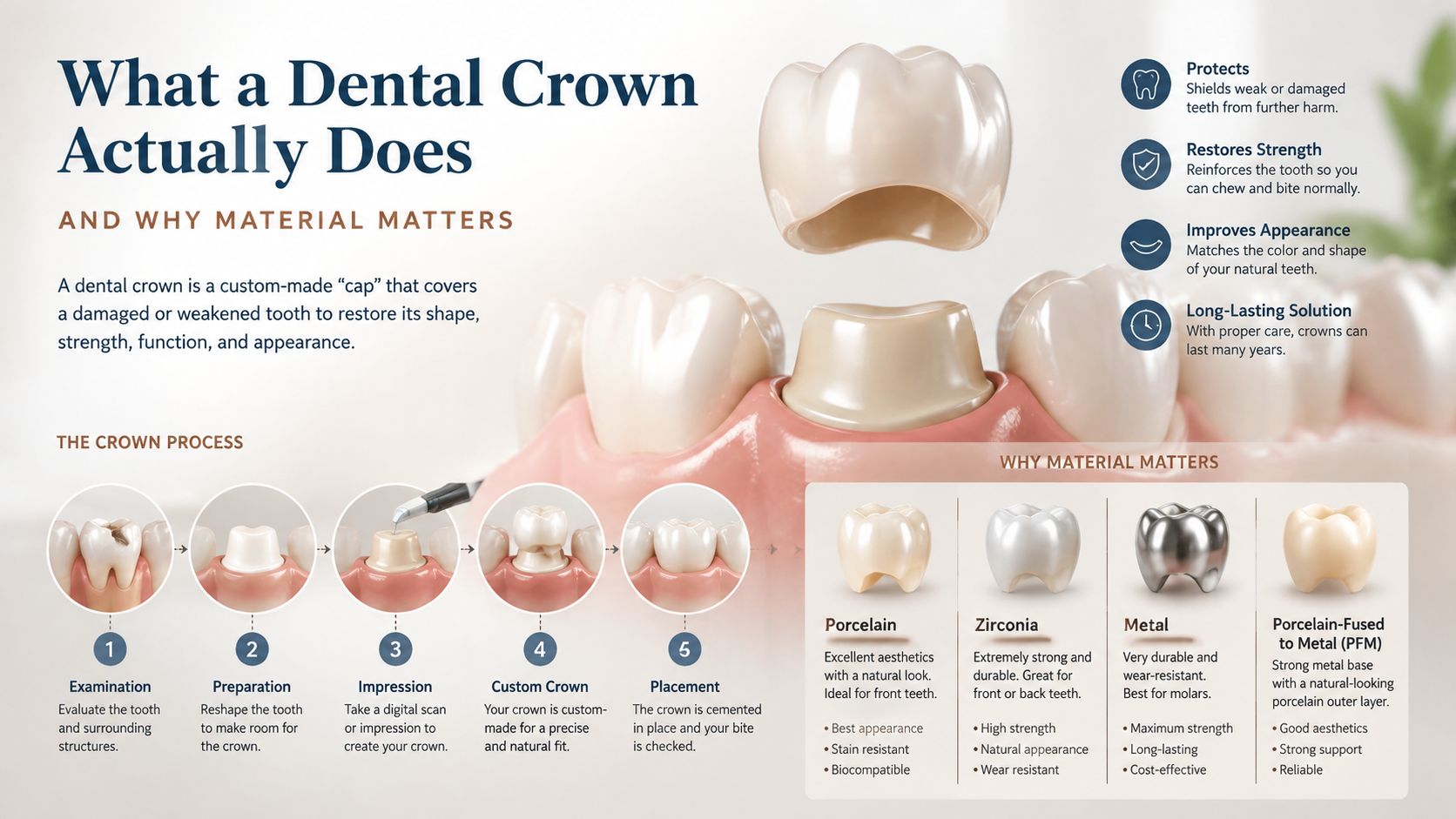
A dental crown is a custom-made cap that covers a damaged, weakened, worn, or cosmetically flawed tooth. It restores the tooth's shape and chewing function while helping protect the remaining structure. A crown can be thought of as a helmet for a tooth, but the helmet must be designed for the activity it will perform.
A front crown needs to blend with neighboring enamel. A molar crown needs to tolerate chewing. A crown placed over a tooth after root canal treatment needs to protect a tooth that may have lost substantial structure. The material affects how the restoration handles these demands.
Five factors guide the recommendation
Material selection balances several properties:
- Strength and fracture resistance: The crown must handle the patient's bite without cracking or separating.
- Translucency and shade: The restoration should reflect light in a way that looks compatible with natural enamel.
- Opposing-tooth wear: A rough ceramic surface can affect the tooth or crown that contacts it.
- Thickness and tooth preparation: Some materials may work in conservative designs, while others need a specific amount of space.
- Bonding and margin integrity: The dentist must create a stable seal around the prepared tooth.
The building-material analogy helps. Brick can support one type of structure, steel another, and glass serves a different purpose. Dental crown materials work the same way. A material that excels at strength may not provide the most lifelike appearance, while a highly translucent ceramic may need more careful case selection in a high-load area.
The final recommendation also depends on the amount of natural tooth remaining, the location in the mouth, bite forces, gum condition, and cosmetic expectations. The five categories, porcelain or ceramic, zirconia, PFM, gold and metal alloys, and composite, give the dentist a practical starting point. Durability and aesthetics often pull in different directions, which is why a Scottsdale crown consultation should include both clinical findings and the patient's priorities.
Comparing Today's Most Common Dental Crown Materials
A front tooth that shows when you smile has different demands from a molar that absorbs heavy chewing forces. The right crown material depends on that location, the remaining tooth structure, your bite, and how closely the restoration must mimic natural enamel. Each category has a useful role, so the practical question is which balance of appearance, strength, wear, and maintenance fits this particular tooth.
Porcelain and all-ceramic crowns
Porcelain and other all-ceramic crowns are often selected for visible teeth because they can reflect light in a way that resembles enamel. Their metal-free appearance suits the smile zone, and lithium disilicate is one example that combines lifelike appearance with meaningful strength.
Ceramic still requires thoughtful case selection. Heavy bite forces, bruxism, limited space, an unsuitable design, or poor occlusal adjustment can contribute to chipping or fracture. High-strength glass ceramics can perform well in appropriate cases, but a strong material does not remove the need to evaluate the tooth and bite.
Zirconia crowns
Zirconia is a strong ceramic used for both front and back teeth. Newer translucent forms can look more natural than earlier versions, while a monolithic design avoids a separate veneering layer that may chip.
Surface finishing deserves attention. A comparative study found that wear on the opposing tooth against zirconia was about twice the amount of strong wear traces seen against lithium disilicate (comparative ceramic wear study). The dentist should check the bite and polish the crown carefully. A smooth, well-adjusted zirconia surface is preferable to a rough surface or a glaze layer that may wear away.
Porcelain-fused-to-metal crowns
Porcelain-fused-to-metal, or PFM, crowns pair a metal substructure with porcelain on the outside. This design has been used for many years and can serve front or back teeth when the dentist wants a familiar combination of support and tooth-colored coverage.
The main concern is appearance at the gumline. Gum recession can reveal a dark margin or the underlying metal. PFM may still suit a tooth where predictable structure matters, while a fully ceramic option may provide a more natural light response in the visible smile area.
Gold and other metal alloys
Gold and other metal alloy crowns are valued for durability, resistance to chipping, and, in selected cases, the ability to preserve more natural tooth structure. Metal can also be shaped with a functional surface that is gentle on the opposing tooth compared with a rough ceramic surface.
The trade-off is the metallic appearance. These crowns are usually considered for less visible back teeth, especially when structural performance has greater priority than a tooth-colored result. A history of metal sensitivity should be discussed before choosing this category.
Composite and resin crowns
Composite or resin crowns may be easier to repair and can serve as temporary, transitional, or lower-cost restorations. They generally resist wear, staining, and fracture less effectively than stronger ceramic or metal options. That makes the expected maintenance and replacement trade-off part of the treatment conversation, not an afterthought.
| Material | Strength | Esthetics | Best Location | Typical Lifespan | Relative Cost |
|---|---|---|---|---|---|
| Porcelain or all-ceramic | Moderate to high, case-sensitive | Very high | Front teeth and selected premolars | Often medium to long term with proper care | Moderate to high |
| Zirconia | High fracture resistance | High, especially with translucent designs | Posterior teeth, implants, selected front teeth | Often long term with proper care | Moderate to high |
| PFM | High | Good, with possible margin visibility | Front or back teeth | Often long term with proper care | Moderate |
| Gold or metal alloy | Very high | Low for visible areas | Back teeth | Often very long term | Moderate to high |
| Composite or resin | Lower | Good initially, more maintenance-sensitive | Temporary or selected short-term uses | Shorter term | Lower |
Cost is only one part of the decision. Patients reviewing treatment fees can consult the practice's information about dental crown and bridge costs. The final fee may depend on the tooth, preparation, laboratory work, additional treatment, and insurance details. A Scottsdale consultation with Eric Wiitala DDS can connect those practical details with the material's position in the mouth and the patient's priorities.
Longevity and Maintenance by Material
A crown can look perfect on the day it is placed, yet its service life depends on more than the material name. Tooth location, preparation quality, cementation, bite forces, gum health, daily cleaning, and clenching or grinding all affect what happens over time. Material is one part of the plan. The condition of the tooth and the way it is used matter just as much.
Long-term evidence supports a practical conclusion: several modern crown materials can perform well when the case is properly selected and maintained. A review of lithium-disilicate restorations reported complications such as loss of retention, decay around the crown margin, and sensitivity over extended follow-up (long-term lithium-disilicate review). Those problems are useful to understand because they often point to a maintenance or tooth-related issue, rather than proving that one material always fails.
What shortens crown life
A crown may need attention for several reasons:
- Loss of retention: Cement, preparation, or weakened tooth structure can allow the crown to loosen.
- Marginal decay: Plaque and bacteria can cause decay where the crown meets the natural tooth.
- Ceramic chipping: A veneering layer on some PFM or layered restorations can chip when forces are unfavorable.
- Fracture: Clenching, grinding, trauma, a thin design, or a heavy contact can damage the restoration.
- Sensitivity or gum irritation: These symptoms may involve the tooth, crown margin, bite, or nearby tissue.
A small ceramic chip can sometimes be polished or repaired. A loose crown may be recemented after the dentist checks both the restoration and the supporting tooth. Replacement is more likely when the crown is fractured beyond repair, decay has weakened the tooth, the fit is poor, or the tooth requires additional treatment.
Daily care protects the investment. Brush with a non-abrasive fluoride toothpaste and clean carefully along the crown margin. Avoid chewing ice or hard candy. If clenching or grinding is present, a night guard can reduce damaging forces. Regular examinations and professional hygiene visits allow the dental team to check for leakage, gum inflammation, bite changes, and early wear before a minor concern becomes urgent.
A long-term crown follow-up study reported a mean survival of 47.53 years for metal-ceramic crowns, with periapical periodontitis identified among failures, while other restoration types in that study showed 100% survival at 50 years (long-term crown follow-up study). The practical lesson is straightforward: controlling disease and maintaining the supporting tooth can matter as much as selecting the crown material.
| Material | Average Lifespan | Key Maintenance Considerations |
|---|---|---|
| Porcelain or all-ceramic | Often medium to long term | Protect from heavy clenching and monitor chips |
| Zirconia | Often long term | Maintain a polished surface and balanced occlusion |
| PFM | Often long term | Watch for porcelain chipping and gumline changes |
| Gold or metal alloy | Often very long term | Keep margins clean and monitor the supporting tooth |
| Composite or resin | Usually shorter term | Expect closer monitoring for wear, staining, or repair |
Front Teeth Versus Back Teeth and How the Choice Changes
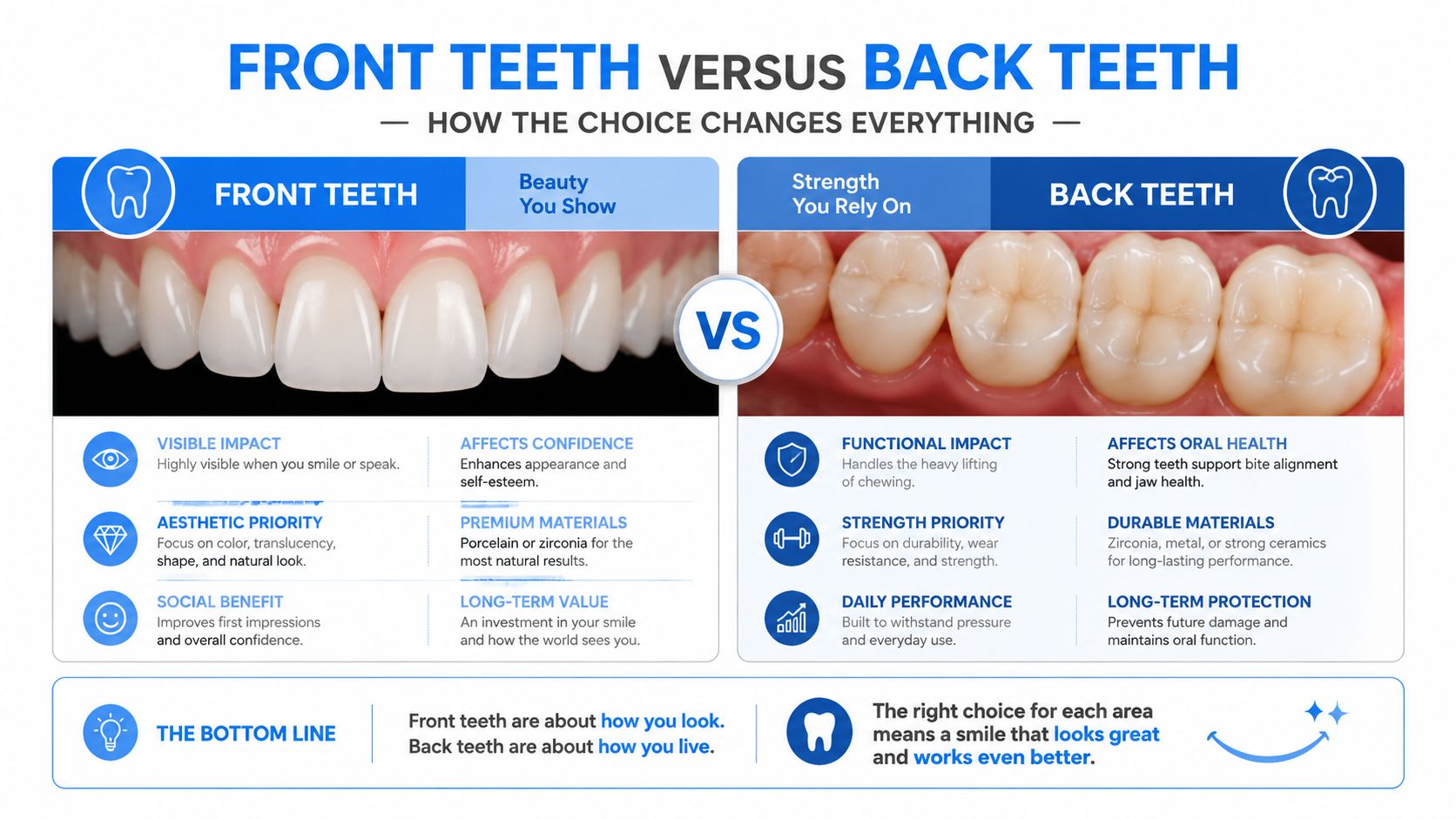
Tooth location changes the decision immediately. Front teeth sit in the smile zone, where people notice shade, contour, translucency, and how the crown interacts with light. Back teeth handle chewing, so fracture resistance, functional contacts, and wear on opposing teeth become more important.
The smile zone
A single dark front tooth may need a material that masks the underlying discoloration while still blending with neighboring teeth. Layered all-ceramic restorations and translucent zirconia may be considered, depending on the darkness of the tooth, available space, gumline, and desired shade.
Shade matching should happen before the final crown is made. If a patient plans teeth whitening, that decision should be discussed before final shade selection because the crown's color won't whiten along with natural enamel. Photographs and careful clinical comparison can help the dental team evaluate the result in more than one lighting condition.
Gold generally isn't selected for a visible front tooth because of its metallic appearance. PFM can provide a tooth-colored surface, but the possibility of a visible dark margin may make an all-ceramic option more appealing for some patients.
The chewing zone
A cracked molar after root canal treatment presents a different challenge. The restoration must protect the remaining tooth and tolerate chewing, especially if the patient clenches. Monolithic zirconia, PFM, and metal alloys may enter the conversation, while lithium disilicate can still perform well in selected posterior cases when the design and occlusion are favorable.
Evidence remains nuanced. A 2025 systematic review and meta-analysis reported no significant difference in clinical outcomes over three years between translucent monolithic zirconia and lithium disilicate crowns, while a 2025 clinical study reported five-year survival of 94.0% for zirconia and 89.0% for lithium disilicate (posterior zirconia and lithium-disilicate evidence). That doesn't turn zirconia into an automatic answer. It shows why tooth position, bite force, and whether the crown is tooth-supported or implant-supported should guide the recommendation.
Personal factors that change the plan
A patient with bruxism may need occlusal protection regardless of crown type. A custom guard can reduce damaging contact, but it doesn't replace proper crown design or bite evaluation. A patient with a documented metal allergy should share that history before the dentist discusses alloys or PFM substructures.
A practical rule is simple:
Aesthetics usually leads in the smile zone, strength often leads posteriorly, and the transition area needs a balanced assessment.
Ultra-thin designs add another layer of judgment. A 2025 study found ultrathin lithium-disilicate crowns were more reliable than zirconia at functional loads, but both materials showed significantly lower reliability at higher loads (study of ultrathin ceramic crown reliability). Conservative preparation can be valuable, but preserving tooth structure shouldn't mean ignoring load, thickness, or bruxism.
Questions to Ask Your Dentist and What to Expect
A crown consultation works best when the patient leaves with answers to four practical questions: Why is the crown needed? Which material fits this tooth? What could shorten its service life? What will the complete treatment cost?
Begin with diagnosis
Patients can ask:
- Treatment need: Why does this tooth need a crown instead of a filling, bonding, veneer, or monitoring?
- Timing: What could happen if treatment is delayed?
- Tooth condition: Is there decay, a crack, infection, gum disease, or insufficient tooth structure?
- Imaging: Do dental X-rays or other images show a root or bone concern?
These questions help distinguish a crown that protects a structurally compromised tooth from a crown chosen mainly to change shape or color. If the tooth can't support a crown, the dentist may discuss other restorative options, including tooth extraction followed by dental implants or a bridge.
Ask about the material
The material conversation should be specific to the tooth, not based on a generic online ranking. Useful questions include:
- Which dental crown materials are realistic for this tooth?
- Why does the recommended material fit the tooth's location and bite?
- How will the crown affect the opposing tooth?
- Is the crown tooth-supported or implant-supported?
- Could a metal allergy or sensitivity history affect the recommendation?
- Would a night guard be appropriate?
Patients can also ask whether the crown will be made as a monolithic restoration or include a veneering layer. The answer can affect chipping risk, appearance, and repair options.
Clarify longevity, fees, and logistics
A responsible fee discussion includes the complete treatment, not just the crown itself. Patients should ask whether the quoted fee includes the examination, imaging, preparation, temporary crown, laboratory work, final cementation, and necessary procedures such as buildup or root canal treatment.
Insurance coverage varies by plan and diagnosis. The office can explain the estimated patient portion, available financing options, and any replacement or warranty policy. A patient who's comparing options can also review information about same-day crown technology and ask whether an in-office workflow is appropriate for the specific tooth.
A typical Scottsdale crown visit
At Eric Wiitala DDS, a crown process may include an examination and dental imaging, conservative shaping of the tooth, a digital scan, and placement of a temporary crown while the final restoration is fabricated. At the next stage, the team checks the fit, contacts, bite, shade, and appearance before cementation.
Photographs and shade matching can help evaluate the crown against neighboring teeth. Digital scanning may improve the information sent for fabrication, while traditional impressions remain relevant in some situations. Patients should bring an insurance card, a medication and medical history, a list of allergies, and a short list of priorities such as appearance, strength, conservative preparation, or minimizing future repairs.
A productive consultation ends with a clear reason for the material choice, not just the material name.
For Scottsdale adults dealing with a damaged tooth, cosmetic concern, bite problem, or urgent dental pain, the same evaluation can identify related needs such as cleaning and exams, periodontal care, tooth extraction, dental implants, teeth whitening, or emergency dental services. Patients looking for an emergency dentist, a cosmetic dentist near me, or dental implants near me can ask whether the crown plan fits into a broader sequence of care.
Eric Wiitala DDS offers evaluation, digital crown planning, restorative treatment, cosmetic dentistry, and implant-related care for Scottsdale patients comparing dental crown materials. Patients can visit Eric Wiitala DDS to request a consultation and discuss the material, fit, appearance, maintenance, and cost questions that matter most for their smile.