

A cracked molar, a tooth weakened by decay, or a gap that makes chewing uncomfortable can turn ordinary meals into a daily reminder that something isn't right. Many adults in Scottsdale also notice sensitivity, difficulty cleaning around a damaged tooth, or concern that a visible space is changing the appearance of their smile. Searching for a dentist near me or a dentist in Scottsdale, AZ often begins with one practical question: which restoration will protect the remaining tooth and work comfortably for years?
Dr. Eric Wiitala's Scottsdale practice provides evaluations for crowns, bridges, dental implants, cosmetic dentistry, periodontal care, and bite-related concerns. The right recommendation depends on the tooth's condition, the surrounding gums, the bite, available support, and the patient's priorities. A restoration should fit the mouth as a whole, not just cover a visible defect.
Table of Contents
- Restoring Your Smile With a Trusted Scottsdale Dentist
- Understanding Dental Crowns and Bridges
- Material Choices and Biomechanical Design
- Comparing Bridges to Dental Implants and Alternatives
- The Treatment Process and Digital Workflows
- Long-Term Maintenance and Bite Protection
- Scheduling Your Restorative Consultation
Restoring Your Smile With a Trusted Scottsdale Dentist
A patient with a fractured tooth may want the fastest possible repair. Someone with a missing premolar may be focused on chewing again, while another patient may be most concerned about a front-tooth replacement looking natural. These concerns are reasonable. Restorative dentistry works best when the clinical plan respects both function and the person attached to the smile.
A crown can protect a tooth that has lost substantial structure. A bridge can replace a missing tooth without requiring a removable appliance. Dental implants can offer another fixed option when the anatomy and general health support implant treatment. None of these choices is automatically right for every patient.
A consultation starts with the whole mouth
Dr. Wiitala's practice evaluates more than the damaged tooth. The examination may consider decay, cracks, existing fillings, gum health, bite contacts, jaw comfort, and the condition of neighboring teeth. Dental x-rays and a careful clinical exam help clarify what can't be seen from the surface.
That broader view matters because a crown placed on a tooth with uncontrolled decay or unstable gum support may face avoidable problems. Similarly, a bridge may be poorly suited to a long span or weak supporting teeth, even if it appears to solve the immediate gap.
Practical rule: The most attractive restoration isn't necessarily the most durable choice. The best plan balances tooth preservation, gum health, bite forces, appearance, maintenance, and the patient's goals.
Patients who are nervous about treatment can ask for an explanation of each stage, the alternatives, and the reasons behind the recommendation. A new patient exam can also identify related needs, including professional cleaning, periodontal therapy, teeth whitening, tooth-colored fillings, or an emergency dental assessment when pain or swelling requires prompt attention.
For Scottsdale residents comparing a cosmetic dentist near me, a restorative provider, or an emergency dentist, the useful question isn't how quickly an office can place a crown. It is whether the practice can diagnose the cause, explain the options clearly, and support the restoration after placement. That patient-focused process helps turn an urgent problem into a manageable long-term plan.
Understanding Dental Crowns and Bridges
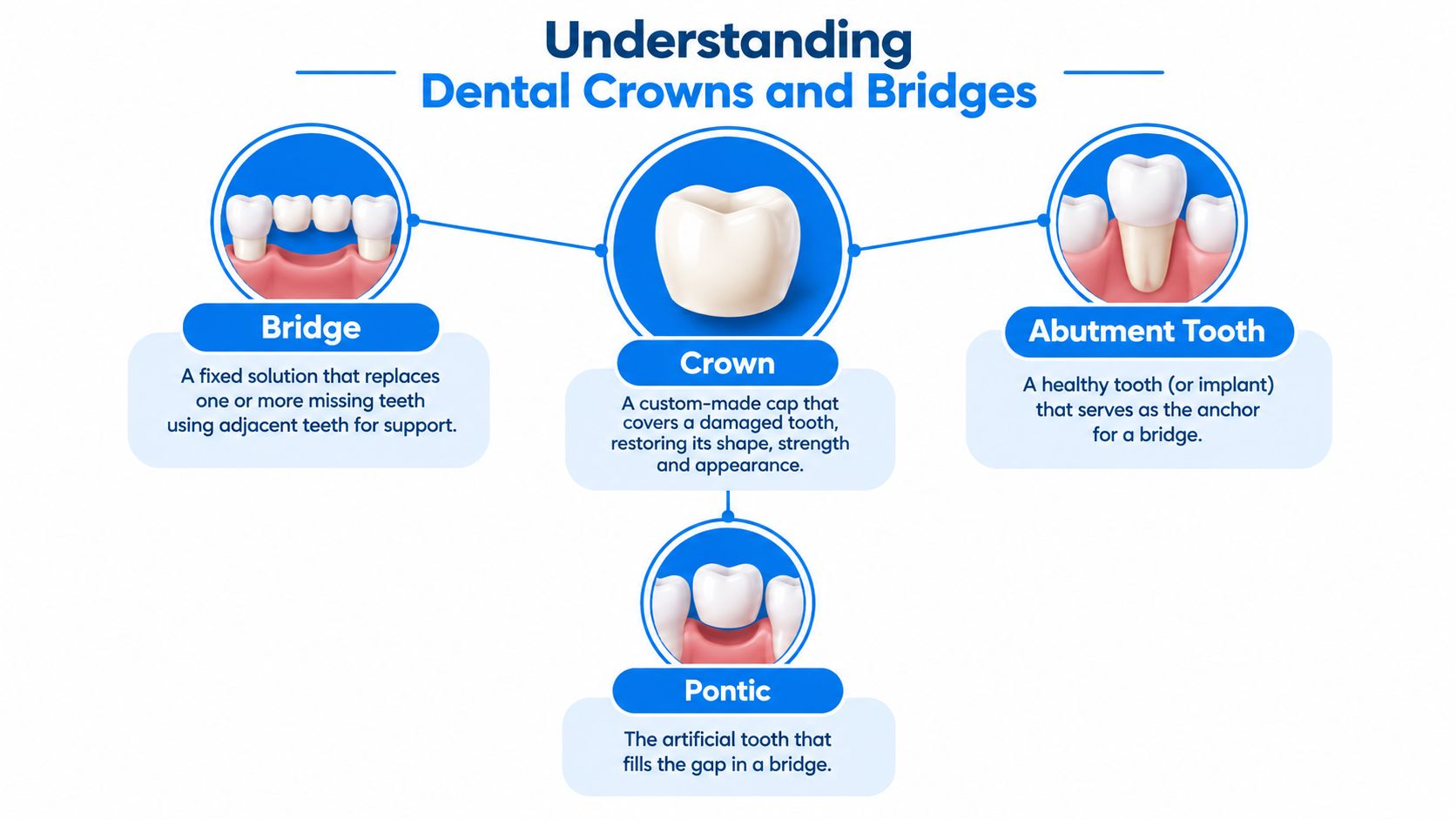
A dental crown is a custom-made covering that fits over a prepared tooth. It functions much like a protective helmet. The crown restores the tooth's shape, shields weakened structure, and helps the tooth meet its opposing partner during chewing. Crowns may be considered when a tooth has a large filling, extensive decay, a fracture that remains restorable, or damage after root canal treatment.
A dental bridge replaces one or more missing teeth by spanning the empty space. The artificial replacement teeth are called pontics, and the crowns supporting them are attached to neighboring abutment teeth. The completed bridge is cemented in place, so the patient doesn't remove it during ordinary daily use. This fixed design can restore chewing and help prevent nearby teeth from drifting into the gap. Cleveland Clinic's explanation of dental bridges provides a patient-friendly description of pontics, abutments, and fixed placement.
When a crown makes sense
The dentist first determines whether enough healthy tooth remains to support a crown. A filling may be sufficient for a smaller defect, while a crown may offer better coverage when the remaining walls are thin or heavily restored. A front tooth may need a restoration designed around translucency and shade, whereas a back tooth usually requires close attention to chewing loads and contact with the opposing teeth.
A crown doesn't replace the need for daily care. The margin where the crown meets the tooth still needs brushing, flossing, and professional monitoring. Decay can develop at that junction, and gum inflammation can affect comfort and appearance.
When a bridge makes sense
A bridge can be considered when a missing tooth is bordered by teeth that can provide reliable support. The dentist evaluates the abutments, the length of the gap, the patient's bite, and the ability to clean beneath the pontic. A short, well-supported bridge may be practical, while a longer design can place substantially greater demands on its supports.
The decision also includes alternatives. A bridge may avoid surgery and can often restore a gap without waiting for implant integration. An implant, however, may preserve the neighboring teeth from bridge preparation. The appropriate choice depends on anatomy, health, timing, cost considerations, and long-term maintenance preferences.
Material Choices and Biomechanical Design
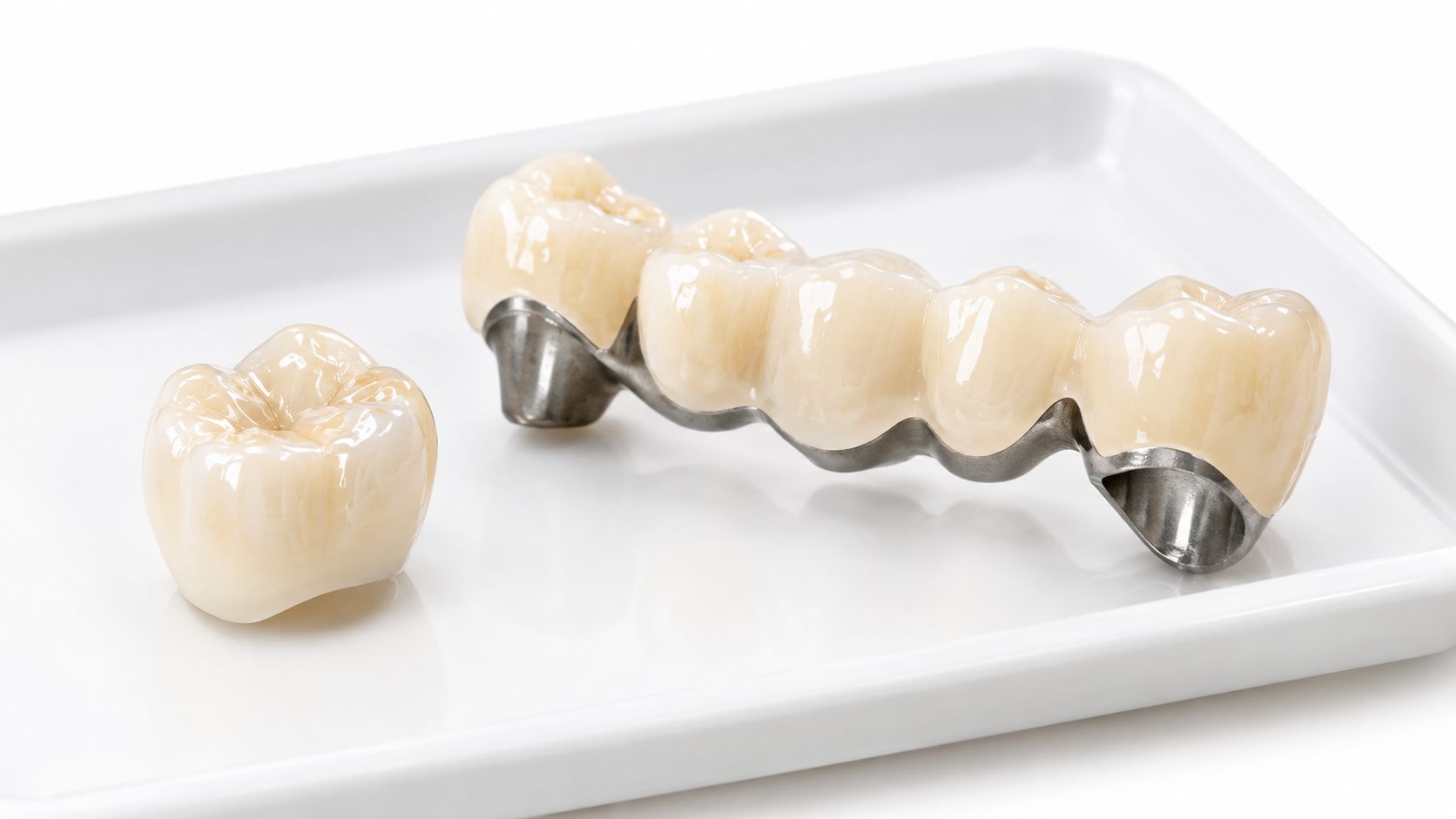
Material selection isn't a cosmetic afterthought. It affects how a crown or bridge responds to chewing, how it looks under different lighting, how much tooth preparation is needed, and how it behaves against opposing teeth. Modern restorative planning may include tooth-colored, mercury-free materials such as porcelain and monolithic zirconia, but the most suitable option depends on location and loading.
A front restoration may prioritize lifelike light transmission and shade blending. A back-tooth restoration may place greater emphasis on fracture resistance and the patient's bite. Bruxism, clenching, a heavy chewing pattern, or an opposing restoration can change the risk profile. Patients can review the available choices in this guide to dental crown materials.
Span length changes the load
Bridge design is a mechanical problem as well as a tooth-replacement problem. Longer bridges flex more, increasing stress on abutment teeth. A prosthodontic biomechanics source describes bridge stress as varying with the cube of span length, which explains why a modest increase in distance can create a much larger design challenge. The prosthodontic lecture on bridge biomechanics illustrates why support planning becomes more important as a bridge gets longer.
This is why a dentist may recommend changing the design, strengthening the support, considering an implant, or choosing a different treatment entirely. A cantilever arrangement, in which the replacement tooth is supported from one side, requires especially careful evaluation because the loading isn't distributed like it is in a conventional bridge.
Material and design must work together
A strong material can't compensate for an unsuitable span, unstable abutment, or untreated grinding. Research on long-term outcomes found that bridge survival differed according to tooth vitality and design. At 15 years, three-unit bridge survival was 83% for vital teeth and 76% for non-vital teeth, while all bridges combined showed 84% versus 64% survival for vital and non-vital teeth, respectively. Cantilever bridges showed lower survival, 74% at 16 years for vital teeth versus 52% at 18 years for non-vital teeth. The long-term study published through Europe PMC supports cautious planning for endodontically treated abutments, larger bridges, and cantilever designs.
A practical plan therefore asks several questions:
- Are the abutment teeth structurally sound?
- Is the span short enough for predictable support?
- Does the patient clench or grind?
- Will the material suit the tooth position and appearance goals?
- Can the patient clean around and beneath the restoration?
Comparing Bridges to Dental Implants and Alternatives
Patients searching for dental implants near me often want a direct answer about whether an implant is better than a bridge. The honest answer depends on the condition of the neighboring teeth, bone availability, gum health, medical factors, treatment preferences, and bite. A bridge uses adjacent teeth for support, while an implant replaces the root portion independently and supports a crown.
A bridge can be useful when treatment needs to avoid surgery, when neighboring teeth already require crowns, or when the patient prefers a non-surgical fixed restoration. An implant may be attractive when adjacent teeth are healthy and preserving them from preparation is a priority. It also requires an assessment of bone and soft tissue, along with a treatment sequence that may take longer than a conventional bridge.
Restorative options comparison
| Feature | Dental Bridge | Dental Implant |
|---|---|---|
| Support | Uses neighboring abutment teeth | Uses an implant placed in the jaw |
| Effect on adjacent teeth | Supporting teeth generally require preparation | Neighboring teeth can remain separate from the restoration |
| Surgery | Doesn't require implant surgery | Requires surgical placement and healing |
| Treatment planning | Focuses on abutment strength, span, bite, and cleanability | Includes bone, gum, implant position, bite, and restoration planning |
| Maintenance | Requires careful cleaning around abutments and beneath the pontic | Requires professional monitoring and diligent home care |
| Best fit | A patient with suitable support who wants a fixed replacement without implant surgery | A patient with appropriate anatomy who values independent tooth replacement |
A single implant isn't the only implant-based option. Patients missing many teeth may be evaluated for a full-arch solution, including an All-on-Four approach when clinically appropriate. Patients with a restorable natural tooth may also need to compare a crown with root canal treatment against extraction followed by replacement.
The decision is anatomical, not promotional
An implant shouldn't be recommended just because it sounds more advanced. A bridge shouldn't be selected just because it can be completed without surgery. The treatment should account for the condition of each tooth, the gum tissues, cleaning access, occlusion, and the patient's ability to complete and maintain care.
The comparison in dental implants versus bridges can help patients prepare for a focused conversation. A Scottsdale consultation can then translate those general differences into a plan based on the actual gap, supporting teeth, bone, bite, and aesthetic expectations.
The Treatment Process and Digital Workflows
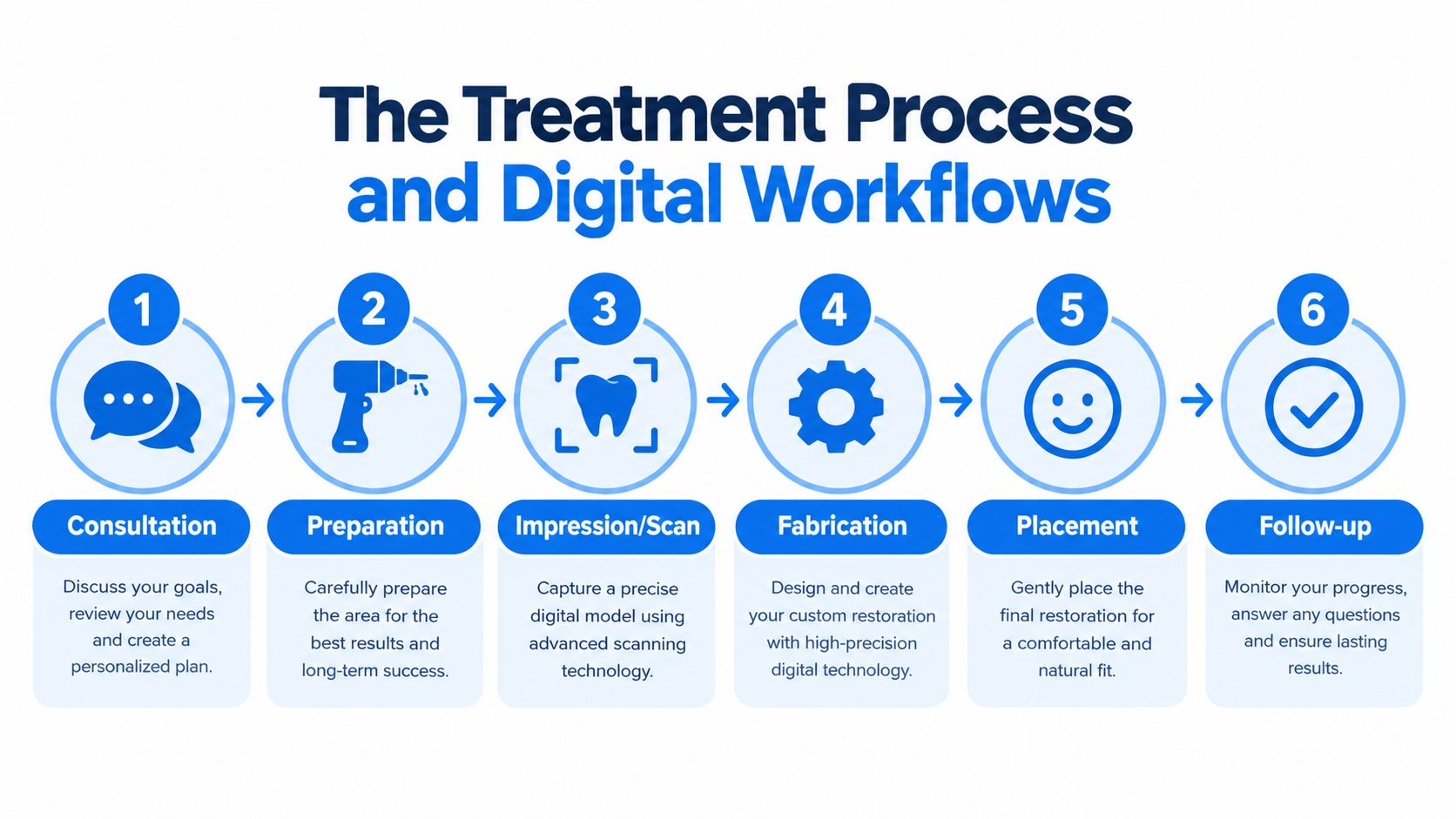
Crown and bridge treatment begins with diagnosis, not preparation. The dentist examines the tooth or gap, reviews dental x-rays when needed, assesses gum health, and discusses alternatives. If the tooth is painful, cracked, or infected, those concerns must be addressed before the final restoration is planned.
Preparation and records
After local anesthetic, the dentist removes only the tooth structure needed to create space for the selected material and design. Preparation is material-specific. One published guideline describes about 0.5 mm chamfer reduction for some crown margins and 1 mm to 1.5 mm reduction along three planes. Another prosthodontic source describes about 1 mm facial reduction for porcelain, 0.5 mm for metal, and a 1.5 mm shoulder for porcelain-and-metal restorations. The published preparation guideline demonstrates why the planned material affects the preparation.
The practice then records the prepared teeth and surrounding tissues. Traditional impressions remain useful in many cases, especially when laboratory technicians need detailed records for a complex restoration. Intraoral scanning can offer a comfortable digital alternative and can help the team inspect the captured preparation before sending the information for fabrication.
Traditional and same-day workflows
A conventional laboratory workflow gives the dental team time to coordinate shade, contours, contacts, pontic form, and bridge design. That can be particularly valuable for longer spans, challenging bite relationships, multiple restorations, or cases with demanding aesthetic requirements.
Digital workflows may shorten the number of visits in appropriate cases. Recent market reporting projects the crowns-and-bridges market to grow from USD 4.22 billion in 2025 to USD 6.75 billion by 2031, and industry reporting describes 2026 FDA-cleared 3D-printed porcelain crowns and new chairside print-to-cure systems. The market overview provides that projection and context. Academic reviews also discuss scanner performance and the developing clinical, economic, and environmental questions around additive manufacturing.
Speed doesn't automatically mean better longevity or value. A same-day crown may be reasonable for a well-defined single-tooth case, while a complex bridge may benefit from a traditional laboratory process. Patients should ask which workflow is proposed, why it suits the case, and how the restoration will be checked before final cementation.
Long-Term Maintenance and Bite Protection
A crown or bridge sits in a living environment. Saliva, bacteria, gum tissues, chewing forces, and daily habits all affect its performance. The supporting teeth and gums deserve as much attention as the visible porcelain or zirconia.
A meta-analysis found that fewer than 15% of fixed partial dentures were removed or needed replacement at 10 years, while nearly one third were removed or needed replacement at 15 years. It also found that less than 5% of abutment teeth were removed at 10 years. The PubMed meta-analysis shows why long-term care must focus on both the bridge and the teeth holding it.
Daily care protects the foundation
Patients should brush carefully along crown margins, clean between teeth, and use an appropriate method to reach beneath a bridge pontic. Professional hygiene visits help identify plaque retention, gum bleeding, decay, loose margins, and changes in the supporting teeth. Periodontal evaluation becomes especially important when a patient has a history of gum disease or difficulty cleaning around fixed work.
A restoration doesn't make the tooth underneath immune to decay. It also doesn't prevent gum disease. Regular exams and dental x-rays, when clinically indicated, allow the dental team to monitor areas that aren't visible during home care.
Grinding needs an active plan
Clenching and grinding can overload crowns, bridges, natural teeth, and jaw muscles. A TMJ assessment can help identify bite discomfort, muscle tenderness, uneven contacts, or signs of excessive wear. When appropriate, a custom occlusal guard can reduce direct contact and help protect the restoration during sleep.
Patients who notice morning jaw soreness, headaches, chipped dental work, or flattened tooth surfaces may benefit from discussing bruxism rather than waiting for a restoration to fail. For a broader explanation of the relationship between bruxism and receding gums, patients can review this periodontal resource before bringing questions to a consultation.
Long-term care matters: A restoration is an investment in a tooth system. Cleaning, gum stability, bite management, and timely repairs all influence how comfortably that system functions.
Scheduling Your Restorative Consultation
A restorative consultation at the Scottsdale office begins with a conversation about the immediate concern. Patients can describe pain, sensitivity, a broken tooth, a missing tooth, difficulty chewing, cosmetic changes, or worries about an older crown or bridge. The office can also discuss insurance and billing questions, financing options, and what to expect as a new patient.
The first visit may include a thorough examination, necessary dental x-rays, an evaluation of the gums and bite, and a review of treatment alternatives. The purpose isn't to push one restoration. It is to establish whether the tooth can be saved, whether a bridge is supported adequately, whether an implant evaluation is appropriate, or whether a different service, such as tooth extraction or periodontal treatment, should come first.
What patients can bring to the appointment
A useful consultation includes practical details that help the dentist understand the full situation:
- Symptoms: Note pain, temperature sensitivity, swelling, changes in chewing, or discomfort when biting.
- Treatment history: Share information about root canals, previous crowns, bridges, fillings, tooth extraction, or dental implants.
- Bite concerns: Mention grinding, clenching, jaw clicking, headaches, or a previous occlusal guard.
- Personal priorities: Explain whether appearance, treatment time, avoiding surgery, preserving neighboring teeth, or maintenance access matters most.
Patients aren't expected to know whether a crown, bridge, implant, or All-on-Four solution is appropriate before arriving. The clinical examination supplies the information needed to make that decision responsibly. The office is located at 9755 North 90th Street, Suite B250, Scottsdale, AZ 85258, with phone support at (480) 657-6981, consistent Monday through Thursday hours, and Friday appointments available by arrangement.
Eric Wiitala DDS provides preventive, restorative, cosmetic, implant, periodontal, TMJ, and sleep-related dental services in Scottsdale. Adults seeking a dentist near me, a cosmetic dentist near me, an emergency dentist, or an evaluation for dental crowns and bridges can start with a focused conversation about comfort, function, appearance, and long-term oral health.
Eric Wiitala DDS offers crown and bridge evaluations, restorative care, dental implants, bite protection, and complete dental examinations for patients in Scottsdale. Visit Eric Wiitala DDS to request a consultation and discuss the restoration that best fits the tooth, bite, surrounding tissues, and long-term goals.