
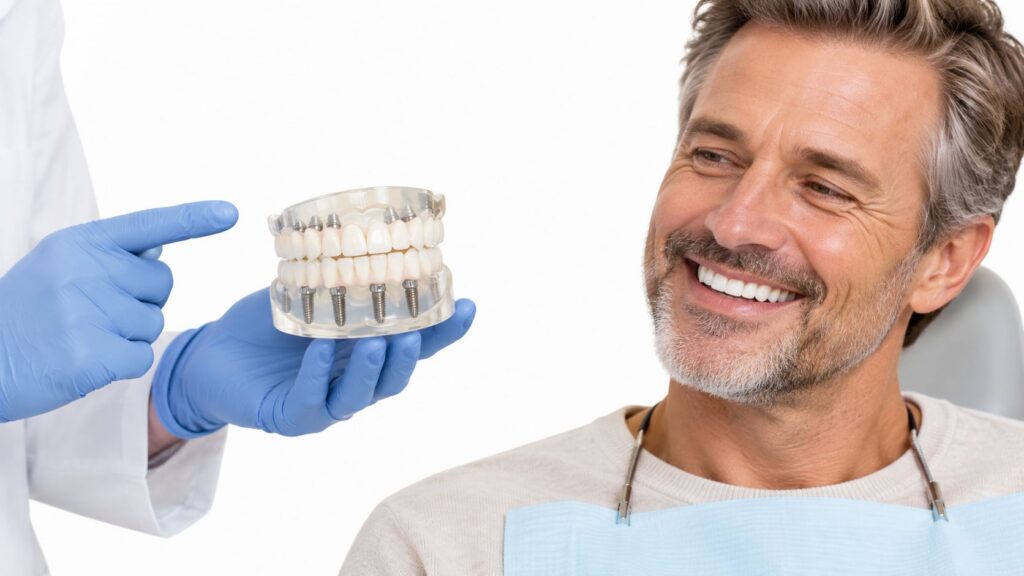
Four implants can support a complete arch of replacement teeth in selected patients, creating either a fixed restoration or a secure removable option. Long-term studies report implant survival above 90% for many full-arch cases, but the prosthesis still needs professional maintenance, repairs, and careful daily cleaning.
A person searching for dental implants full mouth treatment may be dealing with loose dentures, painful chewing, failing teeth, or embarrassment when smiling in Scottsdale. Marketing often makes “teeth in a day” sound like the entire treatment. In reality, a same-day temporary smile may be possible for carefully selected patients, while healing, design, hygiene, and long-term servicing determine whether the result remains comfortable and functional.
For adults comparing dental implants near me, All-on-Four treatment, fixed bridges, and implant-retained dentures, the right choice depends on bone anatomy, gum health, bite forces, dexterity, appearance goals, and willingness to attend maintenance visits. Dr. Eric Wiitala provides broad restorative, cosmetic, preventive, and implant-focused care at 9755 North 90th Street in Scottsdale, helping patients understand those trade-offs before choosing a path.
Table of Contents
- Finding the Right Full Mouth Dental Implant Care in Scottsdale
- What You Need to Know About Dental Implants
- Comparing Your Full Arch Restoration Options
- What to Expect During Your Treatment Journey
- Success Rates, Risks, and Long-Term Maintenance
- Understanding the Cost of Full Mouth Implants
- Restore Your Smile with Dr. Eric Wiitala
Finding the Right Full Mouth Dental Implant Care in Scottsdale
Missing teeth affect more than appearance. Patients with unstable dentures may avoid certain foods, speak less freely, or worry that their teeth will move during an important conversation. A failing arch can also make routine activities, such as eating with family or smiling for photographs, feel stressful.
A consultation with a local dentist should begin with listening. Dr. Eric Wiitala has more than 20 years in practice and provides restorative and cosmetic dentistry in Scottsdale. His office evaluates the condition of the teeth, gums, jawbone, bite, medical history, and personal goals before recommending a full-arch restoration.

Start with a complete evaluation
The first visit may include a new patient exam, dental X-rays, periodontal evaluation, and a conversation about previous dentures, tooth loss, jaw discomfort, or difficulty cleaning. These details matter because a fixed bridge isn't automatically the most suitable restoration for every mouth.
Patients should ask the dental team to explain:
- The proposed design: Whether the restoration will be fixed or removable by the patient.
- The surgical sequence: Whether tooth extraction, gum treatment, or bone preparation is needed.
- The temporary teeth: What can be worn during healing and what limitations apply.
- The maintenance plan: How the underside of the prosthesis will be cleaned and serviced.
A community-based practice can also coordinate related care, including tooth extraction, periodontal therapy, crowns, bridges, cosmetic dentistry, and bite protection. That continuity helps patients avoid treating implant surgery as an isolated event.
The practice's patient education approach is designed to make complex decisions easier to understand. Scottsdale patients who are also comparing a cosmetic dentist near me, an emergency dentist, or a general dental office can begin with the same principle: the provider should explain what the mouth needs now, what treatment can wait, and how each choice affects future care.
A short educational video can help patients visualize the consultation and planning process:
What You Need to Know About Dental Implants
If missing teeth make eating, speaking, or smiling difficult, dental implants may offer a stable foundation for a new restoration. An implant is a small titanium post placed in the jawbone to replace the root portion of a missing tooth. During healing, bone can attach to the implant through osseointegration. A crown, bridge, or full-arch prosthesis is then connected to that foundation.
A traditional denture rests on the gums, like a structure sitting on a surface. An implant reaches into the jaw like a root anchored below ground. This anchorage can improve stability and provide stimulation to nearby bone, but it does not protect the restoration from wear, infection, or maintenance needs.

Why the evaluation matters
Tooth loss alone does not determine candidacy. The dental team assesses available bone, gum health, active infection, bite forces, general health, smoking exposure, and the patient's ability to clean around the planned restoration. Some patients may need bone grafting or other preparation. For others, a different design may provide a safer and more maintainable result.
Full-arch treatment has progressed from conventional multi-implant reconstruction to designs that can support a fixed complete-arch prosthesis with as few as four implants in selected patients. The All-on-4 concept was introduced clinically for mandibular cases in 2003 and maxillary cases in 2005, milestones in modern full-arch dentistry. These dates describe the development of an approach, not a promise of “teeth in a day.” Healing, provisional teeth, final prosthesis design, and follow-up still shape the treatment process.
An implant does not replace every missing root. Strategically positioned implants support the arch, which may reduce surgical sites compared with replacing each tooth individually. The prosthesis must still account for hygiene access, chewing forces, speech, appearance, and future repairs.
Patients exploring bone health may also see nutrition discussions. A general educational resource about finding the best vitamin K2 form can offer background, but supplements cannot replace an examination, diagnostic imaging, or a treatment plan based on clinical findings.
Comparing Your Full Arch Restoration Options
Full-arch care has no universal winner. A fixed bridge may provide the psychological feeling of permanent teeth, while a removable overdenture may offer easier access for cleaning. The most appropriate option depends on the patient's anatomy, dexterity, aesthetic expectations, budget, and comfort with professional maintenance.
| Option | Number of Implants | Permanence | Best For |
|---|---|---|---|
| All-on-Four fixed restoration | As few as four in selected patients | Fixed for patient removal | Patients seeking a fixed full-arch bridge when anatomy and load control are favorable |
| Fixed full-arch bridge | Commonly four or six, selected from anatomy and prosthetic needs | Fixed for patient removal | Patients who need stable arch support and can maintain professional and home care |
| Implant-retained overdenture | Varies by treatment design | Removable by the patient | Patients who value cleaning access, simpler servicing, or the ability to remove the prosthesis |
Fixed options and their responsibilities
All-on-Four uses four strategically placed implants to support a full-arch bridge when the jawbone, implant positions, and cantilever are favorable. A higher implant count may improve load distribution or provide redundancy in selected cases, but more implants don't automatically make a treatment better.
A systematic review summarized in a peer-reviewed clinical report found no statistically significant survival difference between four- and six-implant configurations for completely edentulous arches. Mean implant survival was approximately 96%, and restoration survival was approximately 99%, across follow-up periods from 1 to 15 years, with a median follow-up of 8 years. The clinical report on four- and six-implant configurations also makes clear that survival doesn't mean freedom from screw loosening, acrylic fracture, hygiene difficulty, inflammation, or overload.
Removable doesn't mean inferior
An implant-retained overdenture can snap onto implants while remaining removable for cleaning and servicing. Patients with arthritis, reduced vision, dry mouth, a strong gag reflex, or a history of periodontal disease may value that access. Others may prefer the feeling and appearance of a fixed bridge.
A systematic review of 13 studies found no significant overall difference in patient-reported outcomes between implant-supported fixed complete dentures and implant overdentures, with inconsistent results for chewing, speech, aesthetics, and satisfaction. The review of patient-reported outcomes supports a practical conclusion: the most expensive or permanently fixed option isn't automatically the best daily-life solution.
Patients interested in broader discussions about biological dentistry can explore Peak Performance on biological dentistry, while keeping the final decision grounded in an individualized dental examination.
What to Expect During Your Treatment Journey
Full-mouth implant treatment usually unfolds in stages. A temporary bridge may be attached promptly in selected cases, but that doesn't mean the final treatment is complete. The implants still need to heal, the bite must be monitored, and the definitive prosthesis must be designed for comfort and cleaning.
The planning appointment
The dental team reviews remaining teeth, gum tissues, jawbone, facial proportions, bite, and medical history. Three-dimensional imaging can help map implant positions and identify areas requiring extraction or bone preparation.
Patients should expect questions about:
- Current symptoms: Pain, mobility, bleeding, food trapping, or denture movement.
- Daily function: Foods avoided, speech concerns, gagging, and cleaning ability.
- Health factors: Smoking, diabetes, previous gum disease, medications, and grinding.
- Personal priorities: Fixed teeth, removable access, appearance, timing, and repair preferences.
If several teeth are failing, tooth extraction may be coordinated with implant planning. The dental team explains whether a temporary restoration is possible and which foods or activities should be avoided during early healing.
Surgery and healing
During surgery, implants are placed according to the restorative plan. Some patients receive a temporary prosthesis soon after placement, while others need a different sequence based on stability, infection, bone quality, or overall risk.
The healing phase allows osseointegration to develop. Patients may experience swelling, tenderness, and temporary changes in chewing or speech. Follow-up visits help the team monitor the tissues, implant stability, bite, and cleanliness before moving to the final restoration.
The final prosthesis
The permanent teeth are fabricated after the clinical team has enough information about healing, bite position, speech, facial support, and aesthetics. A well-designed restoration should be stable, retrievable by the dental team, and shaped so patients can clean beneath it.
Patients can review the practice's dental implant treatment timeline when preparing questions about appointments and healing. Treatment length varies, particularly when extraction, grafting, infection control, or staged healing is needed.

Practical rule: “Teeth in a day” may describe the delivery of temporary teeth, not the end of healing, maintenance, or prosthetic care.
Success Rates, Risks, and Long-Term Maintenance
A stable implant does not automatically mean a trouble-free set of teeth. Implant survival measures whether the fixture remains integrated with bone. Prosthetic success concerns the attached bridge or denture, which may still need adjustment, repair, component replacement, or eventual renewal.
A long-term study included 561 patients, 2,364 implants, and follow-up periods ranging from 3 to 17 years. For maxillary rehabilitation, cumulative implant survival was 94.4% at the patient level and 97.4% at the implant level. Mandibular outcomes were 96.7% at the patient level and 98.9% at the implant level. The long-term full-arch study review shows why published results describe groups of patients, not a guarantee for one person.
A separate systematic review identified 13 eligible studies from 487 screened papers, involving 4,804 implants. It reported that 74% of implant failures occurred during the first 12 months. The included evidence also recorded 1,201 fixed prostheses delivered within 48 hours. At approximately 36 months, mean cumulative implant survival was 99.0%, while prosthetic survival was 99.9%. Fracture of all-acrylic prostheses was the major reported prosthetic complication. The systematic review of the All-on-4 concept supports careful early follow-up and ongoing prosthetic servicing.
What maintenance includes
Full-arch care involves more than a quick visual check. The dental team may assess peri-implant tissues, bleeding, plaque, the bite, prosthetic fit, and access beneath the restoration. These checks help identify problems while they are easier to address.
Patients can support the result by:
- Cleaning daily: Use a soft brush and implant-specific interdental tools recommended by the dental team.
- Watching for changes: Report bleeding, swelling, persistent discomfort, looseness, odor, or an altered bite.
- Protecting the prosthesis: Discuss grinding, hard foods, and an occlusal guard when appropriate.
- Keeping recalls: Attend individualized hygiene, periodontal, radiographic, and prosthetic reviews.
A systematic review of maxillary implant-assisted full-arch restorations reported pooled implant loss of 5.5%, mean marginal bone loss below 0.8 millimeters, complication-free prosthesis survival of 61.9%, and technical complications in 62.9% of cases. The review of maxillary full-arch restorations illustrates the practical distinction: implants may remain functional while the prosthesis still requires maintenance.
Patients can review how long dental implants last, but a personal prognosis requires examination, imaging, risk assessment, and a plan for continuing care..calc
Understanding the Cost of Full Mouth Implants
The cost of full-mouth implants can't be determined responsibly from the phrase “dental implants near me” alone. The treatment is a combination of surgery, restorative design, laboratory fabrication, temporary teeth, final teeth, professional maintenance, and possible preparatory care.
The main cost factors include:
- Implant planning: The number and position of implants required by bone anatomy, bite forces, and prosthetic distribution.
- Preparatory treatment: Extractions, gum therapy, infection control, or bone grafting when clinically necessary.
- Restoration type: A fixed bridge and a removable overdenture have different laboratory, attachment, repair, and maintenance needs.
- Material selection: The final prosthesis may use different materials based on appearance, strength, repairability, and the treatment plan.
- Long-term servicing: Patients should ask about hygiene visits, adjustments, replacement components, and future prosthetic repairs.
Insurance may contribute to some portions of treatment, but benefits vary by plan and may not cover the complete implant process. The office can review available benefits, billing arrangements, and financing options during the consultation.
A written estimate should separate surgical, restorative, laboratory, imaging, temporary, and maintenance fees. Patients should also ask what happens if a temporary tooth breaks, a screw loosens, an attachment wears, or the final prosthesis requires repair. That discussion gives the financial plan more meaning than a single headline price.
Fixed treatment may carry a higher maintenance burden in some cases because the patient can't remove it for cleaning. Removable designs may offer simpler home access, while still requiring professional adjustments and replacement of worn components. A clear treatment plan should connect the initial investment with expected care over time.
Restore Your Smile with Dr. Eric Wiitala
Full-mouth dental implants can help restore chewing, speech, facial support, and confidence after extensive tooth loss. The result isn't defined only by the day a temporary bridge is attached. It depends on careful diagnosis, stable implant placement, thoughtful prosthetic design, healing, hygiene access, and regular professional care.
Dr. Eric Wiitala provides preventive, restorative, cosmetic, periodontal, implant, and bite-related services in Scottsdale. The office can also address tooth extraction, crowns, bridges, teeth whitening, veneers, custom occlusal guards, and new patient care, allowing the treatment plan to respond to the whole mouth rather than one isolated problem.
Patients who are comparing fixed full-arch treatment with an implant-retained denture deserve a direct conversation about daily cleaning, appearance, comfort, repairability, and long-term appointments. A consultation can also clarify whether All-on-Four, another fixed design, a removable option, or a different restorative approach fits the patient's anatomy and goals.
The Scottsdale office is located at 9755 North 90th Street, Suite B250, Scottsdale, AZ 85258, with appointments available for patients seeking a trusted local dentist, cosmetic dentist, restorative care, or dental implants.
Eric Wiitala DDS offers thorough evaluations for full-mouth dental implants, All-on-Four treatment, tooth replacement, and related restorative care in Scottsdale. Patients can visit Eric Wiitala DDS to request a consultation and discuss the safest, most practical path toward a stable and maintainable smile.