

If chewing dinner has become a quiet negotiation, the choice between dental implants vs dentures is probably already affecting more than teeth. It changes how easily someone orders at a Scottsdale restaurant, how confidently they speak at brunch, and whether a simple meal feels like a hassle or a pleasure.
The right answer isn't driven by hype. It comes down to what works over the next 5 to 10 years, not just what looks cheaper today.
| Option | What it feels like day to day | Main strength | Main trade-off |
|---|---|---|---|
| Single Implants / All-on-Four | Fixed, stable, closer to natural teeth | Better function and confidence | Higher upfront treatment burden |
| Conventional Dentures | Removable and lower-cost | Easier starting point | More maintenance and less stability |
A Scottsdale patient who hikes, dines out, and wants to stop thinking about loose teeth needs a different plan than someone who mainly wants an affordable way to restore appearance. Dr. Wiitala helps sort through those trade-offs with a practical focus on comfort, function, and long-term value, not marketing language. For anyone starting the search for a dentist near me or looking into dental implants near me, the first step is understanding what each option really does in everyday life. How to fix missing teeth
Table of Contents
- Replacing Missing Teeth in Scottsdale
- What Dental Implants and Dentures Actually Are
- Comfort Chewing and Daily Function Compared
- Cost Considerations and Long-Term Value
- Candidacy Timeline and Treatment Process
- Which Option Fits Your Situation Best
- Side-by-Side Comparison at a Glance
- Common Questions From Scottsdale Patients
Replacing Missing Teeth in Scottsdale
A retired hiker comes back from the McDowell Sonoran Preserve, sits down for lunch, and spends the whole meal managing lower dentures that don't want to stay put. At the next table, a neighbor with implant-supported teeth orders steak without a second thought. That difference is why this decision feels bigger than a dental procedure.
For patients in Scottsdale, missing teeth affect more than appearance. They affect what gets ordered at Old Town dinners, how a gym class feels when breathing is already a little harder, and whether Sunday brunch with grandkids feels easy or awkward. A good dentist in Scottsdale, AZ should talk about those real-world trade-offs, not just the parts and the price.
Practical rule: if the main goal is to stop thinking about teeth during the day, the conversation should lean hard toward implant-based options.
Dr. Wiitala's role is to help patients separate fact from sales talk. That means looking at the shape of the mouth, the condition of the gums, the available bone, and the kind of daily life someone wants. It also means being honest when a removable option still makes sense.
The comparison here is straightforward. Dental implants, All-on-Four, and removable dentures all replace missing teeth, but they don't create the same daily experience. Some choices are better for stability, some for cost, and some for speed. The right answer depends on whether the priority is comfort at dinner, easier cleaning, or a lower starting investment.
For patients also considering tooth extraction, restorative care, or a cosmetic dentist near me for a fuller smile change, the tooth replacement plan should fit the bigger picture, not just one missing tooth.
What Dental Implants and Dentures Actually Are
Single implants and implant-supported options
A single dental implant is a titanium post placed in the jawbone and topped with a custom crown. After healing, it functions as an artificial tooth root and gives the replacement tooth a fixed foundation. If several teeth are missing in a row, an implant-supported bridge uses two or more implants to hold multiple replacement teeth.
All-on-Four replaces a full arch with a fixed prosthesis supported by four implants. Many patients receive temporary teeth the same day, making this a practical full-mouth rehabilitation option for people who want a fixed restoration instead of a removable one. The trade-off is a more involved treatment plan and long-term maintenance around the implants and prosthesis.
Removable dentures and hybrid designs
A conventional denture is a gum-colored appliance that rests on the soft tissues. Suction or adhesive helps hold it in place, and the appliance comes out for cleaning. As the mouth changes, periodic adjustments or replacement may be needed.
An implant-retained overdenture sits between a conventional denture and fixed implant teeth. It attaches to two to four implants for added stability, but you still remove it for cleaning. Research supports improved stability with implant-supported removable prostheses, while also showing that the prosthetic system requires maintenance over time implant overdenture evidence.
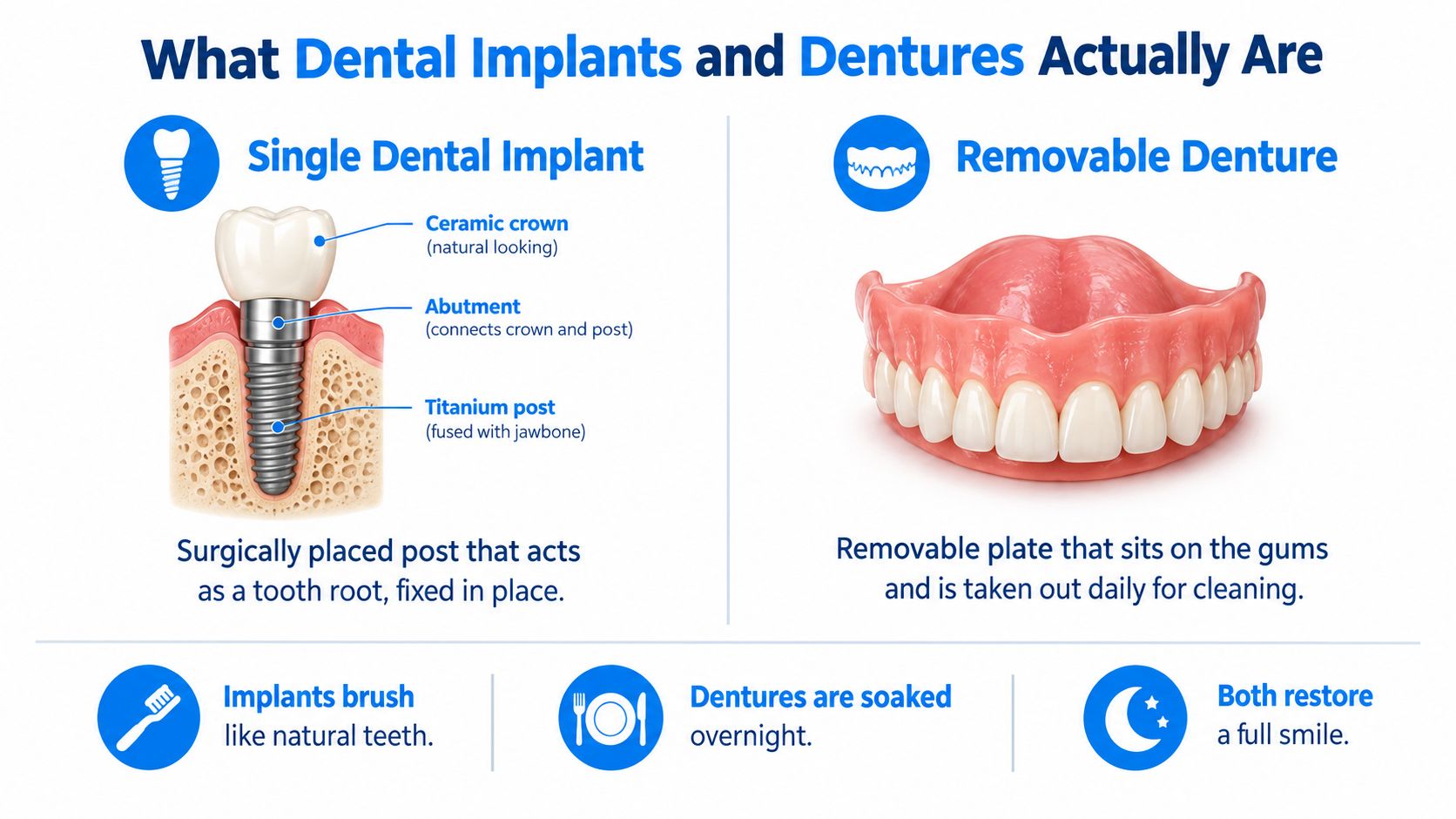
Fixed teeth change more than the smile. They change the daily routine, including brushing, eating, and speaking, because the prosthesis stays attached.
The distinction is structural. Implants and implant-retained options attach to implants placed in bone. Dentures rest on tissue and remain removable. Choose by looking beyond the starting price. Over a five to ten year period, compare daily stability, cleaning, adjustments, repairs, and the maintenance each design will require. That total burden matters more than how the options look on the day they are placed.
Comfort Chewing and Daily Function Compared
Stability is the real dividing line
Implants win on comfort because they don't rock, rub, or shift the way many dentures do. That matters when someone is talking, chewing, or just going through a normal day without wanting to think about their mouth. Conventional dentures can feel fine at first, but pressure points and sore spots tend to show up once fit changes or the gums become irritated.
Chewing is where the difference becomes obvious. Implant-supported overdentures and fixed implant options perform better than conventional dentures on function and satisfaction, and the evidence also supports stronger oral-function scores for implant-supported overdentures versus complete dentures oral function evidence. A separate review also notes that implant-retained or supported prostheses produce greater biting force and masticatory efficiency than conventional dentures bite force evidence.
What that means at the table
The practical effect shows up with tougher foods and longer meals. Steak, corn on the cob, crusty bread, and other difficult textures are much easier to handle with fixed or implant-retained teeth. Dentures can work, but they usually ask the patient to adapt the menu instead of the appliance adapting to the meal.
Bottom line: if the goal is to eat like a person with teeth, not like a person managing a removable device, implants are the stronger choice.
Bone health matters too. Complete dentures don't preserve jawbone, and bone loss continues after extractions. A Canadian Dental Association review notes that most alveolar bone loss happens in the first year after extractions and continues throughout life, while a long-term study found bone loss in edentulous individuals was four times greater in the mandible than in the maxilla jawbone loss review. That's why fixed or implant-retained options often age better in the mouth than removable dentures.
Cost Considerations and Long-Term Value
The sticker price is only part of the story
Dentures usually look cheaper at the start, and that matters to a lot of patients. But the key comparison is the burden over time. A denture can need relining, rebasing, repair, adhesive, and eventual replacement as the mouth changes shape.
Implants ask for more upfront treatment, but they often reduce the amount of day-to-day maintenance that follows. A major evidence-based comparison shows that implant survival is strong when osseointegration succeeds, while dentures can survive for years but often follow a different maintenance pattern as oral tissues change survival comparison. In plain terms, the question isn't just what costs less this month. It's what costs less once the repair cycle starts.
Thinking in years instead of quotes
That is why the better question is, “What will this choice cost across the next decade, including repairs, relines, and the chance of needing to change plans later?” Recent reviews of full-arch implant-supported prostheses describe stable outcomes over several years with manageable technical complications, which is a more realistic frame than pretending fixed teeth are maintenance-free full-arch review.
| Option | Initial Cost Range | Annual Maintenance | Replacement Cycle | 10-Year Total Estimate |
|---|---|---|---|---|
| Single implants | Higher upfront | Low to moderate | Long-term restoration planning | Often more predictable over time |
| Implant-supported bridge | Higher upfront | Low to moderate | Restoration work may be needed later | Usually better long-term value than repeated denture work |
| All-on-Four | Highest upfront | Ongoing hygiene and periodic repairs | Long-term prosthetic maintenance | Best viewed as a fixed full-arch investment |
| Conventional dentures | Lower upfront | Moderate to high | Relines and replacement over time | Can narrow the price gap as maintenance adds up |
Financing and insurance can change the math, but they don't change the structure of the decision. A patient should ask what the mouth will need in year 1, year 5, and year 10, not just what the first invoice says.
Candidacy Timeline and Treatment Process
Who fits each path
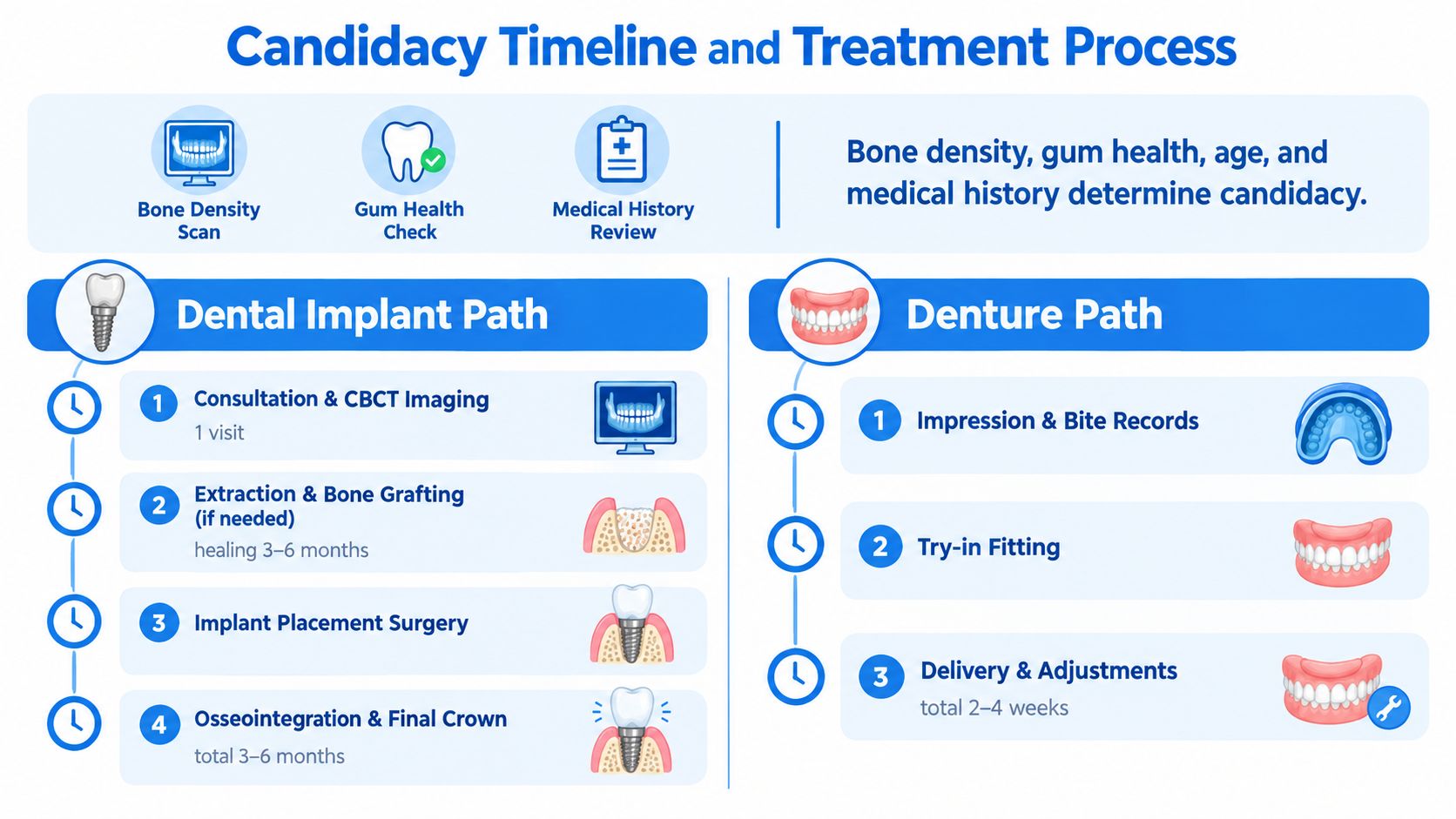
Bone density, gum health, age, and medical history determine whether implants are appropriate now or later. A patient may qualify immediately, while another may need extraction healing, bone grafting, periodontal treatment, or a removable option before implant treatment can begin. Those decisions affect the total burden over the next several years, not just the first appointment.
Implant treatment usually begins with an examination and imaging. The plan may then include extraction, grafting, implant placement, a healing period, and the final crown, bridge, or denture. Dentures generally move faster because the process uses impressions, bite records, try-ins, delivery, and adjustments rather than osseointegration. With All-on-Four, temporary teeth may be placed the same day, reducing the time spent without teeth while the permanent restoration is prepared.
How long each path tends to take
Implants take longer because the jawbone must heal around the implant before the final restoration can carry normal chewing forces. A study of maxillary implant overdentures reported implant survival of 93.8% after a mean 3.1-year observation period. The denture component had 100% survival and 95.8% success, since prosthetic complications could still occur clinical study. These results support careful planning, regular follow-up, and realistic expectations about maintenance.
Patients who travel frequently or divide their time between homes should choose a treatment schedule that fits their calendar. A faster denture process may suit an immediate need, while staged implant care may better support stable daily function over the longer term.
For the expected stages and healing intervals, review this implant timeline overview. Dentures remain the quicker route when surgery is unsuitable or healing time is limited. That convenience can carry more adjustment, relining, and stability concerns over five to ten years, so the treatment schedule should be judged alongside the daily experience it creates.
Which Option Fits Your Situation Best
A 50-something professional who wants fixed teeth and minimal hassle should look hard at implants or All-on-Four. That patient usually values confidence, stability, and fewer daily reminders that teeth were lost in the first place. The right choice supports work dinners, travel, and active weekends without creating extra mental load.
A retiree on a tighter fixed income may still choose dentures, especially if the goal is to restore appearance and basic function without a large treatment commitment. That doesn't make the decision wrong. It just means the priority is affordability now, not maximum long-term stability.
A younger patient missing one tooth from a sports injury is often a strong single-implant candidate if the bone and gum tissue are healthy. A long-time denture wearer who's tired of adhesive and sore spots may be better served by implant-retained overdentures or a fixed full-arch plan, depending on the mouth's condition.
One local option for patients comparing restorative choices is Eric Wiitala DDS, which provides single-tooth and full-arch implants, All-on-Four solutions, bridges, crowns, and other restorative services in Scottsdale. That kind of broad treatment menu matters because the right answer is often a custom mix, not a one-size-fits-all appliance.
Side-by-Side Comparison at a Glance
Use the table below as a quick filter. The rows that matter most are usually comfort, chewing strength, bone preservation, and maintenance burden. Budget matters too, but it should be weighed against how much daily friction the patient is willing to tolerate.
| Criterion | Single Implants | Implant-Supported Bridge | All-on-Four | Removable Dentures |
|---|---|---|---|---|
| Comfort | Feels most like a natural tooth | Stable, fixed feel | Fixed full-arch feel | Can rub, shift, and need adhesive |
| Chewing Strength | Strong for one tooth | Strong for multiple teeth | Strong full-arch function | Lower chewing efficiency |
| Bone Preservation | Supports the jawbone | Helps preserve support | Helps preserve support | Does not preserve bone |
| Aesthetics | Very natural | Very natural | Very natural | Can look good, but less stable |
| Longevity | Long-term with care | Long-term with care | Long-term with care | Often needs relines and replacement |
| Upfront Cost Range | Higher | Higher | Highest | Lowest |
| 5 to 10 Year Maintenance Burden | Lower | Lower | Moderate | Higher |
| Treatment Timeline | Slower | Slower | Often same-day temporaries | Faster start |
| Ideal Candidate | Missing one tooth | Missing several teeth in a row | Full-arch replacement need | Budget-focused or surgery-avoidant patient |
The most important row for active people is usually comfort. The most important row for bone health is bone preservation. The most important row for someone protecting a monthly budget is usually the maintenance burden over time, not the starting price.
A Scottsdale patient who wants a durable, fixed result should ask for a consultation that maps these rows to their own mouth. Dr. Wiitala can evaluate whether implants, an implant-supported bridge, All-on-Four, or removable dentures make the most sense before the decision gets any more expensive or complicated.
Common Questions From Scottsdale Patients
Can a long-time denture wearer switch to implants
Yes, many can, but the mouth has to be evaluated first. Bone volume, gum health, and overall medical history determine whether a patient can move straight to implants or needs grafting or an interim solution first. A person who has worn dentures for years shouldn't assume they're locked into them forever.
Does bone grafting always mean implants are off the table
No. Bone grafting is often what makes implants possible when the ridge has changed over time. The better question is whether the mouth can support implants after the right preparation, not whether the first scan closes the door.
What does daily cleaning look like
Fixed implants are cleaned much like natural teeth, with brushing and routine professional care. Dentures come out for cleaning and soaking, and they still need fit checks because the mouth continues to change. Implant-retained overdentures sit between the two, since they snap in for stability but still come out.
How should travel or second-home schedules affect the plan
That depends on the treatment timeline and how many adjustment visits are needed. Someone who leaves Scottsdale for long stretches may prefer a plan that avoids frequent short-term follow-ups during healing. A consultation should build the treatment schedule around the calendar, not force the calendar to fit the treatment.
For patients ready to get a clear answer on dental implants vs dentures, Dr. Wiitala and the Scottsdale team can review bone health, comfort goals, and long-term maintenance so the choice fits real life, not guesswork. Schedule a visit with Eric Wiitala DDS and get a straightforward treatment plan built around your mouth, your schedule, and the way you want to eat and live.