
Trouble breathing, uncontrolled bleeding, or rapidly spreading face or neck swelling means calling 911 or going to a hospital now, while a knocked-out permanent tooth, severe toothache, or localized swelling means contacting an emergency dentist in Scottsdale as soon as one can be reached. That split matters most when pain strikes at dinner, during the night, or after a fall on a Scottsdale sidewalk.
A person searching for a dentist near me while holding a cold pack isn't looking for a lecture. The immediate questions are simple. Where should help come from first, how fast does it need to happen, and what can protect the tooth in the meantime? Calm, ordered steps answer all three without guesswork.
Table of Contents
- Which Dental Problems Need 911 or a Dentist
- First Aid While You Arrange Urgent Care
- How the Dentist Treats the Source of the Pain
- Typical Costs for Urgent Dental Treatment
- Aftercare and Ways to Prevent the Next Emergency
- Schedule Urgent Care at Eric Wiitala DDS
Which Dental Problems Need 911 or a Dentist
Two Scottsdale mornings can begin with the same sharp pain and end in very different waiting rooms. In one, swelling along the jaw makes swallowing hard before breakfast. In the other, a cracked molar throbs every time something cold touches it. Both feel urgent. The right destination is different.
The American Dental Association guidance on emergency treatment identifies uncontrolled bleeding, airway-threatening swelling or infection, and facial trauma that may compromise the airway as true emergencies requiring immediate hospital-level care. Severe tooth pain, localized abscesses, painful fractures, avulsed or displaced teeth, dry socket, and lost or broken temporary restorations generally need prompt dental treatment instead.
Hospital First Signs
Call 911 or go to a hospital emergency department for trouble breathing or swallowing. Swelling racing across the face or into the neck belongs there too. So does bleeding that doesn't slow after about 10 minutes of firm pressure, facial trauma that may block the airway, or fever with confusion or altered consciousness.
A same-day dental appointment isn't automatically the safest first step. Delaying hospital care to hunt for an opening can be dangerous when the airway or bleeding is at risk.
Choosing between a hospital and a dental office works like choosing between a fire crew and a carpenter. The fire crew stops the immediate threat. A hospital can control dangerous infection, bleeding, or trauma, yet it typically cannot finish a filling, crown, root canal, or extraction, so the tooth itself still needs a dentist afterward.
Dentist First Problems
An emergency dentist is the right call for a knocked-out permanent tooth, a painful crack, localized gum swelling, dry socket, or a lost filling or crown. The office has dental X-rays, instruments to drain an abscess, and materials to repair or remove a tooth. A dental team that handles after-hours calls well, including approaches like routing urgent calls with AI receptionists, can sort these symptoms faster so airway cases go to a hospital and tooth cases reach a chair.
Sleep-disrupting pain, swelling, fever, recent trauma, and pain on biting or with temperature usually need evaluation within 1 to 2 days, sooner if symptoms climb. A lost filling with almost no pain can often wait a few days if the tooth stays clean and comfortable. Pain that eases after an over-the-counter reliever is no proof the tooth is fine, the way a quiet smoke alarm still means the wiring needs checking.
Where to go for common dental emergencies
| Symptom | Go to | How soon | Why |
|---|---|---|---|
| Trouble breathing or swallowing | Call 911 or hospital emergency department | Immediately | Airway may be closing |
| Swelling spreading across the face or into the neck | Hospital emergency department | Immediately | Possible deep-space infection |
| Bleeding that does not slow after about 10 minutes of firm pressure | Hospital emergency department | Immediately | Needs medical control of bleeding |
| Facial trauma that may block the airway, or fever with confusion | Call 911 or hospital emergency department | Immediately | Life-threatening trauma or systemic illness |
| Knocked-out permanent tooth | Emergency dentist | Same hour | Root cells die as the tooth dries |
| Severe toothache, pain on biting, or pain with hot and cold that disrupts sleep | Emergency dentist | Same or next day | Only a dentist can find and treat the cause |
| Localized gum swelling or a small abscess without breathing trouble | Emergency dentist | Same day | Local infection needs hands-on relief at the source |
| Chip, loose tooth, or mild trauma without airway risk | Emergency dentist | Within 1-2 days | Fragments and the pulp need assessment |
| Dry socket or pain after an extraction | Dentist who treated the tooth, or an emergency dentist | Same or next day | The socket needs medicated care directly on the spot |
| Lost filling or crown with little or no pain | Dentist | Within a few days | Protect the tooth; lower urgency if comfortable |
Match the row first, then act. Choosing the right door in the first hour protects both breathing and the tooth.
First Aid While You Arrange Urgent Care
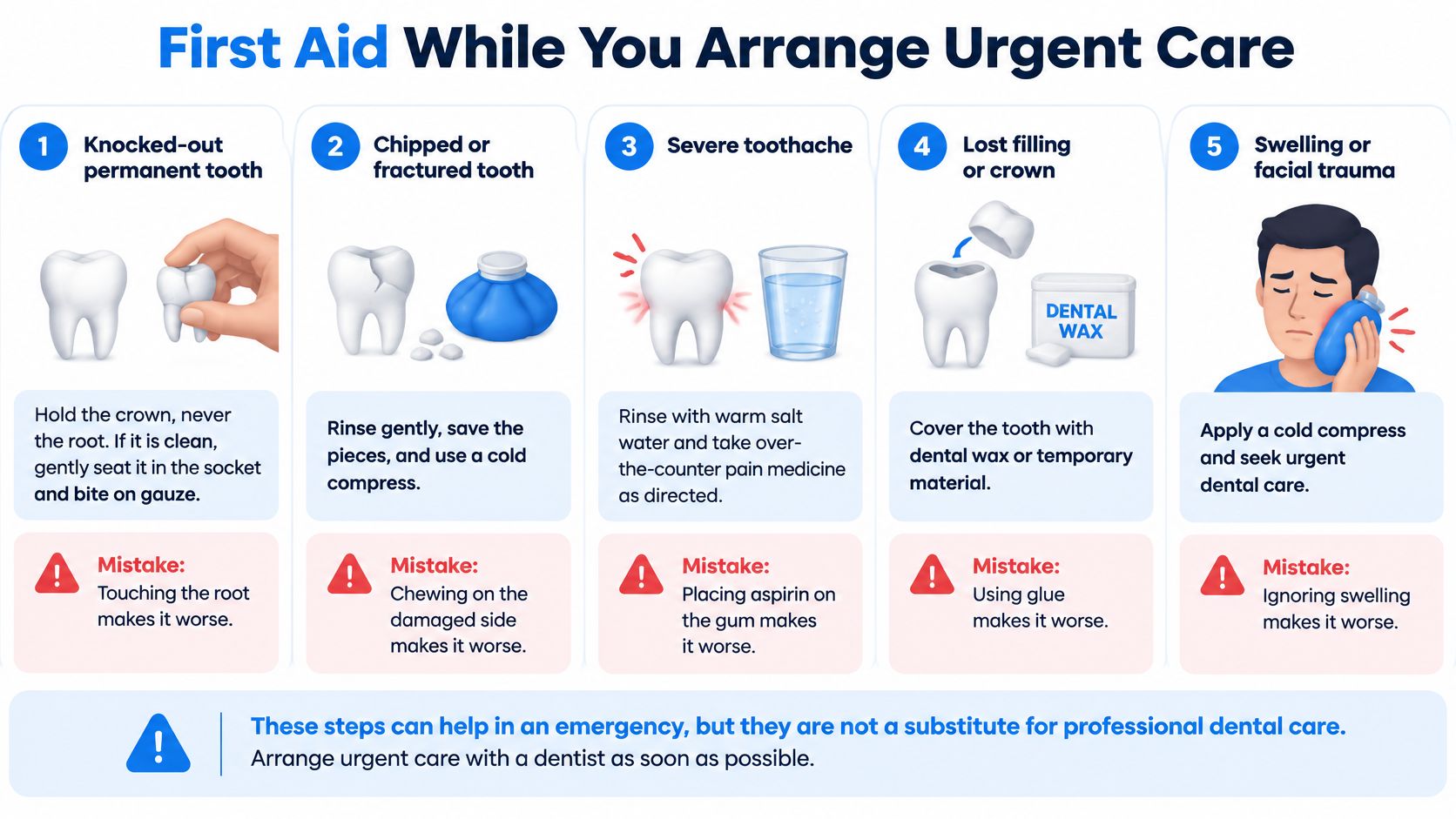
Hold a knocked-out tooth by the crown. Press clean gauze against a bleeding lip. Small moves like these protect the tooth, limit swelling, and buy time until a dentist in Scottsdale, AZ can treat the cause. Each routine below pairs the right move with the mistake that makes things worse.
Five Short Routines
Knocked-out permanent tooth: Hold the tooth by the crown, never the root. The American Dental Association page on dental emergencies recommends gently placing the tooth back into its socket without touching the root when possible. If reinsertion isn't possible, the tooth can be held between the cheek and gum, placed in milk, or stored in an ADA-accepted tooth-preservation product. Don't scrub it, and don't replant a baby tooth. Contact an emergency dentist immediately because the tooth must stay moist.
Severe toothache: Rinse with warm water and gently floss away trapped food. A cold compress on the cheek for 10 minutes can ease swelling. Never place aspirin on the tooth or gum because it can burn soft tissue. Trapped food is sometimes the trigger, but throbbing pain that lingers usually signals decay or pulp trouble underneath.
Swelling: Note whether it is increasing, whether fever is present, and whether the mouth still opens fully. Use a cold compress on the outside of the face and keep the head raised. Leave leftover antibiotics in the cabinet; the reason swelling calls for hands-on treatment becomes clear once the dentist's steps are laid out. Spreading swelling changes the destination to a hospital.
Lost filling or crown: Save the piece and keep the area clean with gentle brushing. Pharmacy temporary cement can hold a crown only if it seats fully and comfortably. Skip sticky foods and chewing on that side. Household glue doesn't belong in a mouth and can trap bacteria against exposed tooth structure.
Chip or loose tooth after a hit: Save fragments in milk and bring them along. Rinse gently, cold-compress the face, and control lip or tongue bleeding with clean gauze and steady pressure. Don't wiggle a loose tooth to test it. Guidance on repair options for a chipped tooth explains why even a small chip deserves a look, since a crack can reach deeper than it appears.
Pain Medicine With a Safety Screen
For adults, the ADA guidance on oral analgesics for acute dental pain lists a representative regimen of ibuprofen 400-600 mg plus acetaminophen 500 mg at fixed 6-hour intervals for 24 hours, subject to contraindications and clinician review. The ADA describes NSAIDs such as ibuprofen or naproxen, alone or combined with acetaminophen, as more effective than opioid analgesics for acute dental pain. That plan isn't safe for everyone.
- Skip NSAIDs without clinician advice: kidney disease, gastrointestinal bleeding or ulcer history, anticoagulant use, NSAID allergy, pregnancy, or uncontrolled hypertension.
- Watch acetaminophen totals: liver disease, heavy alcohol use, and duplicate acetaminophen in cold or pain products raise risk.
- Stay within daily limits: exceeding the label maximum helps no one and can cause real harm.
Pain medicine buys time; it doesn't remove the source, so keep the appointment.
Increasing pain, swelling, fever, trouble opening the mouth, or difficulty swallowing means waiting has stopped working. Those signs need a faster call and same-day attention, since another dose would only mask them.
How the Dentist Treats the Source of the Pain
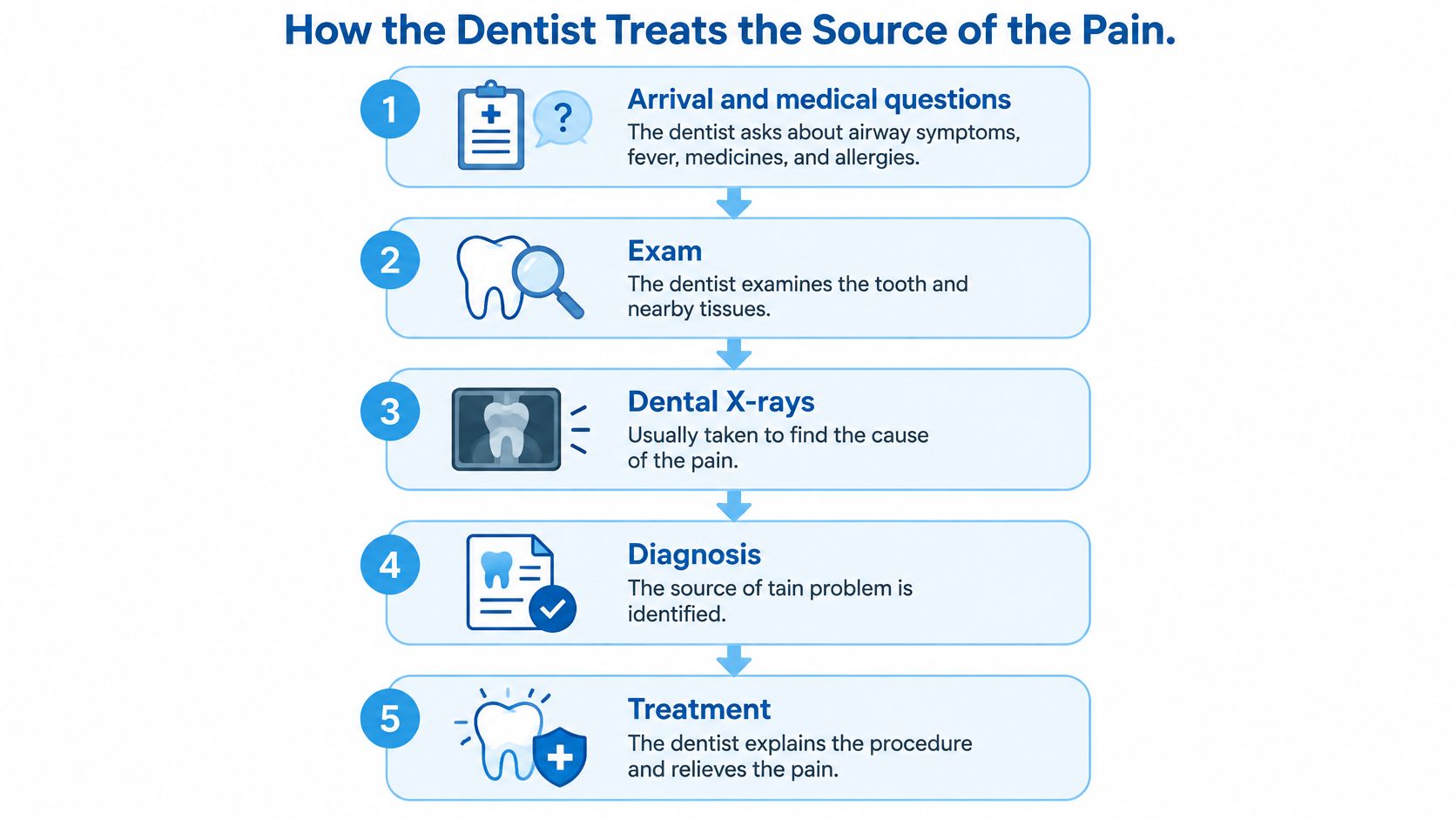
An urgent visit follows a predictable order, and knowing it lowers anxiety. The dentist asks about airway symptoms, fever, medicines, and allergies first. Then the tooth and nearby tissues get examined, and dental X-rays usually show decay, a crack, or infection at the root tip.
Matching the Finding to the Fix
Decay that has formed a cavity gets cleaned out and restored, often with a tooth-colored filling. The National Institutes of Health overview of tooth decay states that once a cavity forms, a dentist removes the decayed tissue and fills the space with restorative material. If infection reaches the inner pulp, root-canal treatment removes damaged tissue, cleans and seals the tooth, and helps preserve the natural tooth.
A badly broken tooth may need a crown in porcelain, ceramic, or metal to cover and protect what's left. A tooth that can't be saved may need tooth extraction, with a bridge or dental implant planned only after the emergency is stable. A localized abscess may need drainage or pulp treatment the same day. A frank comparison of root canal treatment versus extraction helps patients weigh saving a tooth against removing it before pain forces a rushed choice.
The clinical name for this approach is definitive conservative dental treatment, meaning pulpotomy, pulpectomy, root-canal treatment, extraction, debridement, or incision and drainage. It's the step that removes the source. Everything else supports it.
The Antibiotic Rule
Many patients expect a prescription and feel shortchanged without one. The reason is straightforward. Antibiotics can't reach dead pulp tissue inside a sealed tooth well enough to cure it, so the infection returns.
ADA guidance summarized in the CDC document on dental antibiotic treatment states that antibiotics are generally unnecessary for immunocompetent adults with most pulpal or periapical pain and localized swelling when definitive treatment is available. Antibiotics become appropriate with systemic involvement such as fever or malaise, or when immediate definitive care is unavailable. CDC and ADA stewardship material recommends the shortest effective course, typically 3-7 days, with follow-up after 3 days and discontinuation 24 hours after systemic signs resolve.
- The failure mode: repeating antibiotic prescriptions while the source stays inside the tooth.
- The escalation rule: worsening swelling, suspected deep-space infection, trouble breathing or swallowing, or possible sepsis means urgent hospital care.
- The reassessment step: the dentist checks whether pain and swelling are retreating, not just quieter.
Once pain is controlled, related care may follow. That can include a final crown, gum treatment, or restorative dentistry to rebuild chewing function. Cosmetic repair of a front tooth comes after stability, not during the crisis.
Typical Costs for Urgent Dental Treatment
A toothache at 9 p.m. produces two questions at once: what is wrong, and what will it cost. The second answer depends heavily on where the treatment happens, so real numbers help before insurance enters the picture. National figures are not a Scottsdale quote, but they show the shape of the bill.
According to CareCredit information based on ASQ360 research, the average U.S. cost of a bicuspid root canal in 2023-2024 was $984, with a reported range of $757-$1,798. The range is wide because the tooth itself sets the difficulty. A molar has more roots and canals to clean and seal than a bicuspid, so a harder case lands higher on the scale. That figure covers the root canal alone, and the tooth often still needs a crown afterward.
Urgent dental costs versus an emergency-department visit
| Care | Published figure | Year or source context | What the patient should take from it |
|---|---|---|---|
| Bicuspid root canal | $757-$1,798; average $984 | 2023-2024, CareCredit based on ASQ360 | A common definitive treatment; harder teeth and cases sit higher in the range |
| Dental emergency-department visit, not hospitalized | Higher than a dental visit for the same problem | ADA-reported figures | Pays for stabilization; usually no final restoration |
| Adult emergency-department charge for a nontraumatic dental condition | $994 average | 2014, NIDCR | Children averaged $971 in the same report |
| Dental-related emergency-room visits from abscess or decay | A large majority of visits | Published emergency-room data | Most of these problems are treatable in a dental office |
What the Hospital Path Costs
An emergency-department bill and a dental bill pay for different things. The hospital exam, imaging, and medication bring pain and swelling under control, and the dental work still waits for a dental chair. The National Institute of Dental and Craniofacial Research summary reported that in 2014 nontraumatic dental conditions generated average emergency-department charges of $994 for adults and $971 for children. ADA-reported figures place a dental visit to the emergency department well above the cost of an office visit, and published emergency-room data attribute a large majority of dental-related visits to abscesses and decay, problems a dentist can treat at the source.
The hospital still has its place. Trouble breathing or swallowing, swelling that spreads quickly, or bleeding that will not stop is a medical emergency, and cost is not the deciding factor there.
How a Dental Bill Is Built
A typical urgent bill has three parts. The exam and X-rays locate the problem. The procedure treats it, whether that turns out to be a filling, a root canal, or an extraction. A crown may follow later if the tooth needs full coverage to hold up under chewing. Fillings and crowns wear over time and may eventually need replacement, so a restored tooth still needs routine monitoring.
- Bring the insurance card: ask what the plan pays for emergency exams, root canals, extractions, and crowns before the work starts.
- Ask about financing early: the choice between saving a tooth and removing it should rest on the tooth, not the day's budget.
- Expect an exam before a quote: no responsible office prices a tooth it hasn't examined, and an estimate given before the X-ray is a guess.
Delay moves the math in one direction. A cavity that needed a filling can become a root canal, and a root canal delayed can become an extraction plus a replacement tooth. The sooner the source is treated, the smaller the bill tends to be, and the better the odds the tooth stays in place.
Aftercare and Ways to Prevent the Next Emergency
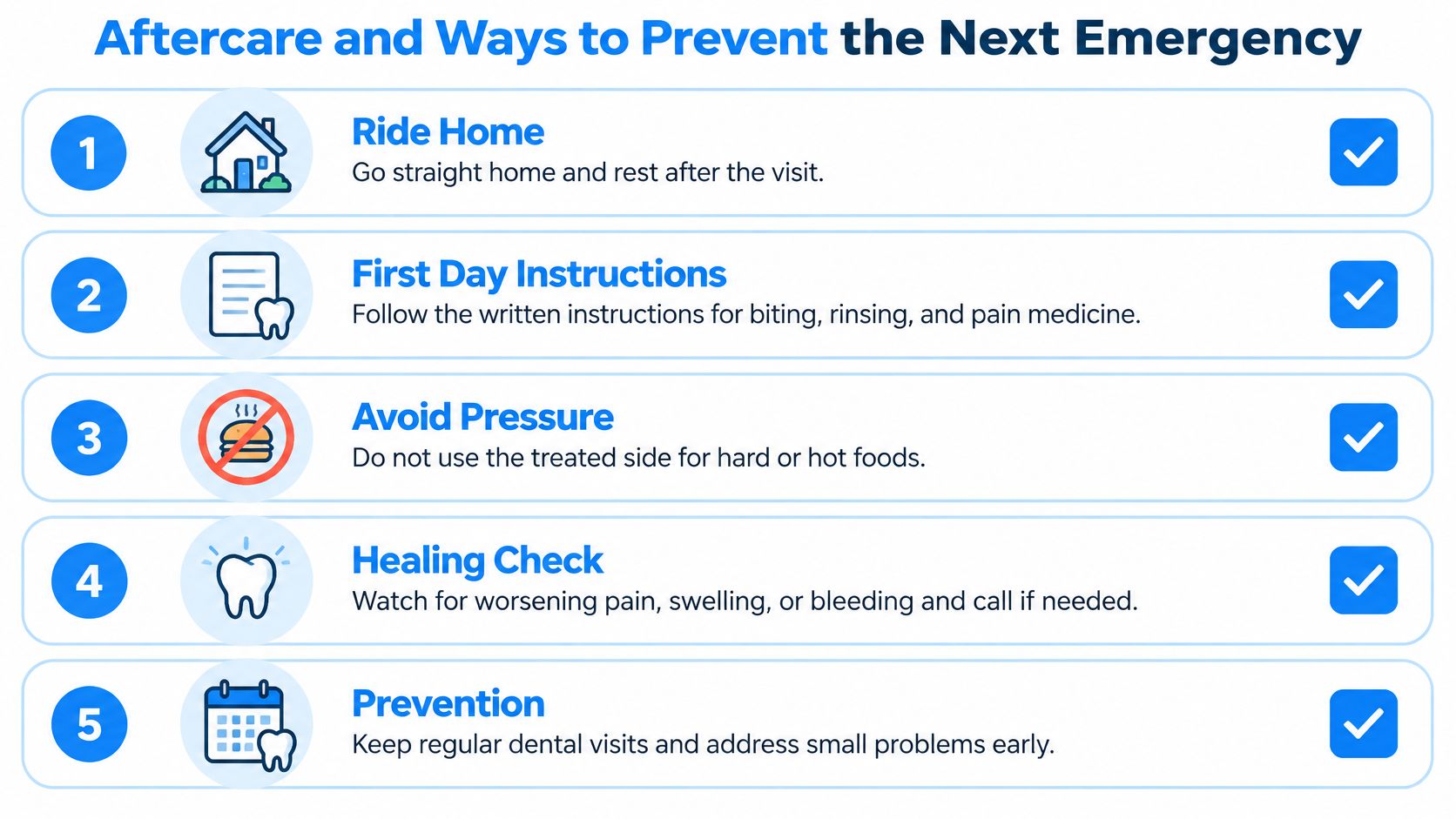
Aftercare starts on the ride home. For the first day, follow the written instructions for biting, rinsing, and pain medicine exactly as given. The treated side shouldn't handle hard or sticky food, and a surgical site shouldn't be disturbed by smoking or vigorous rinsing. The repair is finished, but the tissue around it is still settling, so the instructions exist to buy the tooth a few quiet days.
Same-Day Call-Back Signs
A phone call the same day is warranted for swelling that spreads, fever, trouble swallowing, or bleeding that restarts. Pain that's worse on day two than day one also deserves a call rather than a wait-and-see weekend. A bite that feels high, lingering numbness, or a cracked temporary are phone-call issues too.
A lost temporary crown should be saved, and the office should hear about it promptly. Waiting until the permanent crown date risks sensitivity or shifting if the tooth sits exposed. For warning signs that feel less urgent, the ADA emergency treatment guidelines document sets the evaluation window at roughly 1-2 days. The triage table in the first section shows which of those signs belong in a hospital and which belong in a dental chair.
Pain that settles with over-the-counter medicine still deserves the follow-up visit that was booked. A calmer tooth can still hold an incomplete repair underneath.
Why Emergencies Return
Untreated cavities are common. The CDC data brief on emergency department visits for tooth disorders estimates that 1 in 5 U.S. adults ages 20-64 has at least one untreated cavity, and that reservoir explains many repeat emergencies. A tooth that needed a root canal or crown can break again if the final restoration is delayed.
- Night grinding: a custom guard protects teeth without changing the bite the way a loose drugstore tray can.
- Sports: an athletic mouthguard absorbs the hit that otherwise lands on front teeth.
- Loose work: a filling or crown that feels loose should be checked before it falls out on a weekend.
- Routine visits: regular exams and cleanings let a small cavity become a small filling instead of pain.
Before the next weekend arrives, check off the basics: medicines as directed, soft foods until chewing feels normal, no smoking on a surgical site, the follow-up visit on the calendar, and a mouthguard if the emergency started with sports or grinding.
The payoff is concrete. A root canal left unfinished often has to be re-treated from the beginning, which means paying for the same procedure twice before the crown is even placed. Finished work and a fitted guard cost less than starting over.
Schedule Urgent Care at Eric Wiitala DDS
For readers whose problem belongs with a dentist, the next step is a phone call with the right information ready. Dr. Eric Wiitala is the dentist at Eric Wiitala DDS, a dental office in Scottsdale, Arizona that has cared for patients across generations in the Scottsdale area. The practice offers cosmetic, family, and general dentistry in Scottsdale, Arizona, with root canals, crowns, fillings, gum care, and patient education among its general services.
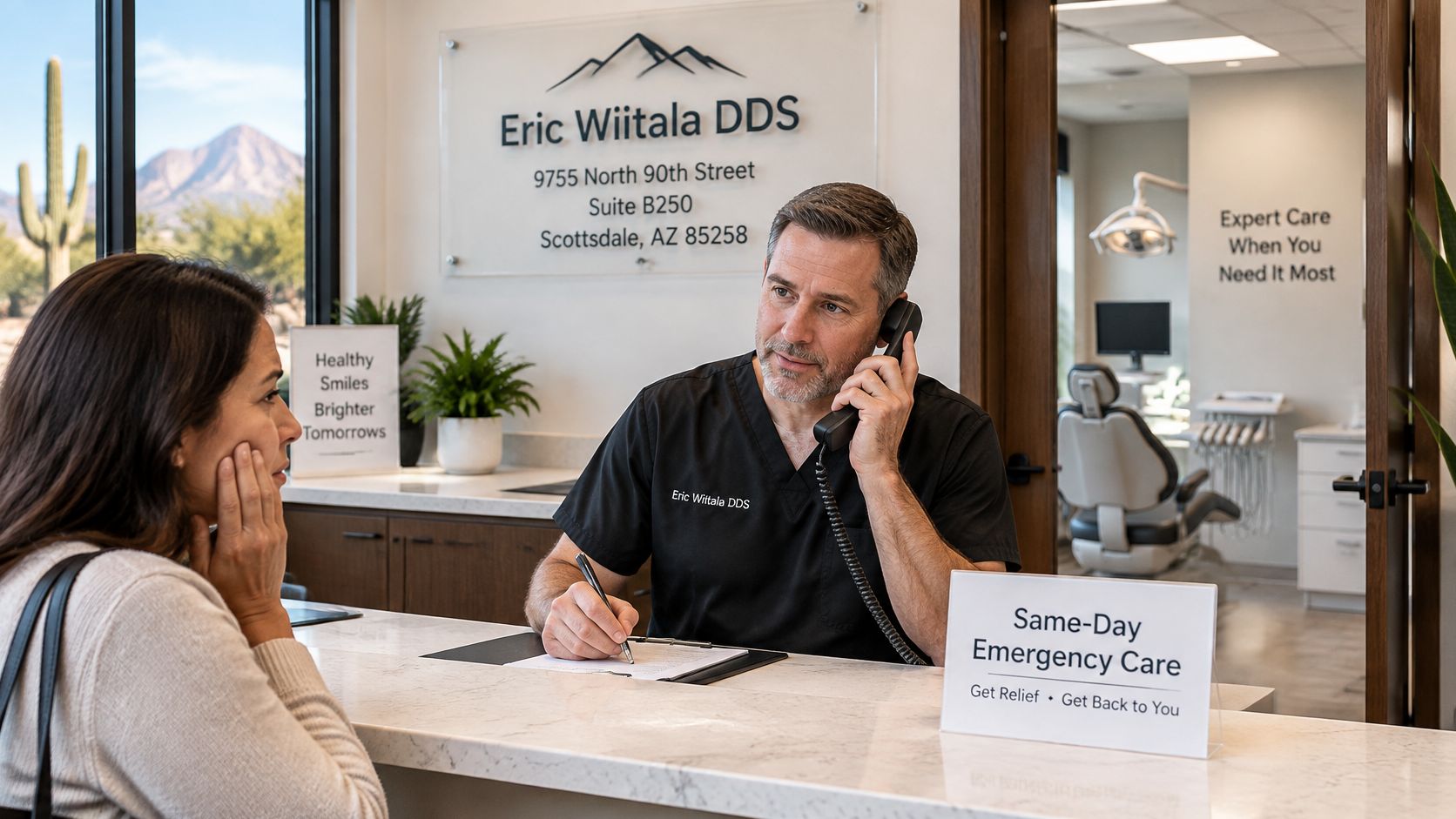
Dr. Wiitala graduated from Indiana University School of Dentistry in 1999 and has more than 20 years in practice. Dr. Wiitala has been recognized as one of the Valley's Top Dentists by PHOENIX magazine. That experience matters when a patient needs a clear choice among a filling, crown, root-canal treatment, or extraction while hurting.
What to Say and Bring
On the call, state when the pain or injury started and whether swelling or fever is present. Mention whether a tooth was knocked out, a crown came off, or the problem followed recent dental surgery. Medical conditions, allergies, and blood thinners belong in that first conversation because they change treatment planning.
- Bring identification and insurance: a photo ID, insurance card, and a list of medicines and allergies.
- Bring the evidence: the tooth, crown, or broken piece in milk or a clean container.
- Ask the practical questions: insurance, billing, and financing before agreeing to care.
The practice doesn't publish a guaranteed same-day policy, so asking whether today's schedule can fit the problem is the honest approach. If the office is closed and symptoms point to a hospital, nobody should wait for the next open morning. An emergency dentist in Scottsdale handles the tooth, and a hospital handles the airway.
A short video walkthrough can help patients picture the visit before arriving.
A new patient exam for urgent care follows plain steps. There's an exam, X-rays when needed, and an explanation of options, with tooth-colored restorations when a repair is appropriate. Later needs such as dental implants, cosmetic dentistry, or teeth whitening can be planned once the urgent problem is stable.
Eric Wiitala DDS contact and visit details
| Item | Detail |
|---|---|
| Address | 9755 North 90th Street, Suite B250, Scottsdale, AZ 85258 |
| Phone | (480) 657-6981 |
| contactus@drwiitala.com | |
| Office hours | Monday through Thursday; Friday by appointment |
| Same-day policy | Not published; ask when calling |
To schedule an appointment, patients can fill out a contact form or call (480) 657-6981. Patients can also email contactus@drwiitala.com with questions. Calling early in the day gives the schedule the best chance to absorb an urgent problem.
A search for a cosmetic dentist near me or dental implants near me after a broken front tooth still starts in the same place. The tooth gets stabilized first, then appearance and replacement options get planned calmly. Prompt action protects both comfort and the final result.
Eric Wiitala DDS provides urgent dental evaluation, restorative treatment, and clear next steps for patients in Scottsdale dealing with tooth pain, swelling, or a broken tooth. Readers who need care now can call (480) 657-6981, send the contact form, or visit Eric Wiitala DDS to request the next available visit.