

Full mouth reconstruction is a thorough process that typically takes 3 to 12 months and is designed to restore oral health, bite function, and appearance in a coordinated way, with much of the timeline shaped by the 3 to 6 months implants may need to integrate with the jawbone (treatment timeline for full mouth reconstruction). For patients facing widespread wear, broken teeth, missing teeth, jaw discomfort, or trouble chewing, it's often the path that turns a mouth that feels unstable into one that feels dependable again.
Many Scottsdale patients start looking for answers after years of piecing problems together. One tooth breaks, then another crown fails, then chewing shifts to one side, then smiling starts to feel awkward. Some begin by searching for a dentist near me, others for dental implants near me, a cosmetic dentist near me, help after a tooth extraction, or even an emergency dentist when something finally becomes too painful to ignore.
That's usually the moment when the bigger picture becomes clear. The issue isn't just one tooth. It's the whole system.
For patients in Scottsdale, AZ, who feel overwhelmed by how many things seem wrong at once, full mouth reconstruction offers a way to organize the chaos into a clear, staged plan. Instead of chasing one emergency after another, the focus shifts to rebuilding comfort, stability, and confidence with a sequence that makes clinical sense and fits real life.
Restore Your Smile in Scottsdale with Full Mouth Reconstruction
A common Scottsdale scenario goes like this. A patient can still function, but only barely. Front teeth are wearing down. Back teeth are missing or cracked. The jaw feels tired by evening. Cold drinks sting. Meals take too long. Photos get avoided.
At first, the problem looks cosmetic. It rarely stays there.
When teeth are broken, worn, infected, missing, or out of balance, the bite changes. That can affect chewing, speech, comfort, and the way force is distributed across the mouth. One weak tooth starts carrying too much load. Another begins to chip. A filling loosens. A patient who only wanted whiter teeth suddenly needs a broader plan involving restorative dentistry, gum care, or dental implants.
Full mouth reconstruction gives scattered dental problems one organized answer.
In Scottsdale, patients often search online for a dentist in Scottsdale, AZ after years of postponing treatment because they assume the process will be too complicated or too disruptive. That concern is understandable. Reconstruction sounds large because it is large. But it becomes much easier to understand when it's broken into stages, each with a clear purpose.
What patients are usually dealing with
- Missing teeth: Gaps can make nearby teeth drift and can push chewing force onto the wrong areas.
- Severely worn teeth: Grinding, acid wear, or long-term bite imbalance can shorten teeth and change the way the jaws meet.
- Broken dental work: Old crowns, failing bridges, and cracked fillings can signal a mouth that needs more than patchwork repairs.
- Pain or daily frustration: Trouble chewing, jaw soreness, or embarrassment about smiling often means the problem has moved beyond routine dental care.
For many people, relief comes from hearing that a solution exists even when the mouth feels far gone. Full mouth reconstruction isn't reserved for a rare type of patient. It's a practical treatment pathway for adults whose oral health problems are connected and need to be solved as one system instead of one tooth at a time.
Understanding Full Mouth Reconstruction
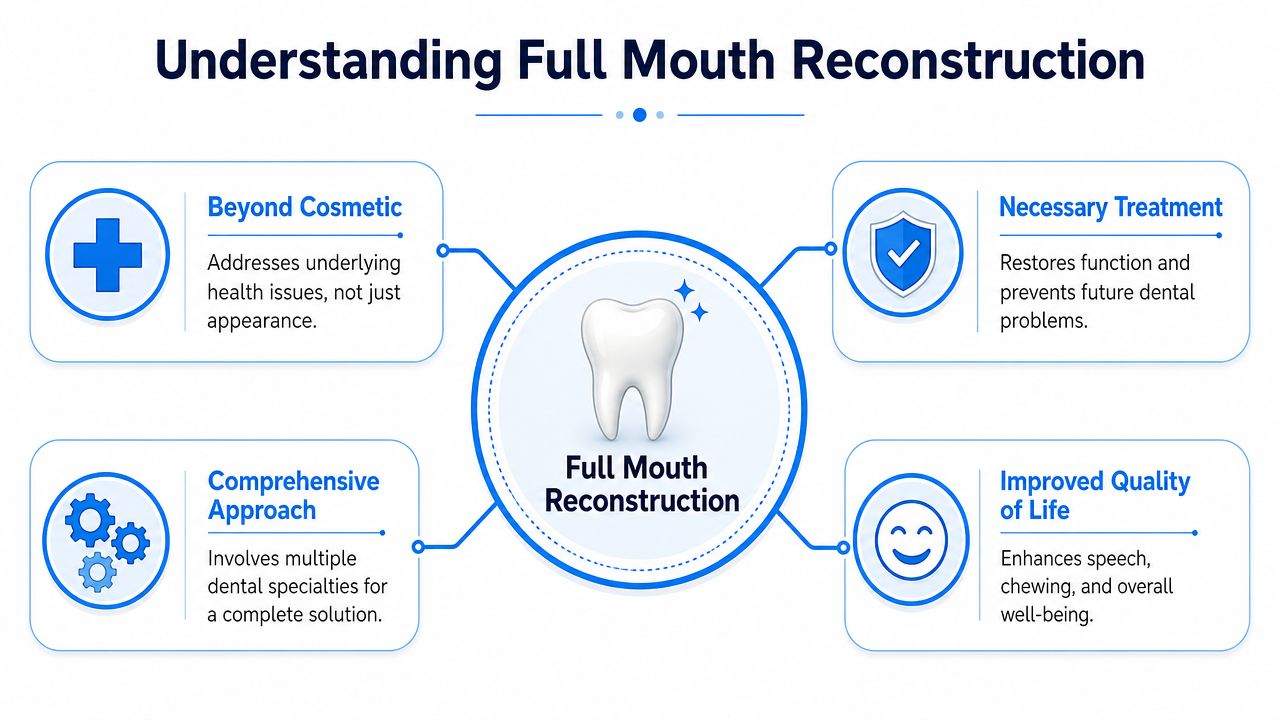
Full mouth reconstruction is the process of rebuilding the health, function, and appearance of the entire mouth when damage is too widespread for a single treatment to solve. It often combines restorative dentistry, implant dentistry, bite analysis, periodontal care, and sometimes orthodontic treatment into one coordinated plan.
More than a cosmetic upgrade
A point that confuses many patients is the difference between reconstruction and a smile makeover. A smile makeover is mainly about appearance. Full mouth reconstruction starts with health and function.
A simple comparison helps. Repainting a house improves how it looks. Rebuilding the damaged framing, leveling the floors, and repairing the roof changes whether the house works properly. Reconstruction is the second category. It addresses the hidden support system.
That matters because the mouth is not just a row of visible teeth. It includes the bite, jaw muscles, temporomandibular joints, gums, bone, and the way the upper and lower arches meet during speech and chewing. In more advanced cases, treatment may involve increasing the vertical dimension of occlusion to restore lost height and rebalance the bite. When teeth are structurally preservable, a full mouth reconstruction may involve about 28 units of crowns, onlays, and veneers across both arches, often using monolithic zirconia or lithium disilicate materials in a carefully planned bite scheme (clinical overview of full mouth rehabilitation and vertical dimension planning).
A custom rebuild, not a standard package
No two plans look the same because no two mouths fail in the same pattern. One patient may need crowns and bite correction. Another may need extractions, bone grafting, and implant-supported replacement. Another may still have most teeth, but they're so worn and uneven that chewing efficiency and jaw comfort are suffering.
A careful evaluation has to include the teeth, jaw muscles, periodontal tissues, and TMJ. That's why candidacy and treatment design are highly individualized. A customized plan may include root canal therapy, bone grafting, orthodontics, crowns, bridges, or implant treatment depending on what each mouth needs (individualized assessment of teeth, jaw muscles, TMJ, and treatment needs).
The best reconstruction plans don't start with, “What procedure should be done?” They start with, “What's making this mouth unstable?”
That shift in thinking helps patients understand why a thorough exam matters so much. The goal isn't to create a prettier version of a damaged bite. The goal is to create a bite that is healthy, stable, comfortable, and able to last.
What Procedures Are Involved in a Reconstruction Plan
A reconstruction plan is usually made of several smaller treatments, each solving a specific problem. That's good news for patients because it means the process can be understood step by step instead of as one overwhelming event.
The treatments that rebuild structure
Some procedures restore teeth that can still be saved. Others replace teeth that are no longer supportable.
| Procedure | What it does in plain language | When it may be used |
|---|---|---|
| Crowns | Cover and strengthen a damaged tooth | Cracks, large fillings, severe wear |
| Bridges | Replace a missing tooth by connecting to neighboring teeth | Small gaps when adjacent teeth also need support |
| Veneers or bonded restorations | Improve shape and visible surfaces in selected cases | Esthetic refinement after health is stabilized |
| Dental implants | Replace the root of a missing tooth and support a restoration above it | Single missing teeth, multiple missing teeth, or full-arch support |
| Implant-supported full arches | Replace many teeth with a fixed option | Extensive tooth loss or failing dentition |
For patients exploring tooth replacement, dental implants often become a central part of the conversation because they help anchor restorations in a way that feels more secure than removable alternatives.
The treatments that support the foundation
Other procedures don't show in the final smile as clearly, but they're often what make the reconstruction possible.
- Bone grafting: Used when the jaw needs more support before implants can be placed.
- Root canal therapy: Helps preserve a tooth whose nerve is inflamed or infected when the tooth is still worth keeping.
- Periodontal therapy: Treats gum disease so restorations are placed on a healthier foundation.
- Orthodontic clear aligners: Move teeth into better positions when spacing, crowding, or bite relationships would interfere with a stable result.
- Occlusal guards and bite therapy: Protect restorations and reduce overload from clenching or grinding.
A patient with a collapsed bite, for example, may not start with veneers or crowns right away. The first step may be controlling gum inflammation, protecting the jaw joints, and deciding whether certain teeth can be saved. Only after the foundation is stable does the visible rebuilding begin.
How materials and planning affect longevity
Material selection also matters. Full-mouth reconstruction with modern fixed prosthetics shows strong long-term performance. A retrospective analysis of 150 cases found a 92% five-year survival rate for fixed dental prostheses used in full-mouth reconstruction, with 15% of patients experiencing technical complications and 12% experiencing biological complications. In the same analysis, zirconia-based prostheses had a 95% five-year survival rate compared with 88% for metal-ceramic options, supporting the value of advanced restorative materials in total rehabilitation (five-year outcomes for fixed dental prostheses and zirconia performance).
That doesn't mean every patient needs the same material everywhere. It means the choice of material should match the forces, esthetic demands, and biology of the case.
Practical rule: A beautiful restoration that doesn't fit the bite properly won't stay beautiful for long.
This is why reconstruction often includes both restorative and cosmetic dentistry. The visible outcome matters. But the order matters more. Teeth have to be comfortable, functional, and structurally sound before the finishing details can do their job.
Your Treatment Journey from Consultation to Final Smile
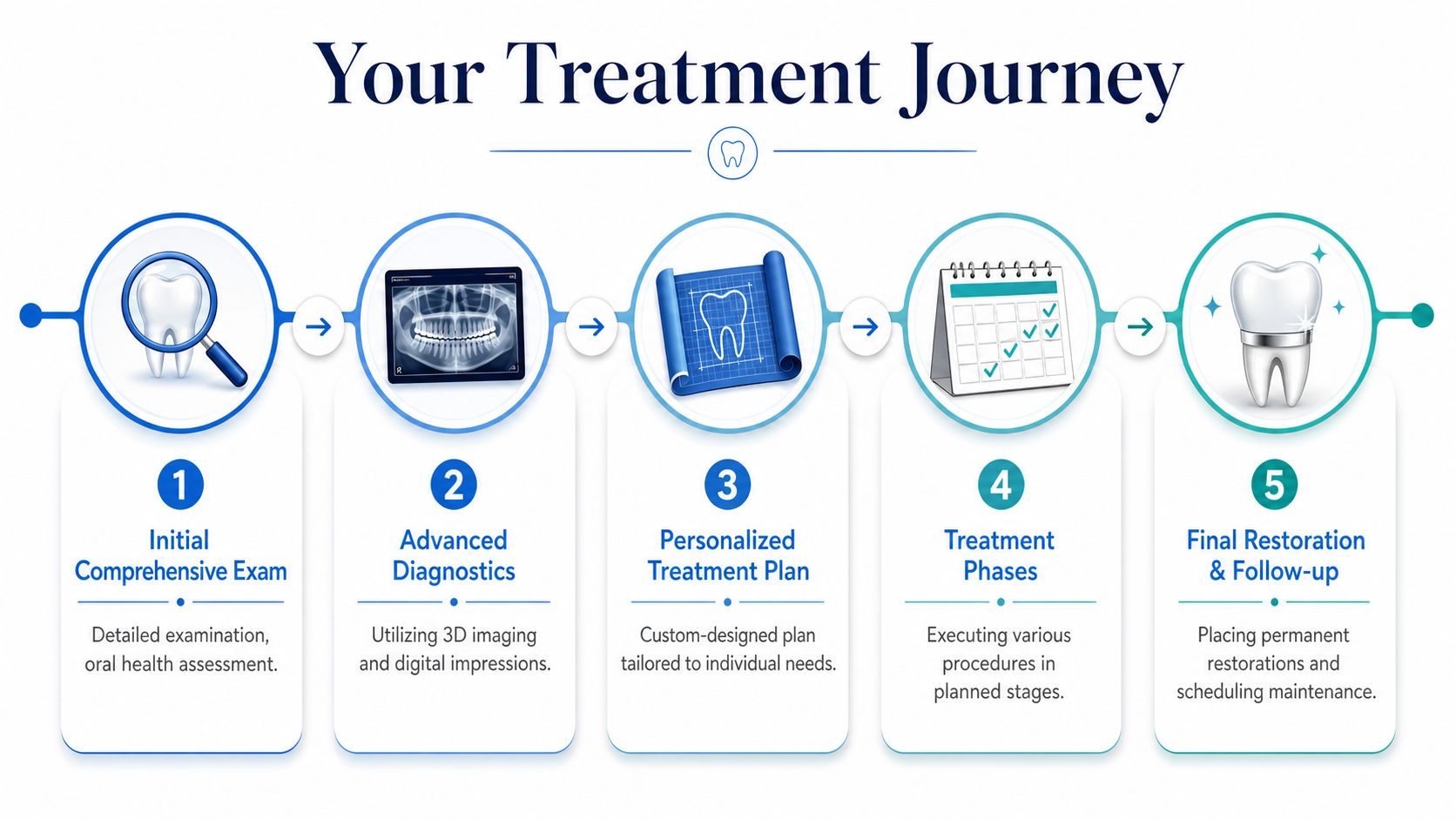
A successful reconstruction doesn't begin with drilling or placing restorations. It begins with understanding exactly how the mouth works now, where it has broken down, and what a stable endpoint should look like.
To make that clearer, this visual helps outline the progression patients can expect.
The first visit and the records that matter
The early appointments are diagnostic. That usually means a detailed clinical exam, photographs, digital imaging, impressions or scans, and a bite analysis. In more involved cases, records may also include mounted study casts, facebow transfers, and centric relation bite records to evaluate wear patterns, jaw position, and TMJ status.
A structured protocol is one of the most important predictors of a smooth case. Full mouth reconstruction planning often follows a seven-step process that begins with exhaustive diagnostics and later uses diagnostic wax-ups and provisional mock-ups to test esthetics, phonetics, and occlusion before anything permanent is delivered (structured clinical protocol with records, wax-ups, and provisional validation).
Trying the plan before the final version
One of the most reassuring parts of reconstruction is that the final result is often tested before it becomes permanent. Temporary or provisional restorations let the patient and dentist evaluate tooth length, comfort, speech, and bite balance in real life.
That step answers questions patients can't solve from photos alone:
- Speech: Do certain sounds feel awkward with the new tooth position?
- Comfort: Does the bite feel even, or does one side hit first?
- Appearance: Does the smile look natural with the face and lips?
- Function: Can the patient chew without a feeling of strain?
Later in the process, occlusal refinement may include computerized analysis to help even out force distribution across the restorations, as a full mouth reconstruction fails faster when the bite looks right but functions unevenly.
A short video can help patients understand how this broader process comes together in practice.
Why treatment is often phased
Not every patient completes treatment all at once. Some plans begin with urgent care, infection control, or a needed tooth extraction. Others move first into implants or gum therapy. Some start with provisional restorations to reestablish the bite before final ceramics are made.
That phased approach often makes treatment easier to tolerate both physically and emotionally. A patient who has spent years avoiding smiling may need time to adjust. A patient with a demanding work schedule may need surgery and restorative visits arranged around life, not against it.
Good reconstruction planning respects biology, function, and the patient's day-to-day reality.
Are You a Candidate for Full Mouth Reconstruction
Many adults wonder whether their dental situation is “bad enough” for full mouth reconstruction. Usually, the better question is whether multiple problems are connected and affecting daily life.
Common signs the mouth needs a bigger solution
A patient may be a candidate when several of these issues overlap:
- Multiple missing teeth: Chewing has become difficult, or the bite has shifted over time.
- Extensive wear: Teeth look shorter, flatter, or more sensitive from grinding or erosion.
- Repeated breakage: Crowns, fillings, or natural teeth keep chipping because the force pattern is off.
- Jaw discomfort: Bite imbalance may contribute to muscle strain or TMJ symptoms.
- Failing older dentistry: The mouth has reached the point where replacing isolated restorations no longer solves the bigger problem.
- Loose teeth or gum problems: The support structures may need treatment before lasting restorative work can be done.
Candidacy has to be determined through an examination of the teeth, jaw muscles, and TMJ because each patient brings a different combination of structural, functional, and biological issues. That individualized assessment is what guides whether a plan should include root canals, bone grafting, orthodontics, or other therapies (how candidacy is tailored to teeth, jaw muscles, and TMJ findings).
What successful treatment can change
The benefits are practical before they are cosmetic. Patients often want to eat without planning every bite. They want hot and cold foods to feel normal again. They want to speak without worrying about unstable teeth or removable appliances. They want fewer emergencies.
A well-designed reconstruction can help restore:
- Chewing confidence
- Speech clarity
- Jaw comfort
- Facial support
- Smile confidence
- A healthier daily routine
For many patients, the emotional benefit is just as important as the physical one. When the mouth stops feeling fragile, the rest of life often gets easier too.
Navigating the Cost of Full Mouth Reconstruction
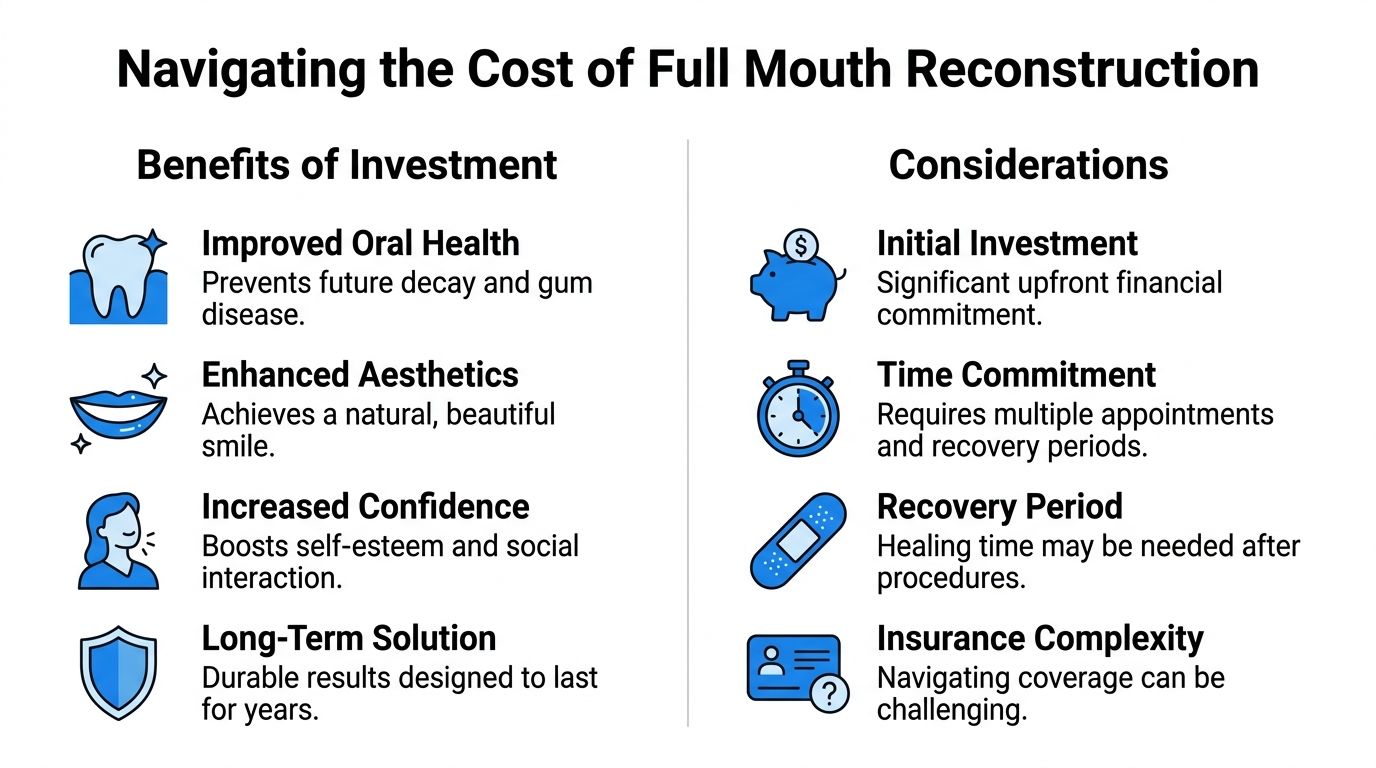
Cost is one of the first questions patients ask, and it should be. Full mouth reconstruction is a major investment, so a realistic conversation matters.
What drives the total investment
In the United States, full mouth reconstruction typically ranges from $30,000 to $150,000+, with the final cost depending heavily on case complexity. Bone grafting, which may be needed to prepare the jaw for implants, can cost $200 to $3,200 per site (U.S. cost range and bone grafting cost details). In some cases, a combined approach with implants, crowns, and veneers can reach $100,000, while an All-on-X approach is roughly $30,000 per arch.
Those numbers vary because treatment plans vary. One patient may need to save many natural teeth. Another may need full-arch replacement. Materials, surgical needs, temporaries, bite rehabilitation, and healing stages all affect the total.
Why phased treatment deserves more attention
The part many articles skip is the human side of budgeting. Patients aren't only asking, “What does it cost?” They're asking, “How can treatment fit into work, family life, and the months between starting and finishing?”
That's where phased treatment becomes so valuable.
A phased plan may separate care into priorities such as:
- Stabilize pain and disease: Handle infections, fractures, or urgent failures first.
- Secure the foundation: Address gum health, extractions, or grafting where needed.
- Restore function: Rebuild chewing surfaces and bite stability.
- Complete esthetics: Finish the final smile details once the system is healthy and predictable.
A patient may choose that path for budget reasons, but the benefit isn't only financial. It can reduce stress, make recovery periods easier to schedule, and prevent the emotional fatigue that sometimes happens when a complex case feels endless. A source focused on patient questions highlights how often standard explanations miss this reality, especially when treatment stretches across many months and affects both budget and daily confidence.
A treatment plan is more likely to succeed when the patient can realistically live with it.
Insurance, financing, and practical planning
Insurance can help with certain medically necessary components, but coverage is often mixed across surgical, restorative, and cosmetic elements. That's why patients benefit from clear pre-treatment estimates and a line-by-line review of what may or may not be covered.
In more complex cases, administrative support also matters. Patients trying to understand insurance documentation may find it helpful to learn how Simbie AI's prior authorization technology fits into the broader effort to reduce delays and confusion around approvals in healthcare workflows.
For patients comparing payment pathways, reviewing available financing options early can make the process feel far more manageable.
Recovery and Long-Term Care for Your New Smile
Recovery depends on what the plan includes. A patient who receives crowns and bite adjustment will have a different experience than someone who undergoes extractions, grafting, or implant surgery.
What healing usually feels like
Patients having invasive procedures may need weeks or months for full recovery, but common side effects such as inflammation, tenderness, and heightened sensitivity typically resolve within a week. When implants are part of the plan, the broader timeline is often shaped by the 3 to 6 months needed for integration with the jawbone (recovery expectations and implant healing timeline).

That's why good post-treatment instructions matter. Patients usually need guidance on hygiene, food choices during healing, and what sensations are normal versus what deserves a call to the office.
How to protect the result
Long-term success depends on maintenance just as much as treatment.
- Daily home care: Brush thoroughly, clean between teeth, and keep implants and margins free of plaque.
- Regular visits: Ongoing exams, cleanings, and dental x-rays help catch small issues before they become costly repairs.
- Night protection: Patients who clench or grind may need a custom occlusal guard to protect restorations.
- Prompt attention to changes: A bite that suddenly feels off, a loose restoration, or tenderness around an implant should be checked early.
A reconstructed smile can last beautifully when it's protected like the major investment it is.
Frequently Asked Questions About Full Mouth Reconstruction
Is full mouth reconstruction painful
Most patients are surprised that the process is more manageable than expected. Comfort measures are used during treatment, and post-treatment soreness depends on the procedures involved. Major surgical phases usually require more healing than restorative visits.
How is full mouth reconstruction different from a smile makeover
A smile makeover focuses mainly on appearance. Full mouth reconstruction addresses function, bite stability, structural damage, and oral health first, then improves appearance as part of the final result.
Will patients be able to eat normally again
That's one of the main goals. As healing progresses and the bite is stabilized, patients are usually working toward more comfortable chewing and a broader diet.
Can treatment be done in stages
Yes. Many cases are best handled in phases so urgent problems can be treated first and the full plan can fit a patient's budget, schedule, and recovery needs.
Patients in Scottsdale who are tired of patching one dental problem after another can schedule a consultation with Eric Wiitala DDS to explore whether full mouth reconstruction, restorative dentistry, dental implants, or other personalized dental care may be the right next step.