
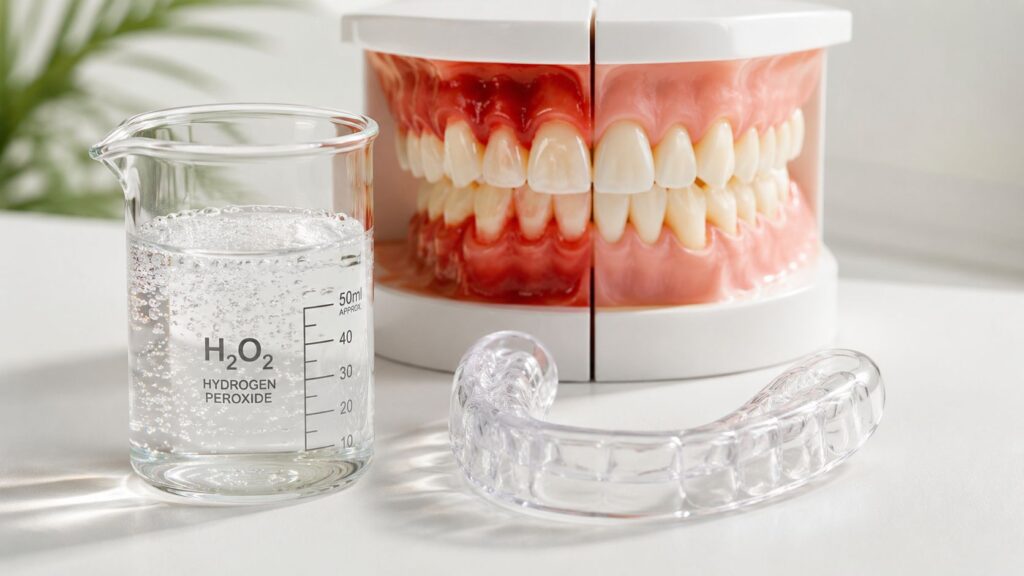
Bleeding when brushing, a sour taste that keeps coming back, or gums that feel puffy even after careful home care can make anyone worry about what's going on. In Scottsdale, patients often try to fix those warning signs on their own before they search for a dentist near me, but gum disease usually needs more than a quick rinse or a better toothbrush. Hydrogen peroxide and periodontal disease is a real topic in dentistry because low-concentration peroxide can support gum care, but it works best as part of a plan built around professional evaluation, cleaning, and maintenance with Dr. Eric Wiitala DDS in Scottsdale.
The practical question isn't whether peroxide has a role. It's whether it's being used in the right way, at the right strength, and for the right problem. A patient with mild inflammation may need a simple home-care adjustment, while someone with deeper pockets, bleeding, or persistent soreness may need periodontal treatment, deep cleaning, or another in-office solution. The safest path is to treat peroxide as a helper, not a cure, and to know when it's time to stop guessing and get examined by a dentist in Scottsdale, AZ.
Table of Contents
- Understanding Gum Disease and Local Treatment Options
- How Hydrogen Peroxide Works Against Gum Disease
- Clinical Evidence Supporting Hydrogen Peroxide Use
- Recommended Concentrations and Home Use Protocols
- Risks Side Effects and Safety Precautions
- Professional Alternatives and Complementary Treatments
- What to Expect at Our Scottsdale Periodontal Visit
Understanding Gum Disease and Local Treatment Options
A common Scottsdale scenario looks like this. Someone brushes twice a day, flosses most nights, and still notices blood in the sink or gums that feel tender near the back teeth. That pattern can be frustrating because good habits are already in place, but it also signals that plaque and inflammation may be moving past the point where home care alone can calm things down.
Periodontal disease starts when bacteria stay sheltered along and below the gumline. In that environment, brushing can miss the deeper areas, which is why a peroxide rinse or gel may feel helpful yet still fall short if pockets have formed. The most useful way to think about peroxide is as a support tool for periodontal maintenance, not a substitute for a proper exam, cleaning, or deep treatment when the gums are already infected.
For patients looking for local help, the next step is a periodontal evaluation, not a guess. A home product such as shop Perio Kin 0.2 gel can be discussed as part of a routine, but only after a dentist checks whether the gums are healthy enough for that approach. If the problem is deeper, the treatment plan needs to match the disease, not just the symptoms. Learn more about periodontal gum disease care at Dr. Wiitala's office.
Practical rule: if gums bleed often, feel swollen, or stay irritated for more than a short spell, that's a reason to book an exam rather than keep experimenting at home.
How Hydrogen Peroxide Works Against Gum Disease
Hydrogen peroxide works because it releases oxygen when it meets oral bacteria and debris. That matters because many of the bacteria linked with gum inflammation do better in low-oxygen spaces, especially near the gumline and inside shallow pockets. The fizzing isn't a gimmick, it's the visible sign of a chemical reaction that can loosen surface debris and make the mouth less friendly to those bacteria.
What it can do in plain terms
It can help soften the sticky film that builds up between cleanings. It can also reduce the bacterial load around inflamed gum tissue, which may make everyday brushing and flossing more effective. That's why low-concentration peroxide is often discussed as an adjunct, not a replacement for mechanical cleaning.
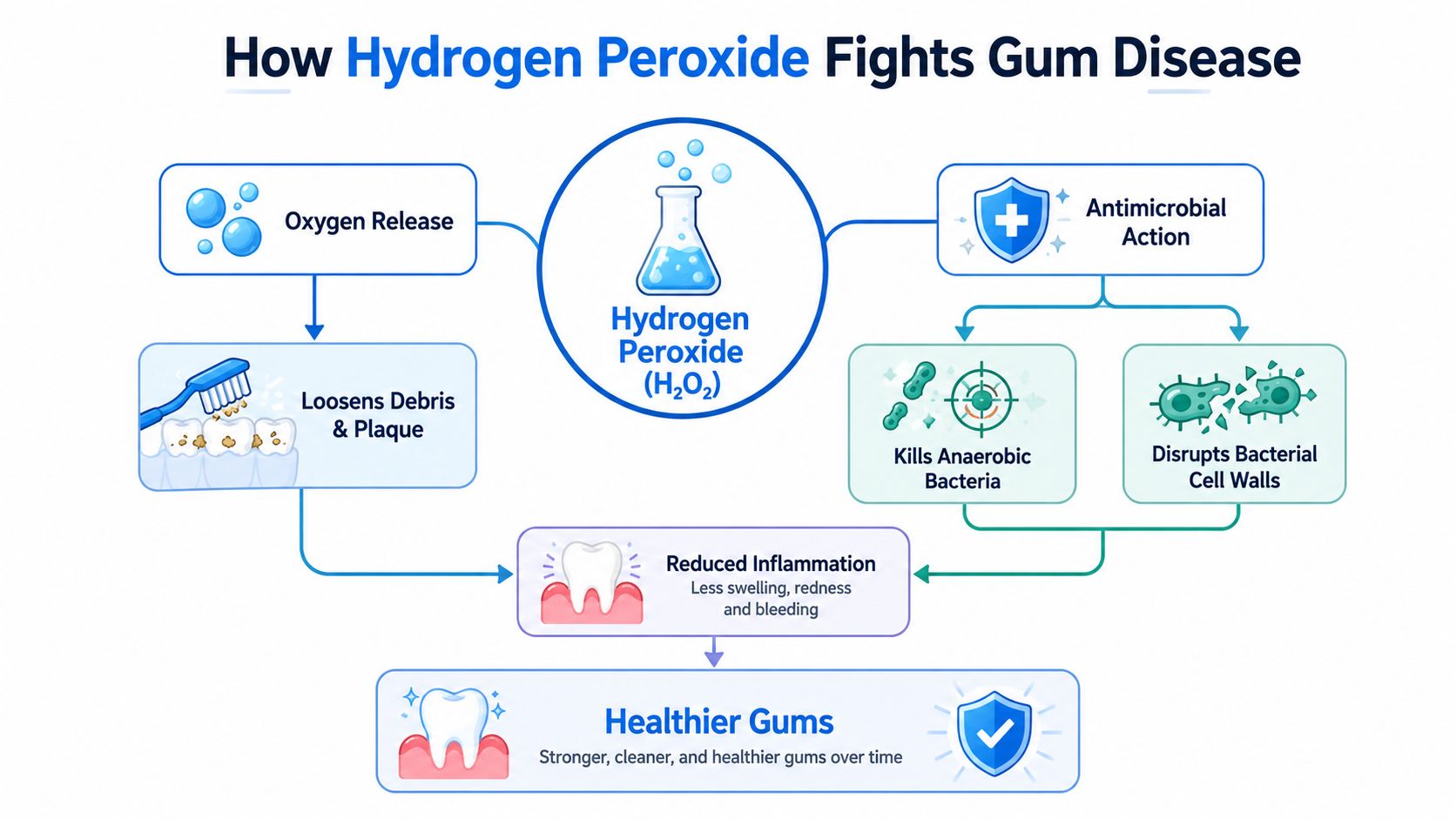
The key is reach. A rinse can touch areas that a toothbrush misses, but it can't clean hardened buildup or access deep periodontal spaces the way professional instruments can. That's why peroxide makes sense for surface control and short-term support, while gum disease itself still needs diagnosis, debridement, and maintenance.
A useful way to explain it to patients is this. Brushing removes the trash you can see. Hydrogen peroxide helps change the environment where bacteria thrive. Neither one replaces professional care when the gums are already under attack.
Clinical Evidence Supporting Hydrogen Peroxide Use
A patient may come in after home brushing and flossing still seeing bleeding along the gumline, and that is often the point where peroxide gets discussed. The best evidence in periodontal care supports low-concentration, professionally guided delivery rather than casual rinsing with a stronger mix. One three-month trial found that 1.7% hydrogen peroxide gel used with scaling and root planing produced statistically significant improvements in pocket depths and bleeding, and a later report on 66 refractory maintenance patients found 75% reduction in whole-mouth bleeding on probing with benefits maintained for up to five years (PubMed).
Why that matters for patients
The practical takeaway is narrow but useful. Hydrogen peroxide can help keep inflammation under better control after professional therapy, especially when the goal is lowering bleeding and supporting long-term stability, not trying to clear periodontal disease on its own. The same report noted no statistically significant difference between smokers and non-smokers, which suggests the approach may still have practical value across major risk groups.
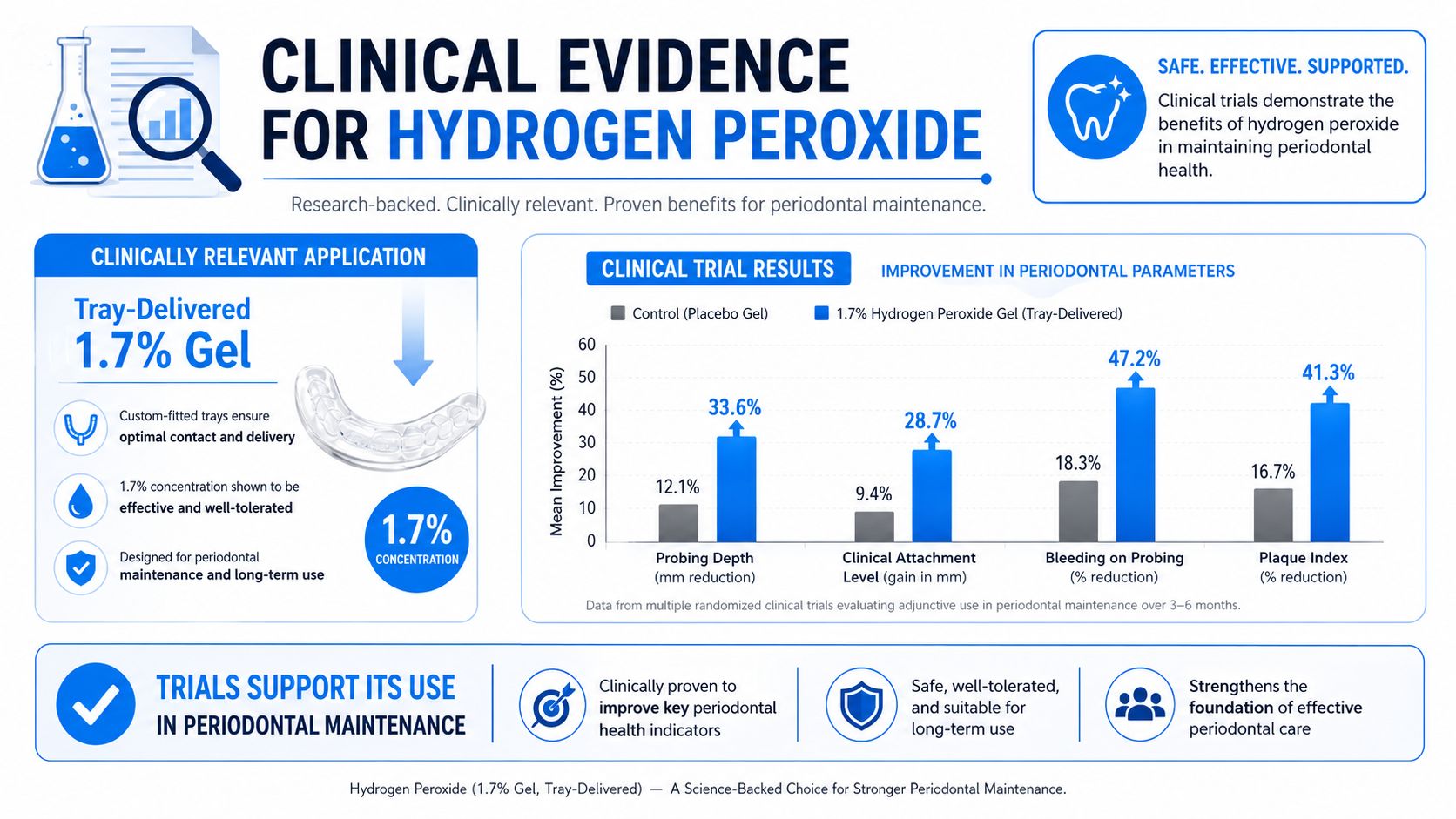
Delivery matters just as much as concentration. Tray-based application reaches areas that a standard rinse often misses, which helps explain why low-dose gel has stayed relevant in maintenance care. In a Scottsdale practice, that difference comes up often with patients who are doing their part at home but still have localized bleeding or deep cleaning history. They usually do better when peroxide is tied to a specific plan, not used as a loose add-on.
The value is not in using more peroxide. It's in using a low dose, delivered consistently, alongside professional periodontal care.
Recommended Concentrations and Home Use Protocols
A patient who wants a simple home routine usually does best with a narrow, conservative plan. The evidence points in that direction. A systematic review found that most mouth-rinse studies used about 1.5% hydrogen peroxide, and the overall pattern was slightly better plaque control and better anti-inflammatory effects than placebo, although chlorhexidine performed better overall (PMC). For home care, that sets a realistic expectation. Hydrogen peroxide can support hygiene, but it is not a replacement for periodontal treatment.
Concentration Guidelines
| Concentration | Usage | Remarks |
|---|---|---|
| About 1.5% | Short-term rinse use in studies | Generally showed better plaque and inflammation outcomes than placebo, but not better than chlorhexidine overall |
| 1.7% gel | Tray-delivered periodontal maintenance | Studied as an adjunct to scaling and root planing, with durable bleeding reduction in maintenance patients |
| 3% or less | Historical use reviewed in dentistry | Safety review reported only occasional, transitory irritant effects in some patients (PubMed) |
How that translates to home use
The safest pattern is conservative and deliberate. Peroxide should be used only as directed, never swished endlessly, and never treated like an everyday substitute for brushing and flossing. Patients with active periodontal disease need individualized instructions because a rinse that feels harmless can still irritate inflamed tissue if it is used too aggressively.
Tray delivery changes the equation for some patients. A custom tray can place the gel where a rinse does not reach as well, including below the gumline, while a rinse covers more surface area but with less precision. In practice at Dr Wiitala's Scottsdale office, I see the difference in patients who are trying to manage bleeding at home after professional care. They do better when peroxide is tied to a defined routine, with clear limits and follow-up, rather than used loosely whenever the gums feel irritated.
For patients with custom trays, the goal is targeted contact below the gumline. For patients using a rinse, the benefit is broader surface exposure, but also less precision. The right protocol depends on the condition being treated, not just on convenience.
Risks Side Effects and Safety Precautions
A common mistake is to assume stronger peroxide cleans better. In periodontal care, that is rarely true. Low-strength peroxide has a limited role, and even then it needs careful use because inflamed tissue can react to it.
Patients with mouth sores, fragile gum tissue, or ongoing irritation need extra caution. Burning, tenderness, altered taste, and a short-lived increase in soreness are signs to stop and reassess. If the gums are already ulcerated, peroxide can aggravate the area instead of calming it.
Dry mouth, deep pockets, and heavy tartar buildup call for a different mindset. Peroxide may reduce surface bacteria, but it does not remove hardened deposits or correct the pocketing that keeps periodontal disease active. In that setting, home use should never replace a periodontal exam when bleeding, swelling, or bad breath continue.
If peroxide stings, that is a signal from the tissue. Stop using it and let a dentist decide whether the gums need time to heal before any rinse or tray-based approach is resumed.
Simple safety habits make a difference. Use only low concentrations, keep contact time brief, and do not keep increasing the dose if results are slow. A rinse or tray can fit into home care, but worsening symptoms belong in the office, not in a stronger bottle.
For patients who also have recession or tissue loss, a discussion about gum grafting procedures may be more relevant than adding more peroxide. That kind of decision belongs in a periodontal visit, where the cause of the bleeding, not just the surface irritation, can be addressed.
Professional Alternatives and Complementary Treatments
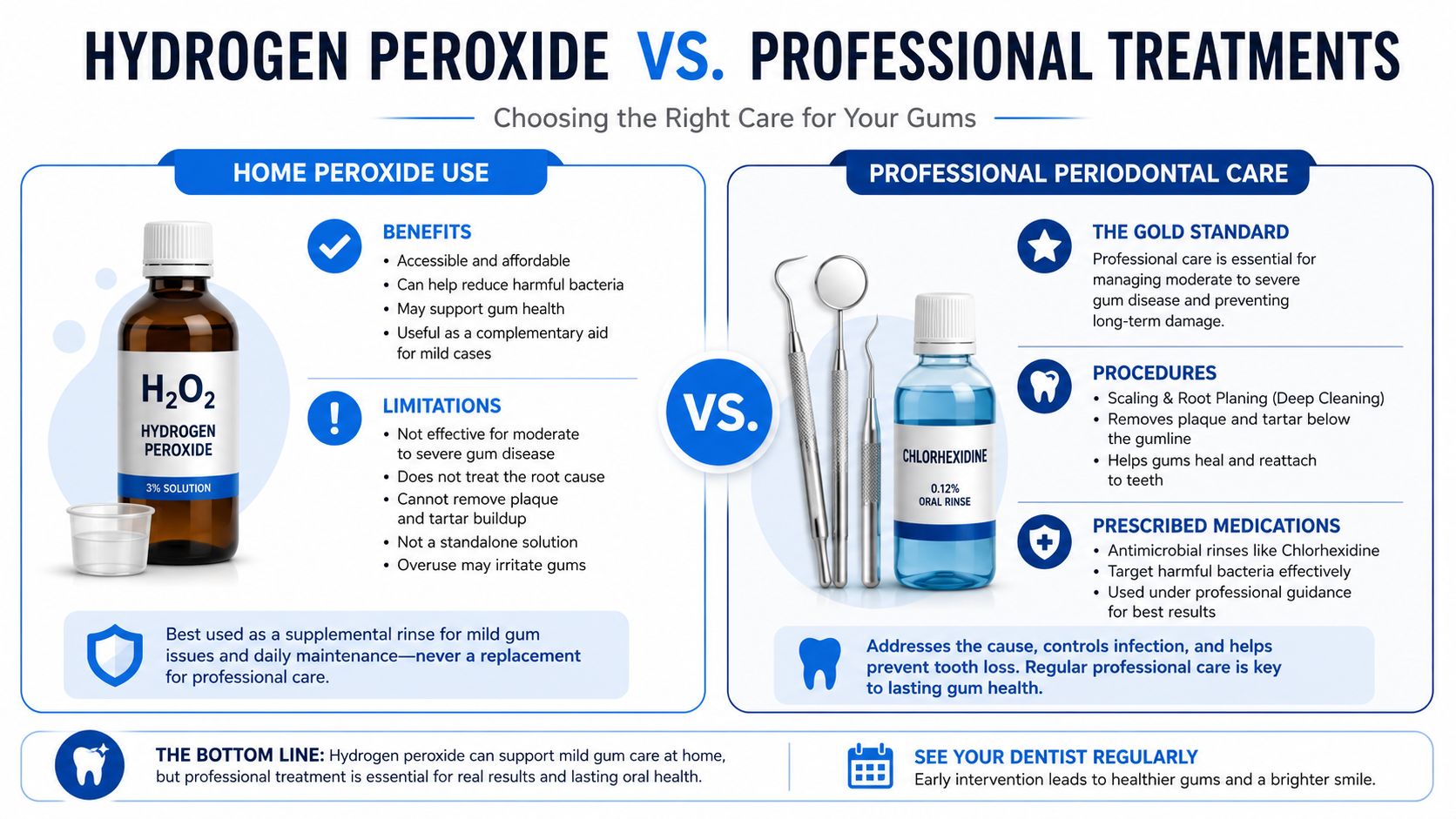
Hydrogen peroxide can support periodontal care, but it does not take the place of treatment for moderate to severe disease. The mainstay remains scaling and root planing, because that removes the deposits and bacteria below the gumline. In a peer-reviewed trial, weekly supragingival irrigation with aerosolized 0.5% hydrogen peroxide used alongside non-surgical therapy improved clinical periodontal status and plasma inflammatory markers over six months, which suggests that delivery method and treatment interval matter when peroxide is used in a professional setting.
A Scottsdale patient with bleeding gums, for example, may feel better after adding peroxide to home care, yet still have deep pockets that keep the infection active. That is the point where professional treatment matters more than another rinse. A periodontal exam can show whether the problem is surface inflammation, trapped deposits, or tissue loss that needs a different plan.
Home peroxide use fits best as maintenance, surface control, and support between visits. It is easy to use, but it has clear limits. Professional periodontal care is built to clean deep, track disease changes, and decide when localized peroxide delivery, irrigation, or other in-office therapies make sense.
That is also where related services fit in. A patient with inflamed gums may need a periodontal evaluation, deep cleaning, or restorative work if decay or broken margins are adding to the problem. When recession is part of the picture, gum grafting procedures may be part of the discussion, since exposed roots and thinning tissue often need a different fix than more peroxide.
Hydrogen peroxide is also different from a prescription antiseptic. It may help calm inflammation, but it does not replace other treatment options, and it should not be used to delay care that the gums clearly need. The best plan matches disease severity, tissue health, and what the patient can maintain at home.
What to Expect at Our Scottsdale Periodontal Visit
A periodontal visit in Scottsdale starts with a careful exam of the gums, pocket depths, bleeding points, and the teeth supporting structures. If the story suggests active disease, the next step may include imaging and a treatment plan that fits the severity of the findings. That could mean a deep cleaning, home-care changes, or a custom maintenance strategy built around the patient's risk level.
Patients also appreciate knowing that the visit is about clarity, not pressure. The point is to identify what's causing the bleeding or soreness, explain what can be managed at home, and separate maintenance care from treatment that needs to happen in the office. If peroxide is appropriate, it can be discussed in that context as a support tool rather than a stand-alone fix.
For local patients searching for a dentist in Scottsdale, AZ or even a cosmetic dentist near me while also dealing with gum concerns, that evaluation can connect the dots between gum health, smile appearance, and long-term comfort. Dr. Eric Wiitala DDS also provides restorative, preventive, and implant care, so the plan can extend beyond the gums if missing teeth, worn teeth, or unstable teeth are part of the picture. The office is at 9755 North 90th Street, Suite B250, Scottsdale, AZ 85258, and patients can call (480) 657-6981 to arrange a visit.
If bleeding gums, bad breath, or recurring irritation have become part of daily life, schedule a periodontal evaluation with Eric Wiitala DDS in Scottsdale. A focused exam can show whether hydrogen peroxide belongs in your home routine, or whether your gums need professional treatment first.