

Walking into a new dental office in Scottsdale can feel like a test you didn't study for. There's the worry about pain, the awkwardness of not knowing the staff, and the bigger question underneath it all, whether this visit is just a cleaning or the start of real answers.
A new patient dental exam should give those answers. At Eric Wiitala DDS, that first appointment is where the clinical picture starts to come together, from hidden decay and gum concerns to bite issues, sleep-related symptoms, and TMJ strain that many people never connect to dentistry. It's the moment a patient stops guessing and starts getting a plan.
Table of Contents
- Why Your First Dental Visit Matters More Than You Think
- What Happens During a New Patient Dental Exam
- Hidden Screenings Most Patients Do Not Expect
- How to Prepare for Your First Dental Appointment
- Understanding Your Exam Results and Personalized Treatment Plan
- Insurance Coverage and Financing Options for New Patients
- Why Scottsdale Patients Choose Eric Wiitala DDS
Why Your First Dental Visit Matters More Than You Think
A first visit can feel simple on the surface. A patient arrives looking for a dentist near me in Scottsdale, sits down, and expects a quick look at the teeth. In reality, that appointment is where the long-term relationship begins, and where the practice learns what's happening before small problems turn into bigger ones.

For new patients, the value of the exam is often in what can't be seen during a casual look. The first evaluation establishes a baseline of oral health, documents what's already present, and gives the dentist a starting point for prevention, repair, and cosmetic planning. At Eric Wiitala DDS, that matters because the office serves people who want routine care, but also patients who may need restorative dentistry, dental implants near me searches answered, or help with jaw and sleep concerns.
Practical rule: a first visit works best when it's treated as a diagnostic appointment, not just a cleaning slot.
That approach fits the reality of dental care. The first exam is where the dentist starts sorting out whether a tooth needs monitoring, whether gum tissue is healthy, whether there's a bite issue, and whether a patient should be seen sooner rather than later. It also gives nervous patients a chance to ask direct questions without being rushed.
The relationship matters as much as the findings. A thoughtful first appointment builds trust, and trust makes the rest of care easier, whether the patient is coming in for cosmetic dentistry, a tooth extraction, or a clean start with a dentist in Scottsdale, AZ. For a practice that has served the community for years, that first meeting is often the foundation for long-term oral health, not a one-time check-in.
What Happens During a New Patient Dental Exam

A first new patient dental exam is organized, methodical, and usually more detailed than people expect. It begins with a conversation and ends with a plan, but each step serves a purpose. The goal is to understand the mouth as a system, not as a row of separate teeth.
Medical and dental history come first
The visit starts with a review of medical and dental history. Medications, prior procedures, symptoms, and past reactions to treatment help the dentist avoid blind spots. That context matters because oral health does not sit apart from the rest of the body, it is shaped by overall health, daily habits, and previous dental work.
Images and visual exam work together
Next come dental X-rays and a careful tooth-by-tooth exam. A visual check alone can miss problems between teeth or below the surface, while radiographs can reveal decay, bone changes, or infection that does not show on the outside. Comparing what is visible in the chair with what appears on the images helps the dentist make a more complete judgment.
For patients who want a broader overview of routine care, a helpful companion piece is what to expect from a dental cleaning, since many first visits pair the exam with hygiene discussion.
The gums, bite, and soft tissues matter too
A full exam does not stop at the teeth. Periodontal assessment, bite analysis, and soft-tissue screening are all part of the picture. Augusta University's patient exam guide describes this as an integrated review that can include periodontal charting and radiographic assessment, not just a quick look at the enamel (Augusta University patient exam guide).
The clearest exam combines what the dentist sees, what the X-rays show, and what the gums reveal under careful charting.
That is why the visit feels more complete than a routine glance. It is designed to catch issues early, build a plan around real findings, and make sure the patient understands what comes next before any treatment starts.
Hidden Screenings Most Patients Do Not Expect
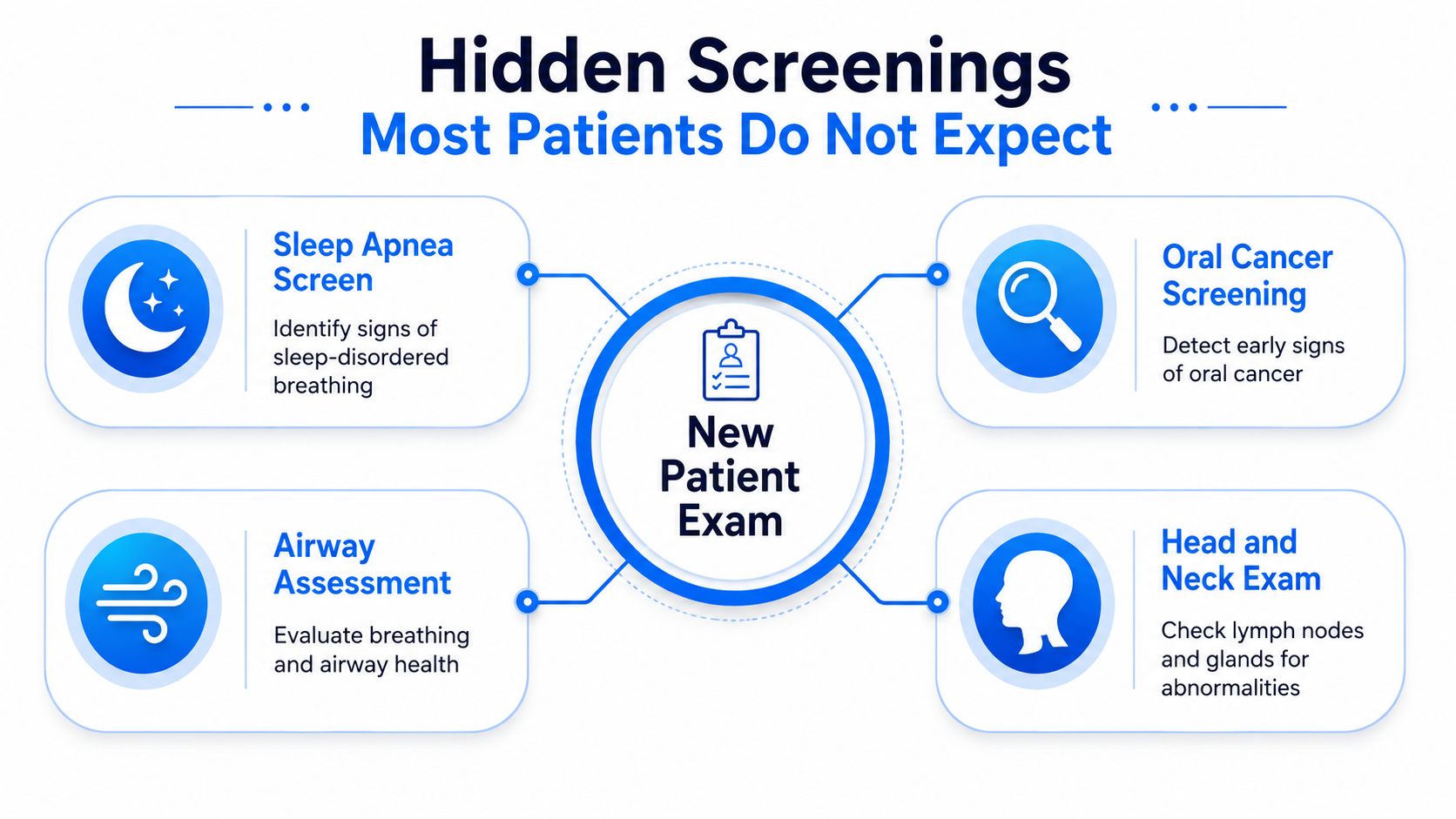
A first dental visit often starts with cavities, but it does not end there. The questions a dentist asks can reveal patterns tied to sleep, breathing, jaw function, and daily strain on the teeth. Snoring, grinding, headaches, jaw clicking, and mouth breathing are not random topics. They help identify signs that the mouth and jaw may be reacting to a larger health issue.
Sleep and airway concerns show up in the chair
A patient may sit down expecting a standard tooth check and leave with a conversation about sleep quality or breathing. Snoring, mouth breathing, and worn tooth surfaces can point a dentist toward sleep-disordered breathing or airway strain, even before the patient has connected those symptoms to dental care. At Eric Wiitala DDS, that matters because snoring and sleep apnea oral appliance therapy are part of the care discussion, so these clues belong in the first visit.
TMJ and grinding often hide behind “normal” wear
Jaw clicking, morning tightness, worn teeth, and headaches can point to clenching or bruxism. Many patients do not treat those signs as urgent because they may come and go, or feel mild compared with a toothache. A dentist who checks bite balance and muscle tension early can help limit further wear and decide whether a custom guard, TMJ assessment, or another conservative option fits the situation.
Standard first-visit intake questionnaires commonly include screening for snoring, mouth breathing, jaw clicking, clenching, grinding, headaches, and worn teeth. That wider view helps the dentist pick up problems that do not show up as a cavity but still affect long-term oral health. The initial patient dental questions make that broader screening obvious, even before treatment begins.
The same whole-person approach includes an oral cancer screening. The dentist checks the soft tissues, the tongue, the cheeks, and the neck structures for anything that needs a closer look. In a practice that also addresses TMJ-related symptoms with therapeutic Botox when appropriate, the first exam becomes a practical chance to catch quiet problems before they turn into harder ones to manage.
How to Prepare for Your First Dental Appointment
A calm appointment starts before the patient ever sits in the chair. The best preparation is practical, not complicated, and it usually saves time once the visit begins. Patients who come ready with records and questions often leave with a clearer plan.

Bring the right information
Medical history, current medications, insurance details, and any previous dental records are worth gathering ahead of time. That information helps the team verify what care is appropriate and whether older X-rays or notes can be useful. If a patient has had a long gap in care, bringing even partial records is better than bringing none.
Say the uncomfortable things early
Dental anxiety, recent pain, sensitivity, or a bad past experience should be mentioned right away. A good first appointment is easier when the dentist knows what to avoid, what to explain more slowly, and where the patient wants extra reassurance. That matters even more if the patient is looking for a cosmetic dentist near me but also has untreated discomfort or fear about treatment.
The office also helps with practical steps after booking. Eric Wiitala DDS describes its first-time visit process in the new patient visit details. That is helpful when patients want to know what the day will feel like before they arrive.
Good preparation lowers stress.
A patient who brings questions, records, and a clear sense of priorities gives the dentist a much better starting point.
Timing matters too. It helps not to let the appointment drift once it is scheduled. The Tufts University study of 26,826 new patient exam appointments found 10,454 no-shows, a 38.97% no-show rate, and when lead time went beyond 5 days, the no-show rate rose to 49.79% (Tufts University study). That is a clear reminder that slow, fragmented scheduling can make follow-through harder, especially for new patients trying to get back into care.
Understanding Your Exam Results and Personalized Treatment Plan
A good exam ends with clarity, not confusion. The dentist should explain findings in plain language, show what the X-rays or charting mean, and connect each concern to a sensible next step. Patients deserve to know what is urgent, what can wait, and what is optional.
Findings should lead to a real plan
If the exam shows decay, the next discussion may involve tooth-colored, mercury-free fillings. If a tooth is cracked or structurally weakened, a crown may be the better long-term choice. If missing teeth are affecting chewing or bite stability, the conversation may move toward bridges, dental implants, or full-arch solutions depending on the situation.
The same logic applies to aesthetics. Stains, spacing, or minor shape concerns may be addressed with whitening, bonding, or porcelain veneers once the foundation is healthy. That sequencing matters because cosmetic treatment works best when the mouth is stable enough to support it.
Gum health changes the sequence
When periodontal findings are present, the plan shifts toward gum therapy and better maintenance. That's not a setback, it's the patient getting the right care in the right order. The treatment plan should explain why the recommendation is being made, what it protects, and how it connects to the patient's daily comfort.
A treatment plan should answer three questions, what was found, what it means, and what happens next.
At Eric Wiitala DDS, that review can also include sleep and TMJ options when the exam points in that direction. The point isn't to sell a long list of treatments. It's to match the findings with the least complicated path that still protects the patient's health, function, and appearance.
Insurance Coverage and Financing Options for New Patients
The financial side of a first visit is easier to handle when the billing language is clear. For an oral evaluation, the CDT code D0150 applies, and Indian Health Service guidance states it can be used when a general dentist or specialist examines a new patient or an established patient with a significant change in health status (IHS coding guidance). In practical terms, patients should think of it as the code tied to a full evaluation, not a stand-alone promise that every plan covers every service the same way.
Coverage can differ by component
| New Patient Exam Coverage Overview | What It Covers | Typical Insurance Coverage |
|---|---|---|
| Comprehensive oral evaluation | Review of oral health, history, findings, and treatment needs | Often covered under preventive or diagnostic benefits, depending on the plan |
| X-rays | Diagnostic images that help identify issues below the surface | Often covered with limits based on plan timing and necessity |
| Periodontal assessment | Gum charting and related evaluation | Coverage varies by plan and clinical need |
| Follow-up treatment planning | Discussion of recommended next steps | Usually part of the evaluation visit, though actual treatment is billed separately |
Patients should ask whether the plan covers a full exam, which X-rays are included, and whether a new patient evaluation counts as preventive or diagnostic care under their policy. Those questions matter because the exam and any treatment that follows are billed differently. Transparent offices also explain costs before any major treatment begins, which helps patients compare timing, sequencing, and financing more comfortably.
Why Scottsdale Patients Choose Eric Wiitala DDS
Scottsdale patients often want a dentist who can handle routine care and more complex needs without making the first visit feel fragmented. Eric Wiitala DDS fits that model with preventive care, restorative dentistry, cosmetic services, implant options, orthodontic aligners, and sleep and TMJ support in one practice. The office is located at 9755 North 90th Street, Suite B250, Scottsdale, AZ 85258, with regular Monday through Thursday office hours and Friday by appointment.
Dr. Wiitala has more than 20 years in practice, graduated from Indiana University School of Dentistry in 1999, and is recognized as one of the Valley's Top Dentists by PHOENIX magazine, as noted on the practice site. The office also emphasizes mercury-free, tooth-colored materials and an approach that includes nutritional health, which appeals to patients who want care that looks beyond a single tooth.
For readers comparing options, the dentist bio is available here: meet Dr. Wiitala. That background matters because a strong first exam depends on experience, communication, and the ability to connect a patient's symptoms to the right service path.
Call (480) 657-6981 or request an appointment online to get started with a new patient dental exam in Scottsdale. If you've been searching for a dentist near me, need help with sleep or TMJ symptoms, or want a clear plan for cleanings and exams, Eric Wiitala DDS can help you take the next step.
Eric Wiitala DDS offers new patient dental exams, preventive care, restorative treatment, cosmetic services, implants, and sleep and TMJ support in Scottsdale. If you're ready to understand what's happening in your mouth and what should come next, visit Eric Wiitala DDS to schedule your first appointment.