

Traditional porcelain veneers typically require about 0.5 mm to 1.5 mm of tooth reduction, while Lumineers are roughly 0.2 mm to 0.3 mm and designed for minimal-prep or no-prep placement. The practical choice depends on the patient's enamel, bite, discoloration, and existing tooth position, not only on the desire to preserve enamel.
A Scottsdale resident may reach this decision after noticing a dark stain that teeth whitening won't lift, a small gap that appears in every photograph, or worn edges that make the smile look older than it feels. Search results for a cosmetic dentist near me can make the choice harder, especially when one page emphasizes “no drilling” and another focuses on strength and long-term wear.
The most useful question isn't which label sounds better. It's whether adding a thin restoration or removing some enamel will create the healthiest, most stable result for that particular smile.
Table of Contents
- Finding Your Local Cosmetic Dentist in Scottsdale
- Understanding the History and Clinical Reality of Veneers
- Porcelain Veneers vs Lumineers Side by Side
- The Real Difference Is Reversibility and Failure Patterns
- Which Option Fits Your Smile Goals and Dental Health
- What to Expect During Your Veneer Consultation in Scottsdale
- Making the Right Choice for Your Teeth and Budget
- Take the Next Step with a Trusted Scottsdale Dentist
Finding Your Local Cosmetic Dentist in Scottsdale
A Scottsdale patient may spend an evening scrolling through cosmetic dentistry pages, comparing before-and-after photos while wondering what happens after the smile looks finished. A gap, stain, or uneven edge can feel like a small concern, but the treatment decision can affect tooth structure, bite comfort, cleaning, and future dental care.
At 9755 North 90th Street, Dr. Eric Wiitala's practice provides a local setting for discussing those concerns without reducing the decision to a brand name. The office's approach connects cosmetic dentistry with preventive care, restorative dentistry, bite evaluation, gum health, and long-term maintenance. That broader view matters for a patient searching for a dentist in Scottsdale, AZ who can assess the whole mouth before recommending a cosmetic change.
A consultation should clarify whether traditional porcelain veneers, a minimal-prep approach, dental bonding, clear aligners, teeth whitening, or another treatment matches the underlying condition. A patient with healthy, well-positioned teeth may have different options from someone with heavy discoloration, worn enamel, crowding, or signs of bruxism.
Why local guidance matters
Patients often want a confident answer before they schedule. Yet a photograph or online comparison can't show enamel thickness, bite contacts, jaw movement, existing fillings, or whether a thin veneer would make a tooth look too prominent.
A health-first consultation gives Scottsdale patients space to ask practical questions:
- How much enamel would be changed?
- Could the result affect the bite or sensitivity?
- What kind of repair would be possible if a veneer chips or debonds?
- Would whitening, bonding, orthodontic treatment, or restorative care solve part of the concern first?
The right recommendation should make sense not only in a smile photograph, but also during meals, brushing, speaking, and routine dental visits.
Understanding the History and Clinical Reality of Veneers
Porcelain veneers are engineered restorations, not temporary cosmetic stickers. Their modern clinical story explains why the quality of the enamel bond and the preparation design matter so much.
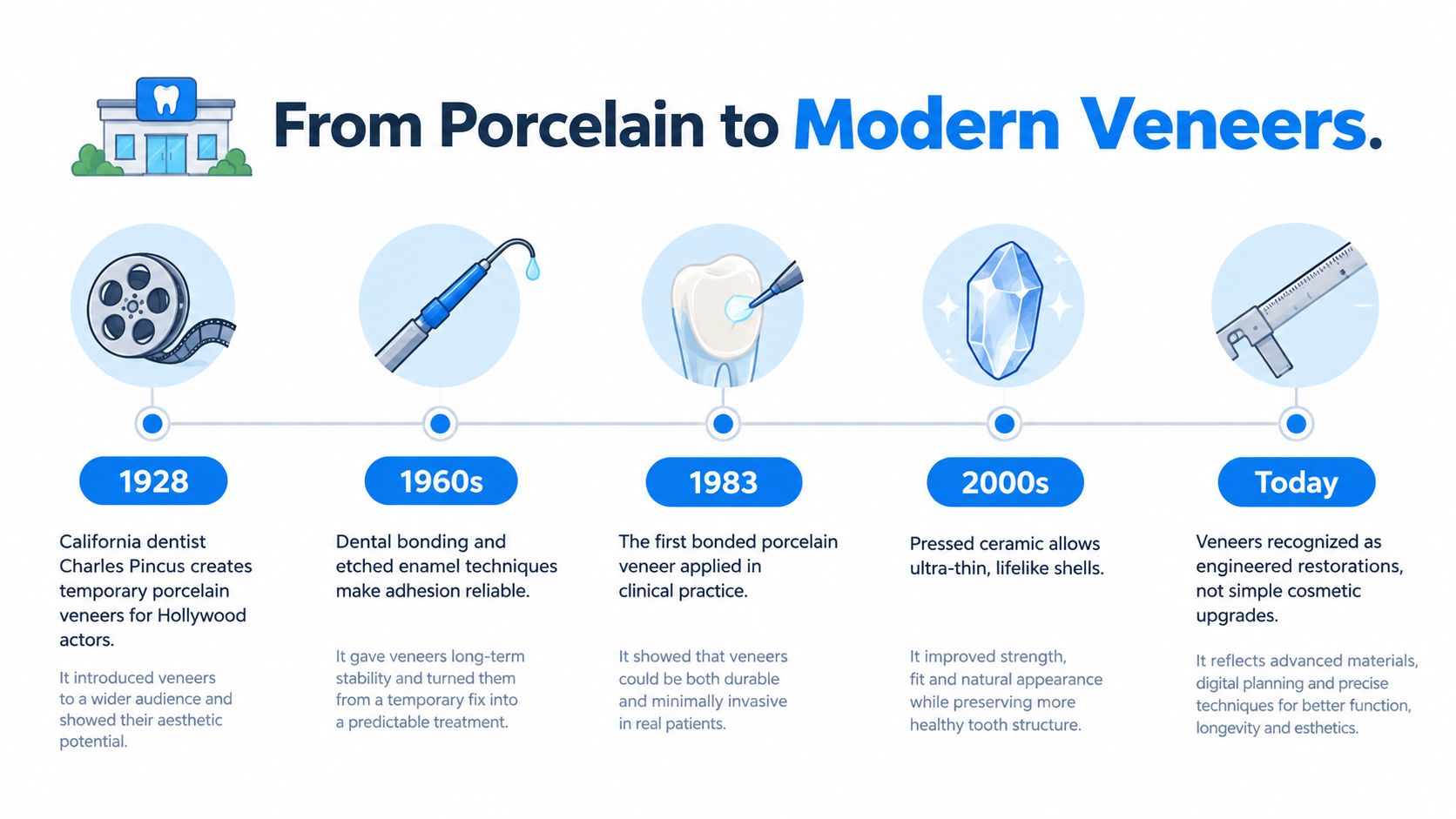
California dentist Charles Pincus is credited with creating early veneers for Hollywood film use in 1928. In 1959, Dr. Michael Buonocore introduced acid etching to improve adhesion to enamel. Then, in 1982, research by Simonsen and Calamia established that porcelain veneers could be etched and bonded permanently. These milestones shifted veneers from simple surface coverage toward carefully bonded restorations built around enamel preservation and controlled preparation. The historical progression is summarized visually below.
Published reviews report approximately 95% to 97% survival at 5 years and around 90% to 96% survival at 10 years for porcelain veneers. Other clinical series report 91% to 96% survival at 10 to 20 years, according to the review of dental veneer materials and outcomes. Survival doesn't mean every restoration remains untouched. It means the restoration remains in service under the definitions used by the clinical study.
Clinical meaning: Bonding breakthroughs matter because modern veneer planning depends on how much healthy enamel can support a stable bond, not simply on placing a cosmetic shell over a tooth.
From brand names to bonding principles
This history also helps explain why two restorations with similar cosmetic goals can require different preparation strategies. Traditional porcelain veneers can provide room to reshape a tooth and control the final contour. Ultra-thin restorations rely more heavily on the existing tooth position and the ability to bond securely without creating an overly prominent result.
Patients exploring cosmetic veneer options may find it helpful to compare materials and preparation concepts rather than treating every veneer as interchangeable. Scottsdale patients can also review the practice's information about natural-looking veneers before bringing questions to a consultation.
The clinical record supports a balanced view. Traditional porcelain veneers can perform reliably when the dentist selects the case carefully, protects the bite, and follows a sound bonding protocol. Lumineers can also perform well in selected cases, but “selected” is the important word.
Porcelain Veneers vs Lumineers Side by Side
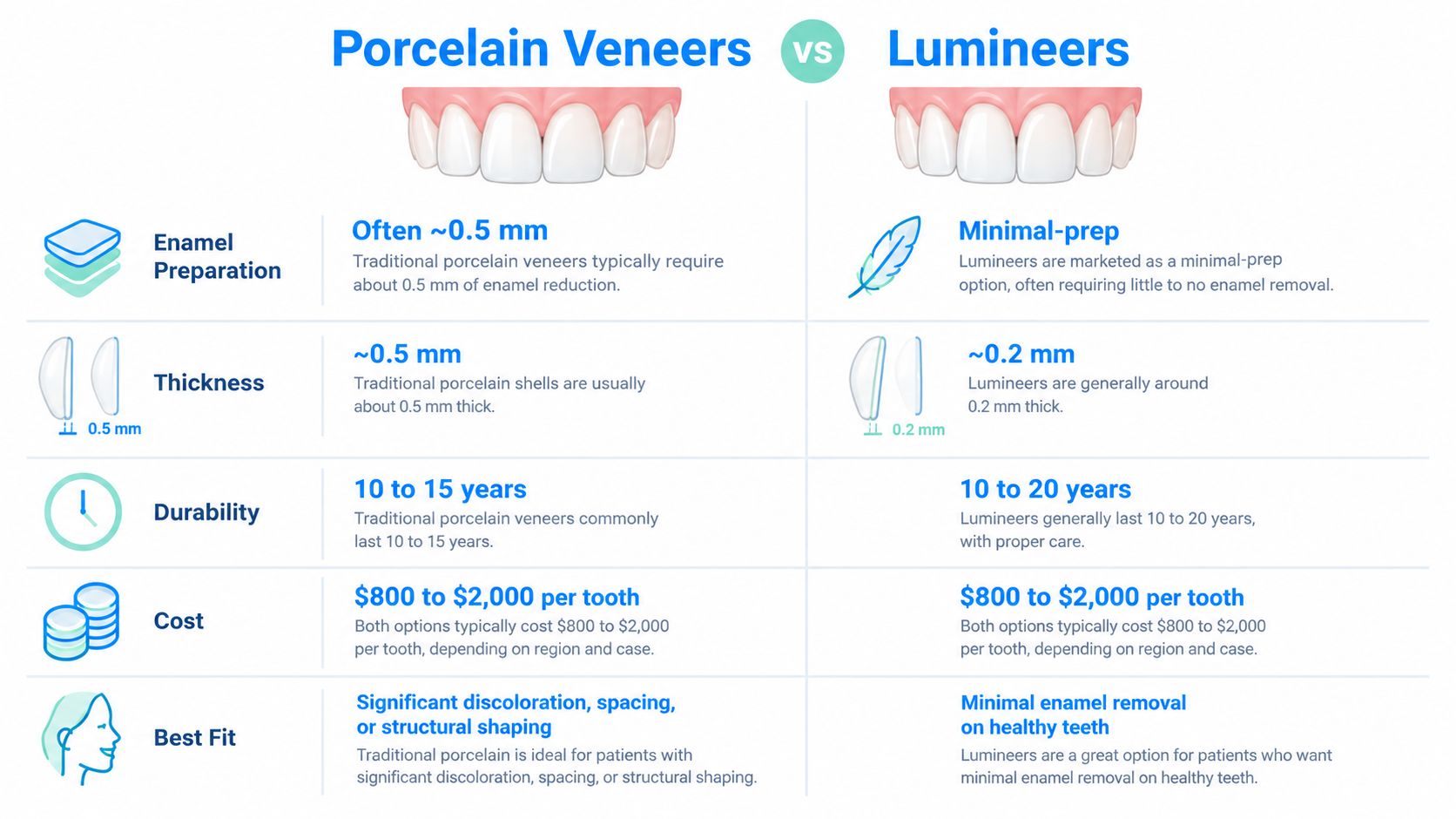
The core distinction is preparation. Traditional porcelain veneers typically require about 0.5 mm to 1.5 mm of tooth reduction, while Lumineers are approximately 0.2 mm to 0.3 mm and designed for minimal-prep or no-prep placement, as described in this clinical comparison of veneer thickness and preparation.
| Criteria | Traditional Porcelain Veneers | Lumineers |
|---|---|---|
| Enamel preparation | About 0.5 mm to 1.5 mm of reduction may be required | Roughly 0.2 mm to 0.3 mm thick, designed for minimal-prep or no-prep placement |
| Thickness | Thicker than ultra-thin approaches, allowing more control over shape and color | Ultra-thin, so existing tooth position has a greater influence on the result |
| Durability | Strong long-term clinical performance when preparation, bonding, and bite management are appropriate | Can perform well in carefully selected cases, but the thin design may not suit every bite or tooth position |
| Cost | Varies by dentist, laboratory, material, and case complexity | Varies by dentist, laboratory, material, and case complexity |
| Treatment timeline | May involve preparation, provisional protection, laboratory fabrication, and final bonding | May involve minimal preparation, fabrication, try-in, and bonding, depending on the case |
What the thickness difference changes
A thicker conventional veneer may give the dentist more ability to mask discoloration, alter length, close spacing, and refine the visible proportions of a tooth. That doesn't automatically make it the healthier option. Removing enamel is a permanent step, so the dentist has to decide whether the aesthetic and functional benefit justifies it.
A Lumineer may preserve more natural tooth structure, but placing material without enough room can affect contour. If a tooth already sits forward, overlaps another tooth, or has a darker underlying shade, adding even a thin shell may create a bulky appearance or an incomplete color change. The same conservative design that suits one Scottsdale smile may be unsuitable for another.
Why the table can't make the decision alone
Cost is important, but it shouldn't be separated from preparation, maintenance, and potential repair. A low-preparation option isn't automatically less expensive over the full life of the restoration, and a conventional veneer isn't automatically excessive. The treatment plan should account for the number of teeth, existing restorations, bite forces, desired shade, and cleaning access.
For a plain-language discussion of how veneers relate to bonding, patients can review veneer and bonding treatment information and then use the consultation to ask how the principles apply to their own enamel and bite.
The Real Difference Is Reversibility and Failure Patterns
The most important difference between porcelain veneers and Lumineers may be what happens when the restoration needs attention. If enamel has been modified, veneer treatment is generally not reversible. The American Dental Association emphasizes that irreversible dental procedures should be performed only by licensed, trained dentists, as summarized in this discussion of veneer reversibility and professional care.
That principle changes the consultation. A patient shouldn't ask only, “Which option removes less enamel?” The more useful questions are, “How will the teeth meet after treatment?” and “What happens if the restoration chips, debonds, or needs replacement?”
Failure isn't one single event
Veneer failure can appear as marginal chipping, debonding, wear, fracture, sensitivity, or an aesthetic problem caused by contour or shade. Those outcomes create different burdens. A restoration that debonds may sometimes be evaluated for rebonding, while a fractured restoration may require fabrication of a replacement. The practical consequence depends on the material, the remaining tooth structure, the bond, and the forces placed on the teeth.
A patient who grinds at night or clenches during the day presents a different planning challenge from a patient with a relaxed bite and stable tooth position. Bite dynamics can concentrate force at the edges of veneers. Existing protrusion or crowding can also make a no-prep design look fuller because the restoration adds material instead of creating space.
The veneer label doesn't control the outcome. Case selection, enamel quality, preparation design, bonding technique, and bite management do.
Choosing for daily life
Someone who frequently clenches while working, exercises, or sleeps may need a discussion about a custom occlusal guard before cosmetic treatment. Someone with thin enamel may place a higher value on preserving the remaining enamel than on achieving maximum reshaping. Someone with gum inflammation or untreated decay may need periodontal or restorative care first, regardless of the preferred veneer type.
For Scottsdale patients, the decision also includes maintenance habits. Coffee, hard foods, nail biting, poor flossing, and missed examinations can affect any restoration. A dentist should explain how the proposed design fits the patient's actual routine, not an idealized version of it.
Which Option Fits Your Smile Goals and Dental Health
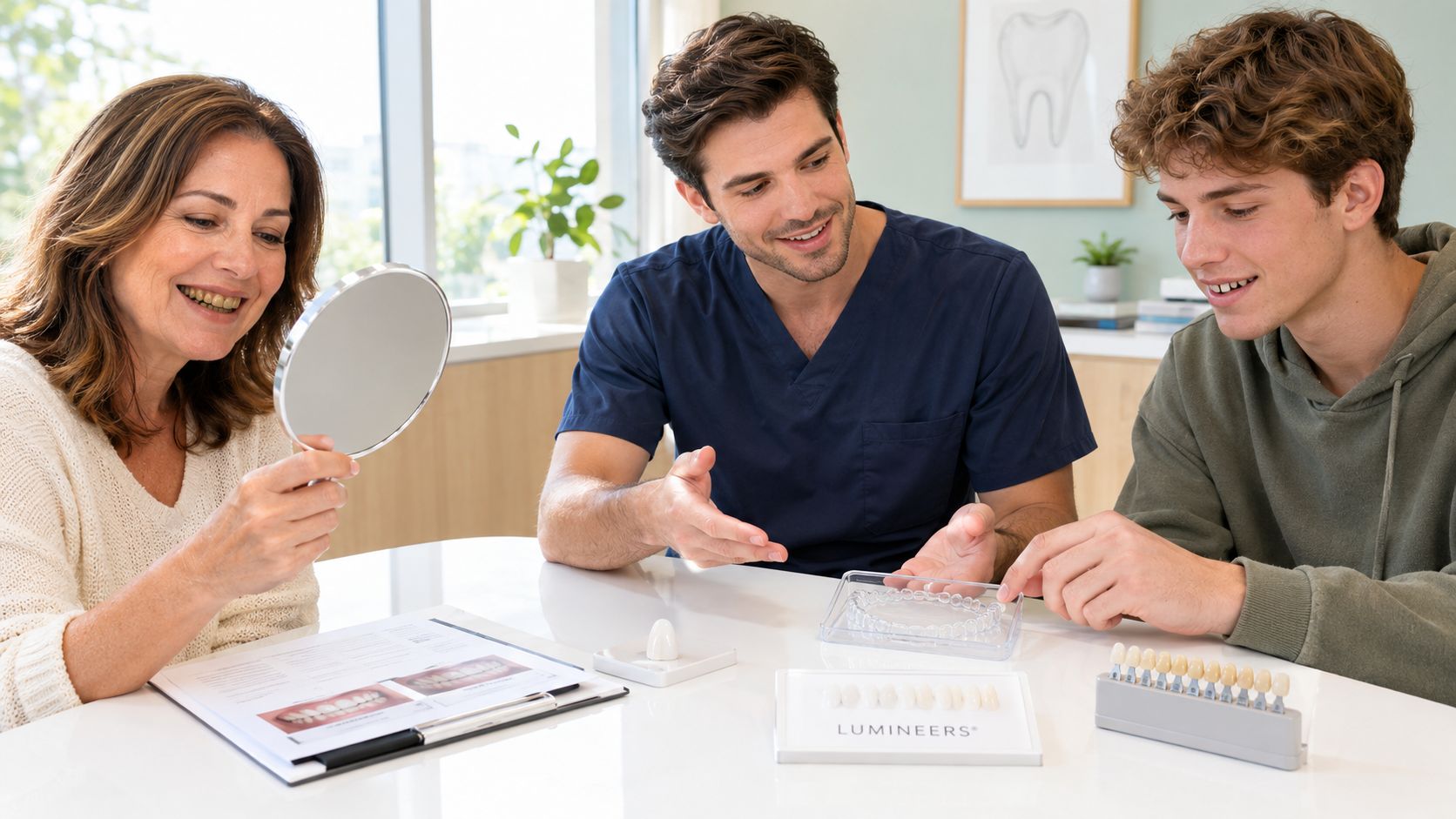
A conventional porcelain veneer may fit a patient whose smile goals require substantial visual reshaping. Consider a Scottsdale adult with deep discoloration, uneven tooth lengths, worn edges, and small spaces between several front teeth. A dentist may need controlled reduction to create enough room for a natural contour and a consistent shade.
Another patient may have straight teeth, healthy enamel, and only minor changes in color or shape. For that person, an ultra-thin approach may deserve consideration because preserving tooth structure is a central priority. The design still has to fit the existing position of each tooth. Minimal preparation doesn't remove the need for careful diagnosis.
Two different patient profiles
A patient with a slightly rotated tooth may assume Lumineers are automatically preferable because they involve little preparation. Yet adding material to a tooth that already projects outward could make the tooth appear more prominent. Clear aligners, reshaping, bonding, or conventional veneers may offer a more balanced route, depending on the examination.
A patient with mild staining may assume conventional veneers are unnecessarily aggressive. If whitening cannot address the underlying color and the patient wants a controlled change in shape, preparation may provide the space needed for a lifelike result. The responsible choice depends on what the dentist can achieve while preserving a healthy bond and comfortable bite.
Long-term data show that ultrathin Lumineers can perform well in selected cases. One clinical follow-up reported 100% retention over 140 to 240 months and 94% clinical success, representing 157 of 167 restorations, at a mean recall of 15.2 years. Broader ceramic veneer literature reports about 97% survival at 5 years and 96% to 98% survival at 5 years for feldspathic and glass-infiltrated ceramic veneers, according to this clinical follow-up and ceramic veneer evidence.
Those findings support neither a universal Lumineers recommendation nor a universal conventional veneer recommendation. They support matching the restoration to the patient.
What to Expect During Your Veneer Consultation in Scottsdale
The first appointment should feel like an evaluation, not a commitment. At Dr. Eric Wiitala's Scottsdale office, a new patient visit can begin with a review of health history, dental concerns, symptoms, previous treatment, and the changes the patient hopes to see.
The clinical examination may include dental x-rays, photographs, gum evaluation, tooth-by-tooth assessment, and a review of the bite. These steps help identify decay, cracks, worn enamel, gum concerns, or missing-tooth problems that could affect cosmetic treatment. They also help distinguish a cosmetic concern from a restorative or functional problem.
A practical consultation sequence
Discuss the desired result. The patient explains concerns such as stains, gaps, short teeth, uneven edges, or an uneven smile line.
Assess the foundation. The dentist evaluates enamel, gums, existing fillings, tooth position, jaw movement, and bite forces before discussing preparation.
Review alternatives. Depending on the findings, options may include porcelain veneers, bonding, teeth whitening, clear aligners, crowns, or periodontal treatment.
Plan the design. The discussion can address shade, shape, length, tooth proportions, and how the proposed restorations should function during speaking and chewing.
Explain maintenance. Patients should understand cleaning, follow-up visits, bite protection, and what to do if a restoration feels loose or changes.
The practice uses mercury-free, tooth-colored restorative materials and emphasizes patient education. That approach connects cosmetic dentistry with general dental care rather than treating the smile as separate from oral health.
Patients searching for a dentist near me in Scottsdale may also need support beyond veneers, including a new patient exam, professional cleaning, dental x-rays, gum therapy, restorative dentistry, or an emergency dental visit. Addressing those needs first can make a later cosmetic decision safer and more predictable.
Making the Right Choice for Your Teeth and Budget
An online comparison can help a patient prepare questions, but it can't determine whether a tooth has enough enamel, whether a bite is stable, or whether a minimal-prep restoration would look natural from every angle. The decision should come from an examination by a licensed dentist who can evaluate both appearance and function.
| When This May Fit Better | Traditional Porcelain Veneers | Minimal-Prep or Ultra-Thin Veneers |
|---|---|---|
| Enamel condition | May fit when controlled preparation is needed to create space and a stable bonded design | May fit when healthy enamel and tooth position allow a conservative placement |
| Bite forces | May require careful planning when the patient has strong bite forces or bruxism | May be considered only when the thin design can tolerate the patient's bite and contours |
| Aesthetic goals | Often provides more room for reshaping, length changes, and masking significant discoloration | May suit minor color or shape concerns when adding limited material preserves a natural profile |
| Tooth position | Can help create a planned visual contour when teeth need significant reshaping | Works best when teeth are already positioned favorably for added material |
| Maintenance preference | Requires acceptance that enamel modification is permanent | May preserve more enamel, but still needs professional evaluation and ongoing care |
Patients comparing veneers with less invasive cosmetic treatments can review the practice's information on veneers versus dental bonding before making a shortlist of questions. The goal isn't to choose the least preparation at any cost. The goal is to choose a design that protects tooth health, supports the bite, and meets the patient's expectations.
Budget planning should include diagnosis, any needed preliminary treatment, laboratory work, follow-up, and future maintenance. A consultation gives the patient a clearer picture without requiring a decision during the first conversation.
Take the Next Step with a Trusted Scottsdale Dentist
A veneer consultation is appropriate for more than a patient seeking a brighter smile. It can help clarify whether discoloration needs whitening, whether small defects can be corrected with bonding, whether worn teeth need restorative care, or whether bite protection should come before cosmetic treatment.
Dr. Eric Wiitala provides cosmetic, family, and general dentistry at 9755 North 90th Street, Suite B250, Scottsdale, AZ 85258. The practice also offers cleaning and exams, dental x-rays, tooth-colored fillings, crowns, bridges, dental implants, clear aligners, periodontal care, custom occlusal guards, and support for TMJ and sleep-related breathing concerns.
Patients looking for Dental implants near me, a cosmetic dentist near me, an emergency dentist, or information about tooth extraction can contact the Scottsdale office to discuss the appropriate next step. Missing teeth, damaged teeth, jaw discomfort, and cosmetic concerns may require different forms of care, and a thorough evaluation helps keep those decisions connected.
A good treatment plan should leave the patient knowing what will change, what will remain natural, how the bite will be managed, and what maintenance will be expected. Scottsdale residents can call (480) 657-6981 to request an appointment and discuss their smile and oral health goals.
Eric Wiitala DDS offers porcelain veneers, bonding, teeth whitening, restorative dentistry, dental implants, and general dental care for Scottsdale patients who want a health-focused plan. Schedule a consultation to discuss whether traditional porcelain veneers or a minimal-prep approach fits the patient's teeth, bite, and goals, then visit Eric Wiitala DDS to contact the practice.