
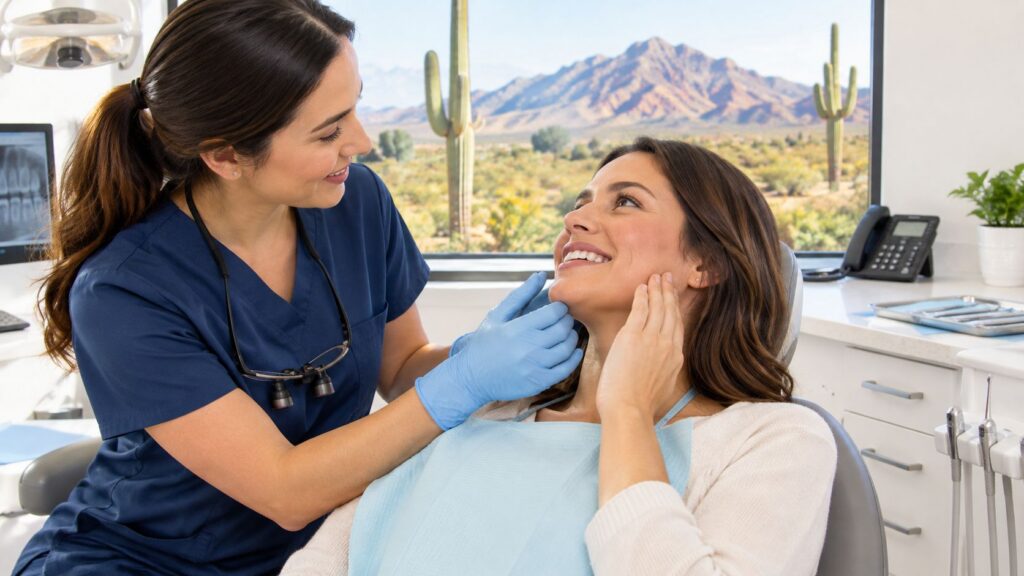
You wake up in Scottsdale with a toothache that has become impossible to ignore. Chewing hurts, cold water sends a sharp jolt through your jaw, or swelling has appeared along your cheek. Finding a same-day emergency dentist in Scottsdale can feel urgent because it is, but the right first step is knowing whether the problem belongs in a dental office or a hospital.
Eric Wiitala DDS provides general, restorative, cosmetic, and urgent dental care for patients seeking a dentist near me or a dentist in Scottsdale, Arizona. A calm description of the symptoms helps the dental team decide how quickly the patient should be seen and what care may be appropriate.
Table of Contents
- Recognizing Dental Emergencies in Scottsdale
- Hospital ER vs Emergency Dental Care
- Immediate First Aid and Booking Steps
- What to Expect During Your Same-Day Visit
- Insurance and Financing for Emergency Visits
- Post-Treatment Care and When to Return
Recognizing Dental Emergencies in Scottsdale
A dental emergency doesn't always begin dramatically. A patient may wake during the night with a deep toothache, notice that a filling has fallen out while eating, or discover that a front tooth has broken after an accidental impact. The immediate question is whether the tooth can wait for a routine appointment or needs professional attention today.
Severe or worsening pain, facial swelling, fever, uncontrolled bleeding, a suspected infection, and dental trauma all deserve urgent assessment. A chipped tooth, lost filling, or damaged crown may not threaten life, but prompt care can protect the tooth from further fracture and make eating more comfortable. A missing permanent tooth after an injury requires especially fast action because handling and treatment time affect the chance of preserving it.
Practical rule: Pain that keeps a patient from sleeping, eating, or functioning normally should not be managed indefinitely with home remedies.
Symptoms that should prompt a call
Contact an emergency dentist in Scottsdale for:
- Severe toothache: Pain that remains intense or worsens despite temporary self-care.
- Swelling: Enlargement of the gum, cheek, jaw, or face, particularly when it is spreading.
- Dental trauma: A knocked-out, loosened, cracked, or displaced permanent tooth.
- Persistent bleeding: Bleeding after an injury or extraction that doesn't settle with firm pressure.
- Broken restorations: A lost filling, crown, bridge, or temporary restoration that exposes sensitive tooth structure.
- Possible infection: Pain accompanied by fever, pus, bad taste, swollen glands, or increasing tenderness.
A mouth ulcer can be uncomfortable without being a dental emergency, although an ulcer that persists, repeatedly returns, or changes appearance deserves evaluation. For general background while monitoring a minor sore, patients can browse the guide on mouth ulcers. The resource doesn't replace a clinical examination when symptoms are severe or unusual.
Facial swelling can become dangerous if it affects swallowing, breathing, the floor of the mouth, or the ability to open the eye. Major facial trauma, loss of consciousness, altered awareness, or airway difficulty requires emergency medical services rather than a delayed office appointment. Patients in those situations shouldn't drive themselves or wait for a routine dental opening.
Hospital ER vs Emergency Dental Care
A Scottsdale patient with a throbbing tooth, a broken crown, or a swollen gum often asks the wrong first question, “Who can see me fastest?” The better question is, “Do I need a doctor or a dentist?” That decision affects how quickly the cause gets treated, what care is available on site, and what the visit is likely to cost.
Hospital emergency departments are built for medical emergencies. They are the right place for airway compromise, serious facial injury, heavy uncontrolled bleeding, dehydration, altered consciousness, or an infection that appears to be spreading into the face, neck, or floor of the mouth. Emergency dental offices are set up for problems centered in the teeth, gums, and supporting structures. In a dental setting, the team can examine the tooth, take focused dental X-rays, drain an abscess when appropriate, repair a damaged restoration, perform a tooth extraction, or start treatment aimed at saving the tooth.
That distinction matters in real life. The American Dental Association reports that Americans make more than 2 million hospital emergency-department visits each year for dental pain, and nearly 40% of patients return to the emergency department because the source of the problem still needs dental treatment. ADA guidance on emergency-department referrals explains why referral to a dentist is often the next step after temporary symptom relief.

Choosing the right destination
If the problem is localized to a tooth or gum and there are no medical red flags, a dental office is usually the more direct choice. Severe tooth pain, a cracked tooth, a lost filling, a broken crown, or a dental abscess with no breathing or swallowing difficulty usually needs dental diagnosis and treatment, not only pain control.
Go to the hospital if the situation has moved beyond the mouth. Rapidly increasing swelling, trouble breathing, trouble swallowing, fever with worsening facial swelling, significant trismus, major facial trauma, or symptoms that suggest a broader medical emergency should be treated as urgent medical issues first.
Cost is part of the trade-off too. Hospital care can be appropriate, but it often does not provide the definitive dental procedure that ends the problem. Patients who need prompt care for a tooth-focused emergency can review emergency dentist services near Scottsdale and call with a clear description of pain, swelling, injury, bleeding, and any medical warning signs. Antibiotics may help in selected cases, but they do not remove decay, close a fracture, or treat the inside of an infected tooth.
Immediate First Aid and Booking Steps
The safest home care depends on the injury. First aid should protect the tooth and surrounding tissues until professional evaluation, not attempt to replace diagnosis or definitive treatment.

What to do before leaving home
For a knocked-out permanent tooth, locate it and hold it only by the crown, the visible portion. Don't scrape, scrub, or disinfect the root. If the tooth is visibly dirty, rinse it briefly with milk, saline, or saliva, then gently replant it if that can be done safely. If replantation isn't possible, place the tooth in milk or a validated tooth-preservation medium and seek emergency dental care.
The target is evaluation and replantation within 1 hour, or as soon as possible, because prolonged dry time injures the periodontal ligament and worsens the long-term outlook. Don't store the tooth dry or in tap water, and don't attempt to replant a primary tooth. The patient should also mention any possible jaw injury, aspiration, or loss of consciousness when calling.
For bleeding, place damp gauze or a clean folded cloth directly over the area and bite with steady pressure for 15 minutes. Some hospital guidance recommends 30 minutes of firm pressure. If bleeding remains uncontrolled after about an hour, contact the dental team or an out-of-hours emergency service. More guidance on urgent dental injuries is available through NHS emergency dental advice.
A cold compress against the cheek may help with swelling. Patients should avoid placing aspirin directly on the gum, applying heat to facial swelling, or using sharp objects to drain a suspected abscess. People who spend time outdoors may also benefit from learning about dental first aid for hikers, but an emergency kit isn't a substitute for a Scottsdale dental examination.
Information to provide when calling
The office needs a clear clinical snapshot:
- Describe the onset. State when the pain, swelling, bleeding, or injury began and whether it is getting better or worse.
- Identify the trigger. Mention a fall, sports impact, biting event, recent extraction, lost restoration, or spontaneous pain.
- Report associated symptoms. Include fever, bad taste, facial swelling, difficulty swallowing, breathing changes, or limited jaw opening.
- List relevant health details. Provide current medications, allergies, medical conditions, pregnancy status when relevant, and insurance information.
- Bring useful items. Patients should bring a dislodged tooth, broken restoration, medication list, identification, and insurance card if available.
For temporary pain control, patients can review the practice's guidance on over-the-counter pain medication for toothache. Medication should be used only as directed on the label and in a way that fits the patient's medical history.
What to Expect During Your Same-Day Visit
A same-day appointment begins with triage, not automatic treatment. The dental team first determines whether the patient has a life-threatening condition, an urgent dental problem, or a non-urgent issue that can safely be scheduled. The intake typically covers onset, pain severity, trauma mechanism, fever, swelling progression, swallowing or breathing difficulty, medications, allergies, and relevant medical history.
Examination and diagnosis
The clinician then examines the face and mouth. That can include checking airway appearance, facial symmetry, lymph nodes, gum condition, tooth mobility, tenderness to tapping or pressure, and the response of the tooth to pulp testing when trauma or pulpal disease is suspected.
Dental X-rays are taken when they can change the treatment decision. Imaging may help identify a fracture, deep decay, bone involvement, an abscess, or the position of a displaced tooth. The purpose isn't to order tests automatically. It is to gather the information needed to choose a safe and proportionate response.
NHS clinical guidance defines emergency conditions as requiring clinical triage within 60 minutes and says urgent, non-life-threatening dental care should generally occur within 24 hours or as soon as practicable. The exact timing of an office visit depends on symptoms, availability, and whether medical escalation is needed. Clinical guidance for urgent and non-urgent dental care outlines the triage principles.
Stabilization followed by a plan
Treatment may be conservative or more extensive. A clinician might smooth or bond a small chip, place a temporary filling, stabilize a loosened tooth, drain an appropriate infection, perform a tooth extraction, or begin treatment for a damaged pulp. The immediate objective is to control pain and protect the tissues. The next objective is to decide whether the tooth can be restored or should be replaced.
Patients may receive a plan involving restorative dentistry, a crown, a bridge, or dental implants near me when a tooth cannot be saved. Eric Wiitala DDS offers preventive, restorative, cosmetic, implant, and urgent dental services at 9755 North 90th Street, Suite B250, Scottsdale, AZ 85258. The practice also provides routine cleaning and exams, new patient exams, teeth whitening, cosmetic dentistry, gum care, and treatment planning for single-tooth and full-arch implants.
Insurance and Financing for Emergency Visits
Cost concerns often cause patients to delay calling. That delay can turn a manageable problem into a more involved episode involving a larger restoration, root canal treatment, extraction, or replacement tooth. The CDC reports that 80% of adults reporting an unmet dental need say they couldn't afford care, while 40% of low-income adults have untreated cavities. These figures are documented in the CDC information on unmet dental needs.
A transparent conversation before treatment helps prevent surprises. Patients should ask whether the quoted visit includes the emergency examination and dental X-rays, whether same-day treatment is possible, what insurance is expected to cover, and whether care can be staged safely. They can also ask about financing and payment arrangements before authorizing treatment.
Questions worth asking before arrival
- What is included today? Clarify whether the appointment covers evaluation, imaging, temporary relief, or a planned procedure.
- What happens next? Ask whether a temporary measure will require a restoration, follow-up visit, or specialist assessment.
- What will insurance cover? Request a benefits estimate while understanding that coverage is determined by the plan.
- Can treatment be staged? Discuss which care is urgent and which care can wait without increasing clinical risk.
Hospital treatment may address immediate medical danger, but it often doesn't complete the dental procedure. Choosing the right setting can reduce duplicated visits and help the patient move toward definitive care sooner.
Post-Treatment Care and When to Return
After an extraction or other urgent procedure, patients should follow the treating dentist's instructions closely. Protecting the blood clot is especially important during the first day. Patients shouldn't rinse, gargle, or repeatedly spit during the first 24 hours, because those actions can dislodge the clot and increase bleeding or delay healing.
If bleeding starts, damp gauze or a clean folded cloth should be placed directly over the socket with constant pressure for 15 minutes. Some hospital instructions recommend 30 minutes. Persistent bleeding after direct pressure, or bleeding that remains uncontrolled after about an hour, warrants an urgent call to the dental team.
Smoking and vaping should be avoided during early healing because they raise the risk of postoperative pain, infection, and bleeding. Soft foods are commonly appropriate during the first 24 to 48 hours, followed by gentle cleaning according to the dentist's instructions. Patients looking for general information about root canal infection recovery should still follow the specific plan provided by their treating clinician.
Pain and swelling don't always improve in a straight line. Infection-related symptoms can become worse approximately 4 to 6 days after surgery, so a sudden increase in pain, rapidly worsening swelling, unmanageable discomfort, fever, or persistent bleeding requires prompt reassessment. Patients should also return if a temporary restoration breaks, a tooth becomes more mobile, or new difficulty with swallowing or breathing develops.
Eric Wiitala DDS offers urgent evaluation for dental pain, swelling, broken teeth, and trauma, along with restorative care, tooth extraction, and dental implant planning in Scottsdale. Patients who need a same-day emergency dentist should contact Eric Wiitala DDS with a clear description of their symptoms and request an appointment before the problem becomes harder to treat.