
A sharp zing in a back molar during lunch can feel like a minor nuisance, especially after a busy day in Scottsdale. A thin crack, cold sensitivity, a worn-down cusp, or a filling that no longer feels solid may seem manageable until chewing becomes uncomfortable. Searching for a dentist near me, an emergency dentist, or Scottsdale dental crowns often begins with one practical question: can the tooth be watched, or does it need protection now?
Eric Wiitala DDS provides general, cosmetic, and restorative dental care in Scottsdale, Arizona, including evaluation and treatment planning for compromised teeth. A crown isn't automatically the answer for every damaged tooth. The right choice depends on how much healthy structure remains, where the tooth sits, how the patient bites, and whether the root can still support a restoration.
Table of Contents
- A Cracked Tooth and the Call to the Dentist
- What a Dental Crown Actually Does
- Crown Materials and How to Choose
- The Crown Treatment Process Step by Step
- Crown Costs, Insurance, and Financing in Scottsdale
- Crowns Versus Fillings, Onlays, Veneers, and Implants
- How Long Crowns Last and How to Care for Them
- Choosing a Scottsdale Dentist for Crown Work
A Cracked Tooth and the Call to the Dentist
A Scottsdale golfer may finish a round, bite into a sandwich, and feel a sudden electric sensation in a lower molar. The pain disappears before the meal ends. A long-time local may notice something different, a fine line running up a tooth while brushing, without any pain at all. Both situations deserve attention because cracks don't always follow a predictable schedule.
Why cracked teeth behave unpredictably
Some lines are superficial craze lines in the enamel. They may affect appearance without threatening the tooth's structure. Other fractures extend into a cusp or toward the center of the tooth. Cold sensitivity, pain when releasing a bite, or discomfort with hard foods can indicate that the tooth is flexing around a deeper crack.
That unpredictability causes many patients to delay a call. A tooth can feel fine in the morning and hurt during dinner, then settle again. The absence of constant pain doesn't prove that the tooth is stable. Decay, an oversized filling, repeated clenching, or a previous root canal can leave the remaining walls vulnerable even when symptoms are mild.
When restoration becomes the safer plan
A dentist evaluates the crack, remaining tooth structure, gum health, nerve condition, and bite. A small defect may be monitored or repaired with a conservative restoration. A tooth that has lost enough structure to separate under chewing force may need full coverage.
Practical rule: A crown protects a tooth when its remaining walls can no longer reliably resist normal chewing forces.
That makes a crown more than a cosmetic cover. It becomes a planned way to hold the tooth together, reduce movement of weakened cusps, and restore comfortable function. The first phone call starts a decision process involving diagnosis, material selection, timing, cost, and long-term maintenance.
What a Dental Crown Actually Does
A dental crown is a custom-made cap that encases the visible part of a tooth above the gumline. The dentist removes damaged or unsupported structure, shapes the remaining tooth, and bonds or cements the crown over it. The restoration replaces lost outer structure with a reinforced shell designed to help the tooth chew without allowing the remaining walls to flex apart.
A useful analogy is a thimble placed over a finger. The thimble doesn't replace the finger. It surrounds and protects it. In dental language, the shaped tooth is the preparation, the edge where the crown meets the tooth is the margin, and the material that holds the restoration in place is the cement or bonding system.
The problems a crown can solve
A crown may be considered when a tooth has:
- Large decay: Removing decay can leave too little enamel and dentin for a filling to support safely.
- Cracked cusps: The raised chewing points can flex independently when a tooth has lost its natural walls.
- A root canal: A tooth treated internally may need protection from fracture because its remaining structure has already been weakened by disease and treatment.
- Severe wear: Grinding, clenching, acid exposure, or years of heavy use can reduce the tooth's protective anatomy.
- A failed filling: Replacing a large filling may remove or stress additional walls, leaving full coverage more predictable.
The mechanical issue matters. A molar absorbs repeated chewing forces, and weakened cusps can act like pieces of a split board. A crown connects the remaining structure and redirects pressure around the tooth rather than concentrating it on one fragile wall.
Repair or prevention
A crown can restore a tooth that is already damaged, but it can also help prevent further breakdown when the remaining structure is at risk. It doesn't make the original tooth indestructible, and it can't eliminate decay or clenching elsewhere. It does provide a carefully designed surface that supports chewing and helps seal the prepared tooth.
Before treatment, the dentist must confirm that the tooth has a stable foundation. If the nerve is infected, root canal treatment may be needed first. If too little tooth remains above the gum, a buildup or another procedure may be necessary. The crown is the visible solution, but its success depends on the tooth underneath, the surrounding gums, and the patient's bite.
Crown Materials and How to Choose
Scottsdale patients typically encounter four main crown categories, all-ceramic or porcelain, zirconia, porcelain-fused-to-metal, and gold or other alloys. No single material is ideal for every tooth. A front tooth and a heavily loaded molar have different jobs, and a patient who clenches needs a different risk discussion than someone with a light, balanced bite.
All-ceramic crowns offer a tooth-colored appearance and can be highly suitable for visible teeth. Layered porcelain allows a dental laboratory to create lifelike surface effects, translucency, and shade variation. These crowns may require careful planning where bite forces are high.
Zirconia provides a strong ceramic option for posterior teeth and can also offer an attractive appearance. Fit depends on preparation geometry, scanning or impression quality, cement space, and manufacturing. A systematic review found that digital impressions were comparable or superior to conventional impressions, while shoulder finish lines produced slightly better marginal adaptation than chamfer designs. In vitro measurements reported mean marginal gaps of 42.3 ± 2.5 micrometers for 1-millimeter monolithic zirconia, 45.4 ± 3.08 micrometers for 0.5-millimeter monolithic zirconia, and 62.9 ± 15.2 micrometers for layered zirconia, all described within clinically acceptable ranges in the cited review of evidence (zirconia fit and preparation findings).
Porcelain-fused-to-metal, or PFM, crowns combine a metal substructure with a porcelain exterior. They remain useful when strength and a familiar restorative design matter, although the appearance may be less translucent than newer ceramic options.
Gold and other alloys can be sensible for back teeth, especially where chewing forces are substantial and appearance isn't the primary concern. The American Dental Association reports median annual failure rates of 0% to 0.29% for posterior gold alloy crowns, and a follow-up study of 25 posterior gold crowns found no failures after 50 years (ADA materials guidance).
For a plain-language overview of available options, patients can review dental crown materials before discussing a specific tooth with the dentist.
Crown Material Tradeoffs at a Glance
| Material | Best Location | Durability | Esthetics | Tooth Prep |
|---|---|---|---|---|
| All-ceramic or porcelain | Visible front teeth and selected premolars | Strong when matched to the bite | Excellent, especially with layered porcelain | Conservative planning may be possible, depending on design |
| Zirconia | Molars, premolars, and selected visible teeth | High strength, especially in posterior use | Natural-looking, with variation by zirconia design | Depends on thickness and occlusal requirements |
| PFM | Posterior teeth, bridges, and cases needing a metal foundation | Established strength and function | Good, though less translucent than some ceramics | Requires space for metal and porcelain |
| Gold or alloy | Back teeth and heavy bite situations | Highly durable in appropriate cases | Metallic appearance | Often allows efficient preparation because the material can be thin |
The practical decision rule is straightforward: match the material to the tooth's job, the patient's bite, the visible smile zone, and the budget. A cosmetic dentist near me search may lead a patient to focus on shade, but strength and maintenance deserve equal attention.
The Crown Treatment Process Step by Step
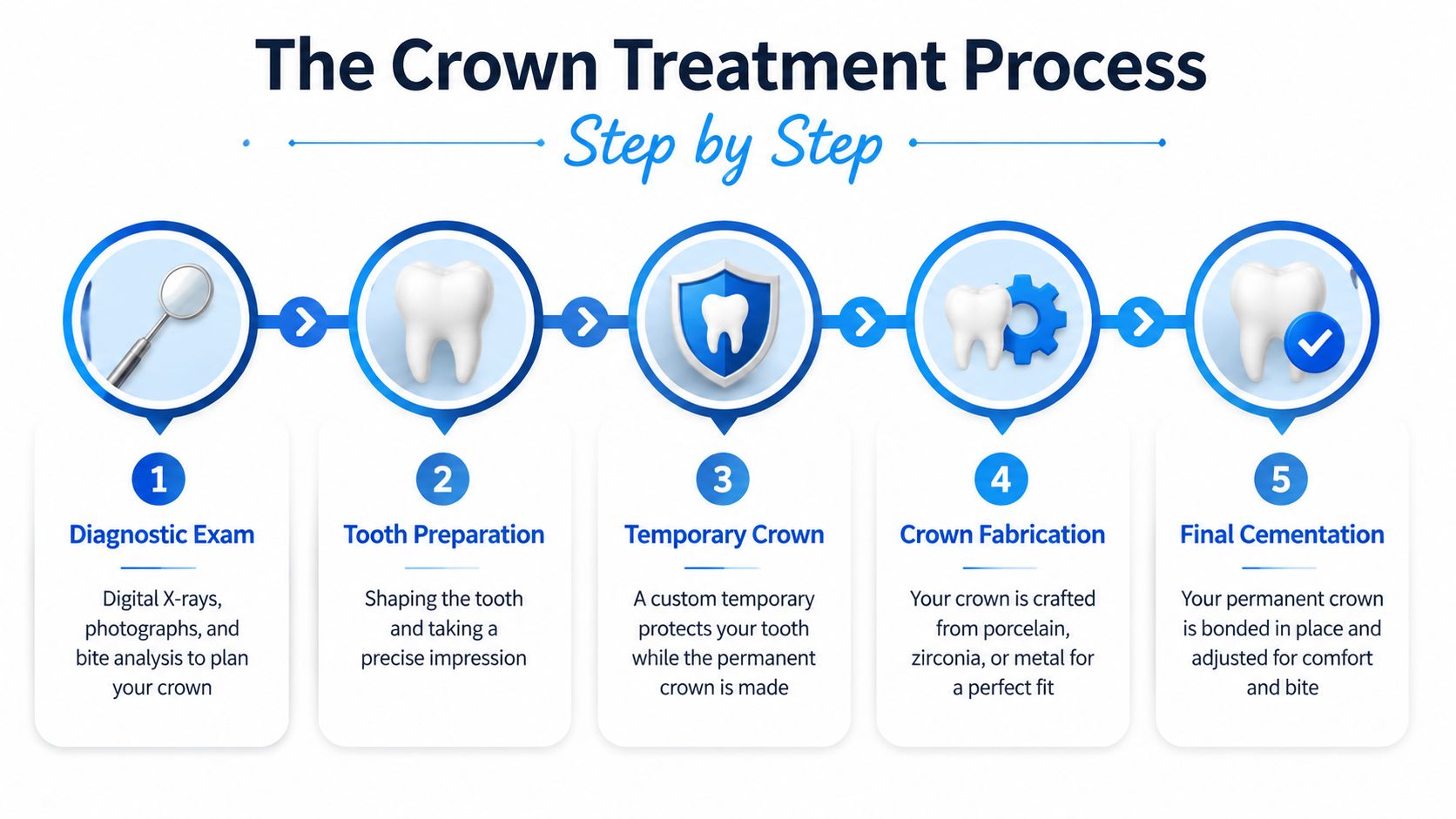
Crown treatment follows a sequence designed to protect the tooth and verify the restoration before permanent placement. The first visit usually begins with an examination, dental X-rays, photographs, and a bite assessment. Shade selection may occur before the tooth is prepared, since dehydration can temporarily change its appearance.
Diagnosis and preparation
The dentist first checks whether the tooth can support a crown. A root canal, buildup, gum treatment, or different restoration may need to come before crown fabrication. The old filling and damaged structure are removed, and the tooth is reshaped so the crown has room to restore its form without creating a high bite.
The amount of reduction varies by material and design. Traditional planning often requires approximately 1.5 to 2 millimeters of space, although the exact preparation depends on the tooth, restorative material, and laboratory requirements. The NHS explains the basic mechanical principle clearly, the old tooth must be shaped before the crown can be fixed in place (NHS dental treatment guidance).
Impressions and the temporary crown
The dentist may use a conventional impression with a putty tray or an intraoral scanner that captures the prepared tooth digitally. The resulting file or impression guides the laboratory or in-office milling process. Some patients qualify for a same-visit restoration, while others receive a temporary crown while a trusted laboratory completes the permanent one. Information about digital and same-visit options is available through same-day crown technology.
The temporary crown protects the prepared tooth from temperature, chewing pressure, and contact with neighboring teeth. Patients should avoid sticky foods, chew carefully, and slide floss out through the side rather than pulling it upward. Mild sensitivity or gum tenderness can occur after preparation.
Try-in and cementation
At the seat appointment, the dentist checks the crown's contacts, margins, color, shape, and bite. Adjustments may be made before bonding or cementation. Once the fit is acceptable, the crown is secured and the bite is checked again so the restored tooth doesn't take excessive pressure.
A common two-visit schedule takes roughly two to three weeks total, depending on the case and laboratory timing. Sensitivity after placement often fades within days, but lingering pain, a bite that feels high, swelling, or increasing discomfort should prompt a call to the practice.
Crown Costs, Insurance, and Financing in Scottsdale
Crown fees in Scottsdale commonly fall between $1,200 and $2,200 per tooth before insurance, but the final estimate depends on the tooth and the treatment needed around it. A straightforward front-tooth restoration won't require the same design as a molar exposed to heavy chewing. Zirconia and high-aesthetic ceramic options may cost more than PFM or base-metal designs, while a complex case may require additional treatment before the crown can begin.
The estimate should separate the crown itself from related procedures. A buildup, root canal, gum contouring, diagnostic imaging, or replacement of an old restoration can affect the total. Patients comparing a crown with a filling, onlay, veneer, or dental implants near me should ask for a written plan that identifies each stage.
Crown Cost Ranges by Material
| Material | Typical Range per Tooth | Best For |
|---|---|---|
| All-ceramic or porcelain | Varies by design and case | Visible teeth and cosmetic priorities |
| Zirconia | Often toward the higher end | Posterior strength with a tooth-colored appearance |
| PFM | Often toward the middle of the range | Established function and bridge designs |
| Gold or alloy | Varies by alloy and laboratory work | Heavy bite areas where appearance is less important |
The broad consumer cost range for crowns is often reported as $500 to $3,500 per crown, depending on material and complexity (crown longevity and cost discussion). That range isn't a Scottsdale quote, so a local examination remains necessary.
Insurance and payment planning
Dental insurance commonly classifies crowns as major restorative care and may cover about 50% of the bill when the procedure is medically necessary, subject to deductibles, waiting periods, and annual maximums (consumer coverage discussion). Coverage may be limited when a crown is elective or primarily cosmetic. Medical insurance usually doesn't apply unless trauma or another qualifying circumstance is involved.
Patients can ask the billing team for a pre-treatment estimate, review financing through a healthcare lender or office payment arrangement, and consider eligible HSA or FSA funds. If treatment timing is flexible, sequencing care across calendar years may help a patient use two annual maximums, though benefits depend on the specific plan.
Crowns Versus Fillings, Onlays, Veneers, and Implants
The least expensive option isn't automatically the most conservative option. The best restoration is the one that preserves healthy tooth structure while addressing the actual mechanical problem.
A direct filling works well for a small or moderate cavity when strong enamel and dentin remain around the restoration. If a filling becomes very large, the remaining tooth walls may flex under chewing and fracture. The clinical question isn't only how much a filling costs today. It is whether the tooth still has enough structure to support one safely.
Partial coverage and cosmetic coverage
An inlay or onlay can protect a damaged tooth without covering every visible surface. An inlay fits within the cusps, while an onlay extends over one or more cusps. These restorations can preserve more natural structure than a full crown when the tooth is weakened but still has dependable walls.
A veneer serves a different purpose. It is a thin cosmetic shell placed on the front of a tooth with adequate underlying structure. Veneers can improve color, shape, or minor spacing, but they don't treat deep decay or provide the same structural reinforcement as a crown.
When an implant enters the discussion
An implant may be appropriate when a tooth can't be predictably saved. It replaces the missing root with a surgically placed foundation and supports a separate crown above the gum. That process involves surgery and healing, while a conventional crown preserves a viable natural root.
| Option | Coverage | Best Situation |
|---|---|---|
| Filling | Direct repair within the tooth | Small to moderate decay with strong remaining walls |
| Inlay | Partial coverage inside the cusps | Damage that doesn't require cusp protection |
| Onlay | Partial coverage over selected cusps | A weakened tooth where full coverage would remove more structure than needed |
| Crown | Full coverage above the gumline | Cracks, major decay, root-filled teeth, or extensive structural loss |
| Veneer | Thin front-surface shell | Cosmetic changes on a structurally sound front tooth |
| Implant | Replacement of root and crown as a unit | A tooth that isn't restorable or has been lost |
Patients looking for tooth extraction or dental implants near me should receive a careful restorability assessment before choosing removal. A crown can be preventive salvage when the natural tooth has a stable root. It can also become an expensive patch if the foundation is infected, fractured below the gum, or unable to withstand the patient's bite.
How Long Crowns Last and How to Care for Them
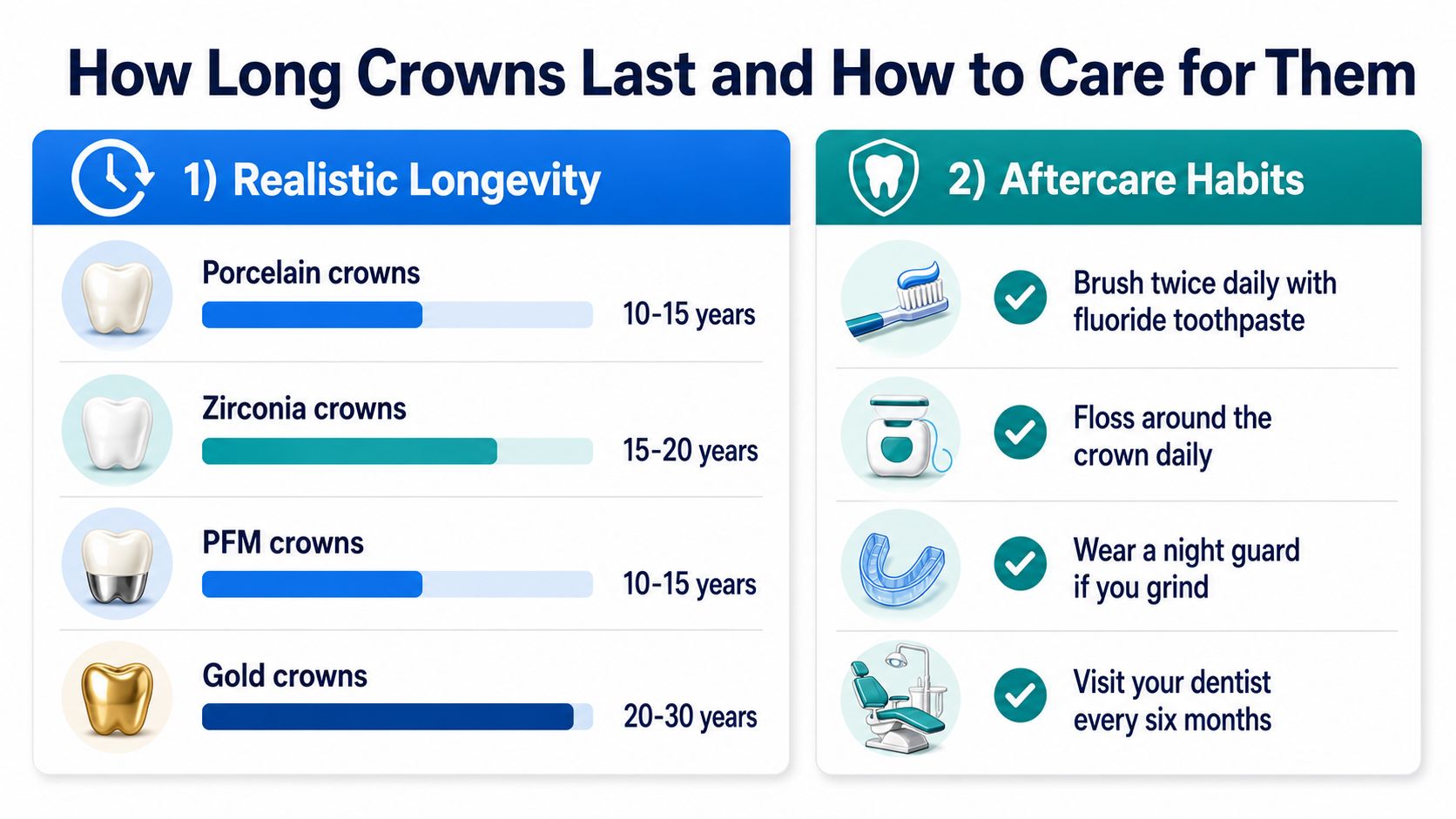
Crown longevity varies by material, tooth location, bite, hygiene, and the condition of the original tooth. Cleveland Clinic describes an average lifespan of 5 to 15 years, while some crowns can last upwards of 30 years with maintenance (Cleveland Clinic crown overview). Those figures are useful for planning, not a guarantee for an individual tooth.
A systematic review of single-unit all-ceramic crowns pooled 1,112 anterior crowns with 73 failures, or 6.5%, and 1,821 posterior crowns with 166 failures, or 9.1%, over follow-up periods from 36 to 223 months. Anterior crowns were about 50% less likely to fail than posterior crowns, highlighting the effect of chewing load and fatigue cycling (systematic review of all-ceramic crown survival). Posterior teeth generally require more attention to material, occlusion, and cementation.
Habits that protect the restoration
- Check the bite: A crown that feels higher than neighboring teeth should be adjusted rather than tolerated.
- Use a night guard when indicated: Patients who grind or clench can place damaging force on crowns and natural teeth.
- Clean the margin: Brushing with fluoride toothpaste and flossing around the crown helps control plaque where the restoration meets the tooth.
- Watch the gumline: Bleeding, swelling, a bad taste, or a visible gap deserves an examination.
- Attend maintenance visits: A follow-up a few weeks after cementation and regular cleaning and exam appointments allow the dentist to monitor the crown and supporting tooth.
During the first day, patients should wait until numbness has resolved before chewing and should avoid very sticky foods. During the first month, patients should pay attention to persistent sensitivity, looseness, sharp edges, or pain when biting. A short adjustment period can be normal. Symptoms that intensify or fail to settle should be reported.
Long-term care also means treating the cause of damage. A custom occlusal guard may help a patient with bruxism, while periodontal care can protect the gum support around the crown. Routine examinations, dental X-rays when indicated, and professional cleanings remain important because a crown can stay intact while decay develops at its margin.
Choosing a Scottsdale Dentist for Crown Work
Crown treatment benefits from continuity. A Scottsdale patient can return to the same local practice for bite adjustments, sensitivity checks, repairs, and questions about the restoration. A nearby office also makes follow-up more practical when a temporary crown needs attention or a final crown requires a minor occlusal adjustment.
Eric Wiitala DDS evaluates more than the visible defect. The practice's restorative planning can consider bite forces, adjacent teeth, TMJ concerns, sleep-related breathing issues, and habits such as clenching before recommending a crown, onlay, bridge, or implant. Digital impression systems and same-day or short-turnaround laboratory partnerships may reduce the time a patient spends in a temporary restoration, depending on the case.
Patients researching the business side of local dental practices can also explore how dentists grow their practice, a resource that provides context about practice development and patient communication. For a crown consultation, patients should bring existing X-rays, a list of current medications, and details about sensitivity, prior root canal treatment, or nighttime grinding.
The first visit typically includes an examination, imaging when appropriate, discussion of restorative alternatives, and a financial estimate. Patients searching for an emergency dentist because of a fractured tooth can call promptly, while those seeking a cosmetic dentist near me for a visible tooth can request a shade and material consultation. The same practice can also discuss preventive dental care, cleaning and exams, tooth-colored fillings, teeth whitening, bridges, and implant planning when those services fit the diagnosis.
Eric Wiitala DDS offers crown evaluations, restorative treatment, cosmetic dentistry, dental implants, and preventive care for patients in Scottsdale, Arizona. Patients with a cracked, worn, root-filled, or heavily restored tooth can visit Eric Wiitala DDS to request a consultation and discuss the most appropriate material, timeline, and next step.