
Waking up tired after a full night in bed, hearing a spouse complain about snoring, or seeing a CPAP mask pushed aside again can leave a Scottsdale patient stuck between frustration and worry. Sleep apnea treatment without CPAP is not a niche idea anymore, it's a practical path for many people who need a solution they can live with. At Eric Wiitala DDS in Scottsdale, that conversation usually starts with one question, what kind of treatment fits the airway, the anatomy, and the reality of daily life.
Table of Contents
- When CPAP Is Not the Answer
- How Obstructive Sleep Apnea Happens in the Body
- Your Main Alternatives Beyond the CPAP Machine
- Why Oral Appliance Therapy Often Makes the Most Sense
- What the Patient Journey Looks Like at Our Scottsdale Office
- Lifestyle Changes That Quiet OSA Symptoms Naturally
- How to Get Started and What to Expect on Day One
- Choosing the Right Path for Better Sleep
When CPAP Is Not the Answer
A working professional sits in the exam chair and says the same thing many patients admit after months of trial and error, the machine is still in the closet. The mask felt awkward, the tubing got in the way, and sleep never really felt natural again. That story is common, and it is not a personal failure.
For obstructive sleep apnea, the treatment decision usually comes down to severity, airway anatomy, and how much a patient can realistically tolerate at night. Oral appliance therapy is one of the best-established non-CPAP options, and in selected cases it is also used when CPAP is not tolerated, including some people with more advanced disease PMC review. Modern guidance also supports a broader approach that includes dental care as part of the treatment pathway Cleveland Clinic review. The key question is not whether a patient “failed” CPAP. The key question is which path fits the airway, the bite, and the daily routine.
Practical rule: if a patient cannot wear CPAP consistently, treatment still has a path forward. The next step is to match severity, anatomy, and tolerance instead of forcing one device to fit everyone.
In a Scottsdale practice, that usually means starting with the mouth, jaw, and bite, because those details often shape whether a non-CPAP approach will work. A dental office that screens for sleep-disordered breathing can be a useful on-ramp to oral appliance therapy, especially when a patient wants a realistic option that feels more wearable than a mask. It does not replace sleep medicine care, but it can help direct the patient toward a treatment that better fits the way their airway behaves at night.
For people who want a second perspective on related airway and jaw issues, Arizona Valley orofacial care can
How Obstructive Sleep Apnea Happens in the Body
Obstructive sleep apnea happens when the upper airway narrows or closes during sleep. During the day, the throat stays more open because the surrounding muscles are active, but at night those muscles relax. If the space is already tight, the airway can collapse like a soft garden hose that gets kinked when the support around it loosens.
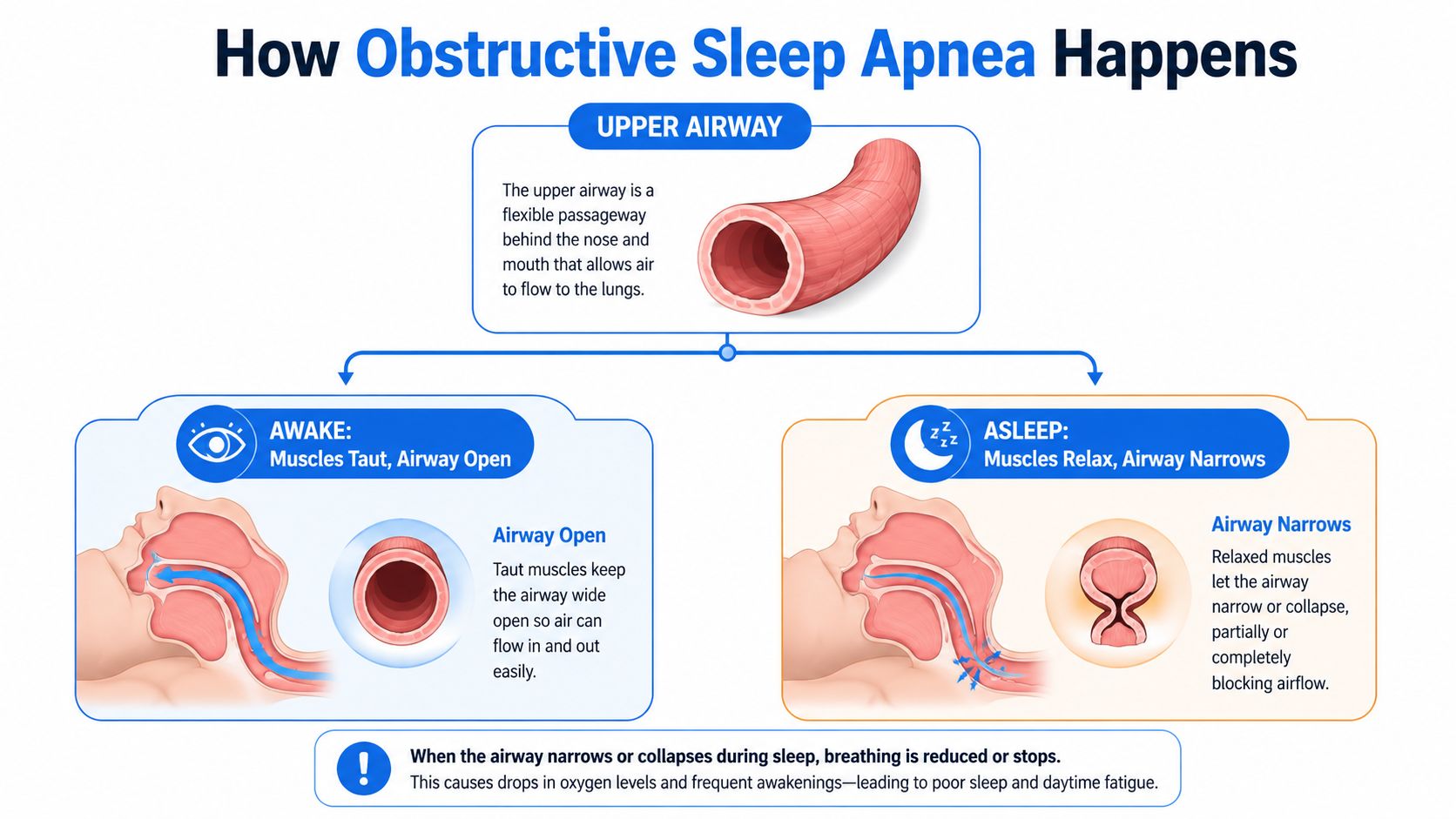
That collapse leads to pauses in breathing, oxygen dips, and brief arousals that fragment sleep even when the patient doesn't fully wake up. Mild, moderate, and severe OSA are usually separated by apnea-hypopnea index ranges, but the lived experience often shows up first as loud snoring, morning headaches, dry mouth, or daytime fatigue. The number matters, but so do the symptoms.
Side sleeping versus back sleeping helps explain why position matters. On the back, gravity can pull the tongue and soft tissues backward, which makes the airway more vulnerable. On the side, that collapse often happens less easily, which is why positional therapy becomes a real option for some patients.
For people who want a second perspective on related airway and jaw issues, Arizona Valley orofacial care can be a helpful resource to understand how oral structures and sleep-related symptoms overlap. The important point is simple, sleep apnea isn't just a breathing problem, it's an airway mechanics problem.
Your Main Alternatives Beyond the CPAP Machine
Once CPAP is off the table, the main question is which option fits the airway and the patient's tolerance. In my office, that usually comes down to three practical factors, how severe the apnea is, what the anatomy looks like, and what the patient can realistically live with every night. Some treatments work by moving the jaw, some work by changing sleep position, and others aim at the tongue or throat muscles. The best plan usually starts with the least intrusive option that still has a good chance of helping.
For many Scottsdale patients, that conversation starts with oral appliance therapy because it gives us a workable on-ramp without committing them to a mask they will not use. A custom device from a dental office, such as custom occlusal guards and appliances, holds the lower jaw slightly forward so the airway stays more open during sleep. Positional therapy is another practical option when apnea gets worse on the back, since staying off the back can reduce collapse in patients whose airway is position-dependent. These are often the first non-CPAP choices because they are noninvasive and can be paired with lifestyle changes.
Oropharyngeal exercises can improve OSA and snoring in the evidence summarized by Cleveland Clinic Cleveland Clinic treatment review. Nasal expiratory positive airway pressure has also shown benefit in a systematic review, and acetazolamide has been studied as well, though no medicine is approved specifically for obstructive sleep apnea. Those options can make sense in selected patients, but they do not fit everyone, and they usually work best when the airway problem is mild or the patient has a specific reason to avoid other approaches.
Hypoglossal nerve stimulation is generally reserved for carefully selected CPAP-intolerant patients, and surgical treatment can be appropriate when the anatomy itself is the main obstacle. Surgery is the more direct choice when tissue or jaw structure creates a fixed blockage, but it also comes with a bigger trade-off, because it changes the airway rather than guiding the patient into a simpler nightly routine.
| Option | How It Works | Typical AHI Reduction | Best Fit |
|---|---|---|---|
| Oral appliance | Moves the lower jaw forward | Qualitative improvement, no single fixed number in this article | Mild to moderate OSA, some severe cases when CPAP fails |
| Positional therapy | Reduces back sleeping | Qualitative improvement | Positional OSA, snoring |
| Oropharyngeal exercises | Strengthens throat and tongue muscles | Qualitative improvement | Motivated patients, mild to moderate symptoms |
| Nasal EPAP | Creates pressure during exhalation | Qualitative improvement | Mild OSA, travel-friendly preference |
| Acetazolamide | Changes breathing chemistry | Qualitative improvement | Selected cases under medical supervision |
| Hypoglossal nerve stimulation | Stimulates tongue muscle overnight | Durable improvement reported in reviews | CPAP-intolerant patients with suitable anatomy |
| Surgery | Changes airway structure | Varies by procedure and anatomy | Structural obstruction, selected severe cases |
A good alternative is not the one that sounds strongest on paper. It is the one that matches the airway problem and still gets used month after month.
Why Oral Appliance Therapy Often Makes the Most Sense
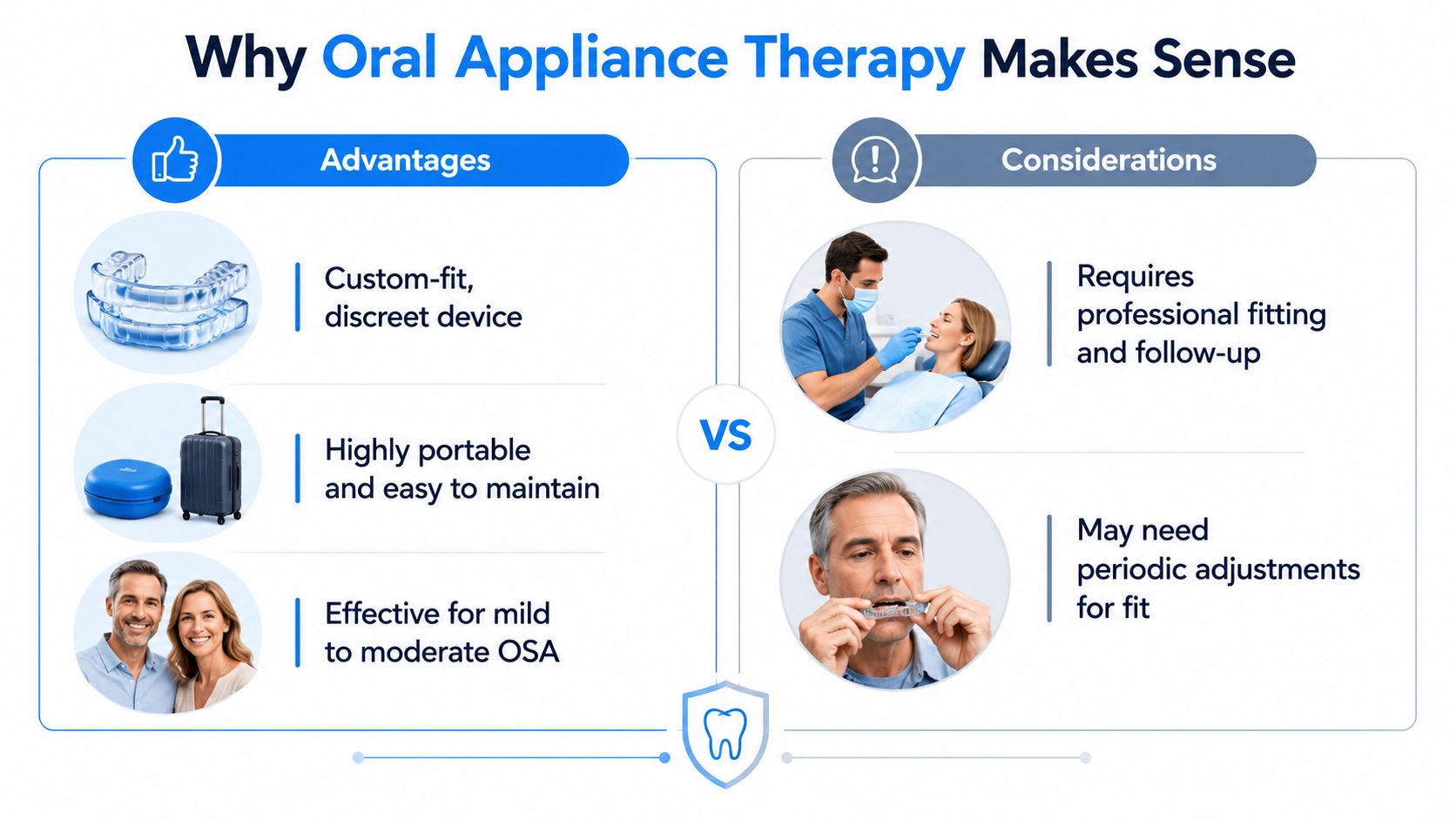
A patient who wants a CPAP-free path usually needs a treatment that fits real sleep habits, jaw anatomy, and tolerance for nightly wear. Oral appliance therapy often fits that decision point better than a long list of other options. It gives Scottsdale patients a practical route when mild to moderate obstructive sleep apnea is present, and it can still be considered in selected severe cases when CPAP is refused or not tolerated, as noted in the PubMed summary.
The trade-off is straightforward. Oral appliances usually do not lower apnea indices as much as CPAP, but many patients wear a custom appliance more consistently than a mask and machine, so the overall result can still be similar for symptoms and real-world use PMC review. In practice, that matters more than a perfect number on paper. A treatment that is used night after night often helps more than a stronger treatment that stays in the drawer.
Who tends to do well with it
The best candidates usually have healthy teeth and gums, enough jaw mobility, and a willingness to come back for titration visits. A patient with central sleep apnea or severe TMJ dysfunction may not be a good fit for a mandibular advancement device. The appliance works through jaw position, so the mouth and jaw have to cooperate for it to help.
Patients also care about day-to-day fit. A custom appliance is quiet, portable, and easier to take on a trip or use in a shared bedroom than a machine with hoses and masks. For many people, that simplicity is what makes treatment realistic instead of theoretical.
Clinical reality: when a patient wants a CPAP-free path, oral appliance therapy often becomes the most practical bridge between sleep medicine and everyday life.
At our office, the next step is usually a custom-fit device made with careful attention to how the teeth, jaw, and bite work together. That is the same reason custom occlusal guards and appliances are shaped and monitored over time in dental care. Sleep apnea treatment uses the same custom-fit principle, with more focus on airway support and follow-up adjustment.
What the Patient Journey Looks Like at Our Scottsdale Office
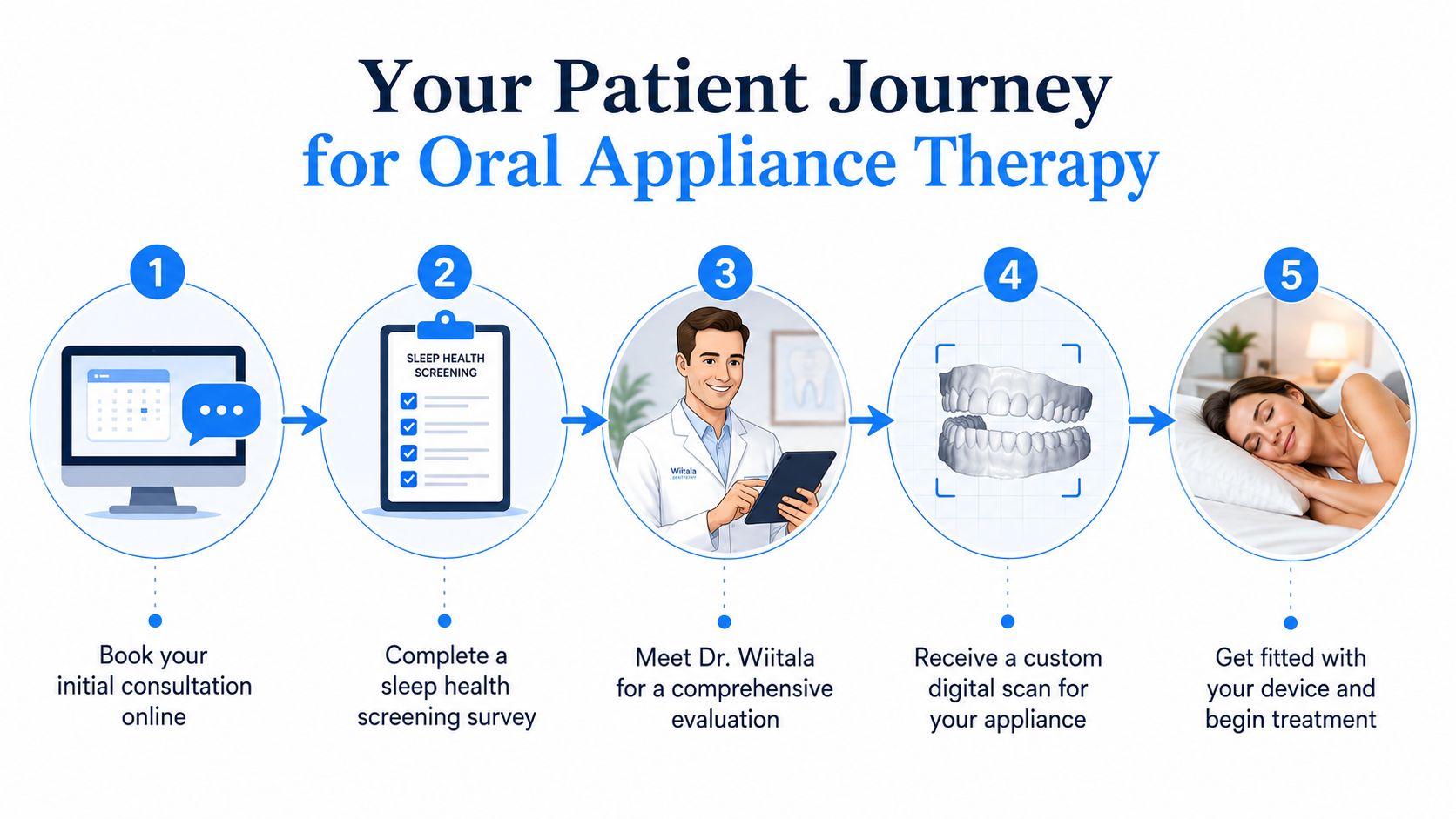
The first visit usually starts with a focused conversation about snoring, daytime sleepiness, morning headaches, and whether a partner has noticed breathing pauses. If the history suggests sleep apnea, the next step may be a home sleep test referral so the severity and type of apnea are clear before treatment begins. That keeps the plan grounded in actual sleep data instead of guesswork.
At the Scottsdale office on North 90th Street, the dental side of the work often begins with impressions or a digital scan and a bite registration that captures how the appliance should fit. From there, the custom device is fitted and adjusted forward in small increments so the jaw moves enough to help the airway without creating unnecessary discomfort. The process is measured, not rushed.
The patient then comes back for follow-up visits so symptoms, fit, and jaw position can be refined. That collaboration matters because the dentist, the sleep physician, and the referring primary care team each see a different part of the picture. When apnea is suspected to be severe or central in nature, that coordination protects safety and keeps treatment in the right lane.
What maintenance usually looks like
- Cleaning: The appliance needs regular cleaning so it stays comfortable and sanitary.
- Checks: Annual reviews help confirm that the bite, jaw position, and device condition still make sense.
- Replacement: Many appliances need replacement roughly every three to five years, depending on wear and fit.
Most patients reach a working position within a few weeks, but the schedule depends on how the jaw responds. A well-tuned appliance should feel like a device you can live with, not something you dread putting in at night.
Lifestyle Changes That Quiet OSA Symptoms Naturally
Lifestyle changes don't replace every treatment, but they can make a meaningful difference in how often the airway collapses. Mayo Clinic recommends sleeping on the side or stomach rather than the back, avoiding alcohol for 4 to 6 hours before bed, and not taking medicines that make you sleepy because they can relax the throat muscles and worsen obstruction Mayo Clinic guidance. Those steps are simple, but they're not minor.
Three habits worth changing first
- Sleep position: Side or stomach sleeping can reduce the gravitational pull that encourages the tongue to fall backward.
- Evening alcohol: Cutting alcohol several hours before bed helps keep airway muscles from relaxing too much.
- Sedating medicines: Bedtime use of sleepy medications, including some antihistamines and muscle relaxants, can make the airway more collapsible.
Weight and activity also matter upstream because they affect airway loading and muscle tone. For readers who want a broader look at weight-focused support, explore Weight Method's approach offers one perspective on how weight change is discussed in relation to sleep apnea. Lifestyle work is strongest when it supports a device or another targeted therapy, not when it's forced to do all the work alone.
Nasal breathing deserves attention too. If the nose is blocked, positional therapy and an oral appliance can feel less effective because the airway still starts with a poor entry point. A cleaner airway often makes every other step easier to use.
How to Get Started and What to Expect on Day One
The smartest first move is a consultation that gathers the medical history, the sleep story, and the dental picture together. A new patient visit in Scottsdale usually covers the intake forms, a sleep questionnaire, and any insurance or financing questions that affect the treatment plan. If the signs point toward sleep apnea, a home sleep test can provide the missing piece.
When the office coordinates with a sleep physician, that handoff matters most for patients whose apnea may be severe or central rather than obstructive. Dental treatment can still be part of the plan, but the diagnosis has to be clear before a device is made. A careful referral process isn't a delay, it's a safety step.
For people dealing with nasal congestion or allergy-driven sleep disruption, Expert tips for allergy sufferers can be a useful read alongside treatment planning. Clearer breathing at night often makes sleep therapy easier to tolerate.
Common signs that it's time to stop guessing include:
- Loud snoring
- Daytime fatigue
- Morning headaches
- Observed breathing pauses
- Trouble staying asleep
A good first appointment should leave the patient with a plan, not confusion. That plan may include oral appliance therapy, a sleep physician referral, or another path that better matches the airway and the symptoms.
Choosing the Right Path for Better Sleep
There isn't one correct answer for every patient. Mild symptoms often respond best to positional changes and lifestyle work, moderate OSA is often where oral appliance therapy makes the most sense, and more severe cases may need a layered approach that includes an appliance, positional help, or another specialist option. The right choice depends on severity, anatomy, and whether the treatment will be used.
For patients in Scottsdale who want a practical place to start, chronic snoring treatment can be part of the same conversation as sleep apnea care. Dr. Eric Wiitala's office helps patients sort through the options without making them guess which path fits.
If CPAP has already failed, or if it never felt like a realistic long-term solution, the next step is a consultation that puts the airway, the bite, and the sleep data together in one plan. Schedule with Eric Wiitala DDS if you want a Scottsdale dental team that can evaluate snoring and sleep apnea, discuss oral appliance therapy, and help you move toward a treatment you're more likely to use. Visit Eric Wiitala DDS to get started.