

Jaw pain has a way of showing up at the worst time. A person gets through the workday, rubs the side of the face near the ear, and wonders whether to ice it, stretch it, or just wait it out. TMJ pain relief exercises can help when the problem is muscle tension or irritated movement patterns, but they're only useful when the symptoms match the right kind of jaw problem.
For patients in Scottsdale, AZ, the practical question is simple, can the jaw be calmed safely at home, or does it need a dentist's exam first? The answer depends on whether the pain feels muscular, joint-related, or mechanical. That distinction matters because the same drill that helps one pattern can aggravate another.
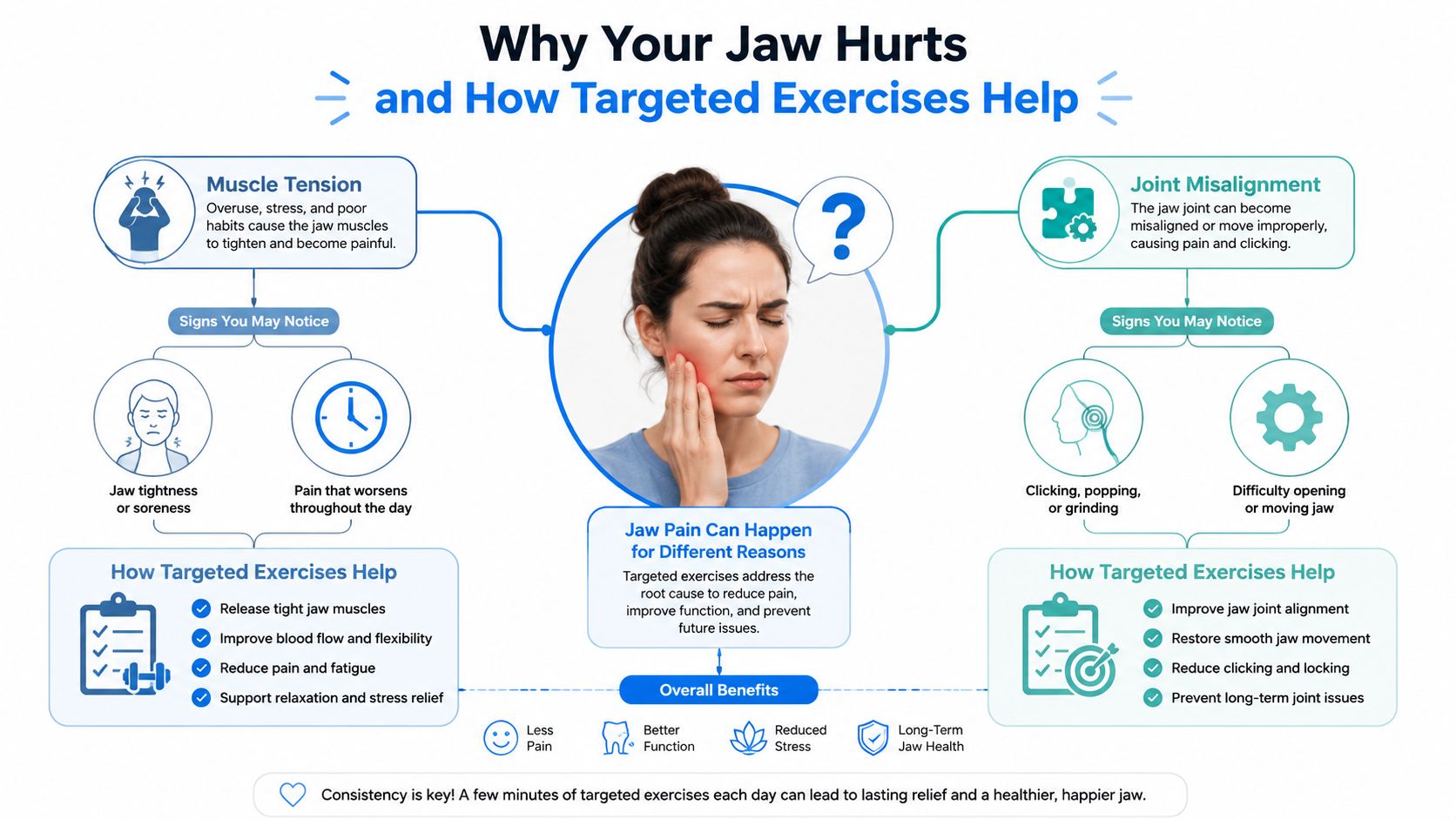
Why Your Jaw Hurts and How Targeted Exercises Help
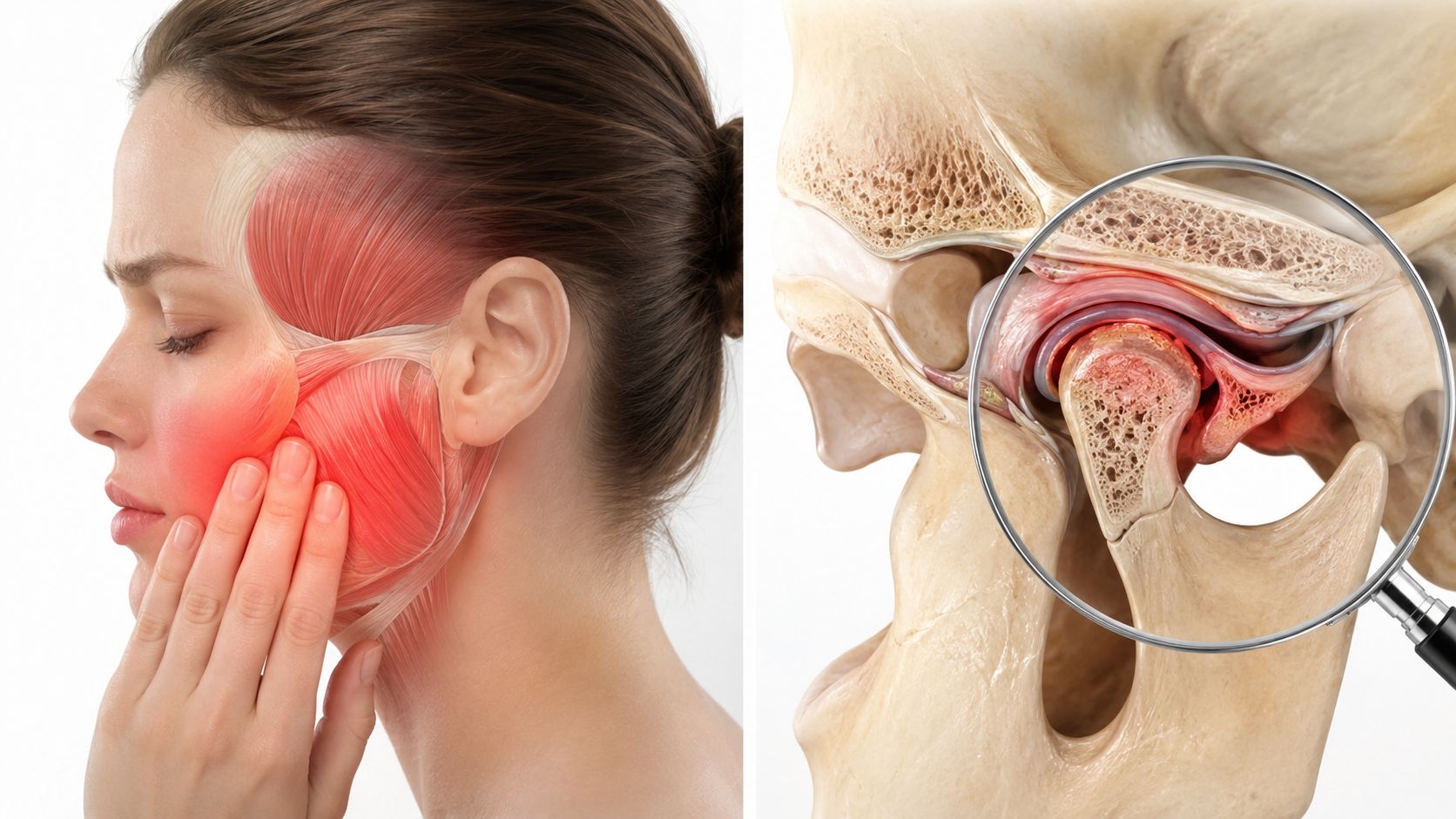
A tight jaw usually isn't random. The temporomandibular joint, the hinge in front of the ear, works every time a patient talks, chews, yawns, or swallows, so it gets overloaded quickly when the muscles around it start guarding. That's why people often feel the pain in the jaw, the temple, the ear, or even the neck.
What the exercises are really trying to do
A good jaw routine isn't about forcing the mouth open wider. It's about helping an irritated system move with less tension and less compensation. A 2023 systematic review and meta-analysis found exercise therapy for temporomandibular disorders produced a moderate short-term reduction in pain and improved jaw range of motion, with a pooled pain effect size of SMD -0.58 and measurable gains in pain pressure threshold and maximum mouth opening (systematic review and meta-analysis).
That fits what patients feel in the chair. When the jaw is overworked, the surrounding muscles brace. Gentle, specific motion helps those muscles stop gripping so hard and lets the joint move more cleanly. A useful way to think about tmj pain relief exercises is that they lower load first, then restore motion second.
Practical rule: if a movement feels calm, controlled, and repeatable, it's doing its job. If it makes the jaw snap, clamp, or ache more, it's the wrong drill for that moment.
People who also hold tension in the neck often need that area addressed too. A simple neck routine can support jaw comfort, and a straightforward example is simple neck stretches for pain relief from MedAmerica Rehab Center. The jaw and neck don't work in isolation, so a tight upper body can keep the jaw guarded even when the joint itself isn't the main driver.
For a broader clinical view of TMJ pain and management, the same patient-friendly logic shows up in TMJ pain care as well. The basic idea is consistent, calm the muscles, restore safe motion, and stop short of anything that increases symptoms.
Match Your Symptoms to the Right Type of Jaw Problem
The smartest jaw routine starts with a quick sort, because not every painful jaw is the same problem. Muscle-related TMJ pain usually feels like soreness, tension, or fatigue, often with morning tightness, temple pressure, or headache. Joint irritation more often brings clicking, popping, or a sense that the jaw isn't gliding smoothly. Mechanical locking is different again, because the jaw can catch, open unevenly, or feel stuck.
A two-minute self-check before any drill
The simplest question is whether the jaw is stiff, noisy, or stuck. Stiff and achy points toward a muscle pattern. Clicking or popping on opening points more toward joint irritation. A jaw that suddenly won't open normally needs a different level of attention, because that's not the same as ordinary muscle tension.
A 2023 systematic review found coordination exercise had a significant effect on pain relief and joint mobility, and it appeared especially useful for TMD myalgia and arthralgia (review of exercise types). That matters because it suggests movement quality is part of the treatment, not just movement quantity. Stretch, excursion, and resistance work may help some patients, but they're not one-size-fits-all.
If the main complaint is morning clenching and tightness, a gentle home routine is usually the right starting point. If the jaw clicks every time it opens, the movement plan needs more caution. If it locks, home drills alone may be the wrong tool entirely. That's the reason many mainstream exercise guides fall short, they list movements without helping patients match them to the symptom pattern first.
A helpful rule in the chair is this, muscle pain wants calm motion, noisy or locked joints want a closer look. That one distinction can save a lot of frustration.
For readers who track symptoms day by day, it can help to notice whether the jaw acts up alongside headache patterns, grinding, or stress. A weather-tracking app like migraine weather tracking from Relief can be useful context if headaches seem to flare with jaw pain, even though the jaw still needs its own assessment. The point is to notice patterns, not to guess blindly.
Gentle Jaw Mobility Drills for Beginners
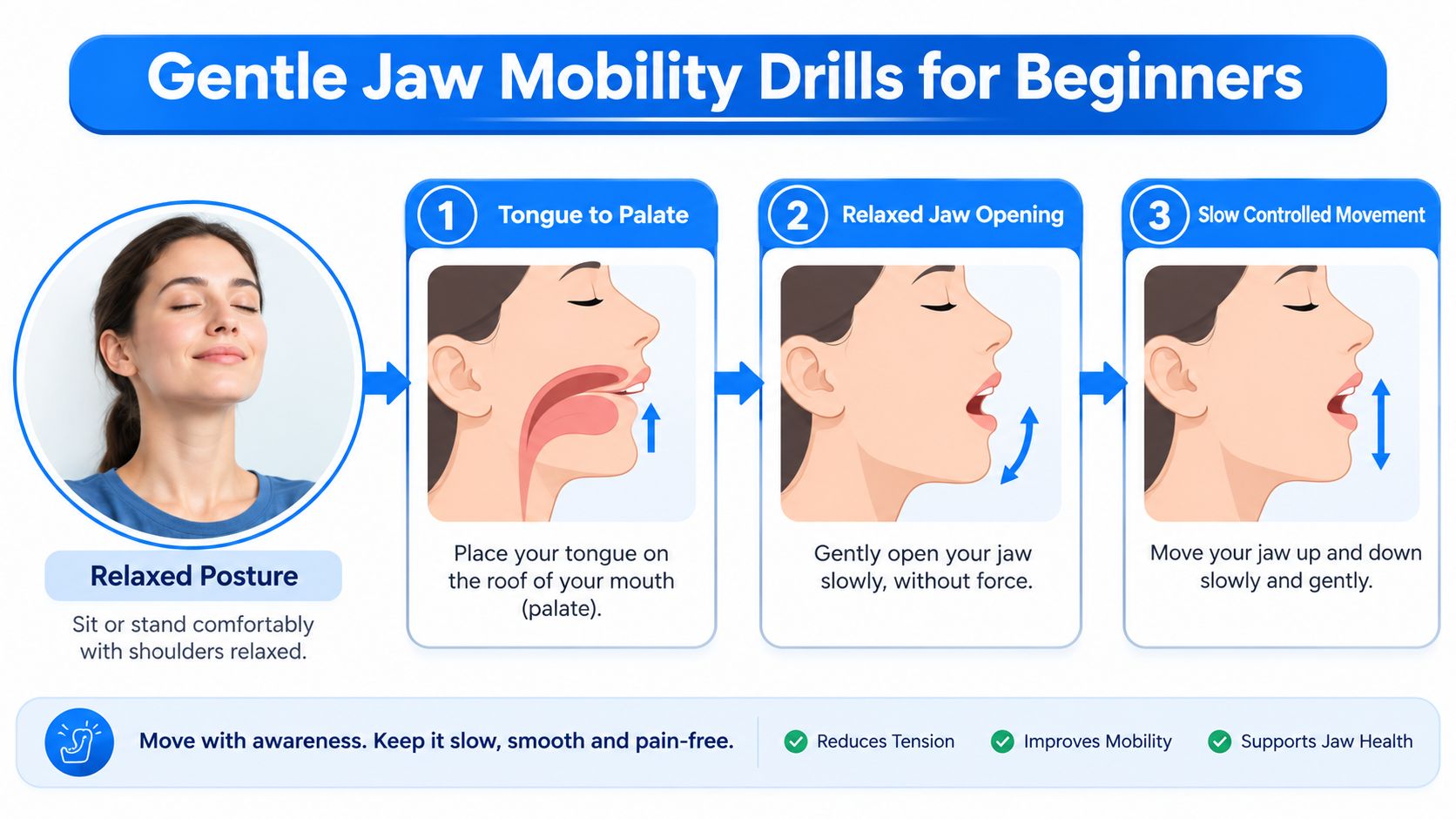
The first routine should feel boring in the best way. It should be slow, low effort, and easy to repeat without forcing anything. The Oxford University Hospitals tongue-to-palate drill is a good model because it uses the tongue as a built-in limiter, which helps prevent over-opening and clenching at the same time (Oxford University Hospitals jaw exercise guide).
Start with tongue position, then open only as far as it stays quiet
Place the tip of the tongue on the palate just behind the upper front teeth, then slide it back toward the soft palate. Slowly open the mouth until the tongue loses contact, then stop there. Hold for 5 seconds and repeat 6 times. The movement should stay relaxed, with no clenching and no extra opening once contact breaks.
That restraint matters. Opening too wide can provoke clicking, and clicking is the body's way of saying the joint is being asked to move beyond its current tolerance. The same guide notes that when clicking shows up, the range should be reduced and the drill restarted more slowly.
A second easy pattern is a relaxed opening in front of a mirror. Keep the shoulders loose, let the teeth stay apart, and open just enough to move smoothly without a pull to one side. Add a slow side-to-side glide only if it stays quiet and comfortable. The goal isn't speed, it's a smooth path that doesn't trigger a protective spasm.
A home routine can stay short. Many major-market patient guides use 6 repetitions or similar low-volume sets, and some programs use a few minutes of mobility work at a time. One practical way to make it stick is to pair it with a routine moment, such as before bed and before getting up.
Clinical cue: if the shoulders rise or the teeth press together, the jaw isn't the only thing working. Reset and start smaller.
For readers who want the movement sequence in visual form, the following step-by-step graphic makes the pattern easy to follow.
For people who already build flexibility work into daily life, a general resource on mobility for Pittsburgh adults from Full Circle Function & Fitness can reinforce the same principle, controlled movement works better than aggressive stretching. The jaw responds the same way.
Adding Light Resistance Once Pain Settles Down
Resistance comes later, not first. If the jaw is still flared up, repeated loading can do more harm than good. Once mobility is easier and pain has settled, the next step is controlled resistance, which helps the muscles support the joint without clenching through every movement.
Use the fingers as a guide, not a force test
Kaiser Permanente's physical therapy guidance describes stabilizing the jaw with the fingers, then applying light resistance while opening slowly, and also resisting side-to-side and upward movements without letting the jaw move (Kaiser Permanente TMJ physical therapy guidance). The resistance should stay light. If the jaw hurts more or clicking appears, stop.
A practical home benchmark is often 3 sets of about 10 repetitions, or a few short mobility blocks each day. The exact volume matters less than the quality of the movement. Holds of three to six seconds are commonly used in primary care guidance, including resisted opening and closing (AAFP TMJ guidance).
For side-to-side and forward work, the American Academy of Family Physicians describes using an object about one-fourth of an inch thick between the front teeth, then increasing thickness as the exercise gets easier (AAFP TMJ guidance). That small detail matters because it turns the exercise into graded loading instead of a brute-force stretch.
| TMJ Care Options at a Glance | What It Does | Best Fit |
|---|---|---|
| Light resisted opening | Builds controlled support without heavy loading | Jaw feels steadier and less painful |
| Resisted closing | Balances the muscles that control shut-down of the jaw | Clenching and fatigue patterns |
| Side-to-side and forward movement | Trains smoother motion with a gentle guide | Mild stiffness without locking |
The failure modes are predictable. Clenching recruits the masseter too hard, forcing extra jaw excursion irritates the joint, and pushing through pain teaches the system to guard harder. A safer progression is mobility first, resistance second, and no exercise that creates new clicking or worsens symptoms.
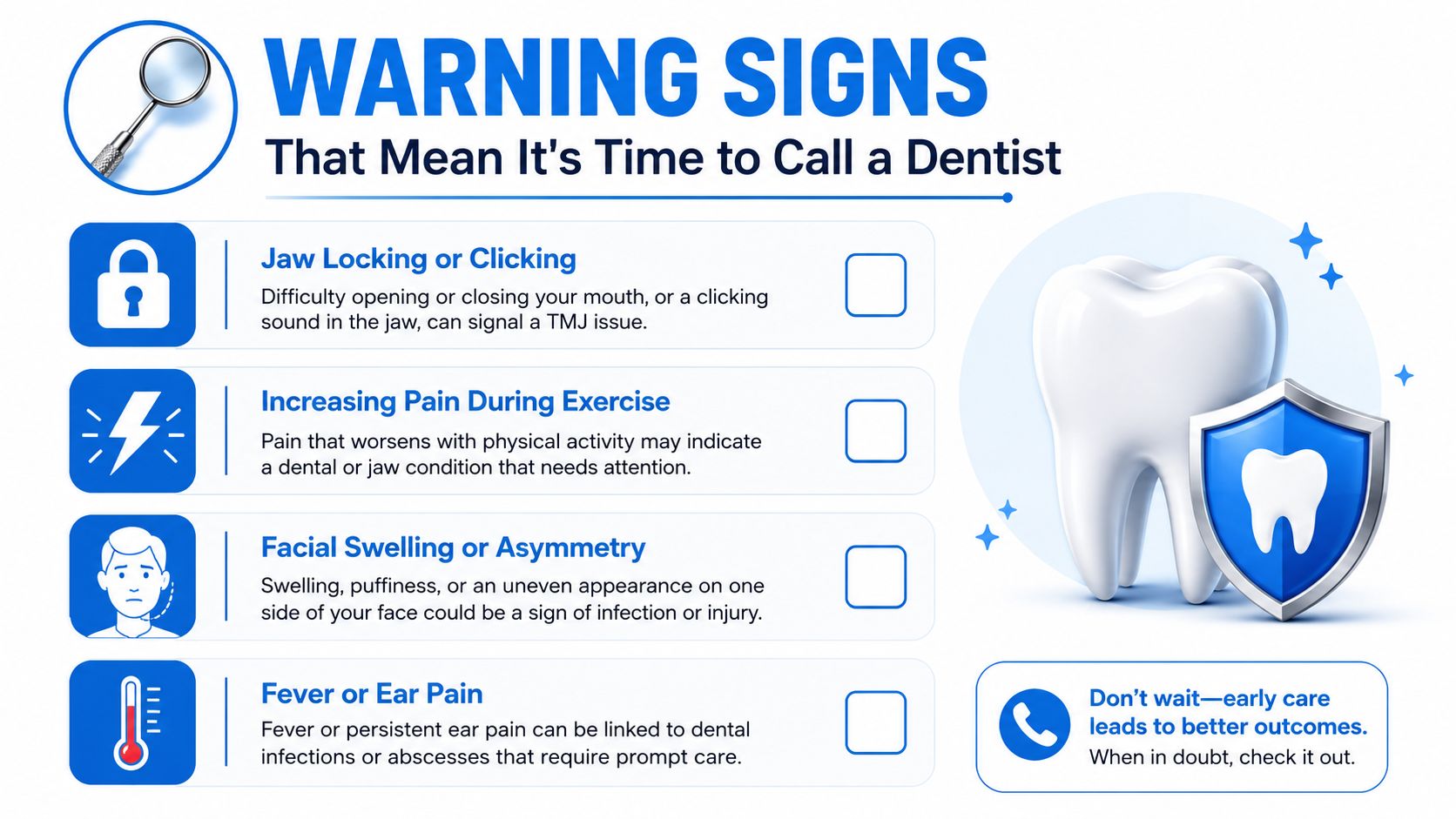
Warning Signs That Mean It's Time to Call a Dentist
Home care has a limit, and the warning signs are usually easy to recognize if they're taken seriously. A jaw that locks open or closed needs evaluation. Pain that gets worse during exercise, instead of easing, is another sign the routine is wrong for that person.
Red flags that should pause the home routine
- Jaw locking or catching: If the mouth won't open or close normally, the issue may be mechanical, not just muscular.
- Increasing pain during exercise: A drill that raises symptoms is loading the wrong tissue or loading it too soon.
- New clicking with pain: Clicking by itself can be tolerable, but clicking with pain suggests the joint needs a closer look.
- Facial swelling or asymmetry: Visible change is not a normal exercise response and deserves evaluation.
- Fever or ear pain: Pain that feels like infection, pressure, or spreading discomfort should be checked instead of pushed through.
Morning headaches that keep returning, ear pressure that doesn't settle, or pain that interrupts sleep are also worth paying attention to. Those symptoms often mean the jaw is part of a bigger pattern, not an isolated ache. A dentist can sort out whether the issue is clenching, bite stress, or a joint problem that shouldn't be treated with home exercises alone.
If a jaw routine makes symptoms louder after several tries, the routine isn't failing, it's giving useful information. That information is a reason to book care, not to push harder.
The good news is that a TMJ-focused dental visit doesn't start with guesswork. A careful exam can connect the symptom pattern to the right next step, and that may include a home program, an appliance, or another treatment that protects the joint while it settles.
How Occlusal Guards, Botox, and Appliance Therapy Fit In
Home exercises are one piece of care, not the whole picture. Some patients need help with nighttime clenching, some need muscle relaxation beyond exercise alone, and some need appliance therapy to reduce strain on the bite. The right plan depends on what the jaw is doing.
A simple care ladder for TMJ-related symptoms
| Care Option | What It Does | Best Fit |
|---|---|---|
| Custom occlusal guard | Reduces wear from clenching and protects the teeth overnight | Night grinding or jaw compression |
| Therapeutic Botox | Calms overactive jaw muscles when muscle tension keeps returning | Persistent muscle-driven pain |
| Appliance therapy | Supports bite-related strain and jaw positioning | Patients who need broader functional support |
A custom guard doesn't “fix” the TMJ on its own, but it can reduce the nighttime load that keeps the jaw sore in the morning. Therapeutic Botox is a different tool, used when overactive jaw muscles keep overpowering the system even after good exercise habits are in place. Appliance therapy plays a broader role when the bite and jaw mechanics need support together.
Those options are complements, not replacements, for proper movement work. The exercise routine still matters because it teaches control, keeps mobility from fading, and helps the jaw stay calm between visits. For a closer look at muscle-focused treatment, TMJ therapeutic Botox shows how that option fits into a larger plan.
Not every patient needs every tool. A careful exam should decide whether the problem is mainly muscle, mainly joint, or a combination of both. That's the difference between chasing symptoms and treating the source.
What to Expect at Your First TMJ Visit in Scottsdale
A first TMJ visit should feel organized, not rushed. The usual starting point is a conversation about where the pain is, when it happens, whether the jaw clicks, locks, or feels tight, and what makes it better or worse. Then comes a jaw exam that looks at opening, closing, and the way the muscles respond.
What a thoughtful appointment usually covers
The dentist reviews the symptom pattern, checks the jaw movement, and looks for signs of clenching, bite strain, or joint irritation. If exercises are appropriate, the home routine is matched to the patient's pattern instead of handed out as a generic sheet. If a guard, appliance, or another treatment makes more sense, that gets discussed in plain language.
For Scottsdale patients, Eric Wiitala DDS is located at 9755 North 90th Street, Suite B250, Scottsdale, AZ 85258, and the office can be reached at (480) 657-6981. Hours are Monday through Thursday, with Friday by appointment. That makes it straightforward to move from online research to an actual plan.
The most useful first visit is the one that leaves a patient knowing what to do next and what to stop doing. If the jaw is still sore, if clenching keeps returning, or if home exercises haven't answered the problem, that visit is the right next step.
If jaw pain has been keeping you from eating, talking, or sleeping comfortably, Eric Wiitala DDS can help sort out whether tmj pain relief exercises, a custom guard, therapeutic Botox, or another treatment is the better fit. Schedule an evaluation in Scottsdale, bring your questions, and get a plan that matches what your jaw is doing.