
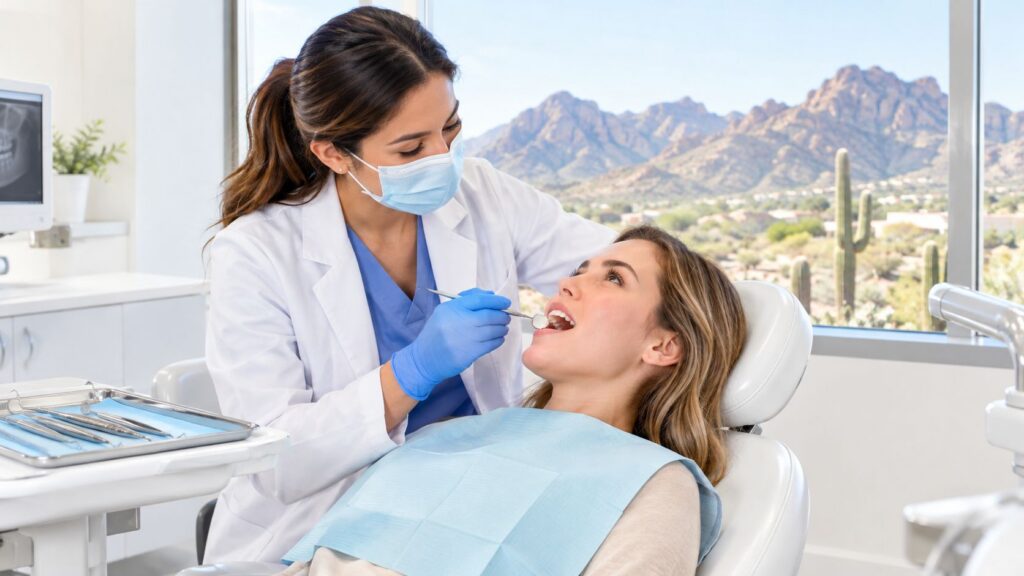
A sharp toothache can turn an ordinary Scottsdale evening into a search for a dentist near me, a cold compress, and a way to sleep without pressing a cheek against a pillow. Pain after biting, sensitivity to temperature, swelling, or a broken filling can all signal a problem that needs more than temporary relief. For patients looking for a tooth pain dentist in Scottsdale, the right first step is calm triage followed by a focused dental evaluation.
Eric Wiitala DDS provides dental care in Scottsdale for urgent concerns, preventive needs, restorative treatment, cosmetic dentistry, dental implants, TMJ concerns, and long-term maintenance. The practice's approach centers on patient comfort, clear explanations, modern diagnostic methods, and treatment that addresses the source of pain rather than masking it.
Table of Contents
- Finding Relief for Tooth Pain in Scottsdale
- Immediate At-Home Steps for Tooth Pain Relief
- When Tooth Pain Becomes a Dental Emergency
- Understanding Dental Diagnoses and Treatment Options
- What to Expect at Eric Wiitala DDS
- Insurance, Financing, and Comprehensive Care
- Your Path to a Healthy, Pain-Free Smile in Scottsdale
Finding Relief for Tooth Pain in Scottsdale
Tooth pain rarely arrives with a convenient explanation. A dull ache may follow a cracked filling, while a sudden pulse can come from decay, an irritated nerve, gum inflammation, or pressure from a jaw-related problem. A Scottsdale patient searching for a dentist in Scottsdale, AZ shouldn't have to decide alone whether the discomfort is minor or urgent.
Eric Wiitala DDS offers a local point of contact for patients who need an examination, dental X-rays, or guidance about the next step. The practice evaluates the whole situation, including the tooth, gums, bite, medical history, and factors that may affect healing. That broader view helps distinguish a tooth that can be protected with restorative dentistry from one that may require root-canal care, tooth extraction, or later replacement.

Start with the pattern of pain
Before calling, note when the pain began, what triggers it, whether it occurs without stimulation, how long each episode lasts, and whether pain medication changes it. Also note swelling, fever, a bad taste, pain on biting, recent trauma, and any medications already taken. These details help the dental team prioritize the visit and select appropriate tests.
Practical rule: Temporary relief is useful, but it doesn't prove that the tooth has healed.
Prompt care can preserve options. A small area of decay may need a filling, while deeper damage may require more involved treatment. A professional assessment gives Scottsdale patients a practical plan and reduces the risk of allowing a manageable problem to progress.
Immediate At-Home Steps for Tooth Pain Relief
Home measures can make the hours before an appointment more comfortable, but they can't remove infected pulp, repair a fracture, or eliminate an abscess. The safest approach is to reduce irritation while arranging professional care.

Protect the sore area
- Rinse gently: A warm salt-water rinse can clear loose debris and soothe irritated tissues. Don't swallow the rinse, and avoid forceful swishing around a visibly injured area.
- Floss carefully: If food is trapped between teeth, gentle flossing may remove pressure that is making the pain worse. Sharp objects can cut the gum or damage a restoration.
- Use a cold compress: Apply a wrapped cold pack to the outside of the cheek for short periods. This can help reduce discomfort and swelling without placing ice directly on the skin.
- Choose mild foods: Avoid very hot, cold, sweet, hard, or sticky foods if they trigger symptoms. Chew on the opposite side until the tooth is examined.
Use medication cautiously
The American Dental Association guidance on oral analgesics identifies nonopioid medicines, including NSAIDs alone or combined with acetaminophen, as effective first-line options for acute dental pain. Examples such as ibuprofen 400 mg every 6 hours, or ibuprofen 400–800 mg combined with acetaminophen 500–650 mg every 6 hours for moderate pain, are clinician-directed examples rather than universal self-dosing.
NSAIDs may be unsuitable for people with gastrointestinal bleeding risk, kidney disease, anticoagulant use, certain cardiovascular conditions, or pregnancy. Acetaminophen also requires care with liver disease, alcohol use, combination medicines, and total daily dose. Patients shouldn't exceed package or clinician directions, and they shouldn't place aspirin directly on the gum.
For readers managing another type of discomfort, natural sciatica pain relief methods may offer general home-care ideas, but those methods aren't a substitute for evaluation of dental pain. If symptoms persist, worsen, or return after medication wears off, contact a Scottsdale dental office.
When Tooth Pain Becomes a Dental Emergency
A common assumption is that every toothache can wait for a routine cleaning. That isn't safe when pain is severe, swelling is growing, or infection may be spreading. Tooth disorders produced an average of 1,944,000 U.S. emergency-department visits annually during 2020–2022, equal to 59.4 visits per 10,000 people, according to American Dental Association emergency dental pain guidance.
Choose prompt dental care
Contact an emergency dentist promptly when pain is severe, persistent, or disrupting sleep and daily activities. The same applies when pain improves with medication but doesn't disappear, or when the tooth hurts on biting. A dental abscess can produce intense pain, temperature sensitivity, a bad taste, facial or jaw swelling, difficulty chewing or opening the mouth, fever, or swollen neck glands. It requires dental treatment because it won't resolve on its own, as explained in guidance about dental abscess symptoms and treatment.
A broken tooth, lost restoration, recent dental trauma, or visible pus also deserves prompt assessment. The dentist may need to stabilize the tooth, remove decay, drain infection, begin endodontic treatment, or discuss extraction.
Know when the hospital is the right setting
Difficulty breathing, swallowing, or speaking changes the urgency. Major mouth or facial swelling, eye involvement, or rapidly worsening swelling can indicate dangerous spread and requires emergency evaluation. A hospital emergency department is appropriate for those life-threatening signs, while a dental office is generally better equipped to diagnose and treat a problem centered in a tooth or gum.
Antibiotics aren't a substitute for source control. A Cochrane review of penicillin for irreversible pulpitis found insufficient evidence that penicillin reduces pain, percussion sensitivity, or analgesic use in that situation, based on a small randomized trial with 20 participants per arm. Antibiotics should be reserved for clinically appropriate situations, such as systemic involvement or spreading infection.
Scottsdale patients can review local guidance for an emergency dentist near me and contact the practice when symptoms need timely dental assessment.
Understanding Dental Diagnoses and Treatment Options
A dental visit for pain should answer three questions: Which structure is causing the symptoms? How much damage is present? What treatment can control the problem and preserve function? The dentist begins with the history, including onset, triggers, spontaneous pain, duration, trauma, medical conditions, and analgesic use.
How the source is located
The examination may include visual inspection, periodontal probing, percussion, palpation, bite testing, and periapical or bitewing imaging. Thermal or electric pulp testing compares the painful tooth with neighboring control teeth. These tests help separate pulpal pain from an apical infection, gum disease, a cracked tooth, trauma, worn restoration, or nonodontogenic jaw pain.
Tooth decay remains central to this discussion. The World Health Organization explains that untreated dental caries affects approximately 2.5 billion people worldwide, including about 2 billion cases involving permanent teeth and roughly 510 million cases involving children's primary teeth. Decay can move from enamel damage into the inner pulp, causing pain, sensitivity, difficulty eating or sleeping, and eventual tooth loss.
The burden is broader than an isolated toothache. WHO reported that oral diseases affected about 3.5 billion people, approximately 45% of the world's population, in 2022, with the global number of cases increasing by 1 billion over the previous 30 years, as reported in its global oral-health update. Those figures support prompt diagnosis, not panic. Pain can reflect a common and treatable disease process, and an examination determines which option is appropriate.
Match treatment to the tooth
A small or moderate cavity may respond to a tooth-colored filling after caries removal. Bonding can repair minor chips or reshape a tooth, while a crown can protect a substantially weakened tooth. If the pulp is inflamed or infected but the tooth remains restorable, root-canal treatment can remove the diseased tissue and preserve the tooth for restoration.
Extraction becomes appropriate when the tooth can't be predictably restored, has severe structural damage, or presents a poor long-term outlook. Patients comparing root canal treatment and tooth extraction should consider restorability, remaining tooth structure, infection, bite function, maintenance, and replacement needs rather than choosing based on fear or short-term cost alone.
If a tooth is removed, dental implants near me may become part of the replacement discussion. The FDA identifies potential implant benefits such as restored chewing and appearance, preservation of surrounding bone and gums, stabilization of adjacent teeth, and improved quality of life. It also lists possible complications, including infection, damage to neighboring teeth or tissues, sinus perforation, jawbone fracture during surgery, loosening, inadequate function, and implant-body failure. A thorough evaluation should therefore cover anatomy, function, surgical risk, and long-term maintenance.
What to Expect at Eric Wiitala DDS
A first visit should feel organized rather than rushed. Patients generally begin with a conversation about symptoms, medical history, concerns, and goals. The team then performs the examinations and imaging needed to identify the source of pain and explain the available paths.

A clear visit from diagnosis to decision
Patients can expect discussion of immediate comfort, tooth preservation, and what must happen next. Depending on the findings, treatment may involve a filling, bonding, crown, periodontal therapy, root-canal evaluation, tooth extraction, or a plan for replacement with a bridge or implant.
Eric Wiitala DDS serves Scottsdale at 9755 North 90th Street, Suite B250, Scottsdale, AZ 85258, with phone access at (480) 657-6981. Office hours are Monday through Thursday, with Friday appointments available by arrangement. The practice provides preventive, restorative, cosmetic, implant, orthodontic, sleep-related, and TMJ services, allowing a pain visit to connect with longer-term oral health planning.
A practice's communication process also matters when a patient is anxious or calling about urgent symptoms. Businesses evaluating ways to manage dental calls can compare answering services for dentists, while patients should focus on whether the office offers clear instructions, timely scheduling, and understandable treatment explanations.
A short introduction to the practice's approach is available below.
Dr. Eric Wiitala graduated from Indiana University School of Dentistry in 1999 and has more than 20 years of clinical practice. The office describes an approach that includes nutritional health, patient education, and treatment planning across preventive, restorative, cosmetic, implant, sleep, and TMJ care. That scope can be useful when tooth pain overlaps with bite strain, bruxism, worn teeth, or broader oral-health concerns.
Insurance, Financing, and Comprehensive Care
Dental treatment decisions involve more than clinical suitability. Patients also weigh timing, insurance benefits, monthly affordability, the value of preserving a natural tooth, and the future cost of replacing one. A useful consultation separates those issues instead of treating them as one decision.
Compare the practical paths
| Situation | Typical clinical direction | Main consideration |
|---|---|---|
| Early decay | Cleaning, fluoride exposure, or a filling | Treating the problem before deeper damage develops |
| Inflamed but restorable pulp | Root-canal treatment and a protective restoration | Preserving function while completing definitive care |
| Non-restorable tooth | Tooth extraction and replacement planning | Healing, bite stability, and replacement timing |
| Missing tooth | Bridge, single-tooth implant, or full-arch planning when appropriate | Anatomy, maintenance, function, and overall goals |
| Jaw strain or bruxism | Occlusal guard, TMJ assessment, or other indicated care | Protecting teeth and addressing muscle or bite symptoms |
Insurance coverage depends on the individual plan and the procedure. The practice's new-patient protocols include insurance and billing support, and patients can ask about financing options before beginning elective or extensive treatment. Requesting a benefits review and written treatment estimate can clarify what insurance may contribute and what balance remains.
Treat the immediate problem without losing the larger plan
Preventive care, professional hygiene, periodontal evaluation, fillings, crowns, bonding, veneers, teeth whitening, clear aligners, retainers, dental implants, sleep-apnea oral appliances, and TMJ services address different needs. A patient doesn't need every service, but a full-service practice can coordinate care when one diagnosis affects another.
The most economical path isn't always the least expensive appointment today. A temporary measure may be appropriate while arranging definitive care, but delaying treatment can limit restorative choices. The right plan balances clinical prognosis, comfort, function, appearance, insurance, and the patient's ability to maintain the result.
Your Path to a Healthy, Pain-Free Smile in Scottsdale
Tooth pain deserves attention even when it briefly improves. Medication can make a patient more comfortable, but it doesn't remove an abscess, repair a fracture, reverse advanced decay, or restore a damaged pulp. A dental examination identifies whether the appropriate response is preventive care, restorative dentistry, root-canal treatment, tooth extraction, periodontal therapy, or a replacement plan.
Scottsdale patients should use the severity and pattern of symptoms to guide timing. Persistent or worsening pain, fever, swelling, a foul taste, and pain on biting support prompt dental contact. Difficulty breathing or swallowing, major swelling, eye involvement, or severe facial trauma requires emergency medical evaluation.
A practical decision
If the tooth hurts but the patient can function, contact a dentist and request a timely examination. If pain disrupts sleep or daily activities, swelling is present, or a restoration has broken, ask about urgent care. If the mouth or face is significantly swollen or breathing and swallowing are affected, seek emergency help immediately.
Patients searching for dentist near me, cosmetic dentist near me, dental implants near me, or an emergency dentist often need more than a single procedure. They need a local office that can explain the immediate diagnosis, outline trade-offs, and coordinate the next stage of care. Eric Wiitala DDS provides that broader Scottsdale dental setting, from cleaning and exams to restorative, cosmetic, implant, sleep, and TMJ services.
The ADA chairside guide advises patients to call if pain doesn't lessen over time or if definitive dental treatment can't be obtained within 2–3 days, as described in its guidance for adult pulpitis. That advice reflects a simple principle: temporary relief should lead to a diagnosis and definitive plan, not indefinite waiting.
Eric Wiitala DDS offers urgent evaluation for Scottsdale patients with tooth pain, swelling, broken teeth, and suspected infection, along with restorative, preventive, cosmetic, implant, sleep, and TMJ care. Contact the practice to schedule an examination or request a consultation, and visit Eric Wiitala DDS to take the next step toward lasting relief.