

You may notice it in photographs first. Your front teeth look narrow, short, or slightly peg-shaped, and the surrounding gum can make the smile appear smaller than it feels. If you're searching for a cosmetic dentist near me in Scottsdale, veneers may seem like a straightforward way to add width and length. The safer question is more specific: can the teeth support that added volume without sacrificing enamel, irritating the gums, or creating a bite that damages the restorations?
At Eric Wiitala DDS, Dr. Eric Wiitala evaluates veneers for small teeth as both a cosmetic and restorative decision. The same Scottsdale practice also provides dental care ranging from cleaning and exams to tooth-colored fillings, crowns, orthodontic clear aligners, dental implants, and TMJ care. That broader perspective matters because a balanced smile depends on healthy teeth, stable gums, and a bite that can tolerate the proposed design.
Table of Contents
- Why Small Teeth Require a Specialized Cosmetic Approach
- The Biology of Bonding to Undersized Teeth
- Comparing No-Prep Veneers and Traditional Porcelain
- Designing the Perfect Proportions and Treatment Workflow
- Hidden Bite Risks and When to Consider Alternatives
- Maintaining Your New Smile in Scottsdale
Why Small Teeth Require a Specialized Cosmetic Approach
A patient may point to short or narrow front teeth and ask for a larger-looking smile. In the consultation chair, that request often includes spaces, excess gum display, worn edges, or proportions that do not suit the face. Veneers can address these concerns, but the restoration must flow naturally from the gumline to the biting edge without adding harmful bulk.
Small teeth are a recognized indication for veneers. A carefully designed restoration can add controlled shape and volume while preserving much of the natural tooth. This applies especially to undersized anterior teeth and microdontia, where the teeth developed smaller than average. Clinical guidance on veneers for smaller-than-average teeth) describes this use and emphasizes appropriate design and bonding.

The problem isn't solved by adding bulk
A veneer that is too thick near the gumline can make the tooth appear heavy and create a contour that is difficult to clean. If the emergence profile, meaning the way the restoration rises from the gumline, is poorly designed, plaque retention and gum inflammation can follow.
Dr. Wiitala's patient-first approach places biological health before cosmetic finishing. The assessment includes tooth condition, available enamel, gum health, facial proportions, and the bite. Those findings help determine whether porcelain, bonding, orthodontics, gum treatment, or another option provides the safer starting point.
Clinical priority: The goal is not to make a small tooth look larger. The goal is to create the right proportion while protecting enamel, gum health, and comfortable function.
A natural result may require more length, width, or both. The design still has to respect the lips, gums, neighboring teeth, and jaw movement. Some patients are candidates for no-prep or minimally invasive veneers. Others need limited enamel contouring, orthodontic alignment, or gum therapy before cosmetic treatment. Choosing the wrong approach can leave too little bonding surface or place excessive force on the restoration.
Veneers also have a long clinical history. California dentist Charles Pincus developed early veneers in 1928. Bonding advances in 1959 and 1982 helped porcelain veneers become more durable in routine care. Contemporary reviews report overall porcelain veneer survival of about 96% to 98% at 5 years and 91% to 94% at 10 to 12 years when case selection and conditions are appropriate. Those figures describe broader veneer treatment and do not guarantee the same result for every small-tooth case. The clinical review of veneer outcomes provides context for interpreting long-term survival and the factors that affect it.
The Biology of Bonding to Undersized Teeth
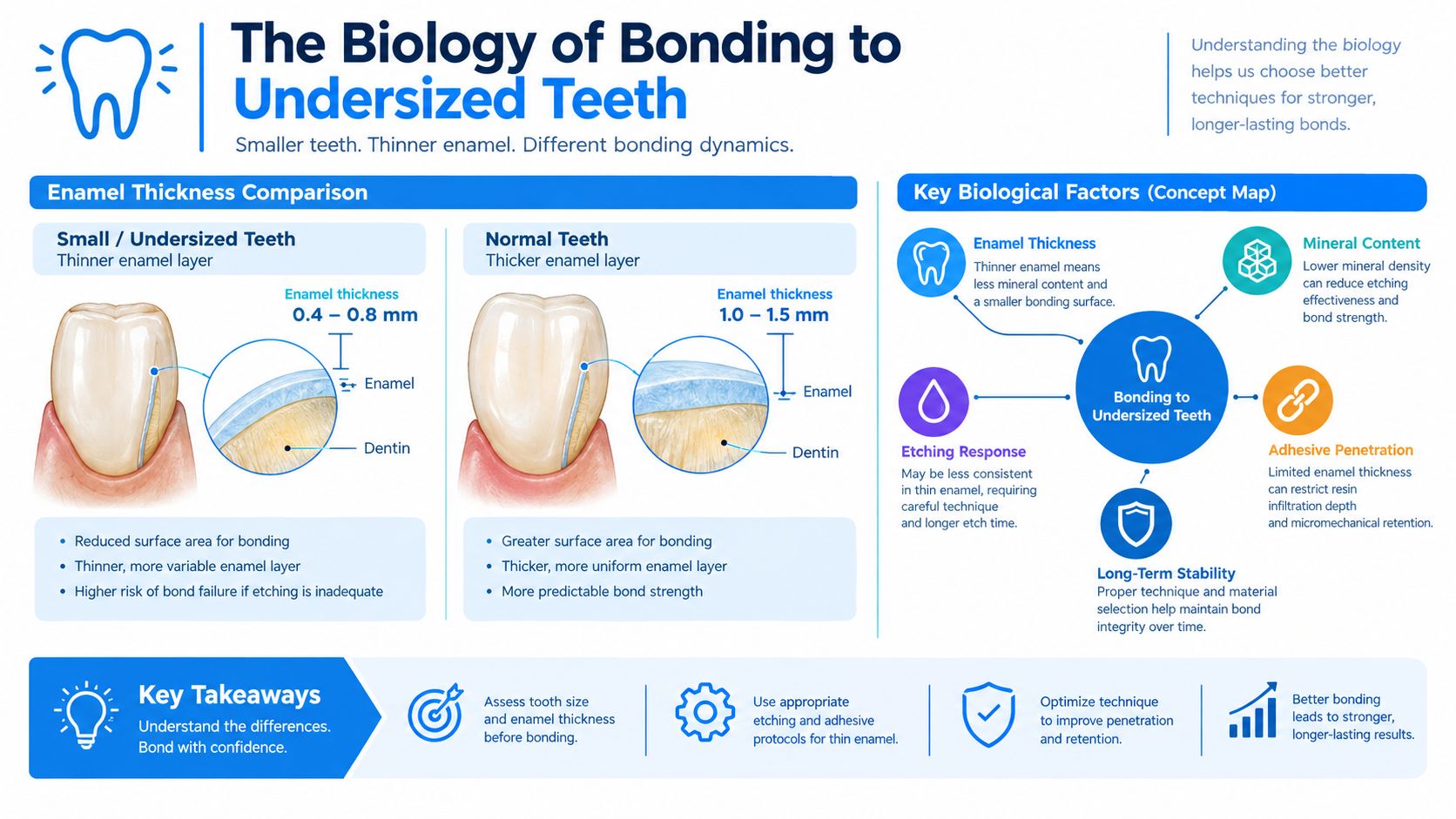
A patient may want small teeth to look fuller, yet the main clinical question is whether the tooth can support that added ceramic safely. Undersized teeth provide less bonding surface, and enamel is generally the preferred bonding substrate for porcelain. Removing excessive enamel can expose dentin, complicate adhesion, and reduce the predictability expected from conservative cosmetic treatment.
Published outcomes show why tooth size matters. One review reported veneer survival of about 94% at 5 years, decreasing to 87% for small teeth with reduced enamel surface area, with greater debonding risk in those cases. The clinical review of veneer outcomes provides context for evaluating small-tooth cases, even when added ceramic appears to have adequate room.
Why enamel preservation matters
Enamel thickness varies across the front of a tooth. A clinical review reports about 1.0 to 2.1 mm in the incisal third, 0.6 to 1.0 mm in the middle third, and 0.3 to 0.5 mm near the gingival third. The review of enamel thickness and veneer preparation shows why preparation should follow each zone rather than apply one uniform reduction.
A small tooth can have healthy enamel but still offer limited usable surface. Tooth position, previous wear, restorations, or an existing preparation may reduce the area available for bonding. During an examination, assess:
- Enamel availability: Determine whether the planned ceramic can remain bonded mainly to enamel.
- Tooth position: Rotation or tipping may require a different design from a tooth that is merely narrow.
- Gum health: Treat bleeding, inflammation, or periodontal disease before cosmetic bonding.
- Existing damage: Decay, cracks, or large fillings may make restorative care more appropriate.
- Functional loading: Clenching and grinding can stress a veneer in ways that tooth shape alone cannot predict.
Selected minimally invasive veneers can be thinner than 0.5 mm, but thin ceramic does not replace diagnosis. A more undersized, dark, worn, or structurally compromised tooth may require a careful balance between masking, ceramic thickness, enamel preservation, and occlusion. The clinical discussion of bonded porcelain veneer transitions examines the risks involved in that balance.
The strongest candidates are defined by more than appearance. They have healthy supporting tissues, enough enamel for predictable adhesion, manageable bite forces, and a design that does not rely on a thin restoration to compensate for an unstable foundation.
Comparing No-Prep Veneers and Traditional Porcelain
Patients often ask whether a dentist must shave down small teeth before placing veneers. Frequently, the answer is no, particularly when the teeth are narrow, worn, or peg-shaped and the planned addition won't create excessive fullness. No-prep and ultrathin porcelain designs can add volume while retaining healthy enamel, but they aren't suitable just because they sound conservative.
Traditional porcelain veneers may be preferable when a tooth's position, shade, or contour requires controlled space. A minimal preparation can help the ceramic seat smoothly and prevent an overbuilt emergence profile. The preparation should remain as limited as the case allows, rather than following a standard depth for every patient.
| Treatment option | Enamel reduction | Best suited for | Longevity |
|---|---|---|---|
| No-prep porcelain | None or minimal, when contours and bite permit | Narrow, small, or peg-shaped teeth with adequate position and favorable shade | Depends on bonding, bite, hygiene, and case selection |
| Minimal-prep porcelain | Often around 0.3 to 0.5 mm in facial enamel when indicated, as described in published preparation guidance | Teeth needing more controlled contour, shade management, or correction of position | Porcelain outcomes are supported by long-term clinical evidence, but small teeth carry added debonding considerations |
| Direct composite bonding | Usually additive with little or no enamel removal | Minor reshaping, a limited number of teeth, or a reversible trial | Requires maintenance and can be more vulnerable to wear and staining than porcelain |
When no-prep works well
No-prep porcelain is most useful when the tooth has room to receive the planned addition without becoming too prominent. A mock-up can reveal whether the new contour supports the lips, clears the opposing teeth, and leaves a clean path for brushing and flossing. If the proposed design looks bulky in the mock-up, adding more porcelain won't solve the underlying problem.
Ultrathin designs may range from about 0.3 to 0.5 mm, and some literature describes ceramic veneers as thin as 0.1 to 0.5 mm, depending on the material and laboratory technique. A review of ultrathin veneer designs shows why thickness should be treated as a design variable, not a marketing promise.
When traditional preparation or another treatment makes sense
Minimal preparation may be needed to manage a dark underlying shade, an unfavorable rotation, or a facial contour that would otherwise force the veneer outward. A crown may be more appropriate when the tooth is heavily restored or structurally weakened because a veneer only covers the front surface. Direct bonding can be a sensible first step when the change is modest or when the patient wants to test added length and width before choosing porcelain.
The right choice isn't determined by the word “small.” It depends on where the tooth sits, how much enamel remains, what the bite does during chewing and sleep, and how much visual change the patient wants.
Designing the Perfect Proportions and Treatment Workflow
A tooth can look too small for different reasons. It may need more width than length, more length than width, or coordinated changes across several teeth. The design should relate to the lips, gumline, facial features, and neighboring teeth so the result does not look isolated or artificial. Dr. Wiitala evaluates those relationships before choosing a veneer shape.
A practical workflow for small teeth
1. Examination and diagnosis. The visit begins with dental and periodontal assessment, photographs, tooth-position analysis, and a review of existing restorations. Decay, gum inflammation, tooth wear, or bite instability can change the order of treatment. Those findings must be addressed before cosmetic bonding.
2. Smile design and mock-up. A digital or physical preview tests the planned width, length, shade, and gumline relationship before permanent treatment. Patients can speak, smile, and assess the design in motion rather than judging a drawing alone. A mock-up also shows whether added volume makes the teeth appear too prominent.
3. Preparation planning. If reduction is necessary, the dentist removes only the amount needed to create ceramic space and a smooth contour. A review of minimally invasive veneer preparation describes a common target of about 0.5 mm, with guidance of approximately 0.1 mm cervically, 0.2 to 0.5 mm in the middle third, and 0.7 to 1.0 mm in the incisal third. The peer-reviewed preparation review explains why preparation varies by region and why the design must follow the tooth's anatomy.
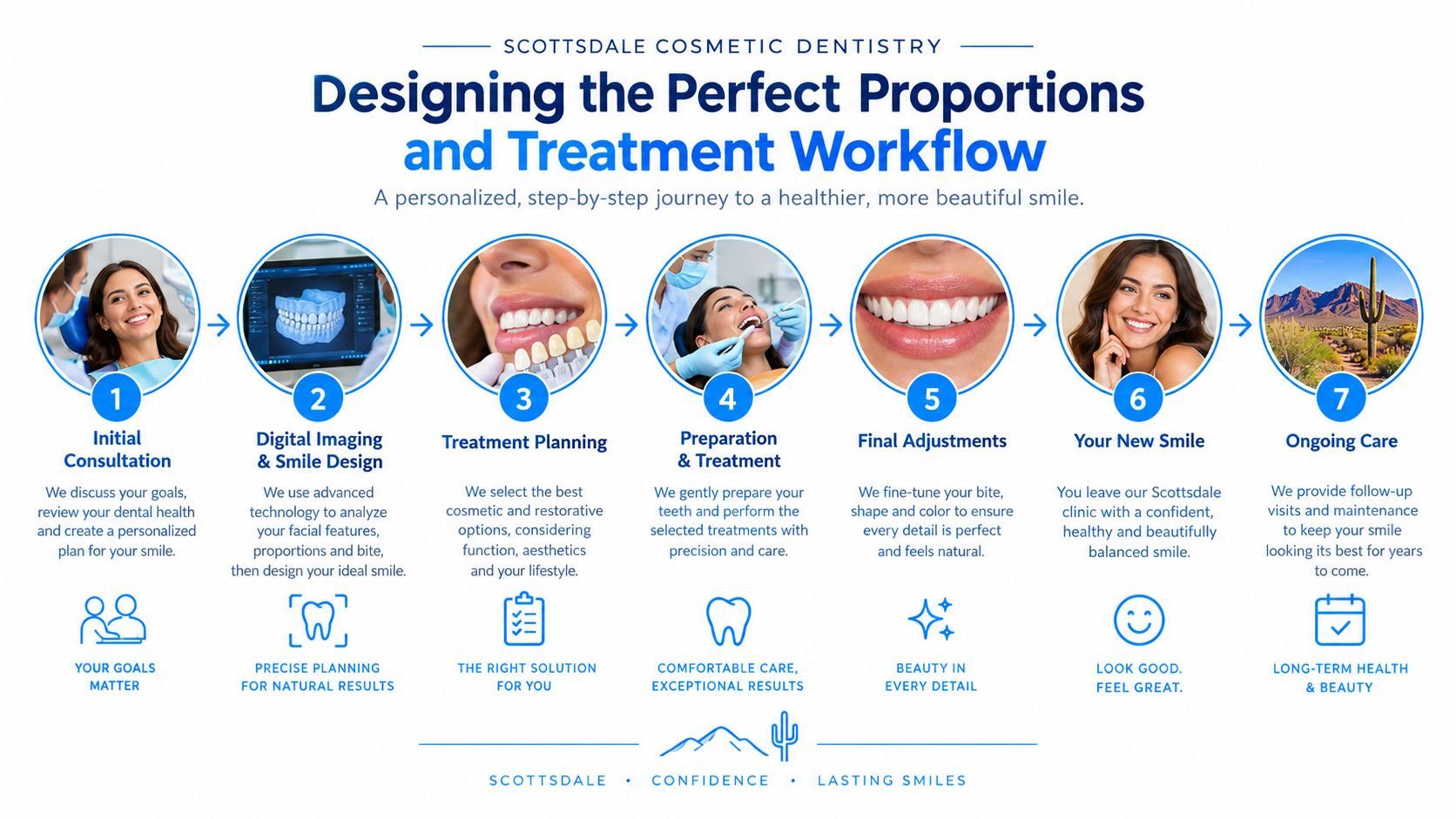
4. Incisal design. If the plan increases crown length, incisal overlap can provide additional ceramic thickness and improve masking without making the facial surface excessively full. Overlap preparations may permit about 1.5 to 2.0 mm of ceramic thickness at the incisal third, supporting color control and reducing the chance of a visibly thin edge. The amount and position of coverage still depend on enamel availability, tooth position, and the planned bite.
5. Try-in and bonding. The veneers are checked for fit, shade, contact points, emergence profile, and bite before bonding. After placement, the dentist checks excursions and contact patterns to confirm that the restorations do not interfere with normal jaw movement.
The emergence profile needs careful control. It should guide the eye smoothly from the gumline to the facial surface, without creating a shelf that traps plaque. Small teeth leave limited room for error, so a veneer can look attractive from the front yet remain unsuitable if its cervical contour is too full.
Patients reviewing natural-looking veneer planning can see why shape and proportion should be previewed before treatment begins.
This video provides another visual explanation of cosmetic dental treatment and planning:
The finished design should look coordinated with the entire smile. If the mock-up makes the teeth appear oversized, revise the plan before preparation or bonding. That pause protects the appearance and the biological tissues supporting the result.
Hidden Bite Risks and When to Consider Alternatives
The bite can determine whether veneers for small teeth remain stable. Small or short teeth may already be affected by wear, spacing, edge-to-edge contact, or grinding. Adding length without checking jaw movement can create a new point of force, placing repeated stress on the incisal edge and increasing the risk of chipping or debonding.
Parafunction and unfavorable guidance patterns can significantly increase veneer failure rates even when the material and bonding protocol are appropriate. Mechanical and biological complications can include fracture, loss of retention, gum problems, and other breakdown around the restoration. A review of parafunction and veneer complications reinforces why a cosmetic plan must include functional assessment.
What the bite assessment looks for
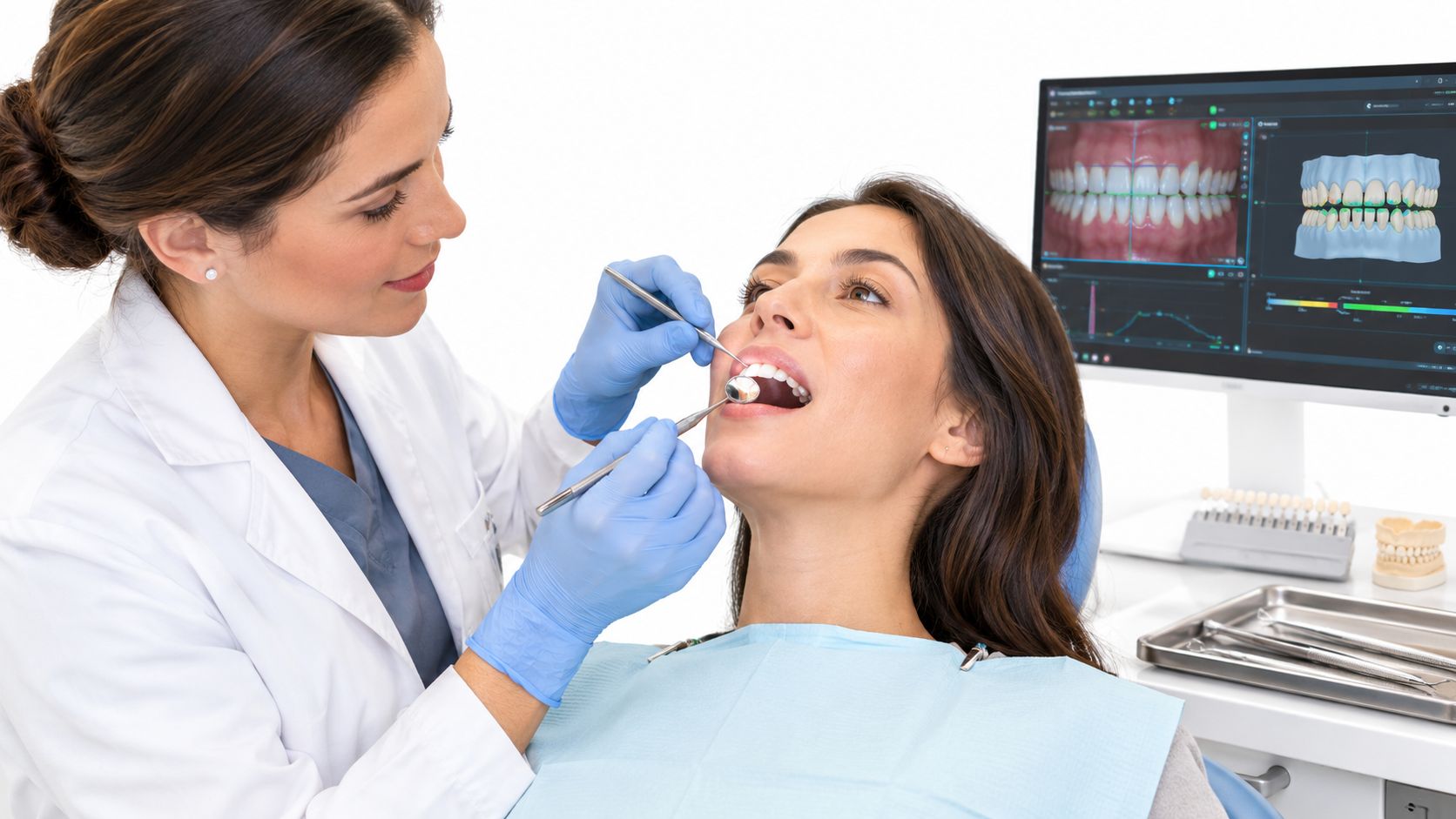
The examination considers whether the front teeth guide the jaw smoothly, whether the back teeth provide stable support, and whether clenching or grinding has flattened the edges. Jaw muscle tenderness, headaches, tooth sensitivity, fractured fillings, or morning jaw fatigue can all change the recommendation.
Patients with jaw discomfort may also benefit from understanding the difference between jaw-joint symptoms and nerve-related facial pain. This explanation of TMJ vs trigeminal neuralgia offers useful context, although a dental examination is still needed for an individual diagnosis.
A beautiful veneer plan that ignores the bite is incomplete.
When another option may be safer
Clear aligners, including SureSmile, may be more appropriate when spacing or tooth position is the primary concern. Aligning teeth first can create a better foundation for later cosmetic reshaping, or it may reduce the amount of restorative treatment needed.
Composite bonding is useful when a patient wants a conservative, reversible change to one or a few teeth. The differences between direct bonding and porcelain are outlined in this comparison of veneers and bonding, including why material choice should follow the clinical problem rather than the desired label.
A custom occlusal guard may protect restorations when nighttime grinding is present. For patients with significant jaw muscle strain, TMJ assessment, therapeutic Botox when indicated, or bite management may need to come before cosmetic enlargement. A crown can be more suitable than a veneer when a tooth requires full-coverage structural support, but full coverage also requires careful evaluation because it involves more extensive treatment.
Eric Wiitala DDS provides cosmetic dentistry alongside clear aligners, custom occlusal guards, TMJ assessment, therapeutic Botox, crowns, and restorative care. Those services allow the plan to address the cause of an unstable result instead of placing porcelain over an unresolved functional problem.
Maintaining Your New Smile in Scottsdale
Porcelain veneers don't eliminate the need for preventive dental care. They cover only selected tooth surfaces, while the natural tooth, gum tissue, bite, and neighboring teeth still require routine attention. A consistent schedule of cleaning and exams helps identify gum inflammation, decay at the margins, changes in the bite, or early signs of debonding.
Daily care should remain gentle and thorough:
- Use a non-abrasive toothpaste: This helps limit unnecessary surface wear and keeps the cosmetic finish smooth.
- Clean between the teeth: Flossing or another dentist-recommended interdental method protects the gumline and contact areas.
- Avoid using teeth as tools: Opening packages or biting hard objects can damage porcelain and natural teeth.
- Manage grinding: A custom occlusal guard can reduce direct stress on veneers when clenching or bruxism is present.
- Keep professional appointments: Hygiene visits and examinations help maintain the tissues that frame the restorations.
Staining foods and drinks can affect exposed natural tooth structure even when porcelain itself resists discoloration. Patients should also report sensitivity, a rough edge, a change in their bite, or bleeding around a veneer rather than waiting for the problem to worsen.
The financial investment depends on the number of teeth, preparation needs, laboratory work, diagnostic planning, and whether preliminary gum, restorative, orthodontic, or bite treatment is required. A consultation provides a more responsible estimate than a generic price because small-tooth cases can range from additive bonding to coordinated porcelain treatment.
Long-term success rests on the same principles that guide the initial plan: healthy enamel, stable gums, controlled forces, and realistic proportions. Patients in Scottsdale who need broader care can also receive preventive dentistry, teeth whitening, crowns, tooth extraction, dental implants, and emergency dental services through a dental practice, rather than treating the smile in isolation.
Eric Wiitala DDS offers cosmetic consultations for patients considering veneers for small teeth, along with bonding, clear aligners, crowns, occlusal guards, and TMJ-focused care when those services are more appropriate. Schedule a personalized evaluation in Scottsdale by visiting Eric Wiitala DDS and discuss a smile plan designed around enamel preservation, natural proportions, and a stable bite.