

Modern tooth-colored fillings are most often composite resin, a plastic-like acrylic base reinforced with glass or ceramic filler particles. The broader category also includes glass ionomer materials and ceramic restorations, which are chosen for specific clinical situations.
What are tooth colored fillings made of, and why does that answer matter beyond appearance? A white filling isn't just colored plastic placed inside a tooth. Its ingredients determine how it bonds, how it handles chewing pressure, how it polishes, how it responds to moisture, and how much healthy tooth structure must be removed.
For Scottsdale patients comparing restorative and cosmetic dentistry, the material recommendation should fit the tooth, the size of the damaged area, the bite, and the patient's priorities. A small cavity near the front of the smile may call for a different material than a broad defect on a back tooth. A dentist near me search may begin with appearance, but the better conversation includes strength, sensitivity, maintenance, and replacement risk.
Table of Contents
- A Quick Answer for Patients
- Composite Resin The Most Common Tooth Colored Material
- Glass Ionomer and Resin Modified Glass Ionomer
- Ceramic Inlays Onlays and Porcelain Options
- How Material Choice Affects Longevity and Wear
- Newer Ingredients Worth Asking Your Dentist About
- What to Expect at a Scottsdale Dental Visit
A Quick Answer for Patients
Most tooth-colored fillings are made from composite resin, a tooth-shaded resin matrix mixed with tiny glass, silica, or ceramic particles. The resin can be shaped inside the prepared tooth, while the filler helps provide strength, wear resistance, and a natural surface finish. The U.S. Food and Drug Administration's explanation of composite fillings describes them as acrylic resin reinforced with powdered glass filler, with shade selection and blue-light curing used to create the final restoration.

A second category is glass ionomer, made from fluoroaluminosilicate glass and an acidic polyalkenoate material. It behaves differently from composite and can release fluoride, which may make it useful near the gum line or in selected high-caries-risk areas. Resin-modified glass ionomer adds a resin component to improve handling and curing.
Ceramic fillings are made outside the mouth, usually as an inlay or onlay. They're shaped from a dental ceramic and bonded to the tooth after the restoration has been fabricated. This option can be useful when a damaged area is too large for a predictable direct filling but doesn't require a full crown.
Material choice affects more than the color of a smile:
- Appearance: Composite and ceramic can be shade-matched to surrounding enamel.
- Tooth preservation: A bonded restoration may allow the dentist to retain sound tooth structure.
- Sensitivity and sealing: Proper isolation and bonding help close the prepared area.
- Budget: Composite generally costs more than amalgam and may take longer to place, as explained by MouthHealthy's patient guide to composite fillings.
Patients who are concerned about older metal restorations can also review a broader discussion of dental materials in Dr Al Danenberg on mercury fillings. A Scottsdale dental consultation can then focus on the actual condition of the tooth rather than on marketing labels.
Composite Resin The Most Common Tooth Colored Material
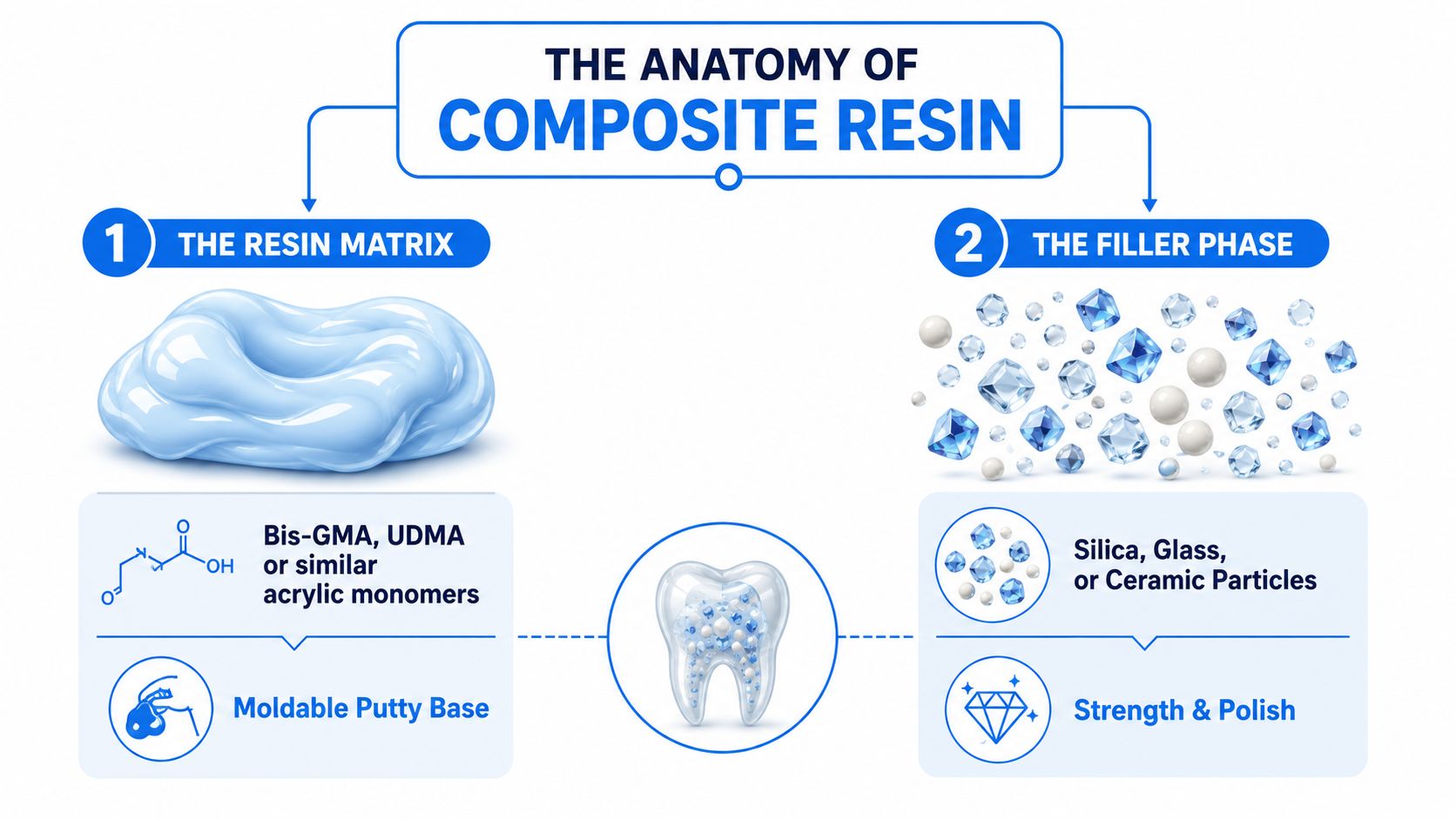
What makes a composite filling look natural while handling everyday chewing? Its performance comes from several ingredients working together, not from resin alone. The material has two main parts: a resin matrix and a filler phase. The matrix contains dimethacrylate monomers such as BIS-GMA, UDMA, Bis-EMA, and TEGDMA. The filler may contain silica, quartz, zirconia, or radiopaque glass. A technical overview of composite chemistry explains how these phases work with a silane coupling agent (ACS Education article on dental composite chemistry).
The resin matrix provides shape and curing
Before curing, the resin matrix is soft enough for the dentist to place, adapt, and sculpt inside the prepared tooth. It contains the light-activated chemistry that changes the material from workable to hard. In practical terms, resin acts like the binder in a construction material. It holds the other ingredients together and lets the dentist rebuild the missing anatomy.
The matrix also affects handling and shrinkage during curing. That is why careful placement, a clean and dry field, and proper bonding matter to the seal around the restoration. Patients can learn more about the adhesive step in this dental bonding overview.
Filler particles supply much of the performance
Filler particles work like gravel in concrete. They occupy space within the resin and can improve stiffness, strength, resistance to wear, and the ability to retain a polish. Filler loading differs by formulation. Macrofill and hybrid composites typically contain 50 to 80% filler by weight, while microfill composites contain about 35 to 50% by weight, according to the European Commission review of alternative dental materials. The same material differences help explain why a composite selected for a front tooth may not be the dentist's first choice for a heavy back-tooth bite.
Particle size also varies, from approximately 5 nanometers to 85 micrometers, depending on the formulation. Smaller particles can support a smoother, glossier finish, while other particle designs prioritize strength and wear resistance. No single composite maximizes every property, so longevity involves a trade-off between appearance, handling, and chewing demands.
Silane helps connect the resin to glass or ceramic filler, allowing chewing forces to move through the restoration more effectively. Pigments and optical modifiers help match the shade and translucency of enamel and dentin.
Composite is commonly placed in increments and hardened with a blue curing light. Proper isolation and bonding help the filling attach to the tooth and reduce gaps at the margins.
Glass Ionomer and Resin Modified Glass Ionomer
Glass ionomer is not a weaker version of composite. It belongs to a different material family. The powder contains fluoroaluminosilicate glass, and the liquid contains a polyacid. When combined, the components set through an acid-base reaction. Fluoride can be released from the material, which is one reason a Scottsdale dentist may consider it near the gum line, on a root surface, or in a selected pediatric restoration.
Composite resin releases far less fluoride because it is primarily a resin-filler system rather than a fluoride-containing acid-base cement. The material comparison described by Nanochemistry Research's discussion of dental restorative materials helps explain why dentists weigh fluoride release, adhesion, appearance, and wear together instead of treating every white filling as interchangeable.
Resin-modified glass ionomer, often shortened to resin-modified GI, adds methacrylate resin to the glass-ionomer chemistry. The resin allows light curing and can improve the setting process, early strength, and tolerance of clinical conditions. It still retains glass-ionomer characteristics, including fluoride release and chemical interaction with tooth structure.
| Property | Composite Resin | Glass Ionomer | Resin-Modified GI |
|---|---|---|---|
| Main chemistry | Resin matrix with inorganic filler | Fluoroaluminosilicate glass and polyacid | Glass ionomer chemistry with added resin |
| Fluoride release | Limited compared with glass ionomer materials | Built-in feature | Retained to a clinically useful degree |
| Appearance | Strong shade-matching potential | Usually less translucent | Generally improved over conventional GI |
| Tooth adhesion | Requires an adhesive bonding system | Can chemically interact with tooth structure | Combines chemical interaction with resin bonding |
| Moisture sensitivity during placement | Requires careful isolation | More forgiving in selected situations | More tolerant than conventional GI, though isolation still matters |
| Common use | Small to mid-size cavities and visible restorations | Root caries, gum-line areas, selected pediatric care | Liner-like applications, cervical restorations, selected small cavities |
| Main limitation | Can wear or fail under demanding posterior forces | Lower wear resistance in heavy load areas | Not a universal substitute for composite in stress-bearing sites |
The practical question is location. A material that performs well beside the gum may not be the right choice on a cusp that receives heavy chewing pressure. A dentist also considers decay risk, remaining enamel, moisture control, and whether appearance is a primary concern.
Ceramic Inlays Onlays and Porcelain Options
Ceramic restorations are fabricated outside the mouth rather than shaped entirely inside the cavity. Depending on the system, the restoration may be milled or pressed from a dental ceramic block. The material can provide excellent esthetics, color stability, surface polish, and resistance to wear, but it requires more planning than a direct composite filling.
Inlays, onlays, and crowns serve different purposes
An inlay fits within the borders of a tooth and remains inside the cusp tips. An onlay extends over one or more cusps, protecting areas weakened by decay or an old restoration. A crown covers the tooth more extensively and is considered when the remaining structure needs broader protection.
The preparation usually involves removing decay and shaping the tooth conservatively. The dentist then records a digital or physical impression, places a temporary restoration when needed, and evaluates the ceramic at a try-in appointment. Final cementation uses an adhesive resin selected for the tooth and ceramic system.
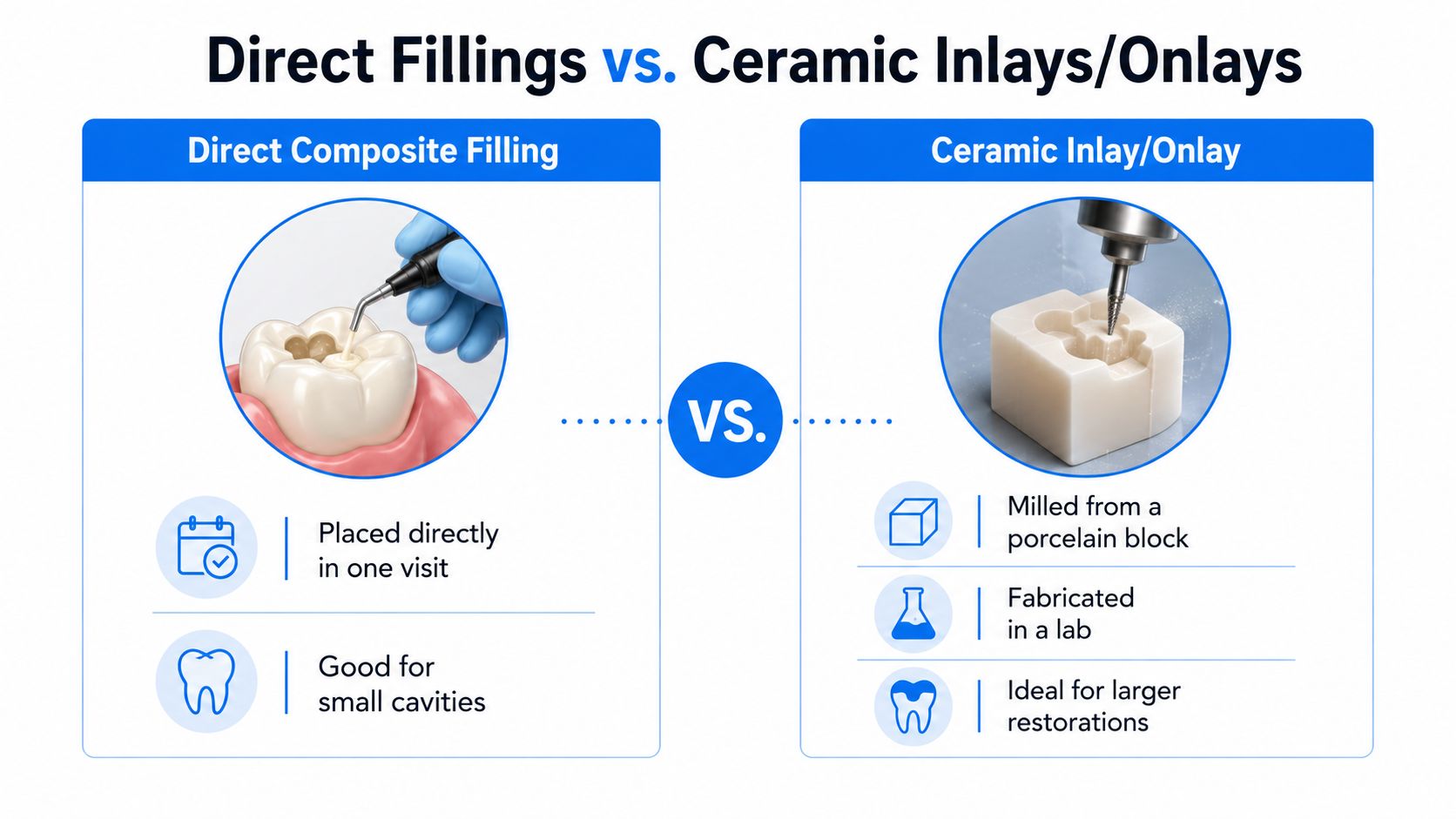
Ceramic can be attractive when a cavity or fracture involves a larger portion of a back tooth. It may rebuild more structure than a direct filling while preserving more of the natural tooth than a full crown, provided enough healthy tooth remains for retention and bonding.
The trade-off is complexity
A ceramic option can require more than one visit, laboratory or milling steps, and a higher fee than direct composite. It also isn't automatically the strongest choice for every patient. A dentist evaluates the bite, signs of grinding, the thickness available for the restoration, and whether the tooth can be isolated and bonded predictably.
For a Scottsdale patient seeking a cosmetic dentist near me, ceramic may be recommended when color stability and long-term surface quality matter. Composite may be more appropriate for a smaller defect, a conservative repair, or a restoration that can be completed directly in one appointment. The recommendation should follow the condition of the tooth, not the assumption that the most expensive material is always the most suitable.
How Material Choice Affects Longevity and Wear
Patients usually want a simple answer to a complex question: how long will the filling last? Material is part of the answer, but longevity also depends on cavity size, tooth location, moisture control, bite forces, oral hygiene, and habits such as grinding or chewing ice. No material is permanent, and a dentist can't responsibly promise one fixed lifespan for every tooth.
The clearest evidence-based caution concerns back teeth. A Cochrane review comparing tooth-colored resin fillings with amalgam found that composite resin fillings were significantly more likely to fail than amalgam fillings in permanent posterior teeth. That doesn't make composite inappropriate. It explains why a dentist may discuss size, pressure, replacement risk, and alternatives before placing a white filling on a heavily loaded molar.
Wear depends on the surface and the force
Composite contains a resin phase that can wear under repeated chewing, especially when the restoration is large or the bite is forceful. Glass ionomer generally has lower resistance to heavy load, which supports its use in selected low-stress areas rather than as a universal posterior material. Ceramic can resist wear well, but the final surface must be finished and polished properly because a rough or poorly adjusted ceramic surface may be harder on the opposing tooth.
| Material | Typical Longevity | Best Used For | Key Trade-off |
|---|---|---|---|
| Composite resin | Varies with size, location, bite, and care | Small to mid-size cavities and visible restorations | Natural appearance and bonding, with greater failure risk than amalgam in permanent back teeth |
| Glass ionomer | Varies by site and chewing load | Root caries, gum-line areas, and selected pediatric care | Fluoride release and chemical adhesion, with lower strength in heavy-load areas |
| Resin-modified GI | Varies by formulation and site | Selected cervical and low-to-moderate stress restorations | Improved handling over conventional GI, but not ideal for every load-bearing defect |
| Ceramic | Depends on design, bonding, bite, and maintenance | Larger restorations where an inlay or onlay can preserve tooth structure | Strong esthetics and surface stability, with higher cost and greater treatment complexity |
A patient who grinds may need a custom occlusal guard to reduce repeated stress. A patient who regularly chews ice may need to change that habit before any restoration can be expected to perform well. During a dental exam, the dentist also checks whether decay has weakened the cusps enough to require an onlay or crown instead of a direct filling.
Newer Ingredients Worth Asking Your Dentist About
Could a tooth-colored filling do more than replace missing structure? Newer formulations are designed to influence surface smoothness, polish retention, shrinkage, mineral exchange, or handling. The ingredients matter because each one affects what you may notice as a patient, from appearance and comfort to maintenance and repair.
Nanofillers are very small silica or zirconia particles. They can help produce a smoother surface and support polish retention. The filler system also affects how much the resin contracts as it hardens. In practical terms, particle size and loading help balance strength, appearance, and the ability to create a smooth finish. The chemistry behind these formulations is explained in an ACS technical discussion of composite formulation.
Bioactive does not mean self-healing
Some newer materials contain calcium, phosphate, or fluoride-containing particles. They may support mineral exchange or limited remineralization near the restoration. Bioactive describes that intended interaction with the surrounding tooth. It does not mean the filling can repair a crack, replace lost tooth structure, or heal after breaking.
Giomer-type materials and other fluoride-releasing formulations aim to combine a natural appearance with ion release. Resin-modified glass ionomers use glass-ionomer chemistry with resin-based handling. These materials may suit recurring decay or lesions near the gum, although the tooth's location, moisture control, and chewing forces still guide the choice.
Antibacterial monomers, such as MDPB and quaternary ammonium compounds, have also received attention. Their laboratory potential is not the same as dependable protection in everyday treatment. Dentists and researchers continue to assess how consistently these additives improve clinical outcomes, as described in a review of newer bioactive dental material trends.

A Scottsdale consultation can focus on four practical questions:
- Material selection: Which filler system fits this tooth, and why?
- Caries risk: Could fluoride release help in this situation?
- Bite protection: Could grinding or clenching shorten its service life?
- Future care: Can the restoration be repaired, polished, or replaced if needed?
Patients can review information about advanced dental materials before asking whether a newer formulation suits the clinical need.
What to Expect at a Scottsdale Dental Visit
A white filling appointment should feel organized, not mysterious. The visit begins with an examination of the tooth, surrounding gums, and bite. Intraoral photographs or low-radiation dental X-rays may help confirm the location of decay and show whether the problem is shallow enough for a filling or deep enough to require a different treatment.
The dentist then discusses the material. For a direct composite, shade selection comes before the tooth becomes dehydrated, because a dry tooth can look lighter than it does naturally. Small shade tabs may be held next to the tooth under the operatory lighting and other available light conditions to select a close match.
Keeping the tooth dry protects the bond
After local anesthetic when needed, the dentist removes decayed or weakened tissue while preserving sound structure. Isolation may involve cotton rolls, suction, or a small rubber sheet. This step is easy to overlook, but moisture can interfere with adhesive bonding, so keeping the working area controlled matters.
The prepared enamel and dentin are conditioned with a mild phosphoric-acid gel. The gel is rinsed away, and a bonding agent is brushed onto the tooth in thin layers. The bonding system creates the interface between the tooth and the composite, which is then placed into the prepared area.
The filling is shaped in controlled increments
Composite is commonly added in small increments rather than as one large mass. Each layer is adapted to the tooth and hardened with a blue curing light. This approach gives the dentist control over the restoration's contour, contact with neighboring teeth, and biting anatomy.
Patient comfort matters: A patient should be able to pause the appointment, ask why a material is being recommended, and understand what happens if the tooth needs more than a filling.
The dentist checks the bite with marking paper and adjusts any high spot. The restoration is then polished so it feels smooth against the tongue and blends with the surrounding tooth. Before the patient leaves, the team reviews expected numbness, eating guidance, sensitivity concerns, and the next preventive visit.
A new patient exam may also include cleaning and exams, dental X-rays, gum evaluation, and discussion of related needs such as teeth whitening, dental bonding, a tooth extraction, dental implants, or emergency dental services. A patient searching for an emergency dentist should contact a Scottsdale office promptly for severe pain, swelling, trauma, or a broken restoration rather than waiting for routine care.
Eric Wiitala DDS offers Scottsdale patients mercury-free white fillings, restorative care, dental bonding, crowns, porcelain veneers, dental implants, preventive visits, and cosmetic dentistry. Patients considering a tooth-colored restoration can visit Eric Wiitala DDS to request an exam and discuss which material fits the tooth, bite, appearance goals, and long-term care plan.