
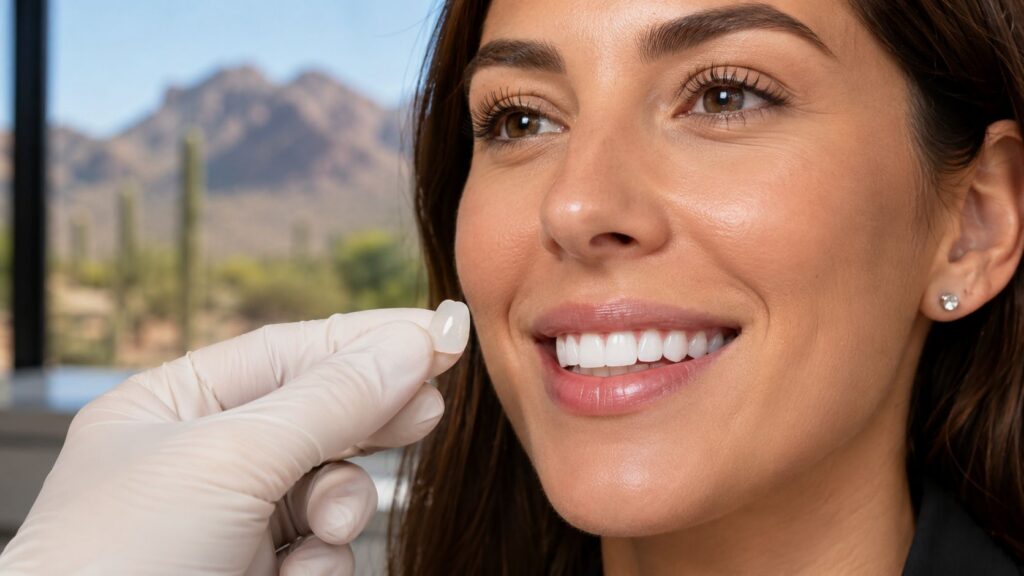
A Scottsdale resident may be covering a smile in photos, holding back a laugh, or wondering whether a cosmetic dentist can improve discoloration without creating an artificial-looking result. Those concerns are common, especially for adults whose teeth look older, darker, more uneven, or more worn than they feel.
Natural-looking veneers can refine color, shape, and proportion while preserving the visual qualities that make real teeth believable. The important question isn't whether veneers can make teeth whiter. It's whether the material, thickness, shade, surface, and underlying tooth can work together. Dr. Eric Wiitala's Scottsdale practice helps patients evaluate that decision alongside preventive, restorative, and cosmetic dental care.
Why So Many Scottsdale Patients Want Natural Looking Veneers
A patient may arrive at a Scottsdale dental office with a small request, “The teeth show too much when smiling,” or “The front teeth don't match anymore.” Behind that request is often a larger emotional concern. A chipped edge can make someone hesitate before speaking. Uneven color can make photographs feel uncomfortable. Worn teeth can create a mismatch between how energetic a person feels and how their smile appears.
Porcelain veneers are thin, custom-made ceramic restorations placed over the visible surfaces of selected teeth. They can address discoloration, minor shape differences, chips, and certain spacing concerns. The best result doesn't erase every natural characteristic. It creates a smile that fits the patient's face, bite, age, and preferences.

The concern behind the cosmetic request
Many people searching for a cosmetic dentist near me aren't looking for a dramatic celebrity-style smile. They want teeth that look healthier, balanced, and more consistent when they talk or smile. A believable result may include slight differences in contour and gentle variation in brightness rather than identical, opaque teeth.
Scottsdale patients also deserve an honest answer about difficult cases. Veneers can be harder to make natural-looking when the underlying teeth are dark, unevenly discolored, heavily worn, or covered by older restorations. Ceramic alone can't always hide every substrate problem without affecting translucency and thickness.
Dr. Wiitala's practice approaches cosmetic planning within a broader dental evaluation. A patient may need cleaning and exams, dental x-rays, gum evaluation, whitening, bonding, or restorative dentistry before veneer treatment. If a tooth is compromised, a crown, tooth-colored filling, or another treatment may be more appropriate than placing a veneer over an unstable foundation.
A believable smile is planned around the patient, not selected from a single shade tab.
By the end of a consultation, patients should understand what makes veneers look lifelike, what can make them appear flat or bulky, and whether veneers are the right path for their own smile in Scottsdale, Arizona.
What Actually Makes a Veneer Look Natural
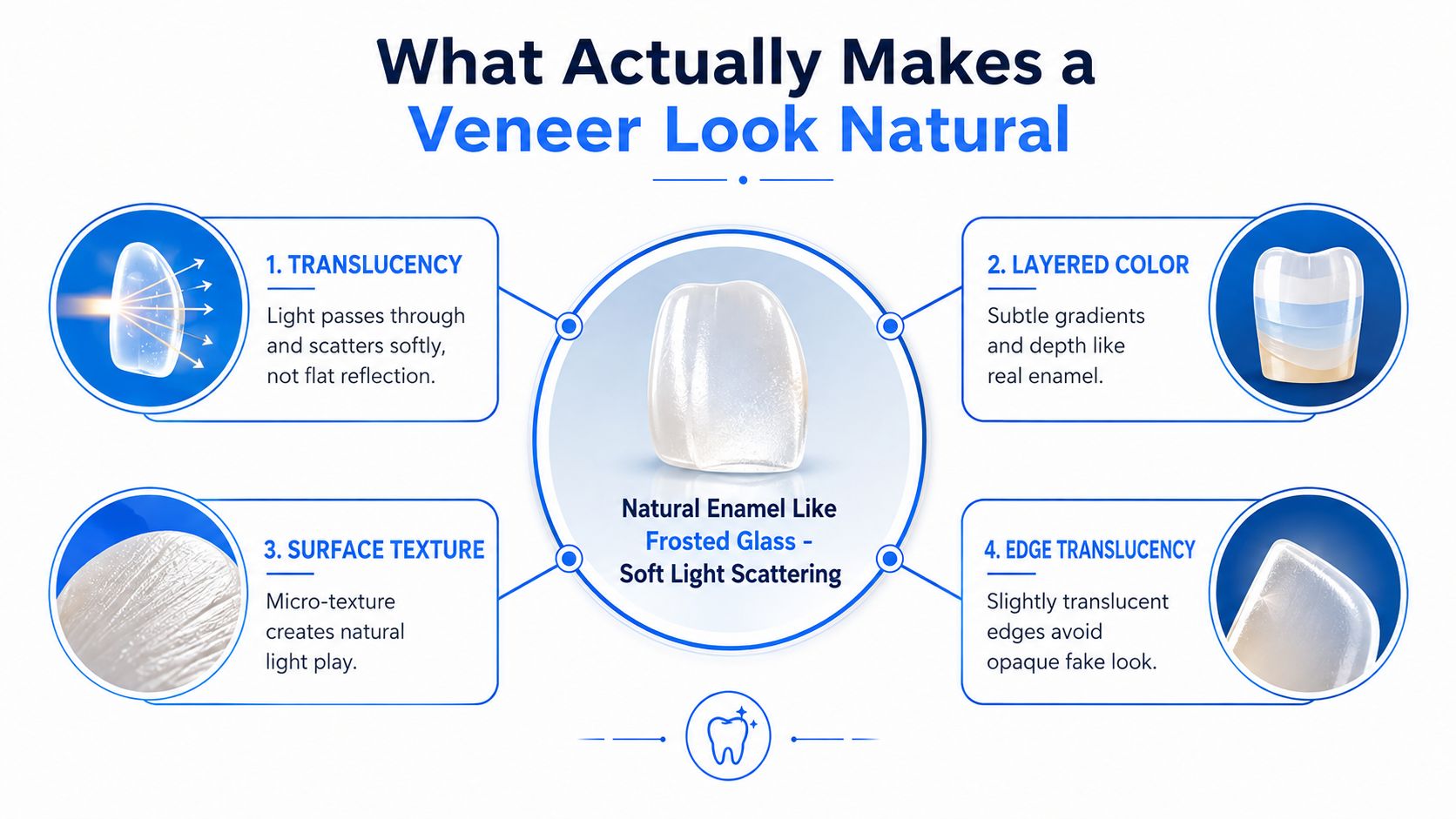
Natural enamel behaves somewhat like frosted glass. Light doesn't just bounce off a flat, solid surface. It enters, scatters, and returns with subtle depth. Veneers that look real need to manage light in a similar way.
Translucency creates depth
Translucency means that some light passes through the ceramic before reflecting back. A veneer with appropriate translucency can show a gentle transition from the body of the tooth toward the edge. Excessive opacity may look flat or chalky. Excessive translucency may allow dark tooth structure, old composite, or discolored dentin to show through.
Research on highly translucent zirconia laminate veneers found that 0.50 mm veneers were significantly more translucent than 0.75 mm and 1.0 mm veneers, and that lighter underlying substrates produced the best translucency regardless of thickness, as reported in the clinical study indexed by PubMed. That finding explains why a thin veneer can look beautifully lifelike on a favorable tooth but less predictable over a dark one.
Thickness changes the optical result
Thickness isn't just a preparation measurement. It changes how much light travels through the veneer and how much underlying color gets masked. A clinician must balance enough ceramic to control the final shade with enough translucency to preserve depth.
A comparative veneer study found that ceramic type and thickness significantly affected translucency, with translucency decreasing as thickness increased from 0.5 to 1.0 mm. The same research reported that lithium disilicate showed color-difference changes near or below the human perception threshold across some thickness changes, as described in this peer-reviewed review.
Color needs layers, not one flat tone
Real teeth aren't one uniform white. They often have a slightly stronger body color near the middle, softer light reflection toward the edges, and subtle opacity close to the gumline. A natural-looking veneer design considers these transitions instead of applying a single bright shade across every surface.
Surface texture also matters. Fine anatomical contours and controlled polish affect how light moves across the tooth. A perfectly smooth, identical set of teeth can look less convincing than a carefully shaped smile with gentle variation.
A shade guide is only one part of planning. The dentist also evaluates adjacent teeth, photographs, the patient's complexion, lip movement, facial proportions, and the color of the prepared tooth. Whitening may be considered before veneers when natural teeth will remain visible beside the restorations.
The central lesson is simple. Natural-looking veneers depend on how light interacts with ceramic, tooth structure, cement, and surface design. They aren't defined by whiteness alone.
The following video provides a visual introduction to veneer appearance and smile design:
Comparing Veneer Materials and Preparation Styles
Patients often ask whether porcelain, composite, minimal-prep, or no-prep veneers will look most natural. There isn't one answer for every mouth. The right choice depends on enamel, tooth position, discoloration, bite forces, desired change, and whether the existing teeth can support the planned material.
| Option | Enamel Removed | Natural Appearance | Best For |
|---|---|---|---|
| Porcelain veneers | Conservative preparation may be needed to create space for ceramic and manage shade | Strong optical depth, translucency, and surface refinement when designed well | Patients seeking durable cosmetic changes to color, shape, or minor wear |
| Direct composite bonding | Often little or no significant enamel removal, depending on the repair | Can look natural when carefully layered and shaped, though the finish and long-term behavior differ from porcelain | Minor chips, small shape changes, and patients seeking a more conservative approach |
| Minimal-prep veneers | Limited reduction when tooth position and shade allow it | Can preserve enamel and maintain translucency, but may not mask dark substrates | Favorably colored teeth needing modest contour changes |
| No-prep approach | May involve no intentional enamel reduction in selected cases | Can appear natural only when added thickness doesn't create bulky contours | Carefully selected teeth with enough space and limited positional change |
| More masking-oriented porcelain design | Additional space may be needed to control a darker underlying shade | Better masking can reduce translucency if the restoration becomes too opaque or thick | Dark, uneven, or previously restored teeth requiring substrate management |
Published porcelain veneer guidance describes facial preparation of about 0.3 mm in the cervical third and 0.5 mm across the remaining facial surface for many cases. When a greater color change is needed, preparation may increase to 0.5 mm cervically and 0.7 mm across the rest of the facial surface, according to published porcelain veneer preparation guidance.
A minimally invasive veneer review states that thickness affects both durability and color, with a veneer requiring a minimum of 0.2 mm and ideally about 0.3 mm for each shade change, as discussed in the peer-reviewed review of minimally invasive veneers. A classic clinical study also concluded that about 0.5 mm of enamel reduction can balance porcelain thickness with the available labial enamel on anterior teeth, as reported in the British Dental Journal study.
These figures aren't a promise that every patient receives the same preparation. Tooth anatomy and material requirements control the plan. Patients considering options can also review how advanced dental materials may support restorative and cosmetic treatment decisions.
Do Veneers Ever Look Fake and How That Is Avoided
Yes, veneers can look artificial when the design ignores the patient's tooth structure, face, or bite. That honest answer is more useful than a blanket promise that every veneer result will look natural.
Common signs of an artificial result
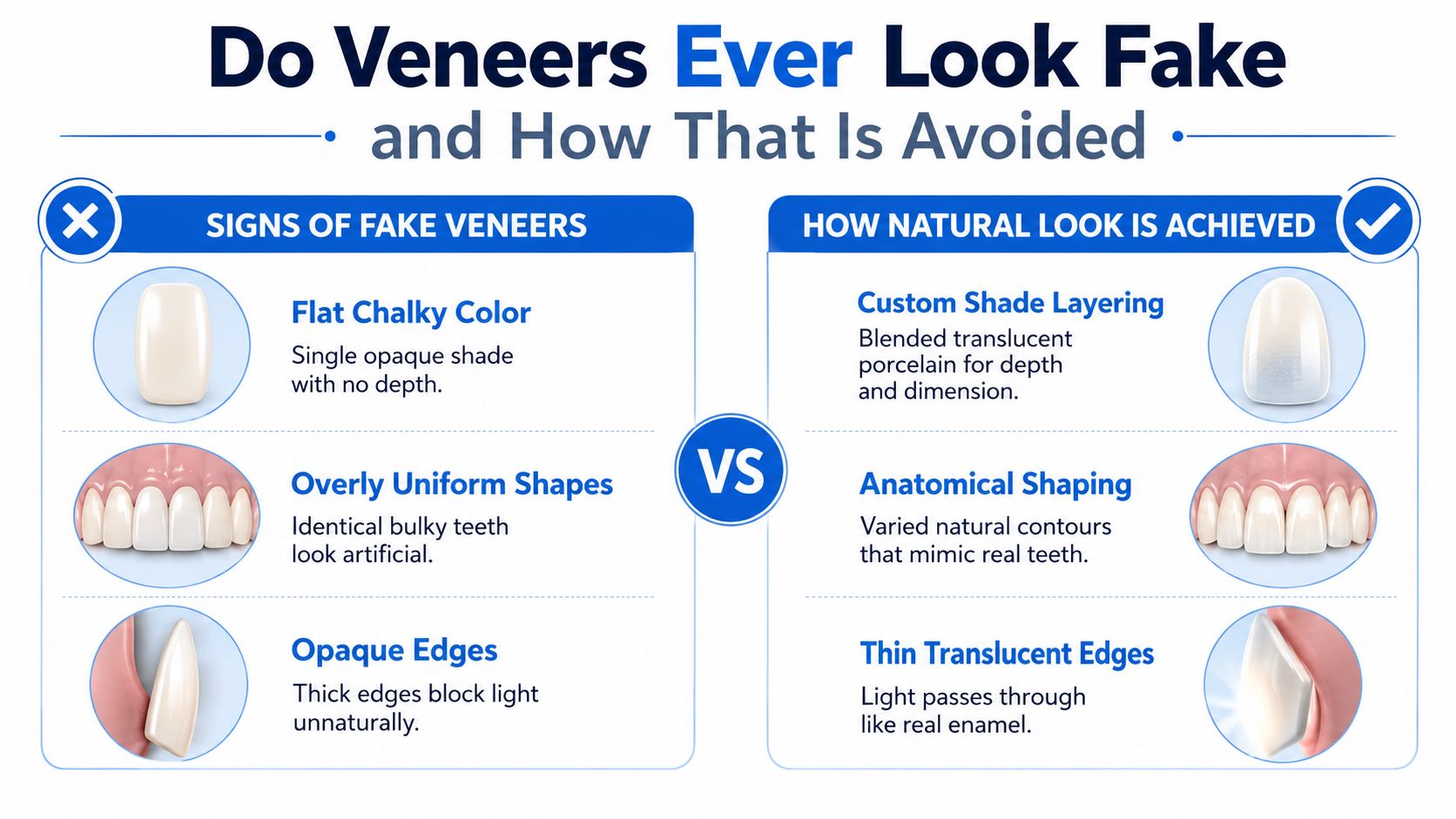
A flat, chalky smile often indicates excessive opacity or a single shade without enough variation. Identical tooth shapes can make the smile look manufactured, especially when the teeth are too wide, too long, or too uniform for the patient's facial proportions. Bulky contours may result when ceramic is added without creating enough room or when tooth position isn't considered carefully.
Opaque edges create another problem. Real enamel often allows light to move through the incisal area. A thick ceramic edge that blocks light may stand out during conversation or photographs.
The challenge becomes greater over dark or restored teeth. Research summarized in a 2026 systematic review of veneer color factors found that resin cement shade and veneer translucency consistently influenced final veneer color. The underlying substrate and cement shade can matter as much as the ceramic shade, particularly when the veneer is thin and highly translucent.
How individualized planning helps
A natural-looking approach may combine different levels of opacity and translucency across the smile. One tooth may need more masking near the body, while another may benefit from a more translucent edge. The laboratory design also needs to account for tooth length, facial curvature, gum display, lip movement, and the way the patient closes the bite.
Natural variation doesn't mean careless inconsistency. It means avoiding a row of identical blocks. Small differences in contour, edge shape, and light reflection can help restorations integrate with the surrounding smile.
Patients with dark, worn, or previously restored teeth should ask how the dentist plans to manage the substrate. The answer may involve whitening first, replacing old restorations, changing preparation depth, selecting a different ceramic opacity, or considering bonding or another restorative option.
The most natural veneer is not always the thinnest or brightest one. It is the one that controls the underlying shade without losing believable light behavior.
A Scottsdale cosmetic consultation should include a discussion of limitations, not only a discussion of the desired shade. That conversation helps patients avoid surprises and decide whether the expected result matches their goals.
How Long Natural Looking Veneers Last and How Satisfied Patients Are
Porcelain veneers have a substantial clinical history. A major review reported a 94.4% survival rate at 5 years and 93.5% at 10 years in one retrospective study. The same review described a randomized clinical trial reporting 96% survival at 10 years and 91% at 20 years, as summarized in the clinical review of porcelain veneer outcomes.
Survival doesn't mean a veneer never needs attention. It means the restoration remains in place and clinically functional over the evaluation period. For appearance, long-term stability matters because a veneer that fractures, debonds, or changes its relationship with the gumline may no longer look symmetrical or consistent.
What the long-term evidence means
The most common failure mode identified in the review was ceramic fracture. That finding supports careful material selection, conservative preparation, accurate bonding, and bite evaluation. Patients who grind or clench may need a custom occlusal guard to reduce damaging forces.
Patient satisfaction also supports porcelain veneers as an esthetic treatment. A 1997 satisfaction study reported 76% overall satisfaction at baseline and 78% after two years, with porcelain veneers performing better than direct composite veneers at the two-year evaluation. More recent research reported an average satisfaction score of 4.51 out of 5 across veneer patients, with porcelain veneer patients averaging 4.63, as documented in the patient-centered veneer research.
A long-term outcomes study involving 68 patients and 312 veneers with an average 8-year follow-up reported high satisfaction and improved oral health-related quality of life, using the same patient-centered evidence source. These findings don't guarantee that every patient will love every result. They show that porcelain veneers have been evaluated for appearance, function, and patient experience over extended periods.
Habits that protect the result
- Use gentle daily hygiene: Brush carefully with non-abrasive toothpaste and clean between teeth as directed.
- Protect against grinding: Wear a custom occlusal guard if bruxism or nighttime clenching is present.
- Avoid excessive force: Don't bite ice, open packages, or hold objects with the front teeth.
- Keep scheduled visits: Professional hygiene and routine examinations help identify gum changes, wear, or bonding concerns early.
Dr. Eric Wiitala has practiced for more than 20 years and is recognized as one of the Valley's Top Dentists by PHOENIX magazine, according to the practice information. His Scottsdale office evaluates cosmetic treatment alongside bite health, gum condition, restorative needs, and long-term maintenance.
Are You a Good Candidate for Veneers in Scottsdale
Veneers may suit adults who have healthy enough teeth and gums to support cosmetic treatment, with concerns such as persistent discoloration, chipped edges, worn contours, minor spacing, or uneven tooth shape. The desired change should also be realistic. Veneers can improve the visible surfaces of selected teeth, but they don't replace the need for cleanings, gum care, decay treatment, or bite management.
Some patients may benefit from a more conservative option. Whitening can address stain when the tooth structure and shape are already acceptable. Bonding can repair a small chip or reshape a limited area while preserving more tooth structure. Clear aligners may make more sense when tooth position or spacing is the main concern.
A practical comparison of dental bonding and veneers can help patients prepare questions, but a clinical examination is still needed before choosing treatment.
Why bite health matters
Grinding and clenching place stress on porcelain. A patient who wakes with jaw soreness, notices flattened edges, or has a history of fractured dental work may need a TMJ and bite assessment before cosmetic treatment. An occlusal guard can be part of the plan when protection is indicated.
The office also provides broader care, including restorative dentistry, dental implants, implant-supported solutions, periodontal evaluation, clear aligners, and sleep-related oral appliance therapy. That scope matters when a smile concern includes missing teeth, unstable restorations, gum issues, or jaw symptoms.
What a Scottsdale consultation can include
A new patient visit may involve:
- Conversation about goals: The dentist listens to what feels unnatural now and what kind of change feels comfortable.
- Clinical examination: Teeth, gums, existing fillings, bite relationships, and signs of wear are evaluated.
- Imaging when indicated: Dental x-rays can help identify issues that aren't visible during a surface examination.
- Aesthetic planning: Tooth color, facial proportions, lip movement, and the underlying shade are considered together.
- Treatment choices: Whitening, bonding, veneers, orthodontic care, or restorative treatment may be discussed.
- Financial planning: Insurance and billing support, along with available financing options, can be reviewed before treatment begins.
Patients searching for a dentist in Scottsdale, AZ, a cosmetic dentist near me, or a practice that can coordinate general and cosmetic care can use this visit to receive a personalized plan rather than selecting a veneer style in isolation.
Caring for Your Veneers and Scheduling Your Consultation
Daily care for veneers is familiar dental care. Gentle brushing, careful flossing, and non-abrasive toothpaste help protect the restoration and the gums around it. Patients who grind should use a custom occlusal guard, while everyone should avoid biting ice, opening packages with the teeth, or placing unnecessary force on veneer edges.
Routine check-ups and professional hygiene at the Scottsdale office help monitor the bite, gumline, adjacent teeth, and veneer surfaces. Whitening may be completed before veneer placement when surrounding natural teeth need stain reduction, while fillings, bonding, crowns, or other restorative care may support teeth that aren't candidates for veneers.
Patients looking for a dentist near me, emergency dentist, tooth extraction, or dental implants near me can also discuss those needs during a full visit, especially when cosmetic goals overlap with damaged or missing teeth.
Eric Wiitala DDS offers cosmetic, preventive, restorative, and general dentistry for patients seeking veneers natural looking results in Scottsdale, AZ. Schedule a consultation with Dr. Eric Wiitala at 9755 North 90th Street, Suite B250, Scottsdale, AZ 85258, by calling (480) 657-6981 or visiting Eric Wiitala DDS to discuss a smile plan built around natural proportions, healthy teeth, and long-term care.