
What if the strongest treatment on paper isn't the one that helps most at home? That question sits at the center of Sleep Apnea Oral Appliance vs CPAP. CPAP controls breathing events more completely in a lab setting, but a machine left on a nightstand protects nobody. For Scottsdale adults searching for a dentist near me because snoring, gasping, morning headaches, or daytime sleepiness won't quit, the useful comparison is simpler: which therapy will be worn for enough hours, on enough nights, while keeping the airway open? The answer depends on severity, anatomy, heart risk, and honest nightly habits, and it should be proven with a repeat sleep test, not guessed from comfort alone.
Table of Contents
- CPAP vs Oral Appliance at a Glance
- How Each Therapy Keeps the Airway Open
- Which Therapy Controls Apnea Best by Severity
- Adherence and Real-World Nightly Use
- Heart Health and Who Each Option Suits
- What Fitting and Follow-Up Testing Involve
- Cost, Insurance and Side Effects in Scottsdale
- Choose and Book Your Sleep Apnea Evaluation in Scottsdale
CPAP vs Oral Appliance at a Glance
CPAP usually controls breathing events more completely, while a custom oral appliance is a clinically recognized alternative that more people keep using. That verdict isn't a tie. It's a trade-off between efficacy, how well a therapy works when it's on, and effectiveness, how much benefit a person gets across real nights at home.
The American Academy of Sleep Medicine and American Academy of Dental Sleep Medicine 2015 guideline concluded that CPAP is superior to oral appliance therapy for reducing the apnea-hypopnea index (AHI), eliminating sleep-related arousals, and improving oxygen saturation, while recommending a custom, titratable oral appliance for adults who can't tolerate CPAP or prefer an alternative. Neither option wins for everyone, and anyone claiming otherwise is selling, not advising.
| Factor | CPAP | Oral appliance |
|---|---|---|
| How it works | Pressurized air through a mask keeps the airway open | Custom device advances the lower jaw or holds the tongue forward |
| Breathing event control | Stronger average reduction in AHI and oxygen dips | Lower average AHI reduction, results shift with device and anatomy |
| Typical role | Usual first choice for most adults with OSA | Option for adults who prefer it, can't tolerate CPAP, or don't respond |
| Daily burden | Machine and mask every night, harder to pack | Small, portable, no electricity needed |
| Common side effects | Mask discomfort, dry mouth, nasal congestion | Jaw soreness, bite changes, tooth movement |
| Monitoring needed | Sleep test to set pressure, then follow-up | Dentist check plus repeat sleep test after fitting |
How to Read This Table
If maximal event control is the priority, especially with severe disease or major oxygen drops, CPAP remains the benchmark. If the main barrier is the mask, travel, noise, or a partner who can't sleep through machine hum, the appliance column deserves serious weight. A strong therapy that isn't worn delivers little benefit, and a milder therapy worn all night can deliver real gains.
Two practical details matter before deciding. An oral appliance for sleep apnea isn't a boil-and-bite guard from a pharmacy shelf. It's custom-made by a dentist trained in sleep medicine, fitted to the teeth, and adjusted gradually. Insurance coverage also differs for each option, so coverage for the sleep test, the device, and follow-up testing should be verified before anyone commits.
Decision rule: Choose the therapy that controls events on a sleep test and still gets worn at 2 a.m., on work trips, and six months from now.
How Each Therapy Keeps the Airway Open
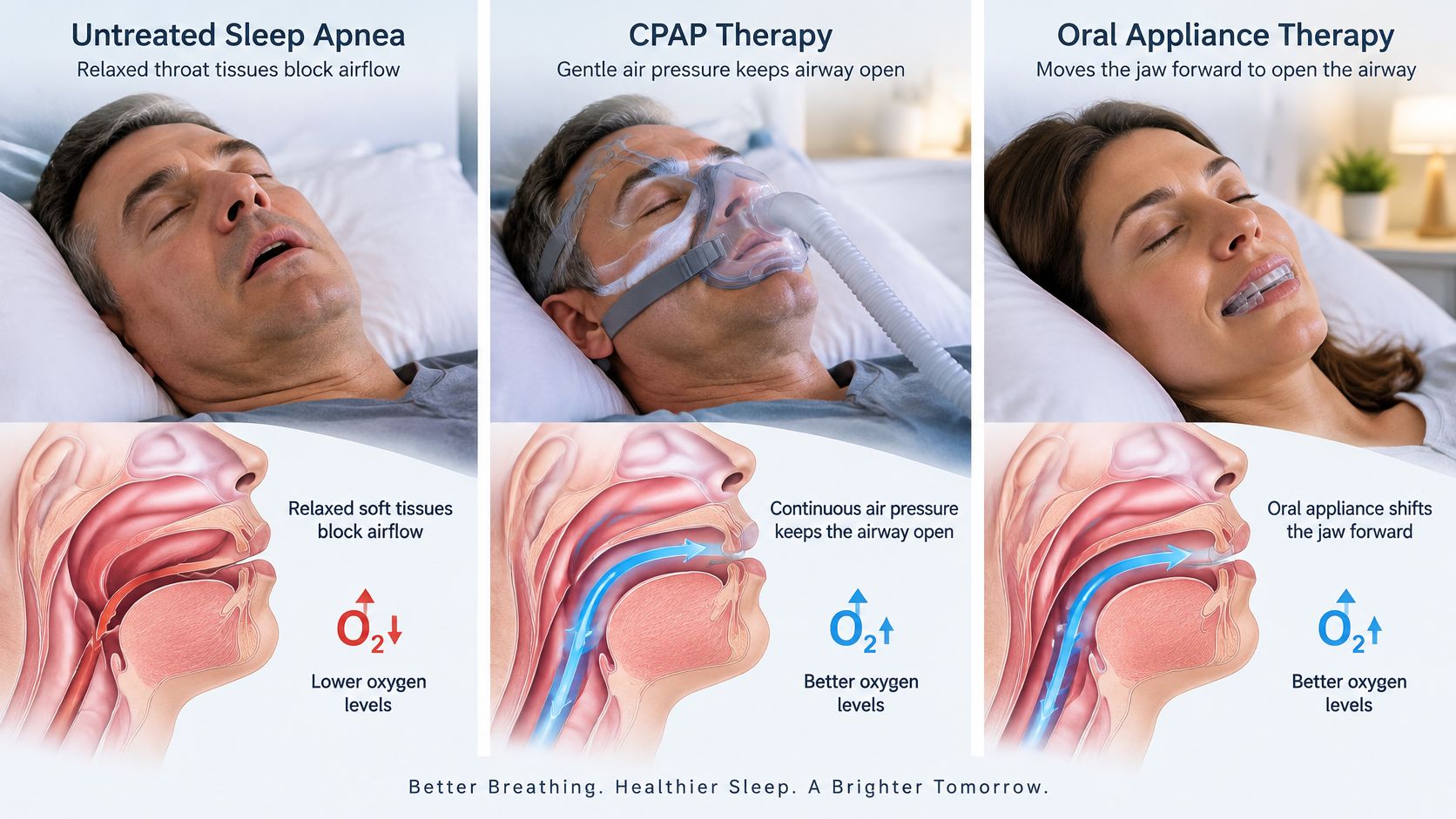
During sleep, the muscles at the back of the throat relax. In obstructive sleep apnea (OSA), the tongue and soft tissues fall backward and narrow or block the airway. Breathing pauses, oxygen dips, and the brain briefly rouses the body to restart airflow. The illustration below shows the difference between an untreated airway and both treatment approaches.
CPAP Splints the Airway With Air
Say a Scottsdale patient falls asleep wearing a CPAP mask. The machine sends a steady stream of pressurized air through the nose, the mouth, or both. That pressure acts like an internal splint, holding soft tissue away from the throat wall so air keeps moving. It doesn't change jaw position or anatomy. It out-pressures the collapse, all night, as long as the mask stays sealed.
An Oral Appliance Repositions the Jaw or Tongue
An oral appliance works mechanically instead. The National Heart, Lung, and Blood Institute treatment guide identifies mandibular repositioning mouthpieces as devices that cover the upper and lower teeth and prevent the jaw from sliding backward during sleep, while tongue-retaining devices hold the tongue in a forward position. The NHLBI also notes that clinicians may prescribe an oral device when a patient doesn't want to use or can't tolerate CPAP.
Because the tongue attaches to the lower jaw, advancing the jaw pulls the tongue forward and widens the space behind it. That extra space is the whole point. The amount of advancement isn't set once and forgotten. It's adjusted in small steps over several visits, a process called titration, until breathing improves without unacceptable jaw strain. The short video below walks through how that repositioning works in practice.
The honest test is behavioral. A person who rips off a mask by midnight gets splinting for only part of the night. A person who tolerates a mouthpiece until morning gets jaw support for the full sleep period. Predicting which device will stay in place is a clinical question, not a matter of willpower.
Which Therapy Controls Apnea Best by Severity
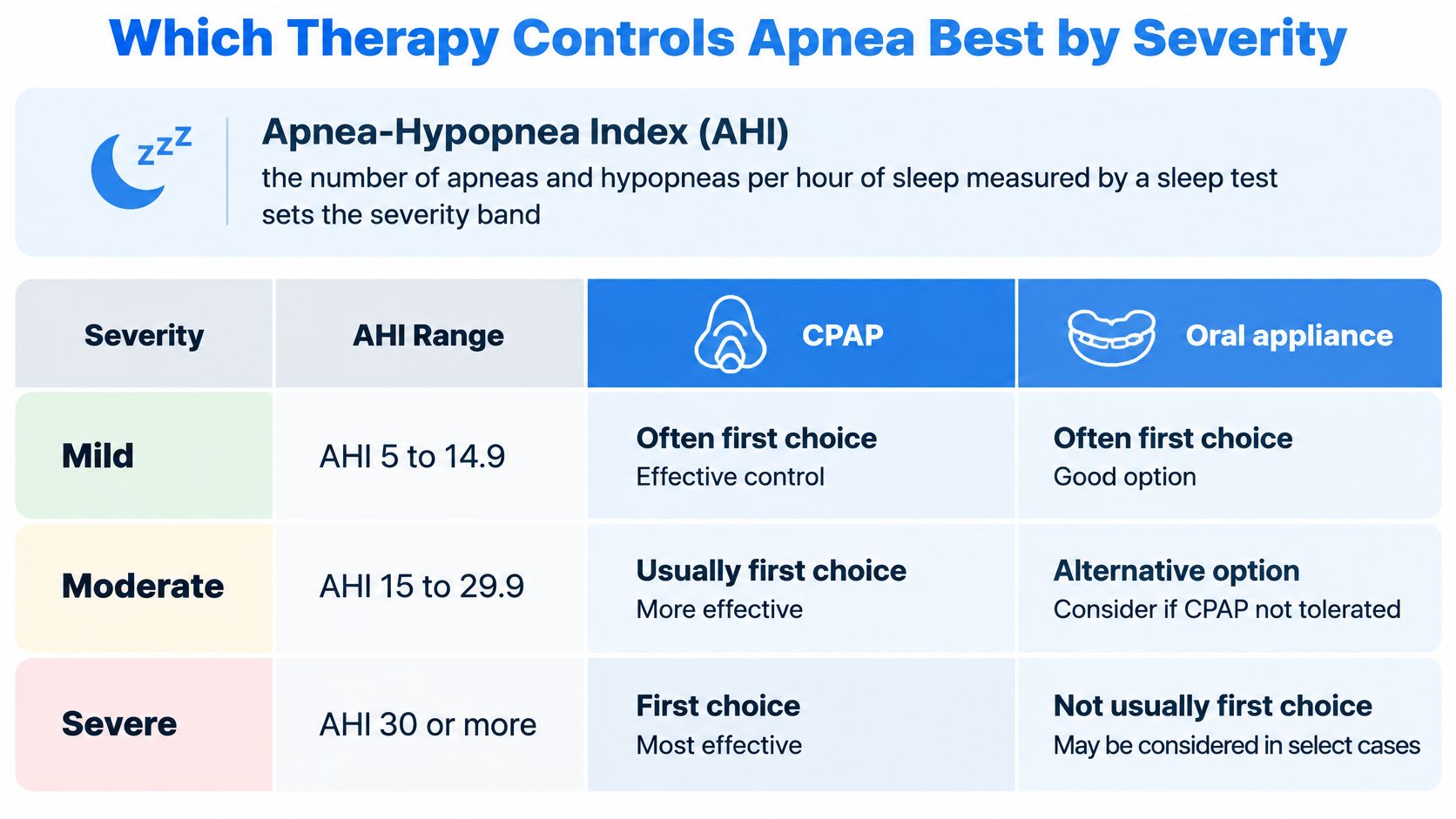
The apnea-hypopnea index (AHI) counts apneas and hypopneas per hour of sleep on a sleep test, and that number sets the severity band. Severity should drive the first recommendation. Preference refines it afterward.
| Severity (AHI events per hour) | Usual first choice | Why it matters |
|---|---|---|
| Mild (AHI 5 to under 15) | Oral appliance or CPAP, chosen by preference and tolerance | Appliance is reasonable if repeat testing confirms control |
| Moderate (AHI 15 to under 30) | CPAP first, appliance when CPAP isn't tolerated | Event burden is high enough that residual AHI must be proven low |
| Severe (AHI 30 or more) | CPAP | Oxygen drops and cardiometabolic risk make maximal control the priority |
What the Comparison Data Show
The gap between the two therapies is real and measurable. The AASM oral appliance clinical guideline reports systematic-review evidence of significantly larger reductions in AHI and oxygen-desaturation index with CPAP, with one pooled comparison showing an AHI advantage of approximately 4.26 events/hour for CPAP (95% CI, 3.44 to 5.09; p<0.00001). That reflects CPAP's continuous pneumatic splinting versus a mandibular advancement device that enlarges the airway by repositioning the jaw and soft tissues.
In mild disease, a gap of a few events per hour may still leave the residual AHI in an acceptable range. In severe disease, that same gap can leave dozens of untreated events every night, plus the oxygen desaturation that comes with them. That's why CPAP stays the preferred benchmark when severe OSA, substantial nocturnal hypoxemia, or major cardiometabolic risk is present.
Control Means More Than One Number
A custom, titratable appliance shouldn't be judged only by whether its residual AHI matches CPAP exactly. Symptom response matters too, including snoring, witnessed pauses, morning headache, and daytime alertness. Still, symptoms alone can't certify control, because people adapt to poor sleep and underreport it. Objective follow-up testing settles the question.
The practical sequence is fixed. The sleep physician sets the treatment target from the diagnostic test. The chosen device gets fitted and adjusted. A repeat sleep test then shows whether that device, in that mouth, meets the target. Patients in Scottsdale should expect that sequence from any dentist in Scottsdale, AZ offering appliance therapy, along with qualified-dentist oversight for dental side effects and bite changes.
Adherence and Real-World Nightly Use
Which treatment protects your airway more often: the one that works best in a sleep lab, or the one you wear each night? Use matters, but it does not make the therapies interchangeable. CPAP can control apnea more strongly; an oral appliance may be easier to keep using. Judge both nightly use and measured results.
| Adherence finding | Reported figure | Context |
|---|---|---|
| Appliance use after 1 year | 60% | Summarized in a 2025 review in Dentistry |
| Appliance use after 2 years | 48% | Summarized in a 2025 review in Dentistry |
| Objectively measured appliance use, 1 to 6 months | 80.0% at 1 month, falling to 67.3% at 6 months | 2025 review in Dentistry |
| Long-term CPAP use at 4 or more hours nightly | Below 50% | AASM quality-measure document |
| Appliance continued over 1 year after CPAP failure | 74.0% | 2025 study of 81 people, summarized in the 2025 review in Dentistry |
| Mean AHI after switching from failed CPAP to appliance | 41.3 at baseline, falling to 12.4 events per hour | 2025 study of 81 people, summarized in the 2025 review in Dentistry |
Self-Reports Overstate Use
People often report using CPAP more consistently than device records show. In an American Academy of Sleep Medicine quality-measure document, 60% of patients said they used CPAP every night for an average of 106.9 days. Objective data showed that only 16 of 35 patients, or 46%, used it at least four hours per night on at least 70% of nights.
Appliance use also declines over time. A 2025 review in Dentistry reports objectively measured use falling from 80.0% at one month to 67.3% at six months. In a study of 81 people whose CPAP had failed, 74.0% continued appliance therapy for more than one year, while mean AHI fell from 41.3 to 12.4 events per hour. These findings show why reported comfort or regular use cannot establish that treatment controls apnea.
What Actually Predicts Sticking With Treatment
For oral appliances, age, dental and jaw characteristics, partnership status, and psychological comorbidities can influence continued use. With CPAP, mask comfort, nasal symptoms, air leaks, and sleeping position can determine whether the device stays in the nightly routine. Travel can matter too: an appliance in a small case may be easier to pack than a machine, hose, and power supply.
The practical test is both adherence and effectiveness. A device worn for seven hours nightly is not a sound choice if follow-up testing shows poor control. Likewise, stronger therapy offers little protection during the hours it sits unused. Choose the option you can sustain, then confirm its effectiveness with objective testing.
Heart Health and Who Each Option Suits
Untreated sleep apnea strains the cardiovascular system night after night. Repeated oxygen drops and arousals push blood pressure up and keep it high, which is why blood pressure is a fair test of whether a therapy delivers benefit beyond quieter snoring.
A 2024 randomized trial in the Journal of the American College of Cardiology compared mandibular advancement devices with CPAP in 220 adults who had moderate-to-severe OSA, defined as an AHI of at least 15 events per hour, plus hypertension and increased cardiovascular risk. After six months, 24-hour mean arterial blood pressure fell by 2.5 mm Hg in the oral-appliance group, while no significant change occurred in the CPAP group, and the difference met the study's prespecified noninferiority criterion. That result doesn't prove every appliance works equally well for every patient. It proves that in a selected, higher-risk group, the appliance wasn't inferior to CPAP for that blood-pressure outcome.
For readers weighing heart risk alongside sleep symptoms, screening for sleep apnea cardiovascular risks is a useful next read before a consultation. It helps frame the questions worth raising with both a physician and a dentist.
Heart outcomes can be comparable even when airway control is not.
Who Each Option Suits
- Oral appliance often fits: Adults with mild or moderate disease, CPAP intolerance, mask leaks or claustrophobia, frequent travel, side or stomach sleeping, or a clear preference for a mask-free option.
- CPAP should come first: Severe oxygen desaturation, very high residual AHI on an appliance, complex cardiopulmonary disease, or any case where maximal normalization of breathing events is urgent.
- Dental health decides eligibility: An appliance needs sound teeth and gums to grip, plus a jaw joint that tolerates gradual advancement, so TMJ pain, loose teeth, or active gum disease need assessment and often treatment first.
- Either therapy needs proof: Cardiovascular benefit follows verified nightly use, so follow-up testing and adherence checks apply no matter which device is chosen.
Scottsdale patients with hypertension shouldn't treat device choice as either/or in isolation. Blood pressure management, weight, alcohol near bedtime, and sleep position all interact with whichever therapy is selected. The right plan accounts for the whole risk picture, then verifies the result.
What Fitting and Follow-Up Testing Involve
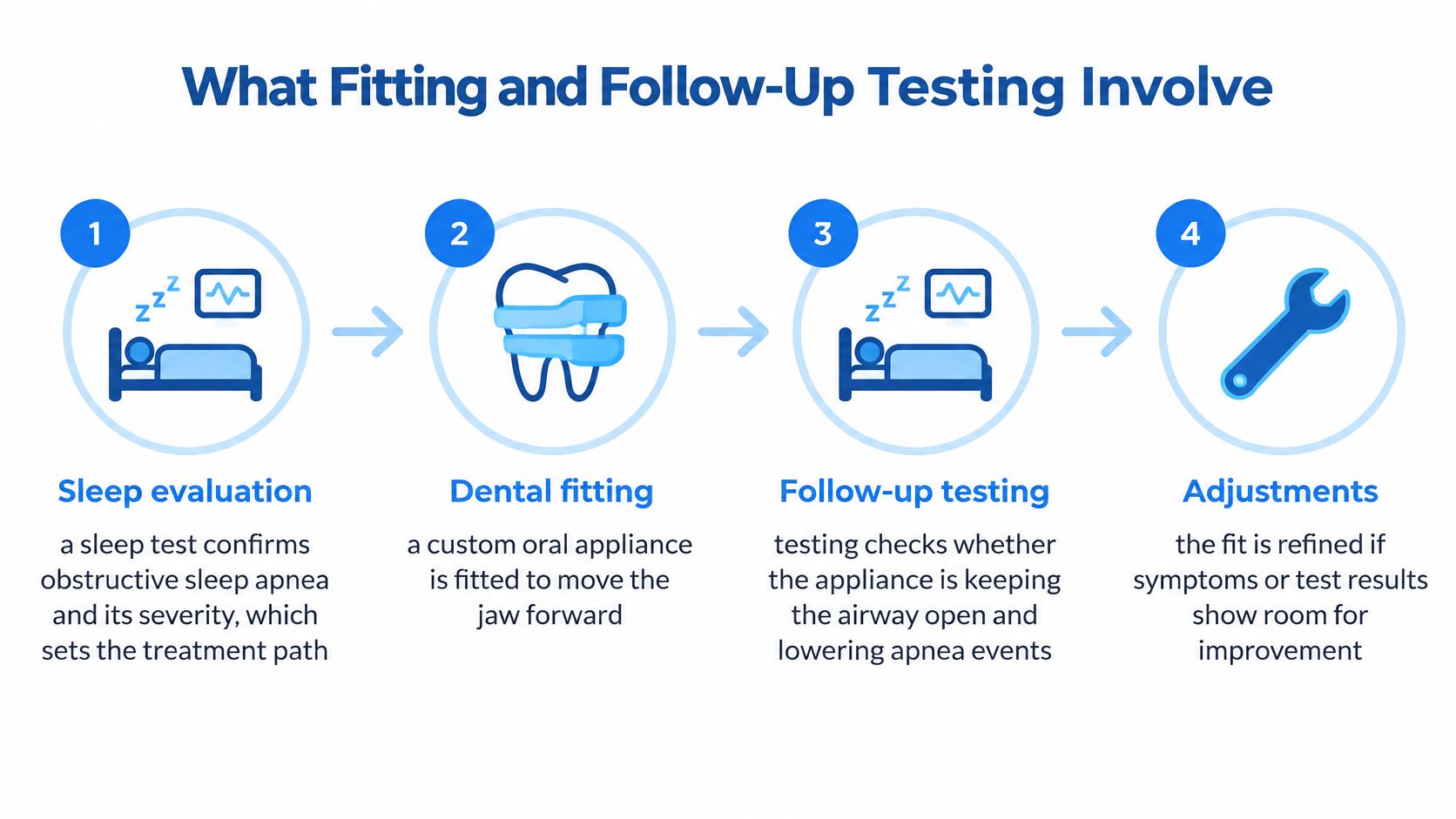
A custom oral appliance needs to be checked against two measures: whether you can wear it comfortably and whether it controls your apnea during sleep. The dental assessment, adjustments, and follow-up test each answer a different question.
The sequence is outlined in the previous section. For readers clarifying the distinction between dental and medical roles, learn whether a dentist can diagnose sleep apnea.
Why the Repeat Test Isn't Optional
A comfortable fit does not prove that an appliance has reduced breathing disruptions enough. The American Academy of Sleep Medicine practice parameters for oral appliances describe oral appliances as an option for adults who prefer them, cannot tolerate CPAP, do not respond to CPAP, or have not benefited from behavioral measures such as weight loss or positional therapy. Results vary with appliance design and patient anatomy.
A 2025 review of 27 studies and 3,768 treated participants reported that 63% achieved a residual AHI below 10 events per hour across six appliance categories. That leaves a substantial share above the threshold. Symptom relief alone cannot show whether breathing events are adequately controlled, so objective testing with the appliance in place matters.
Dr. Eric Wiitala's Scottsdale practice offers Chronic Snoring Treatment and Snoring & Sleep Apnea services. Ask how treatment response will be assessed and what follow-up testing is appropriate for your case.
Cost, Insurance and Side Effects in Scottsdale
CPAP and oral appliances have different cost components. An oral appliance involves a dental screening, custom impressions and lab fabrication, titration visits, and repeat sleep testing. CPAP costs include the machine, mask, tubing, filters, and replacement supplies, in addition to the sleep test. Ask your insurer for coverage details before choosing either therapy.
CPAP is typically billed through medical insurance. An oral appliance may be covered through medical or dental benefits, depending on the plan. Confirm which benefit applies to the device, sleep test, and follow-up testing. The guide to sleep apnea and dental problems explains why dental follow-up matters. At Eric Wiitala DDS, ask about coverage for sleep apnea care alongside routine dental cleanings and exams.
Side Effects Side by Side
Early effects can change as you adjust to treatment. An oral appliance may increase saliva at first; that often settles with continued use. Small appliance adjustments or mask refitting can address some discomfort. Report persistent jaw pain, a bite that still feels different in the morning, loose teeth, or sudden tooth pain to your dentist or sleep clinician promptly. Don't force an appliance or mask through symptoms that are worsening.
Choose and Book Your Sleep Apnea Evaluation in Scottsdale
Start with a sleep test. The right choice depends on measured AHI and realistic nightly use, not preference alone, and guessing wastes money on a device that may not control the condition.
Decision Checklist
- Confirmed diagnosis: Has a sleep test confirmed obstructive sleep apnea and its severity?
- CPAP history: Has CPAP failed, leaked, or proved intolerable despite mask changes?
- Practical barriers: Do mask discomfort, travel, or noise make nightly CPAP unlikely over the long term?
- Heart risk: Is hypertension or other cardiovascular risk part of the picture?
- Dental readiness: Are teeth, gums, and the jaw joint healthy enough to hold and tolerate an appliance?
- Commitment: Is nightly use plus repeat sleep testing acceptable, not just a one-time fitting?
Mostly yes answers from question two onward point toward a serious appliance conversation. Severe results on question one point back to CPAP first. Either way, Dr. Wiitala has extensive training in cosmetic dentistry and sleep apnea, and the practice provides sleep apnea and oral appliance services for Scottsdale patients who need that evaluation. The office is at 9755 North 90th Street, Suite B250, Scottsdale, AZ 85258, phone (480) 657-6981, open Monday through Thursday with Friday by appointment.
Three questions are worth asking when booking. What coverage applies to the sleep test and the appliance? What follow-up testing is included after fitting? How long does fitting and titration usually take from first records to the confirmation test? Clear answers separate a genuine dentist in Scottsdale, AZ sleep service from a practice selling a mouthguard.
Eric Wiitala DDS provides custom oral appliance therapy for Scottsdale patients with snoring and sleep apnea, including dental screening, gradual titration, and coordination around follow-up sleep testing. Anyone ready to compare CPAP with an appliance based on a real diagnosis rather than guesswork can schedule an evaluation through Eric Wiitala DDS.