
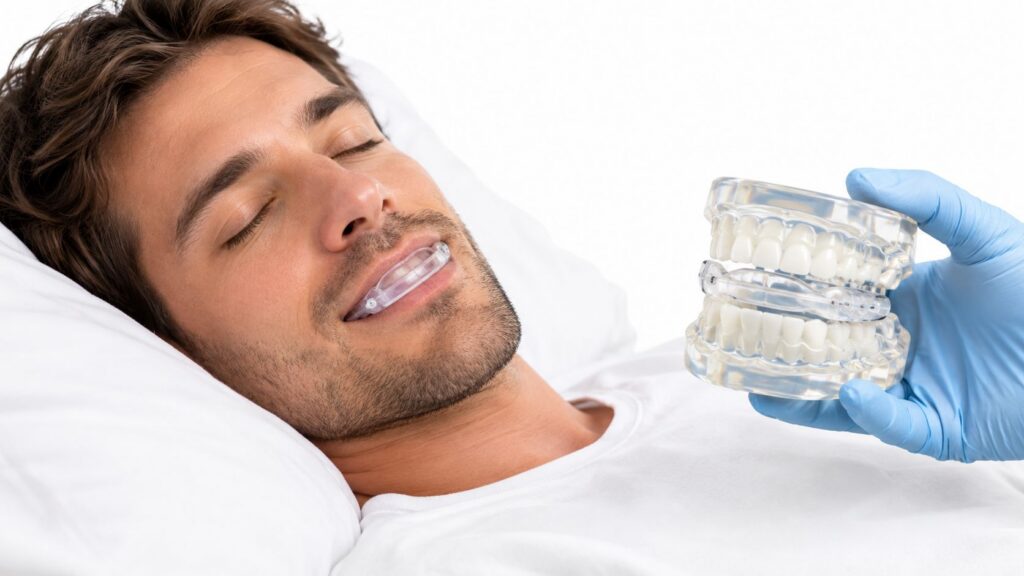
Waking with a dry mouth, sore jaw, morning headache, or unexplained tooth sensitivity can feel like a collection of unrelated annoyances. For many adults, however, these symptoms belong to a larger pattern involving nighttime breathing, clenching, oral inflammation, and poor-quality sleep. A routine visit to a dentist in Scottsdale, AZ can sometimes reveal those clues before a patient realizes an airway problem may be involved.
At Eric Wiitala DDS, dental exams address more than cavities. A careful evaluation can connect tooth wear, gum health, missing teeth, jaw discomfort, and mouth breathing with the need for appropriate medical sleep screening. Patients searching for a dentist near me, an emergency dentist for sudden jaw or tooth pain, or restorative care deserve an office that understands the mouth-body connection.
Table of Contents
- The Hidden Link Between Sleep and Oral Health
- Dental Signs That Point to Sleep Apnea
- From Dental Screening to Sleep Diagnosis
- Dental Treatments for Sleep and TMJ Disorders
- What to Expect at Our Scottsdale Dental Practice
- Protecting Your Smile and Airway Health
The Hidden Link Between Sleep and Oral Health
A patient can sit in the dental chair for a routine cleaning after months of waking with a sticky mouth, tight jaw muscles, or sensitive teeth. No single cavity may explain the discomfort. A Scottsdale dental exam may instead reveal flattened enamel, tender chewing muscles, irritated gums, or a bite that has shifted. These findings do not confirm sleep apnea, but they give the dental team a reason to consider nighttime breathing alongside oral health.
Obstructive sleep apnea, or OSA, develops when the upper airway becomes repeatedly restricted during sleep. The mouth can show the effects of that breathing effort. Chronic mouth breathing dries oral tissues, while fragmented sleep may occur with clenching and grinding. Over time, patients may experience bad breath, greater cavity risk, gum irritation, jaw soreness, and tooth sensitivity.
A 2025 review of OSA and oral health describes sleep apnea syndrome as affecting about 1 billion adults worldwide and reports that up to 60% of patients with obstructive sleep apnea syndrome have moderate-to-severe periodontal disease. The review also connects OSA with chronic mouth breathing, xerostomia, and higher caries risk. This connection makes a routine dental visit a practical first point for recognizing a possible sleep-related concern before airway problems contribute to broader health effects.
Why everyday symptoms deserve attention
Morning dry mouth can result from overnight mouth breathing, medication effects, dehydration, or other conditions. Jaw pain may involve clenching, a joint disorder, a damaged tooth, or several factors together. Morning headaches and daytime fatigue also have many possible causes, so they require appropriate medical evaluation rather than an assumption that OSA is responsible.
A Scottsdale dentist cannot diagnose sleep apnea from a visual exam alone. The dental team can document oral findings, ask focused questions about sleep and breathing, review relevant health history, and recommend coordination with a qualified medical provider when the pattern raises concern. That conversation can help identify a hidden airway issue while the patient is already receiving preventive dental care.
Practical rule: Treat the mouth symptoms in front of the patient, but do not overlook a breathing pattern that may be contributing to them.
The same reasoning improves preventive and restorative planning. A filling, crown, cosmetic bonding procedure, or tooth extraction may address a local problem, while long-term care must also account for clenching, dry mouth, gum health, and bite stability. Patients considering dental implants near me, periodontal therapy, or cosmetic dentistry should have those factors reviewed before major dental work begins. A routine examination can therefore protect the immediate health of the smile and help direct appropriate evaluation of the airway.
Dental Signs That Point to Sleep Apnea
A patient may sit in the dental chair for a routine exam and reveal clues of a sleep-related breathing problem without realizing it. The strongest clues usually appear as a pattern involving tooth wear, jaw tension, dry tissues, gum inflammation, or a history of tooth loss. These findings do not diagnose sleep apnea, but they can show when airway questions belong in the conversation.

Tooth wear and nighttime clenching
Advanced wear may come from acid exposure, an uneven bite, occupational habits, or sleep bruxism. If dry mouth, jaw tightness, and poor sleep occur with the wear, restoring the teeth alone may leave an important contributor unaddressed. A cross-sectional study of dental patients with tooth wear found OSAS prevalence at about three times the general-population level, with tooth-wear severity positively correlated with OSAS severity (study of tooth wear and OSAS).
Another dental-patient study reported a mean apnea-hypopnea index of 32.4 ± 24.9, and 11 of 30 patients had an AHI of at least 30. It also found a significant association between tooth-wear severity and OSA severity, with Spearman R = 0.505 and p = 0.004 (PubMed study on tooth wear and OSA). Severe wear alongside other sleep or airway clues supports a closer screening conversation.
Sleep habits can also be reviewed, including best sleep positions for deeper rest. Changing position may improve comfort for some patients, but it cannot replace medical evaluation.
Dry mouth, gums, and missing teeth
Mouth breathing limits saliva's protective role. Sleep apnea may occur alongside xerostomia, increased caries risk, and periodontal disease, so a Scottsdale dental exam should assess recurring decay, inflamed gums, plaque retention, enamel sensitivity, and dry oral tissues. These findings can reflect several conditions and need clinical context rather than an automatic apnea label.
Tooth loss can provide another historical clue. In a U.S. general-population study of adults aged 25 to 65, 20.3% were classified as high-risk for OSA. High OSA risk increased by 2% for each additional tooth lost, while five to eight missing teeth were associated with a 25% greater prevalence of high-risk status (study of tooth loss and OSA risk). Tooth loss does not diagnose apnea, but it gives the dentist another reason to ask about snoring, breathing interruptions, and sleep quality.
For facial tension or suspected clenching, the team can review what causes jaw clenching and decide whether the patient needs a guard, TMJ assessment, or sleep-focused referral.
From Dental Screening to Sleep Diagnosis
Finding a possible airway concern shouldn't leave a patient wondering what happens next. The process works best when the dental office identifies risk, documents oral findings, and coordinates the appropriate medical evaluation rather than attempting to diagnose OSA independently.
The dental appointment
A thorough new patient exam may include an assessment of the teeth, gums, tongue, bite, chewing muscles, and temporomandibular joints. The dentist may ask about dry mouth, tooth grinding, jaw locking, snoring, witnessed breathing pauses, morning headaches, and daytime sleepiness. Dental x-rays can help evaluate decay, bone levels, missing teeth, infections, and structural concerns that affect restorative planning.
The goal isn't to label every worn tooth as an airway problem. The goal is to recognize when several findings appear together and deserve broader attention. A cracked tooth may need immediate care, while chronic jaw pain may call for TMJ management and sleep evaluation.
Risk assessment and referral
After reviewing the examination and health history, the dental team can recommend a conversation with a sleep physician or another qualified medical provider. The physician determines whether the patient needs a home sleep test or an in-lab polysomnography study, then interprets the results and establishes the diagnosis.
The American Academy of Sleep Medicine and the American Academy of Dental Sleep Medicine recommend oral appliance therapy for adults with OSA who can't tolerate CPAP or prefer an alternate treatment. Their guidance specifies that a qualified dentist should provide a custom, titratable device after prescription by a sleep physician (AASM and AADSM clinical practice guideline).
A dental screening is a starting point, not a substitute for medical sleep testing.
Clear communication helps prevent fragmented care. The dentist can share relevant findings, the sleep physician can confirm the breathing disorder, and both providers can coordinate treatment around the patient's teeth, bite, joints, and general health.
Dental Treatments for Sleep and TMJ Disorders
Treatment depends on the confirmed diagnosis, severity, dental condition, and patient preference. A custom mandibular advancement appliance may suit some adults with mild-to-moderate OSA or those who can't tolerate CPAP. It works by positioning the lower jaw forward to help maintain airway space during sleep.
The choice isn't just between an appliance and no treatment. A patient may need bruxism protection, gum therapy, restorative dentistry, or TMJ care at the same time. Eric Wiitala DDS provides sleep apnea oral appliance therapy as part of its sleep-related dental services.
Comparing Dental Sleep and TMJ Treatments
| Treatment Option | Best For | Key Benefit |
|---|---|---|
| Custom mandibular advancement appliance | Adults with appropriate OSA indications, especially those intolerant of CPAP or seeking an alternate therapy | Helps reposition the jaw during sleep with a custom, titratable design |
| Custom occlusal guard | Bruxism, tooth wear, and bite protection | Reduces direct tooth-to-tooth contact and helps protect compromised enamel |
| TMJ assessment and therapeutic Botox | Selected patients with TMJ-related muscle symptoms or persistent muscle strain | May reduce muscle-related discomfort when clinically indicated |
| Crowns, bonding, and fillings | Worn, cracked, sensitive, or decayed teeth | Restores tooth structure and function |
| Bridges and dental implants | Missing teeth and unstable dental arches | Replaces missing teeth and supports chewing function |
| Full-arch implant solutions | Patients with extensive tooth loss or near-edentulous conditions | Rebuilds a complete functional arch when appropriate |
Evidence supports oral appliances, but they require follow-up. A guideline and meta-analysis reported a mean reduction in oxygen desaturation index of 12.77 events per hour across 399 adults (ADA information on obstructive sleep apnea). The same ADA resource notes progressive reductions in overbite and overjet, mandibular crowding, transient morning jaw pain, and TMJ-related symptoms associated with oral appliance therapy.
That trade-off makes baseline records essential. Before delivery, the dentist should document the bite and TMJ status, then monitor for dental drift, soreness, changes in chewing, and appliance fit. A device shouldn't be treated as a set-and-forget purchase.
Restorative treatment may also be necessary. Crowns can protect weakened teeth, bridges can replace missing teeth, and dental implants can restore individual or complete arches. A cosmetic dentist near me may also provide bonding, veneers, or teeth whitening, but cosmetic changes should follow a careful assessment of bite forces, airway treatment, and tooth stability.
What to Expect at Our Scottsdale Dental Practice
Patients looking for a dentist in Scottsdale, AZ often want more than a quick repair. They want a clear explanation, respectful care, and a plan that accounts for comfort, function, appearance, and long-term health. Dr. Eric Wiitala's practice provides preventive, restorative, cosmetic, implant, orthodontic, sleep, and TMJ services from its office at 9755 North 90th Street, Suite B250, Scottsdale, AZ 85258.

A thorough first visit
A new patient appointment can include cleaning and exams, dental x-rays when appropriate, gum evaluation, bite review, and discussion of current concerns. Patients with jaw pain, clenching, tooth wear, snoring, or morning dryness should mention those symptoms directly. Specific details help the dental team decide whether the next step is preventive care, restorative treatment, TMJ management, or sleep-related referral.
The practice emphasizes patient education and an approach that includes nutritional health. Its restorative services use mercury-free, tooth-colored materials, and its scope includes white fillings, bonding, porcelain veneers, crowns, bridges, dental implants, All-on-Four solutions, clear aligners, retainers, custom occlusal guards, and athletic mouthguards.
Coordinated care without pressure
Patients don't need to choose between oral health and appearance. A worn or damaged smile can be rebuilt while the dental team addresses the forces contributing to the damage. Likewise, a patient considering dental implants near me may need an evaluation of gum health, bite stability, missing-tooth history, and sleep-related concerns before treatment begins.
Dr. Eric Wiitala graduated from Indiana University School of Dentistry in 1999 and has more than 20 years in practice. The practice site also notes recognition as one of the Valley's Top Dentists by PHOENIX magazine. Office hours are Monday through Thursday, with Friday appointments available by arrangement, and the team provides insurance, billing, and financing support.
A patient with sudden swelling, severe tooth pain, a broken restoration, or facial injury may need an emergency dentist assessment. Even when the immediate priority is pain relief, the visit can identify clenching, tooth wear, infection, or bite problems that deserve follow-up.
Protecting Your Smile and Airway Health
Sleep apnea and dental problems can reinforce one another through dry mouth, tooth wear, gum inflammation, jaw strain, and missing teeth. A dentist may be the first clinician to notice that the pattern doesn't look like an isolated cavity or cosmetic concern. That observation can lead to appropriate medical testing and a treatment plan that protects both the airway and the smile.
Patients shouldn't ignore persistent snoring, witnessed breathing pauses, morning headaches, recurring dry mouth, jaw soreness, or advanced tooth wear. Those symptoms don't establish a diagnosis, but they justify a focused conversation with a dentist and, when indicated, a sleep physician.
Practical habits that support oral health
Routine prevention remains important while a patient pursues evaluation or treatment.
- Keep examination visits consistent: Regular exams allow the dental team to track wear, gum changes, sensitivity, tooth movement, and appliance effects over time.
- Protect the mouth at night: A custom appliance may be appropriate for bruxism or sleep-related therapy, but it should be selected and monitored professionally.
- Address missing or damaged teeth: Restorative options such as bridges, crowns, and implants can improve function and support a stable bite when clinically appropriate.
- Discuss related symptoms: Reflux, mouth breathing, jaw locking, and morning pain can change the treatment plan and should be included in the health history.
Patients looking for general sleep comfort may also find it useful to review guidance about a wedge pillow for acid reflux and sleep. Such supportive measures can complement a broader plan, but they don't replace sleep testing or dental follow-up when OSA is suspected.
Scottsdale adults and families can schedule a new patient exam for tooth wear, gum concerns, jaw pain, snoring, sleep apnea screening, restorative needs, or cosmetic goals. Early attention gives the dental team more opportunity to preserve natural teeth, reduce discomfort, and coordinate care before problems become harder to manage.
Eric Wiitala DDS offers preventive, restorative, cosmetic, TMJ, and sleep apnea oral appliance services for patients in Scottsdale and nearby communities. Schedule a new patient exam or request a consultation by visiting Eric Wiitala DDS to discuss dry mouth, jaw pain, tooth wear, snoring, or other sleep-related dental concerns.