

A single dental implant in the U.S. typically runs $3,000 to $7,000 for the post, abutment, and crown. In Scottsdale, “affordable” usually means lowering the total case cost through staging, implant choice, and financing, not chasing the cheapest line item on a flyer.
Table of Contents
- What Affordable Dental Implants Really Mean for Scottsdale Patients
- Why Implant Prices Vary So Much
- Single Implants vs Mini Implants vs All-on-Four
- Smart Strategies to Make Implants More Affordable
- Are You a Good Candidate for Implants
- How Implants Compare to Bridges and Dentures Over Time
- What to Expect at Eric Wiitala DDS in Scottsdale
- Your Next Steps and Common Implant Questions
What Affordable Dental Implants Really Mean for Scottsdale Patients
A missing front tooth, a lower denture that will not stay put, or a bridge that keeps failing, that is usually what pushes someone to start searching for dental implants near me or a dentist in Scottsdale, AZ. The word “affordable” matters, but the better question is whether the treatment fits the patient's mouth, budget, and timeline without creating bigger bills later.
What an implant is
A dental implant is a titanium post placed in the jaw, an abutment that connects the post to the top restoration, and a custom crown or full-arch prosthesis that does the visible work. The simplest way to describe it is a support inside the jawbone that holds the tooth above it.
That structure is why implants feel different from removable dentures. They are built to stay put, and when the case is planned well, they can restore chewing, speech, and appearance without asking neighboring teeth to carry the load. A Scottsdale patient comparing a single tooth implant to a bridge should see that difference right away.
Practical rule: a real implant estimate should show every major part of the treatment, not just the hardware.
Eric Wiitala DDS in Scottsdale places both single-tooth implants and All-on-Four full-arch solutions, so patients are not forced into a one-size-fits-all answer. For many people, the smartest route is a staged plan that protects the budget first and finishes the restoration in the most stable way possible.
Why Implant Prices Vary So Much
A lot of confusion starts when patients compare two implant quotes that don't cover the same work. One office may list the implant post alone. Another may include the surgery, imaging, abutment, crown, and follow-up. Those are not the same treatment, and they shouldn't be priced as if they are.
The real line items in a quote
A legitimate implant plan usually includes six cost drivers. The fixture itself, the abutment, the crown, 3D imaging and planning, the surgical placement, and any grafting or bone work needed before or during treatment. If a quote leaves out one of those, the number on the page is not the accurate price.
The 2025 nationwide median for a complete implant, including the implant, abutment, and crown, was $4,000 in a Dental Economics analysis of major U.S. markets. In that same analysis, specialist-performed procedures had a median of $3,400 versus $4,800 for general dentists, which is a useful reminder that training, workflow, and overhead change the number patients see. Houston's median total cost was $3,665, while Minneapolis was $5,505, showing how much region and provider type can shape the final bill.
| Typical Line Items in a Scottsdale Implant Quote | What It Covers | Why It Affects Total Cost |
|---|---|---|
| Implant fixture | The titanium post placed in the jaw | Material quality and surgical handling matter |
| Abutment | The connector between the post and crown | Different designs and materials carry different costs |
| Crown | The visible tooth replacement | Lab work and restorative material affect price |
| Imaging and planning | Records, scans, and treatment design | Better planning can reduce surprises later |
| Surgical placement | The implant surgery itself | Clinical time and expertise change the fee |
| Grafting or bone work | Bone support before or during placement | Extra procedures add cost and time |
A low quote can be a shortcut, or it can just be incomplete. Patients should ask for a global all-inclusive fee in writing so the estimate matches the treatment path.
Single Implants vs Mini Implants vs All-on-Four
A Scottsdale patient with one broken tooth does not need the same plan as someone whose dentures keep slipping or someone trying to rebuild an entire arch. The sensible choice depends on the size of the problem, the condition of the bone, and how much future maintenance the patient is willing to take on.
Matching the option to the mouth
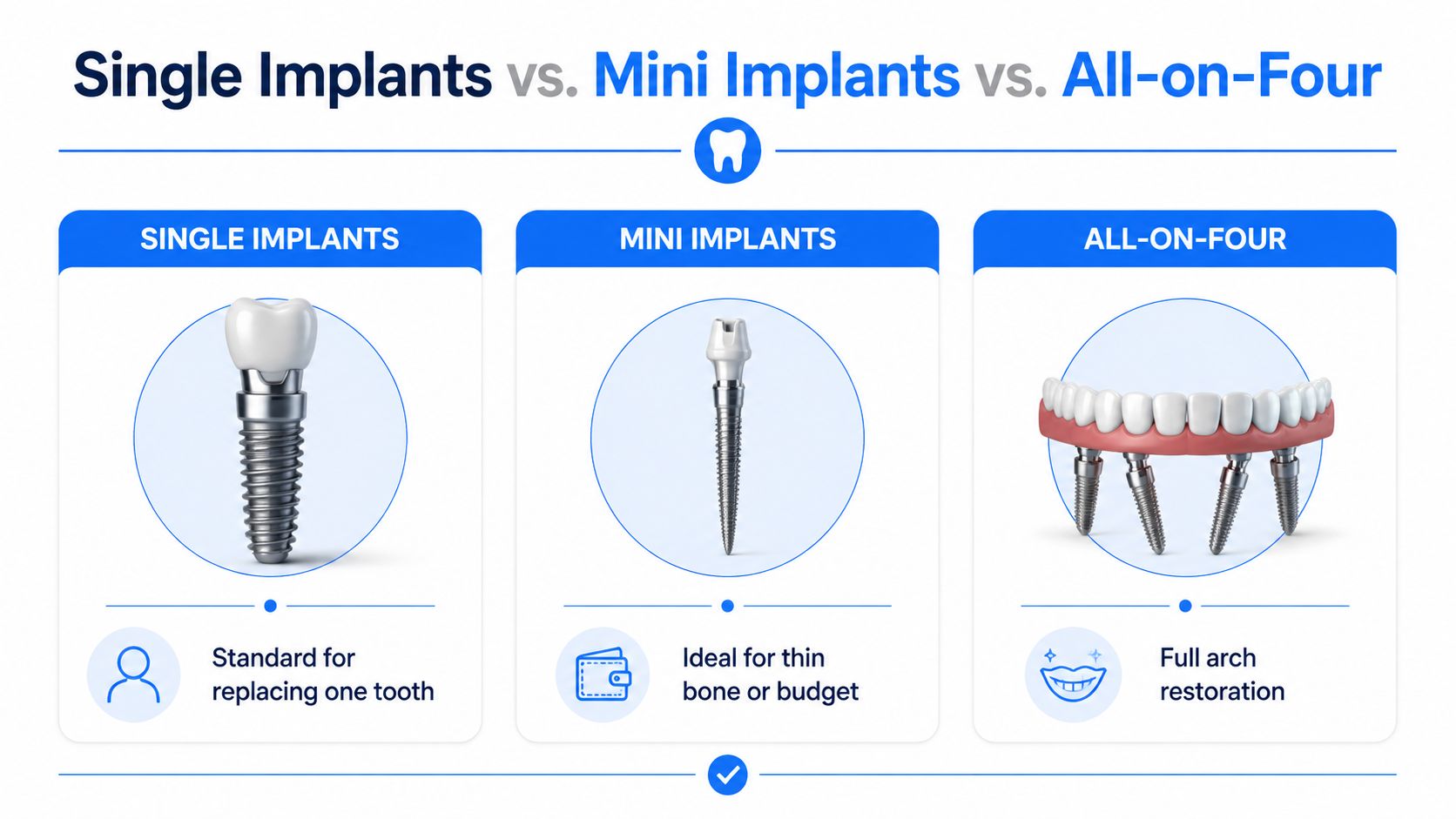
A single titanium implant is the standard choice for one missing tooth. It fits best when the neighboring teeth are healthy and the goal is to replace only the tooth that is gone. A mini implant often comes up when bone is thin or when a patient wants a lower entry point, and mini implants are commonly listed at $500 to $1,500 per implant in the U.S..
For broader cases, implant-supported removable dentures usually land in the $7,000 to $15,000 per arch range, while All-on-4 and All-on-6 full-arch solutions are commonly listed at $12,000 to $25,000 per arch. Full-arch systems often use 4 to 6 titanium posts per jaw to spread the load and control cost, which is why they can be more efficient than replacing every tooth separately.
Bottom line: the best option is the treatment that solves the problem with the fewest future repairs, not necessarily the one with the lowest upfront price.
That matters at Eric Wiitala DDS because a patient may start with one failing tooth, then later need more extensive rebuilding. Keeping the care under one roof makes the plan easier to track, and that usually helps the long-term budget.
A simple side-by-side view
- Single implant, best for one tooth, and the strongest long-term fit for isolated loss.
- Mini implant, useful for thinner bone or a tighter budget, but not the right answer for every case.
- Implant-supported denture, a practical choice for patients who want more stability without a fully fixed reconstruction.
- All-on-Four, a fixed full-arch solution for patients who need to replace many teeth at once.
A note on material choices
Cost-conscious systems often use commercially pure titanium or titanium alloy, and surface engineering like SLA or dual acid-etching is used to improve bone contact and support osseointegration, according to implant system material and surface guidance. The point is not to buy the lowest-priced metal and hope for the best. The point is to choose a system that holds up clinically without paying extra for features the case does not need. Patients who are also sorting out family budgeting often ask about dental and vision coverage for families, because real affordability usually comes down to how the whole household is paying for care.
Smart Strategies to Make Implants More Affordable
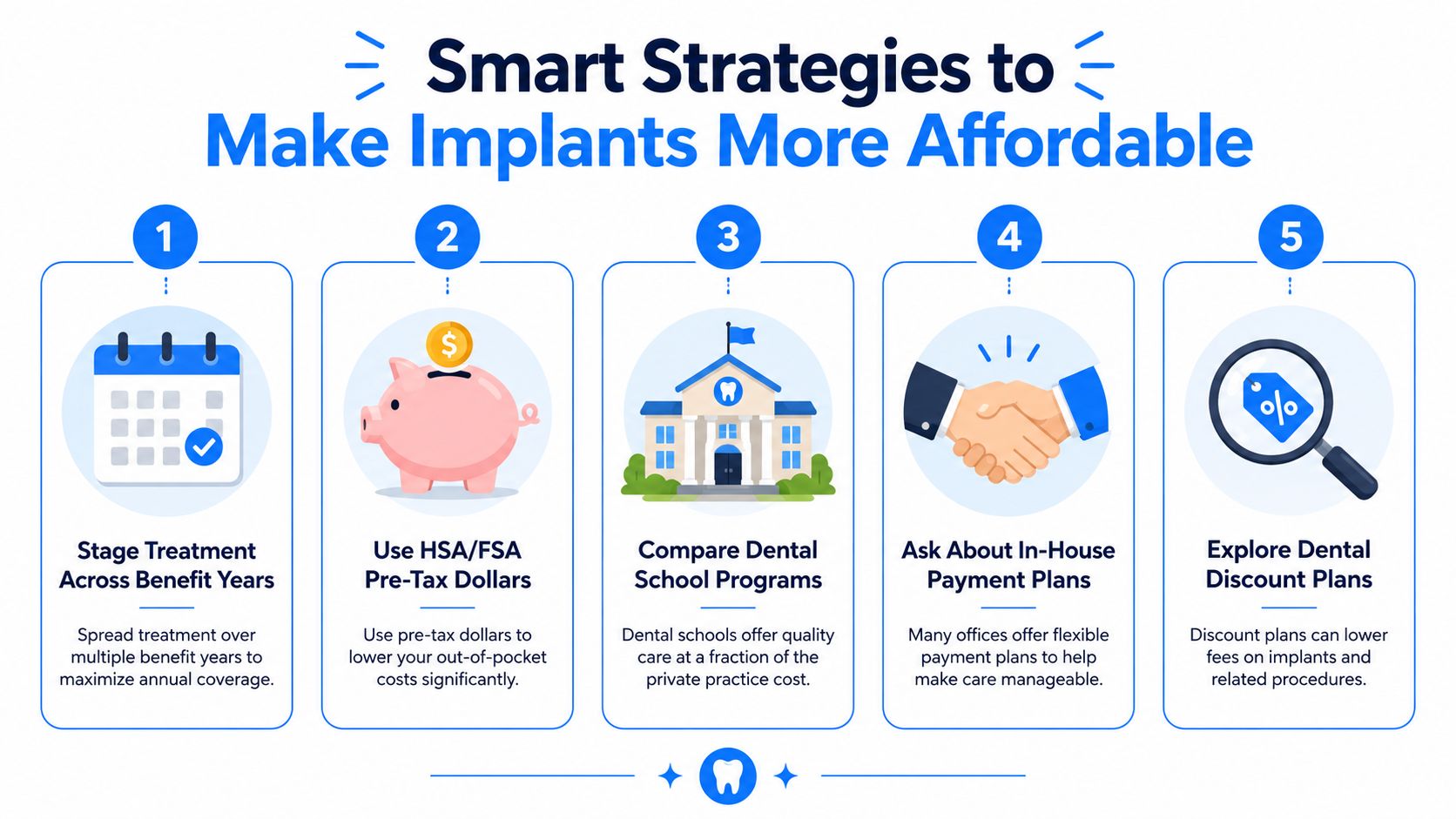
Most patients don't need a miracle discount. They need a smarter payment path. The fastest way to shrink sticker shock is to stop thinking about the entire treatment as one single bill and start thinking about how the work can be staged and funded.
Five moves that lower the bill without lowering quality
- Stage treatment across benefit years. If coverage or out-of-pocket budgeting resets on a calendar, splitting care can make the plan easier to handle.
- Use HSA or FSA dollars. Pre-tax funds stretch farther than after-tax cash.
- Compare dental school clinics. Independent cost guides note those programs are commonly priced about 30 to 60 percent below private-practice rates.
- Ask about in-house payment plans. Monthly payments can make a good treatment path realistic.
- Request a global all-inclusive fee. Teaser pricing leaves too many surprises.
A practical insurance conversation should also include broader family coverage, especially when a household is juggling multiple appointments. For readers comparing medical, vision, and dental benefits in one place, dental and vision coverage for families can help frame the budgeting conversation before a treatment plan is finalized.
Low-cost charity pathways exist, but they're narrow. The Dental Lifeline Network aid described in this overview of free dental implants for low income patients is limited to people who are 65 and older, permanently disabled, or medically fragile, and waitlists can run for months to a year. For most Scottsdale patients, that means the realistic choices are phased care, financing, or a lower-cost setting, not free implants.
Are You a Good Candidate for Implants
Price matters, but candidacy matters more. The cheapest implant is the one that integrates correctly the first time, because fixing a failed case is rarely cheap. At a Scottsdale consultation, the first job is to see whether the mouth is ready, not whether the patient wants implants.
What gets checked first
Dr. Wiitala looks at bone volume and density, gum and periodontal health, overall medical history, and oral hygiene habits. Those four areas determine whether the jaw can support an implant and whether the surrounding tissues are healthy enough to keep it stable. Smoking and uncontrolled diabetes are especially relevant because they can complicate healing.
A “no” is often really a “not yet.” Bone grafting, periodontal therapy, better home care, or medical coordination can turn an incomplete case into a workable one. That's why candidacy should feel like planning, not rejection.
A good consultation gives the patient a path forward, even if the first answer is to slow down and prepare.
Patients who want the formal checklist can review the practice's page on dental implant candidacy. The useful part of that conversation isn't a yes-or-no verdict. It's knowing what needs to happen before placement so the investment has a real chance of lasting.
How Implants Compare to Bridges and Dentures Over Time
A patient sitting in my chair usually starts with the sticker price, then asks the question that matters more: what will this restoration cost after years of chewing, cleaning, repairs, and replacement? That is the true affordability test. Cheap today can turn into expensive later.
The long view on cost and function
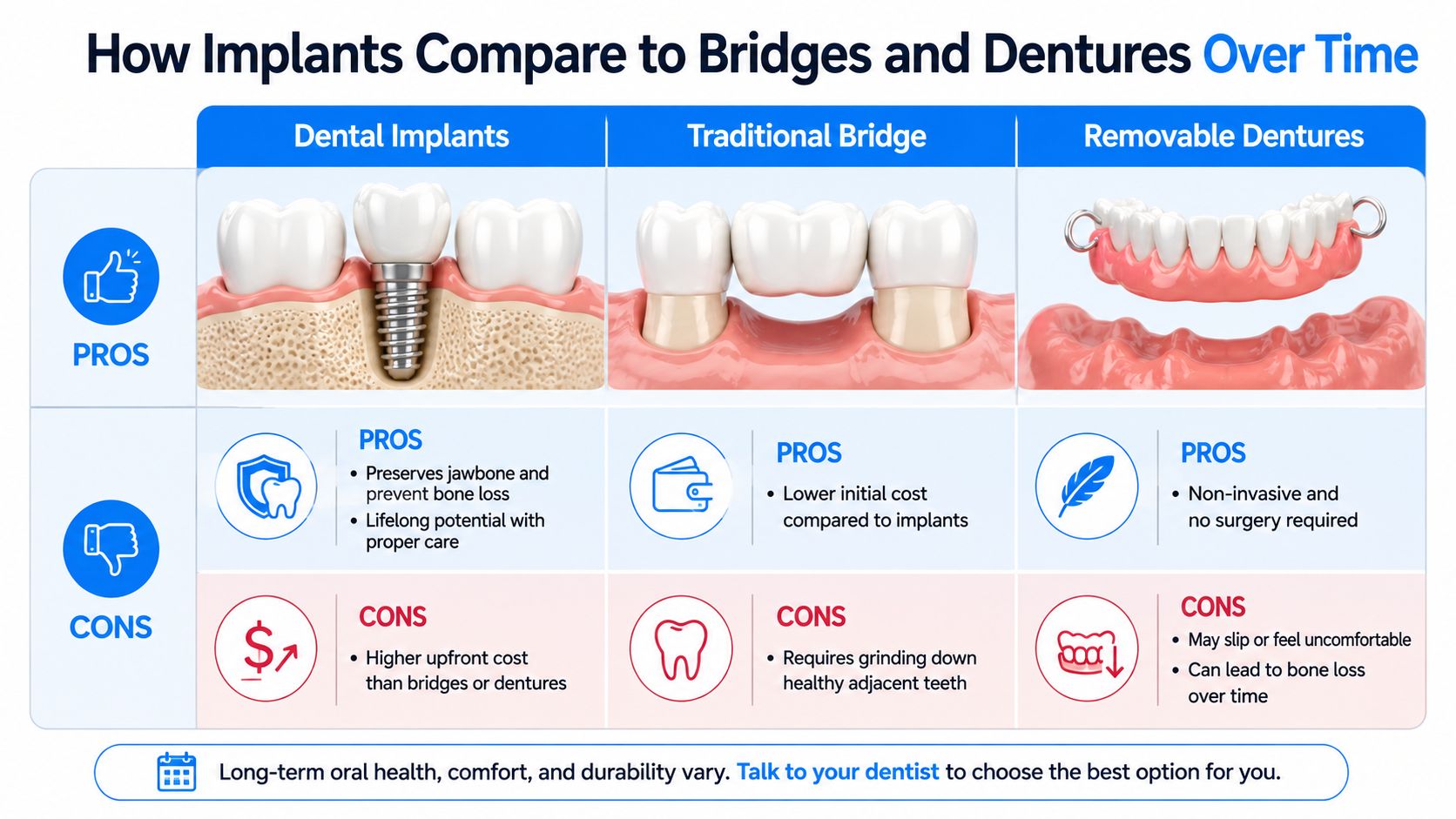
A peer-reviewed economic evaluation found that, over a 10-year model, a single implant cost US$261 to US$342 more than a fixed partial denture, but also had an average survival rate that was 10.4% higher (PubMed economic evaluation). That is the part many treatment estimates skip. A bridge can look like the lower-cost choice at first, yet maintenance, remake work, and replacement can change the final number.
Traditional bridges also depend on neighboring teeth. That means healthy tooth structure has to be reduced to support the restoration. Removable dentures avoid that, but they can shift, require more day-to-day handling, and do not preserve bone the same way a fixed implant solution does. Patients feel those tradeoffs in ordinary life long before they compare invoices.
What patients notice most day to day
- Chewing comfort, implants usually feel more stable.
- Cleaning, implants still need good home care, but they do not create the same under-bridge cleanup issues.
- Bone preservation, implants help support the jaw in ways removable options do not.
- Confidence, fixed teeth tend to change how people eat and speak.
A patient who wants the clearest side-by-side review can read the practice's dental implants versus bridges comparison. The point is straightforward. A restoration that starts cheaper but needs repeat repairs or early replacement can become the more expensive choice over a decade.
What to Expect at Eric Wiitala DDS in Scottsdale
The first visit should feel organized, not rushed. A patient calling about dentist near me or cosmetic dentist near me usually wants two things right away. A clear diagnosis and a plan that respects the budget.
What the visit usually includes
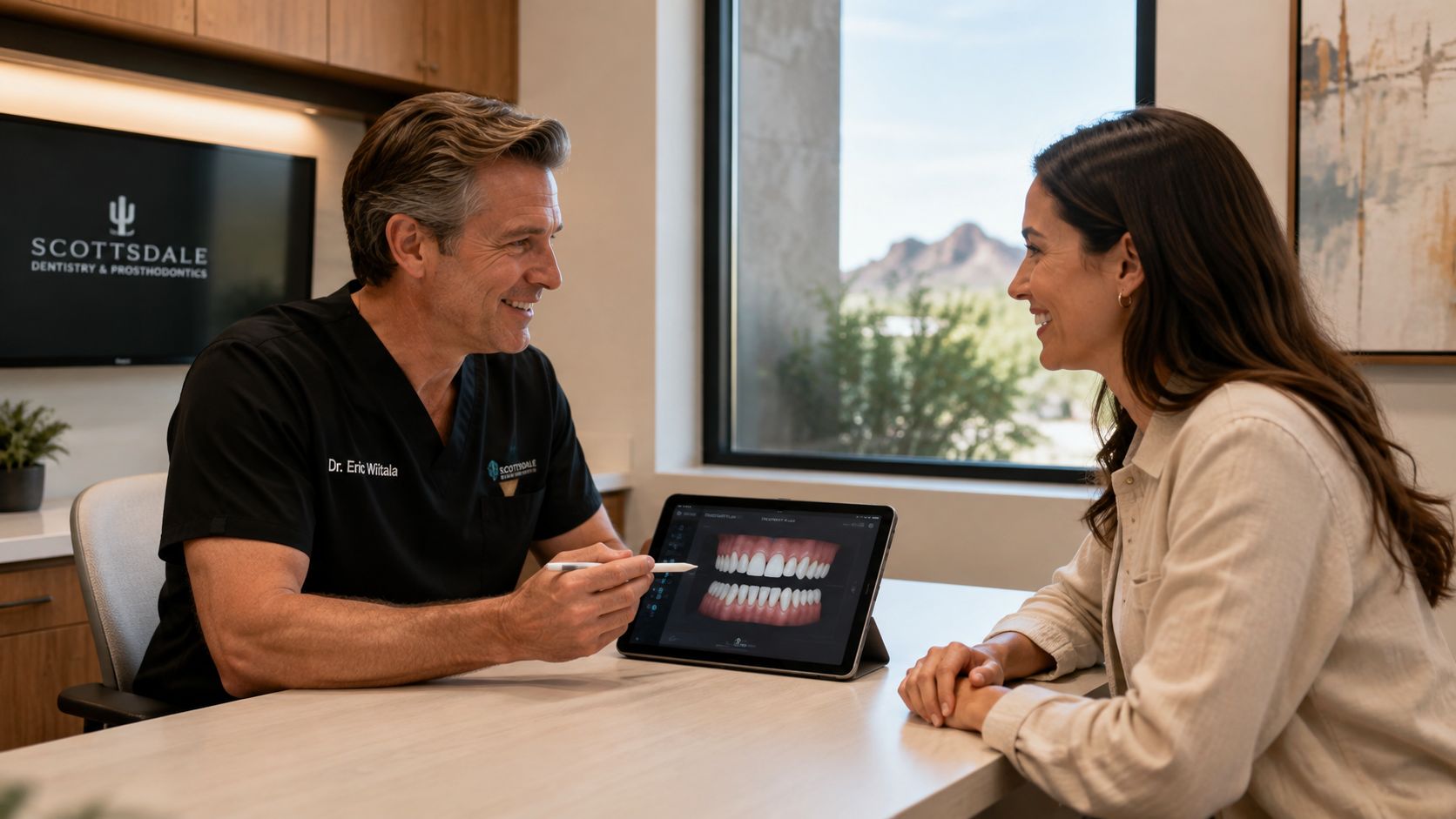
The appointment begins with a conversation about symptoms, goals, and budget. From there, the office gathers the records needed to plan treatment, then provides a written recommendation with itemized fees so the patient can see what's included. That matters because the cost of implants is often spread across surgery, restoration, imaging, and follow-up.
The front desk also supports insurance and financing options, which is where many patients finally see how treatment can be phased into something realistic. For adults who also need tooth extraction, emergency care, or other restorative dentistry, a single office that handles multiple steps can make the path much simpler.
The Scottsdale office is at 9755 North 90th Street, Suite B250, Scottsdale, AZ 85258. The phone line is (480) 657-6981, and the office keeps Monday through Thursday hours, with Friday by appointment. Those details matter because a plan only helps if a patient can begin it.
A good first call should end with clarity, not confusion.
Your Next Steps and Common Implant Questions
Most patients ask the same four questions. How long do implants last, do they hurt, what does insurance cover, and how soon does financing need to be decided. The straight answer is that implants can last for many years with proper care, recovery is usually manageable with standard local anesthesia and aftercare, insurance may help but often won't cover the full treatment, and financing decisions are easiest when they're discussed before surgery rather than after.
The better question isn't whether implants are expensive. It's whether the plan is honest about the full cost, the long-term value, and the steps needed to make the case predictable. A rushed quote can hide the total cost. A careful consultation shows the full picture.
Best next move: bring any prior estimate, ask for a written all-inclusive fee, and compare the plan line by line before committing.
If the patient is still deciding between a single implant, a staged full-arch plan, or a second opinion on an existing quote, the right move is to sit down and get the facts in writing. That's the cleanest way to judge whether the treatment is affordable or just advertised that way.
Eric Wiitala DDS helps Scottsdale patients compare single implants, All-on-Four, and other restorative options with clear written estimates and financing support. For anyone ready to compare apples to apples and get a plan that fits the mouth and the budget, visit Eric Wiitala DDS to request a consultation.