
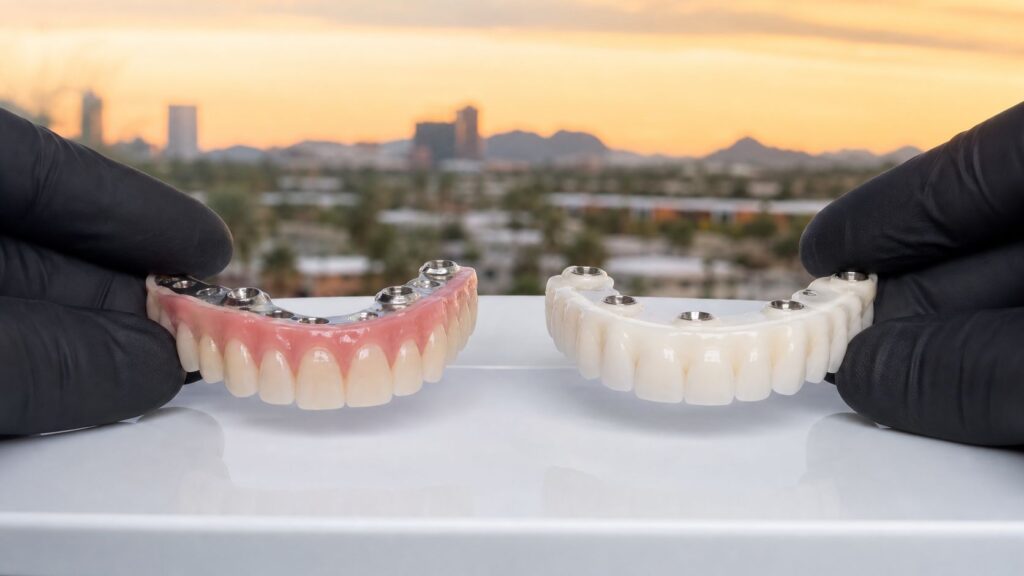
Maria, a 58-year-old from North Scottsdale, sat down on a Wednesday morning expecting a hard conversation about failing upper teeth. By that afternoon, she left with a fixed temporary arch on four implants and the same question many Scottsdale patients ask the second they see their new smile in the mirror, “When do I get the real teeth?” That question comes up in consults from DC Ranch, Old Town, and the Rio Verde corridor because the online conversation usually blurs together two different phases of care, a healing bridge and the final restoration.
The clearest way to think about all on 4 temporary vs permanent is not “good teeth versus better teeth.” Both are fixed, screw-retained, and designed to restore function. The difference is timing, load, and maintenance, because each prosthesis is built for a different job on the same treatment path. For patients comparing options with a dentist near me or looking for dental implants near me in Scottsdale, that distinction matters more than the label on the bridge.
| Criterion | Temporary Prosthesis | Permanent Prosthesis |
|---|---|---|
| Timing | Same day or within days of surgery | After healing and osseointegration |
| Main job | Protect healing implants and restore immediate function | Deliver long-term chewing, fit, and final esthetics |
| Material | Reinforced acrylic, PMMA, or similar lighter material | Zirconia or titanium-acrylic framework, depending on the plan |
| Retrievability | Meant to be adjusted and replaced | Designed as the final restorative phase |
| Maintenance focus | Healing, speech adaptation, soft-food compliance | Occlusion, hygiene, wear, and long-term follow-up |
Why Scottsdale Patients Ask About All on 4 Temporary vs Permanent
The confusion usually starts on surgery day. A patient walks in with failing teeth or a denture that never felt secure, then walks out with a smile that looks finished enough to socialize with the same evening. That creates a natural question, because the result already feels permanent even though the treatment is still in motion. In a Scottsdale practice, that question is often asked by people who have already consulted more than once and are trying to reconcile different opinions they've heard about immediate function, healing time, and final materials.
The answer is simpler than most marketing copy makes it sound. Temporary and permanent All-on-4 prostheses are both fixed, but they serve different phases of the same biologic process. The provisional arch is there to support healing, stabilize tissues, and let the implants integrate. The final arch is shaped after that healing has matured, so the bite, contours, and material strength can match a fully integrated implant system. That's why the distinction is about timing and maintenance, not a downgrade followed by an upgrade.
Why the same question keeps coming up
Patients from North Scottsdale, Paradise Valley-adjacent neighborhoods, and the east valley often arrive with mixed expectations because they've seen quick transformation stories online. What those stories leave out is that the first set of teeth is deliberately engineered to be temporary. It is not a lesser version of the final result, it's the bridge between surgery and the completed restoration.
Practical rule: if a bridge is placed the day of surgery, it should be thought of as part of healing, not the finish line.
That is the lens that makes the rest of the discussion make sense. A patient considering cosmetic dentistry or restorative dentistry may be focused on appearance first, but full-arch implant care has to respect bone biology first, then esthetics. For readers comparing a local cosmetic dentist near me search with a more complex implant solution, the right question is less “temporary or permanent?” and more “what has to happen between those two stages so the final result lasts?”
Learn more about the broader treatment framework at All-on-Four treatment in Scottsdale.
What the Temporary All on 4 Prosthesis Actually Does
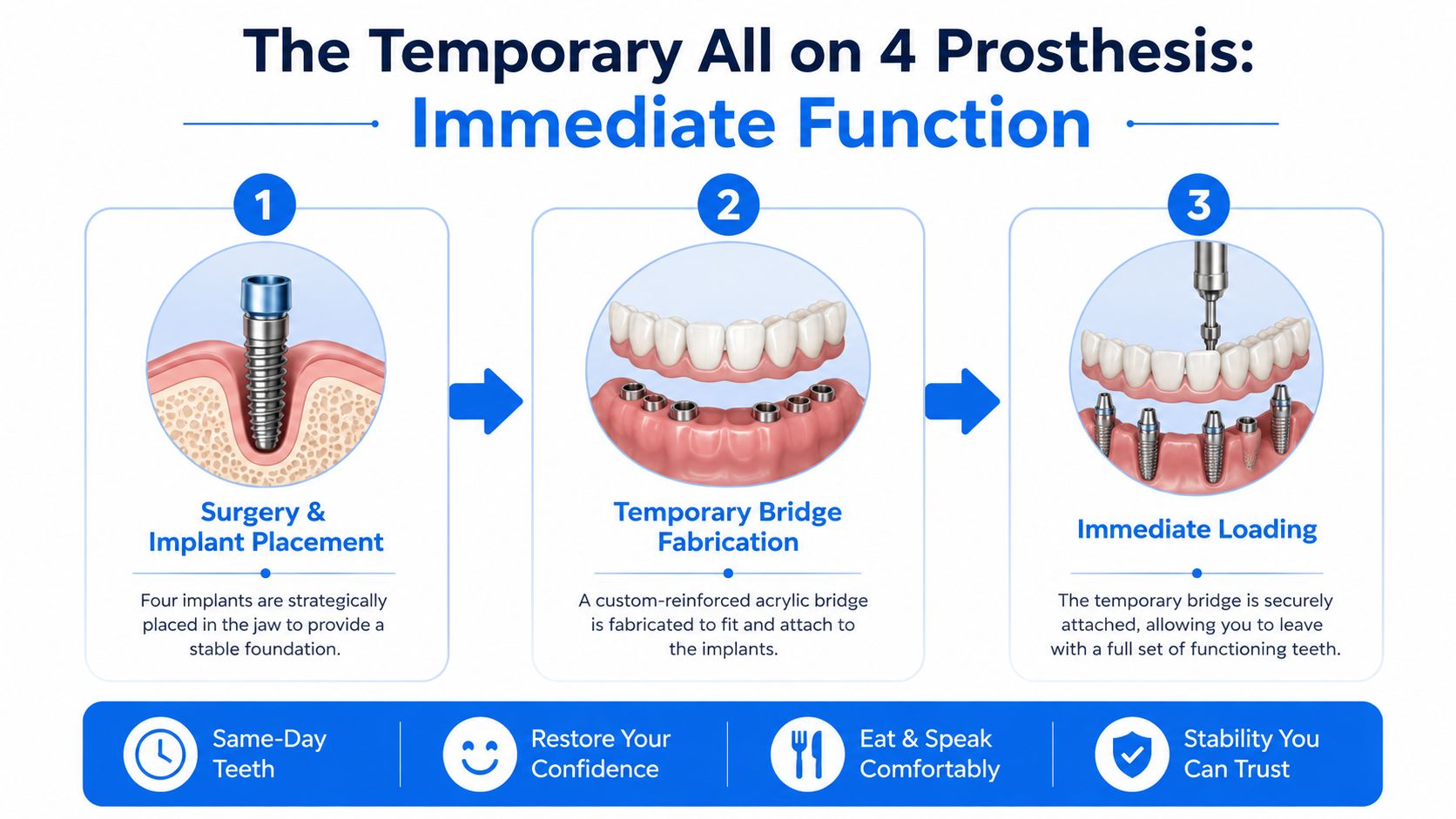
The temporary prosthesis is the working bridge that makes same-day full-arch care possible. In practice, it's usually a reinforced acrylic prosthesis, often PMMA-based, and it's screwed onto the implants soon after surgery. Its job is not to win a beauty contest against the final bridge. Its job is to protect the implants while they bond to bone, distribute force in a controlled way, and let the patient leave with teeth instead of an empty arch or a removable denture.
The three jobs it has to do well
First, it shields healing tissues. That matters when extractions, implant placement, and soft-tissue adaptation happen on the same day. Second, it helps distribute biting forces more gently during osseointegration, which is why early diet instructions matter so much. Third, it restores immediate appearance and speech so patients can talk, smile, and function without hiding at home during the healing window.
Scottsdale labs often favor CAD/CAM-milled PMMA because digital planning can happen before surgery, which lets the team fabricate the provisional bridge ahead of time. That prep work reduces chaos on surgery day and gives the patient a fixed result quickly. The bridge is intentionally retrievable, which means the dentist can adjust it as tissues settle and then replace it once healing is complete.
The temporary bridge should feel like a managed phase of treatment, not a rough draft that gets ignored.
What it's made from and how long it stays
Temporary All-on-4 bridges are commonly fabricated from cold-cured acrylic, milled PMMA, or titanium-reinforced variants. The material choices keep the prosthesis light enough for early loading, but sturdy enough for daily use during healing. In many cases, the provisional phase lasts about four to six months, though that can vary with the healing protocol and the arch involved.
For patients deciding between dental implants and other tooth replacement paths, that timeline is a big part of why the temporary bridge matters. It's not just there to look good while the “real” teeth are being made. It protects the surgical investment and gives the tissues time to settle into a shape that supports the final restoration better.
Side by Side Comparison of Temporary and Permanent All on 4
The easiest way to compare the two phases is by asking what each one is built to handle. The temporary bridge is made for early loading, tissue protection, and adaptation. The permanent bridge is designed for the bite forces, wear patterns, and esthetic fine-tuning that come after healing. That's why the final restoration often uses zirconia or titanium-acrylic construction, while the provisional keeps a lighter structure.
Function and material differences that matter
The temporary prosthesis uses softer materials and lighter occlusion so the new implants aren't overwhelmed during integration. The permanent prosthesis is selected after osseointegration, when the implant system can support a more durable, final occlusal scheme. This doesn't mean the provisional is flimsy, it means it's tuned to a different job.
Speech and comfort also shift between phases. Temporary bridges can feel bulkier as the patient adapts to the new contours and soft tissues. Final restorations are shaped more precisely, with esthetics, gingival architecture, and translucency refined after healing. That's one reason the permanent result often looks more integrated, not because the temporary was poor, but because the tissues have had time to stabilize.
| Criterion | Temporary Prosthesis | Permanent Prosthesis |
|---|---|---|
| Placement | Immediately after surgery | After healing and tissue maturation |
| Material feel | Lighter, more forgiving | More rigid, more durable |
| Occlusion | Designed to protect healing implants | Designed for full chewing loads |
| Esthetics | Natural-looking, but provisional | Final contours, translucency, and gumline refinement |
| Comfort | May feel bulkier at first | Usually feels more settled once healing is complete |
| Adjustability | Intended for easy revision | Adjusted for long-term function |
| Maintenance | Healing-focused follow-up | Long-term hygiene and wear management |
The important takeaway is that permanent does not mean a better version of the temporary. It means a different phase with different forces and different goals. For a patient browsing new patient exams or restorative dentistry while trying to understand full-arch treatment, that distinction helps set realistic expectations before treatment begins.
What the Clinical Evidence Shows About Both Phases
The survival data behind All-on-4 are one reason the treatment became so widely adopted. A 2011 clinical report on completely edentulous maxillae estimated 5-year implant survival at 93% at the patient level and 98% at the implant level, with prosthesis survival at 100% over the same period, and a separate 10-year longitudinal mandibular study reported 94.8% patient-level survival, 98.1% implant-level survival, and 99.2% prosthesis survival. Those numbers matter because they show the fixed bridge itself can remain highly durable even when an implant needs monitoring over time. The source also helped establish All-on-4 as a major full-arch treatment concept, especially for patients who want a fixed solution instead of removable teeth. Clinical report on edentulous maxillae and long-term mandibular outcomes
Why the temporary phase isn't just a placeholder
A temporary bridge has a real biologic purpose. In protocols that start with immediate provisional loading, the provisional restoration supports early function while healing continues. A retrospective cohort comparison reported 1-year implant survival of 98.8% for provisional immediate restorations and 97.6% for definitive immediate restorations, with no significant difference in complications between the groups. A 2023 longitudinal study with 3 to 17 years of follow-up also found durable outcomes across jaws, with 94.4% patient-level survival and 97.4% implant-level survival for the maxilla, and 96.7% patient-level survival and 98.9% implant-level survival for the mandible. Long-term comparison of provisional and definitive immediate restorations
That pattern fits what clinicians see in practice. The temporary phase is not lower-value care, it's the stage that protects the system while biology catches up with the surgery. For a patient researching tooth extraction followed by full-arch replacement, that distinction helps explain why the first bridge is built to be removed later.
What those outcomes mean in daily practice
A 2021 retrospective comparison of 136 All-on-4 restorations and 544 implants found provisional and definitive restorations had comparable complication profiles during follow-up, and the authors concluded both phases were similarly successful from a surgical and prosthetic standpoint. Retrospective comparison of All-on-4 provisional and definitive restorations
Clinical bottom line: the final bridge is not automatically “better,” it's simply the bridge built for the next stage of loading and wear.
Daily Care and Maintenance for Each Prosthesis Type
Home care changes when a patient moves from the temporary bridge to the final one, but the goal stays the same, keep the implants, gums, and prosthesis clean enough to stay healthy. During the provisional phase, the focus is on protecting healing tissue and not over-stressing acrylic. After the permanent bridge is delivered, the emphasis shifts toward long-term peri-implant hygiene and monitoring wear patterns.
The home routine usually includes cleaning under the bridge with a water flosser or oral irrigator, superfloss or implant-specific floss, and a soft brush that can reach the gumline without scraping the prosthesis. Clinical hygiene protocols often recommend follow-up every 6 months, while some advise every 3 to 4 months in the first year for closer monitoring. Maintenance guidance for full-arch fixed prostheses
What to do during the temporary phase
The temporary bridge is more vulnerable to fracture and screw loosening than the final prosthesis, so habits matter. Hard foods, aggressive chewing, and brushing with abrasive paste can create avoidable problems. That's why many offices ask patients to keep the provisional period simple, gentle cleaning, careful eating, and prompt reporting of anything that feels off.
- Use a water flosser daily: It helps flush the area under the bridge where plaque can collect.
- Brush with a soft brush: Gentle pressure protects healing gums and the acrylic surface.
- Choose non-abrasive toothpaste: Harsh paste can roughen temporary materials faster than patients expect.
- Call for cracks or looseness: A cracked tooth or shifting sensation should be handled by the office, not ignored until the next check.
What changes after the permanent bridge is placed
Once the final prosthesis is in, the bridge can handle normal chewing better, but it still needs regular maintenance. “Permanent” doesn't mean maintenance-free. Bite changes, wear, and hygiene patterns can still lead to adjustments over time, which is why follow-up appointments remain part of the plan.
A practical full-arch schedule often includes a 1-week, 1-month, 3-month, and 6-month visit, then routine hygiene visits after that. Persistent bleeding, odor, or a loosening sensation deserves an earlier call, especially for patients who also have TMJ pain or bruxism and may need a custom guard to protect the restoration.
Cost, Repairs, and Long Term Replacement Planning
A realistic budget for full-arch care has to include more than the surgery day. The temporary prosthesis is often bundled into the surgical phase because it's part of how immediate loading works, not an optional extra. Small repairs can happen during healing, and they're usually part of normal upkeep rather than a sign that the treatment is failing.
What patients should expect over time
Temporary acrylic bridges may need relines, tooth additions, or screw replacements as tissues settle. That kind of maintenance is expected because the mouth is changing underneath the bridge. For the final restoration, the main cost differences usually come from material selection and complexity of fabrication, not from whether the bridge is “temporary” or “permanent” in name.
| Factor | Temporary Prosthesis | Permanent Prosthesis |
|---|---|---|
| Up-front role | Part of the surgical phase | Final restorative phase |
| Repair pattern | Adjustments and small repairs are common | Repairs are less about healing and more about wear |
| Material durability | Built for the healing window | Built for long-term function |
| Replacement planning | Replaced after integration | May need future refurbishment or remake |
The long view matters more than the first fee. Patients often hear that a final bridge can last many years with maintenance, but the practical reality is that the prosthetic components and the bridge itself can age at different rates. That's why planning for hygiene visits, a night guard when indicated, and an eventual refresh cycle is smarter than treating the case as a one-time expense.
For patients comparing all on 4 temporary vs permanent in a Scottsdale, AZ setting, the better financial question isn't just what gets delivered first. It's what gets maintained, what can be repaired, and what eventually needs replacement without jeopardizing the implants underneath.
Which Pathway Is Right for Your Full Arch Restoration
The conventional temporary-then-permanent sequence fits more patients than a rushed final-load plan, especially when the mouth has a lot of healing to do. Severe atrophy, immediate extraction cases, and heavy grinders often benefit from a more cautious pathway because the provisional phase gives tissues and implants time to settle before the final bridge is made. That extra time can reduce avoidable problems with fit and function.
Patients with strong primary stability, lower-risk anatomy, and significant time pressure may be candidates for an accelerated approach, but the decision has to be based on bone quality, bite forces, and soft-tissue behavior, not convenience alone. Full-arch treatment is not a place to guess. A CBCT scan and wax-up review usually tell the story more clearly than a quick visual exam.
Matching the pathway to the patient
| Patient Factor | Conventional Temp-Then-Permanent | Accelerated Same-Day Final |
|---|---|---|
| Severe bone loss | Often preferred | Usually less favorable |
| Heavy clenching or grinding | Better protected with staging | Higher risk if pushed too fast |
| Immediate extraction sites | Commonly staged | Possible in select cases |
| Aesthetic urgency | Fixed temporary still solves the appearance issue | Final load may be considered when conditions are stable |
| Healing predictability | Better when time is given | Depends on ideal stability and anatomy |
A local consult is the right next step for patients searching for a dentist in Scottsdale, AZ who handles dental implants, bridgework, and emergency dentist concerns under one roof. Eric Wiitala DDS provides full-arch and restorative treatment in Scottsdale, which makes it possible to review the whole plan in one visit instead of piecing it together from multiple offices.
Dental implant candidacy details
All on 4 Questions Scottsdale Patients Ask Most
Does insurance cover either prosthesis phase?
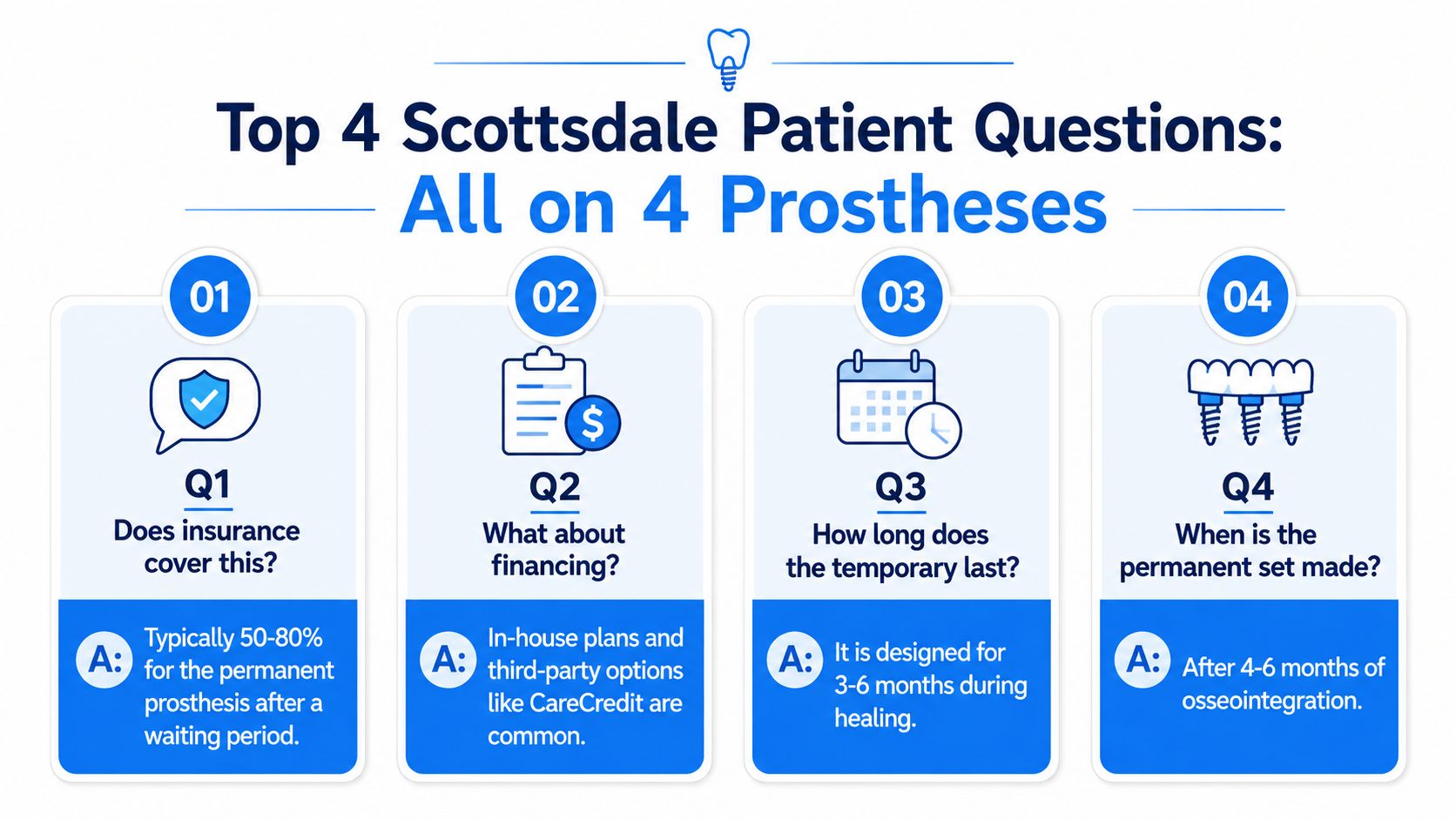
Coverage depends on the plan, but many patients find that major restorative benefits are limited and the permanent phase may receive partial coverage after a waiting period. Financing is often used to bridge the gap when insurance doesn't cover the full case, especially for patients who want to move forward without delaying treatment for another year. The smartest move is to have the office verify benefits before treatment begins so there are no surprises later.
How long before the permanent bridge is made?
The final arch is usually made after the healing phase is complete, which is why rushing it can create problems with fit and load. The temporary bridge stays in place while the implants integrate, and that timing protects the surgical result. Patients who try to compress that timeline usually trade convenience for more risk than they expected.
Will the temporary phase hurt?
Most patients describe the first few days as sore rather than severe, and many manage discomfort with over-the-counter medication once the surgical numbness wears off. The bigger adjustment is often soft foods, speech adaptation, and the feeling of having a fixed arch that still needs to be treated gently. Pain that worsens instead of settling deserves a call to the office.
How long does the final prosthesis last?
With normal maintenance, the final bridge is designed for long-term use, but “long-term” doesn't mean forever without service. The prosthesis may eventually need refurbishment, component replacement, or a remake depending on wear, bite changes, and hygiene. That's why patients who want a stable smile after tooth extraction and implant placement should plan for ongoing follow-up, not just the day the final bridge is delivered.
If you're comparing full-arch options in Scottsdale, Eric Wiitala DDS can review the temporary and permanent phases, explain what your implant timeline should look like, and help you decide whether a staged or accelerated plan makes the most sense for your mouth. Visit Eric Wiitala DDS to schedule a consultation and get a clear treatment plan before you commit to surgery.