
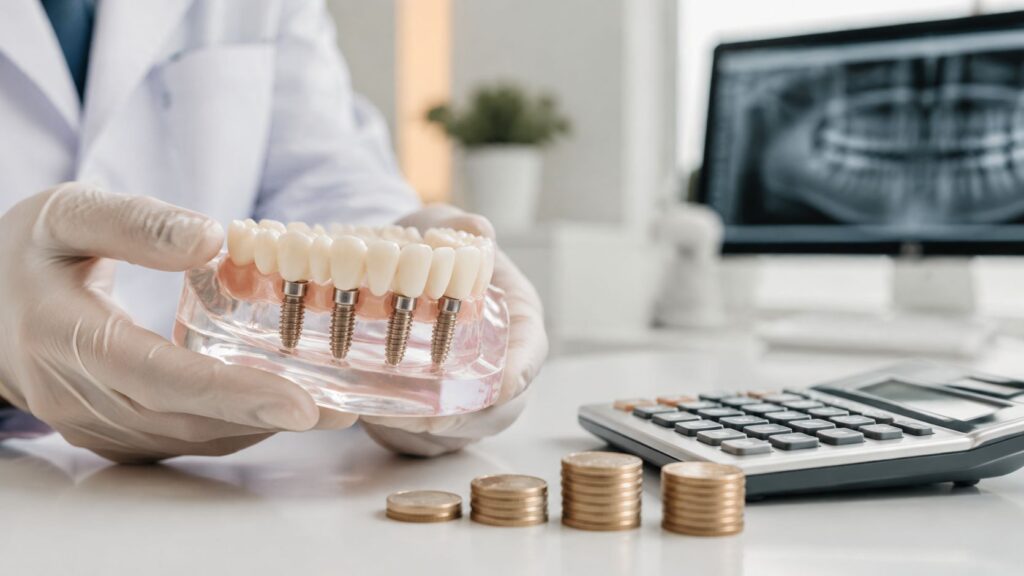
All-on-4 dental implants in Scottsdale typically run $15,000 to $29,000 per arch, while the national average is near $15,176. Full-mouth treatment usually falls between $25,000 and $50,000 or more, depending on the material, bone grafting, and clinic.
A Scottsdale patient often starts researching after years of loose dentures, painful chewing, failing teeth, or a conversation with a family dentist. The search may happen late at night on a phone, with one website showing a surprisingly low figure and another showing a price that seems far beyond reach. The question, “how much are all on four dental implants,” deserves a clearer answer than a single national range.
At Dr. Eric Wiitala's Scottsdale practice, the meaningful number comes from the individual treatment plan. The consultation considers the condition of the remaining teeth, jawbone support, the type of temporary and permanent bridge, and whether tooth extraction or bone grafting is needed. That approach helps a patient compare complete treatment plans instead of comparing incomplete advertisements.
Patients researching practice operations and communication may also find SkipCalls tips for dentists useful as a general resource. For prospective implant patients, the priority remains direct communication, a careful examination, and a written explanation of what the quoted fee includes.
Introduction to All-on-4 Pricing in Scottsdale
A price quote for All-on-4 should answer more than the cost of four implants. It should show whether the fee includes extractions, imaging, a temporary arch, the permanent bridge, follow-up care, and any treatment needed before surgery. Without that detail, two quotes can look different even when they describe similar care.
The phrase per arch causes frequent confusion. An arch means either the upper jaw or the lower jaw. A patient replacing teeth in both jaws needs treatment for both arches, so the total is not the price of one upper arch. Material selection also matters. A temporary PMMA bridge serves a different purpose from a permanent zirconia bridge, and the laboratory work differs accordingly.
Scottsdale pricing can also reflect local operating costs, laboratory fees, and the clinician's training and experience. Arizona guides for 2026 place the state's observed per-arch range around $17,000 to $29,000, according to a recent pricing guide that discusses regional and material differences. That range helps explain why a Scottsdale quote may not match a national average.
What a patient should ask before accepting a quote
A responsible consultation should clarify:
- Scope: Is the fee for one arch or both?
- Prosthesis: Does it include a temporary acrylic or PMMA bridge and a permanent restoration?
- Preparatory care: Are extractions, periodontal treatment, or grafting included?
- Follow-up: What visits are part of the treatment plan?
- Alternatives: Would All-on-6, All-on-X, a conventional bridge, or removable dentures be clinically appropriate?
The right question isn't only “What does All-on-4 cost?” It's “What treatment does this fee cover, and what could change it?” That distinction lets a new patient approach a Scottsdale dentist with realistic expectations rather than fear.
What Are All-on-4 Dental Implants
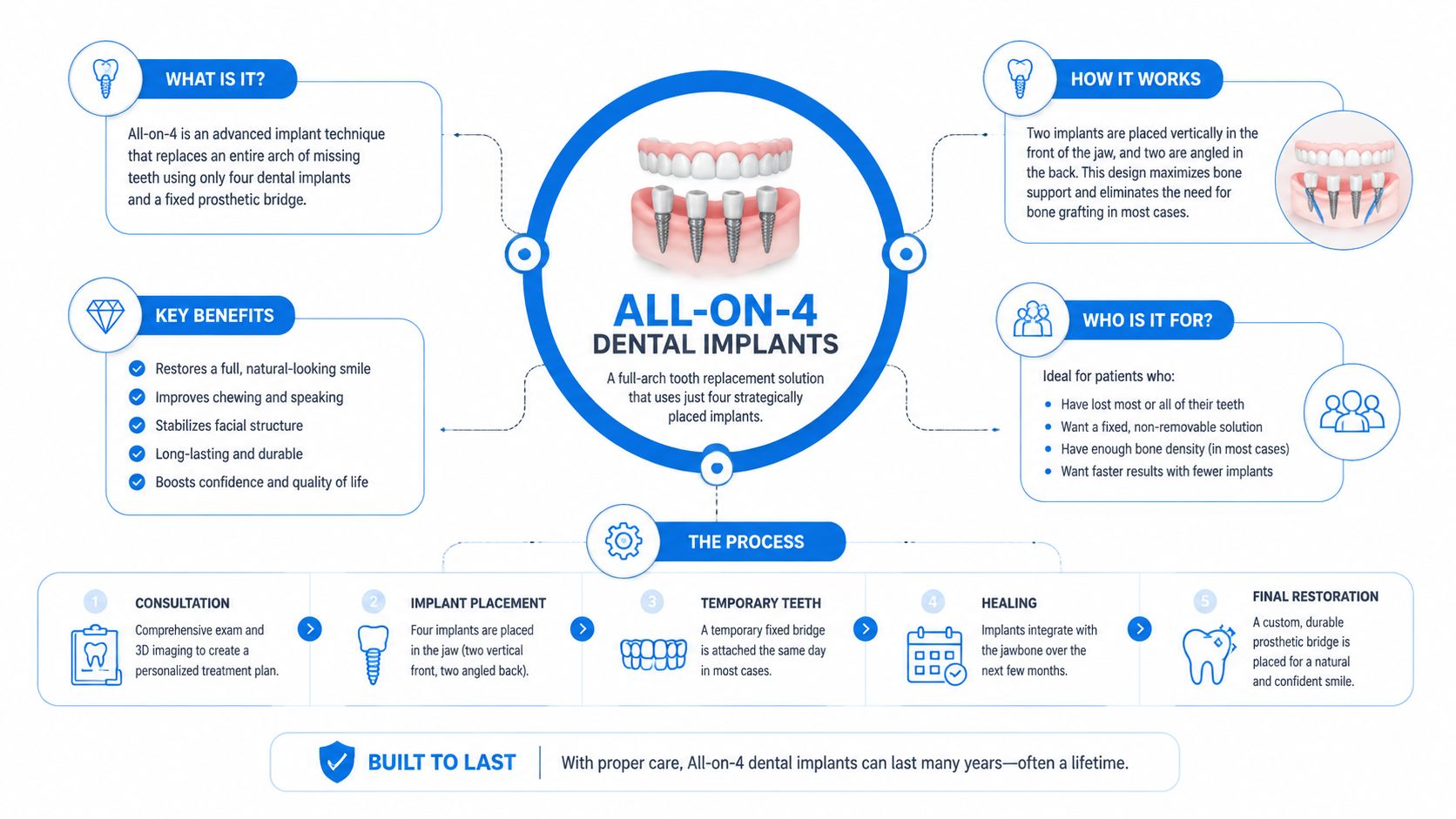
A patient with failing teeth across one arch may need a fixed replacement without placing an implant under every tooth. All-on-4 dental implants address that situation by supporting a full-arch bridge on four implants. Two implants are usually positioned toward the front, where usable bone may be more available. The posterior implants are angled to improve support and distribute chewing forces. The bridge remains attached to the implants, unlike traditional dentures, which the patient removes.
The angled design can use existing jawbone and may reduce the need for extensive grafting. It does not eliminate that possibility. Jaw shape, bone quality, infection, remaining teeth, and bite forces affect candidacy. Imaging and an implant evaluation are needed before a Scottsdale clinician can determine whether the approach fits your anatomy.
Treatment follows several stages: planning, implant placement, a temporary bridge, healing, and a permanent restoration. Some patients receive fixed temporary teeth near the time of surgery. The final bridge is fitted after the implants and jaw have healed enough to support it. If failing teeth remain in the treatment area, extraction may be part of the plan.
Why four implants can support a full arch
Four implants can reduce the number of surgical sites compared with plans using more implants. The arrangement works like a stable foundation: the implants anchor the bridge, while the bridge connects the replacement teeth into one unit. That design can provide fixed teeth even when the available bone is concentrated toward the front of the jaw.
Long-term clinical evidence helps explain why the approach remains in use. A PubMed-indexed retrospective study of 156 implants followed for 5 to 14 years reported a 97.4% cumulative survival rate after a mean 9-year follow-up, with a 77.4% success rate (peer-reviewed All-on-4 outcome study). These findings describe the study group, not a promise for every patient.
Daily hygiene, maintenance visits, bite pressure, smoking status, medical conditions, and bridge design can affect long-term function. The treatment decision should therefore consider how the restoration will be cleaned, repaired, and replaced over time, not only how temporary teeth look on the day they are placed.
An AI chatbot for dentists can answer general questions before an appointment and support routine communication. It cannot replace an examination, diagnostic imaging, or a personalized implant plan.
How Much Do All-on-4 Implants Cost Per Arch
The most useful national benchmark places All-on-4 treatment near $15,176, with an observed range of $11,640 to $27,500 (national All-on-4 cost benchmark). A broader 2026 U.S. range is approximately $14,000 to $28,000 per arch, while full-mouth treatment commonly reaches $25,000 to $50,000 or more.
A per-arch quote can include several separate components. The following breakdown illustrates why the total changes with material and complexity.
All-on-4 cost breakdown per arch
| Component | Typical Cost Range |
|---|---|
| Four implant posts | $4,000 to $8,000 |
| Temporary PMMA arch | $2,000 to $4,000 |
| Permanent zirconia arch | $6,000 to $14,000 |
| Bone grafting, if needed | $500 to $3,000 |
These amounts describe common allocations, not a guaranteed Scottsdale fee. The implant posts are only part of the treatment. Laboratory design, surgery, imaging, temporary teeth, permanent teeth, extractions, sedation, and follow-up may be packaged differently from one office to another.
A temporary PMMA arch is commonly used while the jaw heals. It provides fixed teeth during the transition, but it isn't the same restoration as the final bridge. A permanent zirconia arch generally carries a higher laboratory cost because material selection, design, and fabrication affect the final fee.
Practical rule: A quote should identify the temporary and permanent prostheses separately. “Implants included” doesn't tell a patient what type of teeth will be attached.
Bone grafting can add to the bill when the available bone doesn't provide adequate support. The angled implant strategy may reduce that need for some patients, but it can't remove the need for diagnosis. Extractions can also change the treatment plan, especially when infection or severely damaged teeth must be addressed before or during implant surgery.
The most affordable quote isn't automatically the best value. A patient should compare the restoration material, the surgical plan, what happens if an implant can't be placed as planned, and the maintenance process after delivery.
Why All-on-4 Pricing Varies So Much in Arizona
A Scottsdale patient may receive a quote that differs sharply from one in another Arizona city, even when both plans use four implants. The national average offers context, not a promised local fee. Arizona pricing information describes approximately $17,000 to $29,000 per arch in Scottsdale and the wider Phoenix area. Regional cost information also indicates that major metropolitan areas can cost 20% to 30% higher than smaller cities. One example places a $25,000 procedure in a smaller city at about $32,000 in Manhattan or $35,000 in San Francisco.
Scottsdale fees reflect local labor, laboratory relationships, facility expenses, and professional expertise. A surgeon with advanced training may charge more because full-arch care involves diagnosis, digital planning, surgery, prosthetic coordination, and complication management. Implant count alone cannot explain the value of a treatment plan.
Arizona cost factors beyond the headline quote
| Cost factor | Why Arizona quotes can differ |
|---|---|
| Laboratory partnership | Local or out-of-area laboratories may have different design, communication, shipping, and adjustment costs. |
| Surgical experience | Training and experience affect planning for difficult anatomy and unexpected surgical findings. |
| Bone and tooth condition | Extractions, infection, bone loss, or grafting can add appointments and procedures. |
| Included care | Imaging, sedation, temporary teeth, permanent teeth, and follow-up may be bundled differently. |
Laboratory location can also affect scheduling and revisions. A clinic working closely with a nearby laboratory may coordinate adjustments differently from one that sends cases farther away. The material itself matters, but the larger pricing question is how the laboratory designs, fabricates, services, and replaces the restoration within the proposed fee.
Extractions and bone grafting create further variation. A patient with failing teeth and adequate bone may need a simpler plan than someone with infection or advanced bone loss. The written estimate should show these differences rather than hide them inside one unexplained number.
A peer-reviewed analysis reported lower adjusted costs for All-on-4 than for a historical conventional full-arch approach, associating the difference with four implants and tilted posterior fixtures that may reduce grafting, additional implant placement, surgical complexity, and treatment time. The finding supports a measured conclusion: All-on-4 may cost less than a more extensive reconstruction, yet it remains a major investment. For a patient-focused explanation of full-arch planning, see the Pain and Sleep Therapy Center's guide.
All-on-4 Versus Traditional Implants and Dentures
A patient choosing between removable dentures and a fixed replacement is weighing more than appearance. Dentures usually avoid implant surgery, but they can move during chewing and must be removed for cleaning. Traditional full-arch implant treatment may use more implants and require greater bone support. All-on-4 uses four implants per arch to support a fixed bridge, often offering a middle path between these approaches.
The right option depends on bone density, bite force, periodontal health, hygiene access, appearance, and willingness to undergo surgery. Severe clenching may affect the design or make a fixed full-arch restoration less suitable until the bite is evaluated.
Comparing the main options
| Option | Cost perspective | Function and maintenance | Main trade-off |
|---|---|---|---|
| All-on-4 | Commonly $14,000 to $28,000 per arch nationally | Fixed bridge supported by four implants | Requires surgery and careful maintenance |
| Traditional full-arch implants | Often more expensive when additional implants and grafting are needed | Fixed restoration with a larger support structure | May involve greater surgical and bone requirements |
| Removable dentures | Lower initial investment than implant-supported treatment | Removable and cleaned outside the mouth | Can move and may require future relines or replacement |
Independent pricing pages list non-removable acrylic bridges starting around $13,000 per arch and zirconia options around $16,000 per arch. The comparison shows why restoration material can change a quote substantially, but those figures are not a Scottsdale treatment estimate. Zirconia may provide a different balance of appearance, strength, and repairability than acrylic, so the lower initial fee is not automatically the better long-term value.
All-on-6 or another All-on-X plan may suit a patient with higher bite forces, limited bone in important areas, or concern about future stress on the restoration. Adding implants can raise the upfront cost. Paying more may save money over time if the additional support reduces repair or replacement needs for that patient. An examination is needed to judge whether that trade-off applies.
Patients comparing a fixed bridge with other replacement approaches can review this guide to dental implants versus bridges. A consultation should also cover extractions, gum health, hygiene access, and whether removable dentures remain clinically reasonable.
Long-term ownership includes more than surgery. Repairs, maintenance visits, hygiene tools, relines, replacement bridges, and protection from grinding can all affect value. A lower starting price may lose its advantage if the restoration does not suit the patient's bite, cleaning routine, or daily habits. The written plan should therefore identify the restoration material, number of implants, included follow-up, and likely maintenance needs before treatment begins.
Financing, Insurance, and Your Next Step in Scottsdale
Dental insurance often treats full-arch implant treatment as elective or cosmetic, but coverage varies by policy. Some plans may contribute toward related restorative services, extractions, or medically necessary care. Patients should ask the office to review benefits and confirm exclusions before assuming that insurance will pay the full implant fee.
Financing can divide a large treatment expense into scheduled payments, subject to approval and the terms of the selected plan. The Scottsdale practice provides insurance and billing support for new patients, and its dental financing information can help patients review available arrangements before treatment begins.
What happens at the consultation
A first visit should give the dentist enough information to assess candidacy and create a realistic plan. Patients can expect:
- A thorough examination: The dentist reviews remaining teeth, gums, bite, jaw function, and overall oral health.
- Dental x-rays and imaging: Diagnostic images help evaluate bone and identify infection or other conditions that could affect treatment.
- Treatment planning: The office discusses implant position, temporary teeth, permanent material, extractions, grafting, and alternatives.
- Transparent pricing: The proposed fee should identify what is included and what circumstances could change the estimate.
A patient searching for a dentist near me, dental implants near me, or a cosmetic dentist near me should bring a list of medications, insurance details, prior dental records when available, and specific concerns about chewing, appearance, or denture stability. Patients with urgent pain, swelling, or a broken tooth should request an emergency dentist evaluation before discussing elective full-arch treatment. Tooth extraction, restorative dentistry, periodontal care, and preventive cleaning and exams may need attention first.
For a Scottsdale consultation, patients can call (480) 657-6981 or visit the practice website to request an appointment. The office is located at 9755 North 90th Street, Suite B250, Scottsdale, AZ 85258, and serves adults considering dental implants, All-on-4 treatment, cosmetic dentistry, and dental care.
Eric Wiitala DDS provides examinations, treatment planning, dental implants, and All-on-Four solutions for Scottsdale patients with missing or failing teeth. Visit Eric Wiitala DDS to request a consultation and receive a personalized explanation of the treatment options, expected costs, and next steps.