

A lot of people in Scottsdale reach the same point in a frustrating, quiet way. They've tried the loose denture, the worn-down bridge, or the teeth that keep breaking one by one, and now they're tired of planning meals around sore spots and avoiding photos because the smile feels unstable.
All-on-Four dental implants are often the point where the conversation shifts from patching problems to rebuilding the whole arch in a fixed way. For patients searching for a dentist near me, a dentist in Scottsdale, AZ, or dental implants near me, the question usually isn't whether the idea sounds good. It's whether it fits the mouth, the health history, the timeline, and the life that's happening outside the dental chair.
Table of Contents
- Why Scottsdale Patients Are Choosing Full Arch Treatment
- How All on Four Dental Implants Work
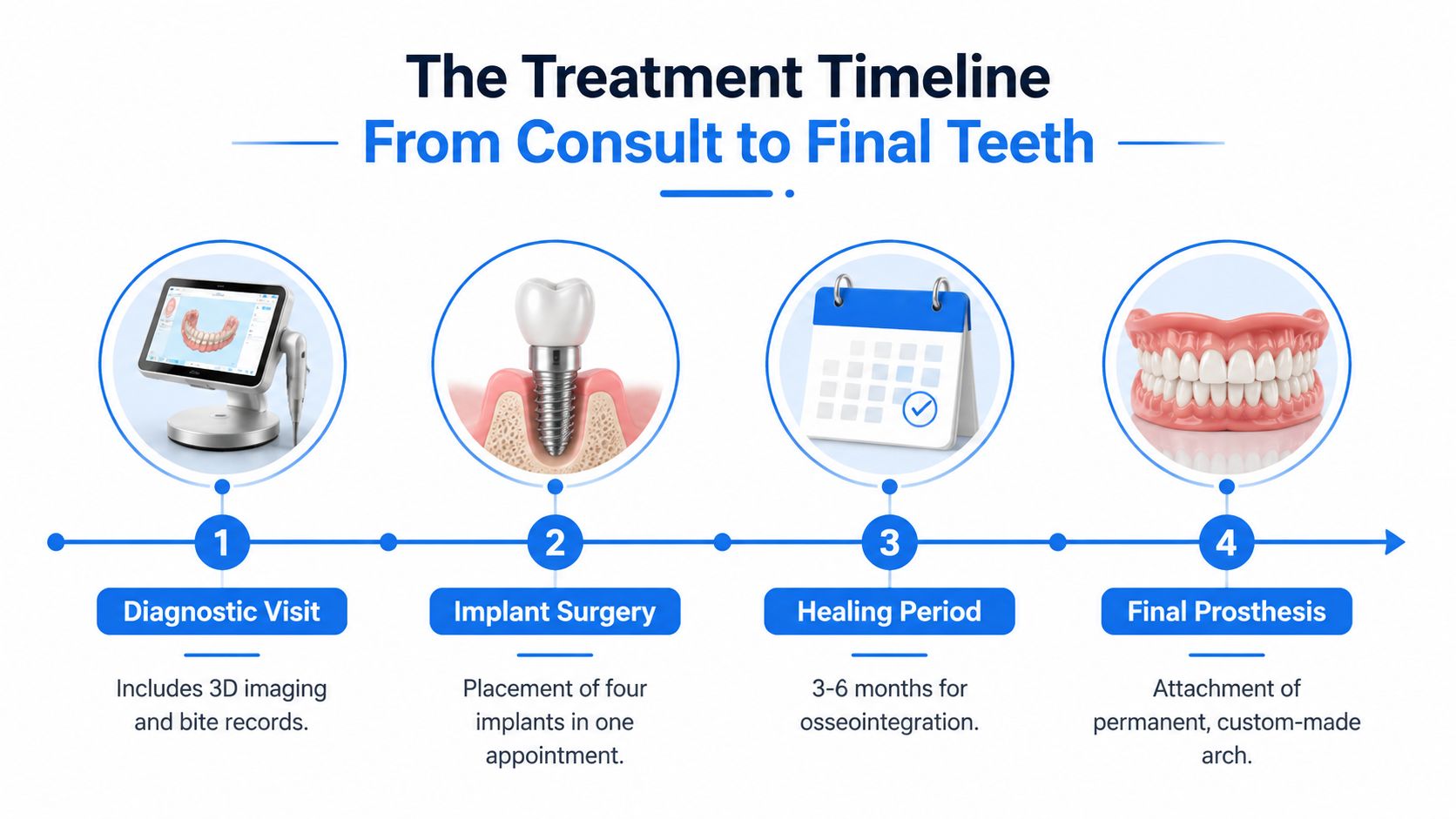
- The Treatment Timeline From Consult to Final Teeth
- Who Is a Good Candidate and Who Is Not
- All on Four Compared to Traditional Implants and Dentures
- Benefits and Risks Patients Should Weigh Honestly
- Recovery, Healing, and Day to Day Aftercare
- Your Consultation at Eric Wiitala DDS in Scottsdale
Why Scottsdale Patients Are Choosing Full Arch Treatment
A typical Scottsdale consultation starts with a patient who's done being embarrassed by a failing lower arch or a denture that shifts at the wrong time. The patient may still be getting by, but it's usually at the cost of crunchy foods, casual dinners, and confidence in everyday conversation. That kind of slow, constant compromise wears people down.
All-on-Four is appealing because it speaks directly to that problem. It's not a single-tooth fix and it's not a removable appliance dressed up as something more. It's a full-arch fixed prosthesis designed to replace most or all teeth in one arch with a small number of implants supporting the whole span.
What patients usually want answered first
Patients don't walk in asking for implant anatomy. They ask whether they'll be able to eat normally, whether they're even a candidate, and how long they'll be stuck in a temporary phase. They also want straight talk about what recovery feels like at home and what the process means for work, travel, and family routines.
Practical rule: if a treatment plan can't be explained in plain language to a spouse or adult child, the plan probably isn't clear enough yet.
That's why this topic matters for patients searching for a cosmetic dentist near me, a restorative dentistry solution, or even an emergency dentist after a tooth breaks down far enough that it can't be saved. Full-arch treatment is usually considered after years of breakdown, but the decision still comes down to a simple standard. The result has to be stable enough to live with, and the process has to be realistic enough to finish.
A good consultation should leave the patient with a clear map, not a sales pitch. The rest of this guide follows that same standard, because the best decision isn't the fastest one. It's the one that matches the mouth in front of the mirror.
How All on Four Dental Implants Work
At its simplest, the concept is easy to grasp. Two implants go in the front more upright, and two implants go in the back at an angle, creating a support system for a full-arch prosthesis. That basic arrangement is the core biomechanical idea behind All-on-Four, and the design is meant to increase the anteroposterior spread while helping avoid the maxillary sinus above and the mandibular nerve canal below. The goal is better load distribution and less cantilever stress across the arch, which is why the geometry matters so much. All-on-Four treatment concept manual
The tripod comparison helps because this visual is instantly recognizable. If the back legs flare outward, the base gets steadier. In the mouth, the angled posterior implants do a similar job by widening the foundation for the teeth that sit on top.
Immediate loading and why stability comes first
The phrase immediate loading means a temporary fixed arch can be attached the same day when conditions are right. That only works when the implants are stable enough at placement, because the bone has to hold the fixtures while healing begins. Expert reviews cite an insertion torque target of about 35 to 45 Ncm, and published guidance also discusses minimum bone dimensions of roughly 5 mm width and 10 mm height in the edentulous maxilla, along with 8 mm height in the edentulous mandible. Tilted posterior implants are commonly placed at 30° to 45°, and splinting is often used when angulation reaches 30° or more. Immediate loading guidance
That's the practical reason same-day teeth aren't automatic. If stability isn't there, the safest plan may be staged instead of immediate. A patient can still end up with a strong final result, but the delivery timeline changes.
The chairside decision isn't about speed. It's about whether the implants can safely carry a temporary arch while bone healing does its work.
For patients who want to understand the process visually, the key idea is that the surgery and the final teeth are related but not identical events. The first step creates the foundation. The second step gives that foundation a permanent, custom-made arch after healing has done enough of the heavy lifting.
The Treatment Timeline From Consult to Final Teeth
The first visit is usually the longest conversation, even though it isn't surgery day. A patient comes in for a diagnostic workup, and that means 3D imaging when indicated, bite records, a medical history review, and a careful look at what's left in the arch. A useful plan comes from those details, not from guesswork.
What happens after the consult
Once the records are in place, the plan moves into surgery day if the mouth is ready. That visit can include extractions, implant placement, and, when stability allows, a temporary fixed arch attached the same day. This is the part that often surprises people, because it's not a “get everything done and go home forever” appointment. It's a concentrated treatment day that starts the process.
The next phase is the healing window. Over the following months, the office checks the implants and the soft tissue as bone integration progresses. This is when the temporary teeth earn their keep, because they let the patient function while the deeper healing work happens below the surface.
If the recovery phase is a concern, a detailed patient guide on healing can help with expectations, and a useful starting point is the practice's own overview of recovery timing at how long recovery can take after implant treatment.
The final phase is delivery of the permanent prosthesis. That arch is usually stronger, more refined, and designed for long-term use. It's the part that turns a surgical result into a day-to-day solution.
The honest answer on timing is that the process is not a single afternoon, but it also isn't endless. The active chair time is concentrated into a few well-defined visits, and the healing work happens in between.
Who Is a Good Candidate and Who Is Not
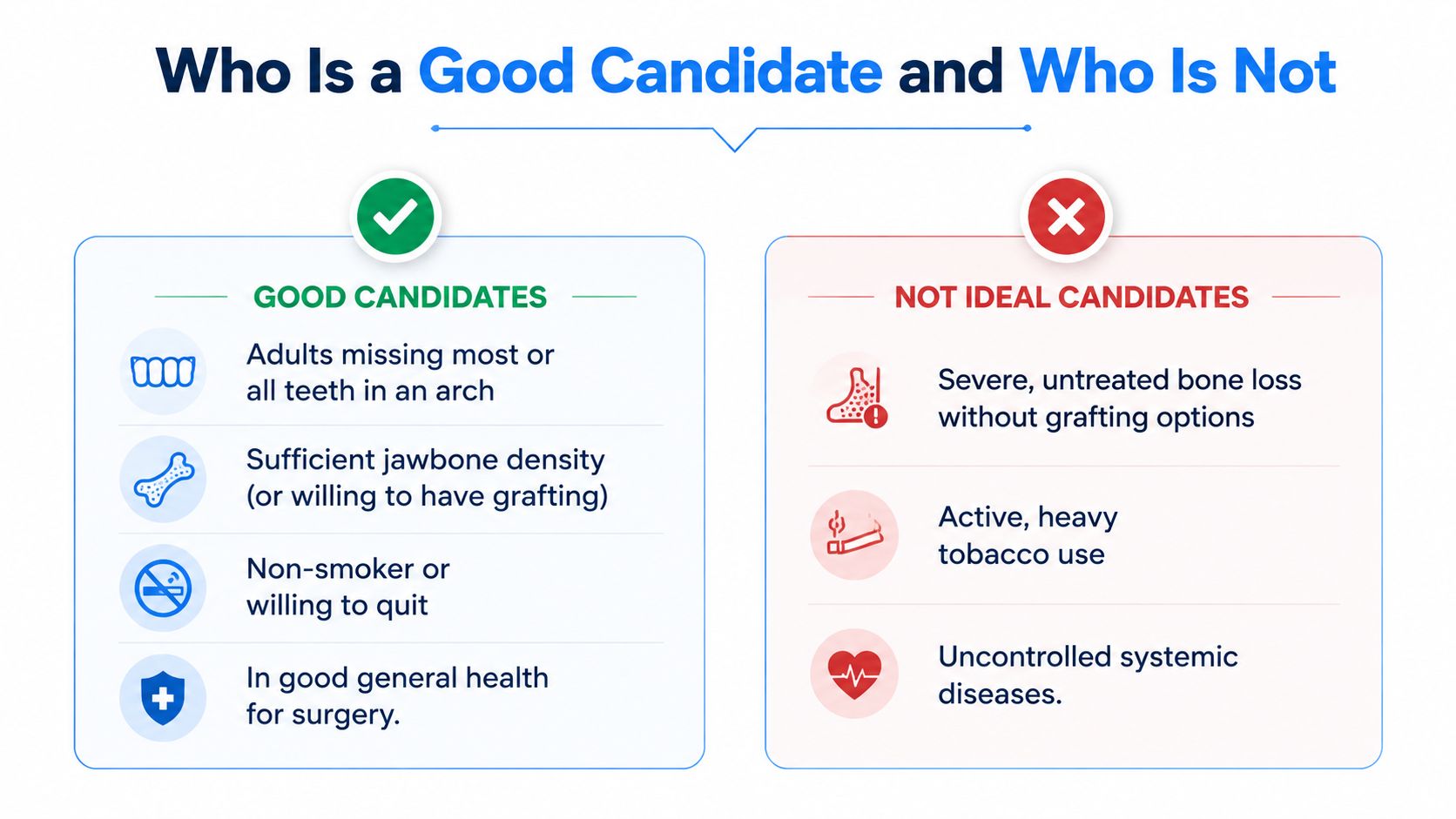
Candidacy for All-on-Four sits on a spectrum, not a simple yes-or-no line. Some patients are clear fits, some need a closer look, and some need a different path first. The clearest candidates are adults missing most or all teeth in an arch, long-time denture wearers who are tired of slipping and sore spots, and people with failing teeth who want a full reset instead of another repair.
A consultation becomes especially important when the mouth or medical history raises questions. Uncontrolled diabetes, active periodontal disease, heavy smoking, bisphosphonate use, and significant bone loss do not always rule treatment out, but they often change the sequence. Some patients need coordinated medical care, some need periodontal therapy first, and some need grafting or staged treatment before implant placement is realistic.
Age alone is not the deciding factor. There is no upper age cutoff just because a patient has more birthdays behind them. What matters more is bone maturity, tissue health, and whether the body can handle surgery and healing in a predictable way.
A patient who is not ready yet is not a failure, and that answer can protect the final result.
A practical self-check is straightforward. If the mouth has multiple failing teeth, a denture that never feels secure, or a history of repeated breakdown in the same arch, a consultation makes sense. If there is active gum infection, uncontrolled systemic disease, or ongoing heavy tobacco use, the first appointment may still be useful, but it is likely to focus on preparation rather than immediate surgery.
For readers sorting through implant eligibility in more depth, the practice's overview of dental implant candidacy is a sensible companion to an in-person evaluation, and the AISEOGrow dental SEO playbook is part of the broader content support behind that resource. The point is not to self-diagnose. It is to show up informed enough to have a productive conversation about whether All-on-Four is the right path for your specific situation.
All on Four Compared to Traditional Implants and Dentures
Full-arch patients usually end up weighing three real choices. One is All-on-Four. Another is a more traditional implant approach using more fixtures per arch. The third is a removable denture, which remains a valid option for some patients even if it's not the dream choice.
| Full Arch Options Side by Side | Option | Implants per Arch | Typical Bone Grafting | Timeline to Final Teeth | Stability and Maintenance |
|---|---|---|---|---|---|
| Fixed full-arch option | All-on-Four | 4 | Often less, because of implant angulation | Usually shorter because temporary teeth may be placed sooner | Fixed arch, needs daily cleaning and periodic professional maintenance |
| Fixed full-arch option | Conventional multi-implant restoration | 6 or more | More often needed depending on bone and spacing | Can be longer because more surgery and healing may be involved | Very stable, but maintenance still matters |
| Removable option | Denture | 0 | Not applicable | Fastest to start, but not a fixed tooth replacement | Easier to remove, but less stable and less natural feeling |
All-on-Four often wins when the patient wants a fixed result without the added complexity of more implants or more grafting. It can also shorten the route to temporary teeth, which matters to people who can't disappear from work or family life for long stretches. That said, more-implant solutions still make sense for certain mouths, especially when the bone and anatomy support them and the patient wants a different maintenance or load distribution strategy.
A denture is not a failure choice. For the right patient, it can be the most practical answer, especially when surgery needs to be minimized or the patient wants a removable path. The limitation is stability, and that trade-off is usually obvious the first time the patient tries to chew on something firmer.
For readers interested in how dental search strategy and educational content are handled in the background, the AISEOGrow dental SEO playbook is a useful reference point for how full-arch topics tend to be organized online. Clinically, though, the better question is simpler. Which option gives the patient the most reliable result for the mouth in front of the chair?
Benefits and Risks Patients Should Weigh Honestly
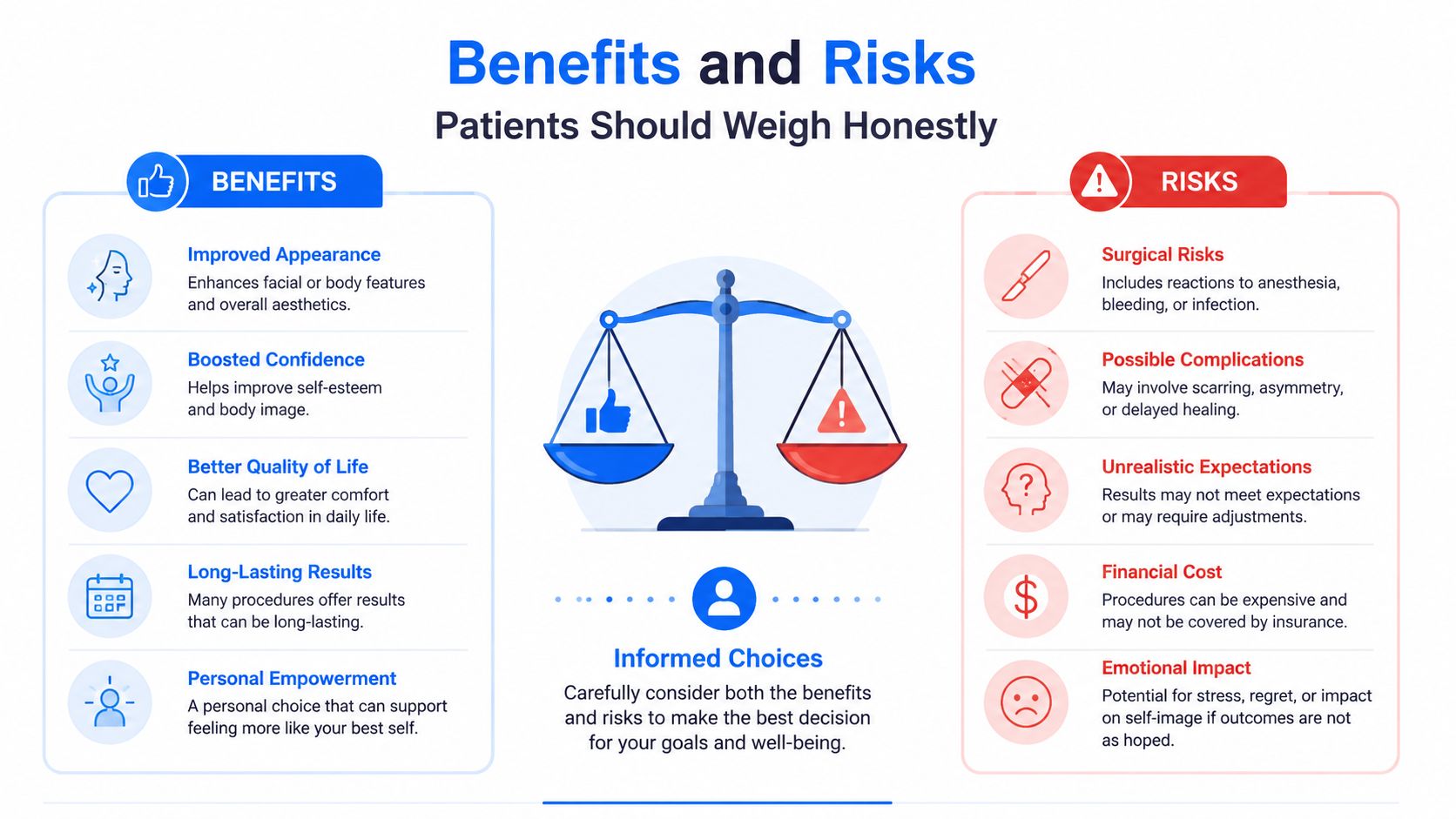
The upside of All-on-Four is easy to understand once someone has lived with loose teeth or unstable dentures. A fixed arch can make it possible to bite into firmer foods again, speak without worrying about movement, and stop hiding the lower face the way many people do when tooth loss has started to change facial support. Daily care also feels more natural than managing a removable prosthetic, because the arch stays in place.
The part marketing often skips
The trade-offs are real. Surgery always carries risk, and that includes infection, peri-implantitis, the chance that an implant doesn't integrate, temporary numbness, sinus-related issues in upper-arch cases, and the long-term reality that a prosthesis can wear and need repair. Patients also need to understand that strong outcomes still require regular professional cleaning and daily home care.
That's why success-rate numbers should encourage, not reassure blindly. The published evidence shows high survival in many studies, including a 2013 review with 4,804 implants and 1,201 prostheses, 74 implant failures, and mean cumulative survival at 36 months of 99.0% for implants and 99.9% for prostheses, with average marginal bone loss of 1.3 mm. Longer follow-up has also shown durable outcomes over many years, but no implant treatment is maintenance-free. Long-term clinical evidence review Decade-scale follow-up review
Good implant dentistry doesn't promise zero problems. It plans for them, monitors for them, and keeps the restoration clean enough to last.
The balance point is honest: the procedure can be life-changing, but it asks for commitment. Patients who understand that trade-off usually do better than patients who only hear the promise of fixed teeth and never hear the part about upkeep.
Recovery, Healing, and Day to Day Aftercare
The first two to three days are usually the most noticeable. Swelling, tenderness, and a soft-food diet are normal, and the surgical sites need careful cleaning without aggressive brushing. Individuals are able to settle into a manageable routine quickly, but that routine matters because the tissues are healing around a new foundation.
Weeks two through four often feel more normal, especially with the temporary arch cleaned carefully using the tools recommended by the team. That's the phase where patients start rebuilding confidence with eating and speaking, even though the final teeth haven't arrived yet. It's also the stage where people sometimes get too comfortable and need a reminder that healing isn't finished just because pain has faded.
What long-term care really looks like
The months that follow are about integration and monitoring. The office checks healing until the implants are ready for the final prosthesis, and after that, maintenance doesn't stop. The long-term routine is straightforward, daily cleaning under and around the arch, regular professional cleanings, and avoiding habits that put unnecessary stress on any prosthesis, like chewing ice.
Warning signs deserve a quick call to the office. Persistent swelling, worsening pain, loosening, drainage, or a change in the way the arch fits should never be ignored. Fixed teeth don't mean hands-off teeth.
A patient who treats the restoration like a set-it-and-forget-it appliance usually gets into trouble later. A patient who keeps up with the hygiene plan tends to protect both the implants and the prosthesis for the long run.
Your Consultation at Eric Wiitala DDS in Scottsdale
A good first visit at a Scottsdale implant office should feel organized, not rushed. At Eric Wiitala DDS, the evaluation can include a thorough exam, 3D imaging when indicated, review of medical and dental history, and a real conversation about goals, budget, and timing. The team also helps with insurance and financing navigation, which matters when a full-arch plan is being compared with other restorative and cosmetic dentistry options.
The office is located at 9755 North 90th Street, Suite B250, Scottsdale, AZ 85258, and the practice keeps consistent weekday hours with Friday by appointment. That matters for patients in Scottsdale and nearby communities who need a practical place to start, whether they're considering full-arch dental implants, a tooth extraction, or another restorative path.
The most useful part of the consult is what comes after it. A patient should leave with a written plan, not a vague promise, and the first conversation should be informational rather than pressured.
If you're comparing All-on-Four dental implants and want a candid review of candidacy, timeline, and recovery, schedule a consultation with Eric Wiitala DDS. The office can help you sort out whether full-arch treatment, other implant options, or a different restorative plan fits your mouth and your goals.