
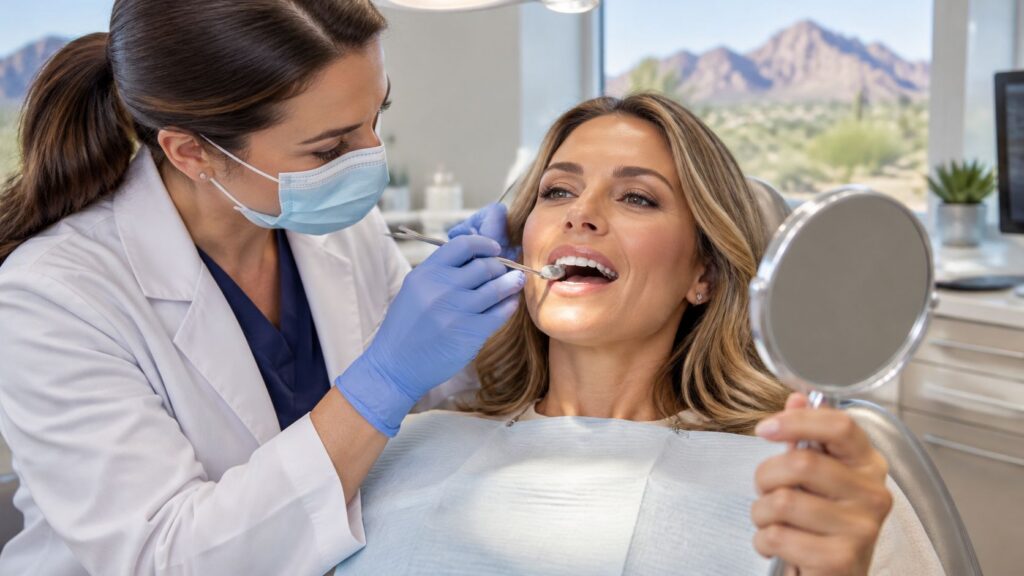
What if a mouth looks completely normal in the mirror, feels fine, and still isn't clear? That's the gap most guides leave out. Learning how to detect oral cancer means learning two things at once, how to spot a change early and why a home check can't rule disease out. For Scottsdale adults searching for a dentist near me, that distinction guides the next step, watch carefully at home, then let a professional exam and, when needed, a biopsy give the answer.
Table of Contents
- Check Your Mouth at Home Step by Step
- Warning Signs and How Long to Wait Before Calling
- Risk Factors That Mean Checking More Often
- Why a Normal-Looking Mouth Does Not Rule Out Cancer
- What Happens During an Oral Cancer Exam and Next Steps
- Book Your Oral Cancer Check in Scottsdale
Check Your Mouth at Home Step by Step
A home check works best as a monthly routine, not a one time glance. Good light, a mirror, clean hands, and a simple log turn vague worry into useful information. A phone torch helps for the back of the mouth, and a piece of clean gauze makes the tongue easier to hold without slipping. Readers who do the check on the same day each month, for example the first Sunday, are less likely to forget.
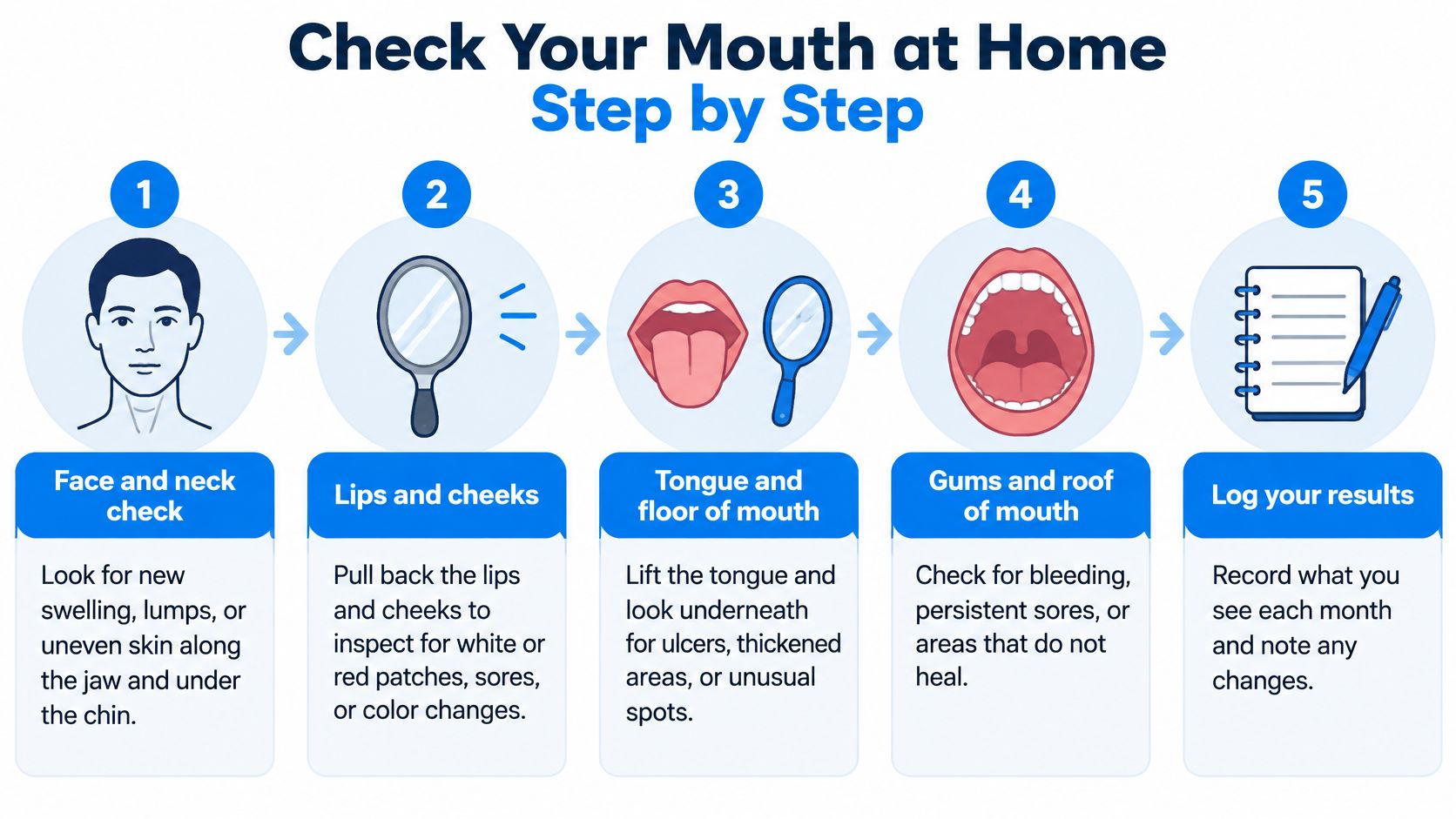
The Seven Step Mirror Check
- Face and neck first: Look for new swelling, lumps, or uneven skin along the jaw and under the chin. One side shouldn't look noticeably fuller than the other.
- Lips and gums: Lift the upper lip, then pull down the lower lip. Check the inner lining and gums for sores, red patches, or white patches.
- Inner cheeks: Pull each cheek outward with clean fingers. Inspect the lining along the bite line, where the teeth meet, because irritation and early lesions often show there.
- Tongue on all sides: Stick the tongue out and check the top. Then lift it to see the underside, and use gauze to move it gently left and right so the edges are visible.
- Roof and throat: Tilt the head back, open wide, and check the roof of the mouth. Use the mirror for the back of the throat, noting any ulcer or area that looks thicker than the tissue around it.
- Feel as well as look: Press gently with clean fingers on the cheeks, the floor of the mouth under the tongue, and the neck below the jaw. Note anything that feels like a lump, firm, or fixed in place rather than soft and movable.
- Write it down: Record anything new with its size, color, location, and the date first noticed. A rough size comparison, such as smaller than a pea, is enough.
Why the Log Matters More Than Memory
Dates matter because the two-week rule only works if the days can be counted. Say a Scottsdale reader notices a small sore on the side of the tongue on March 3 and writes it down. If it's still there on March 18, that entry is clear evidence, not a guess. A clear phone photo taken in the same light each week adds a useful comparison.
Practical rule: A change that hasn't healed within two weeks goes on a list for a dentist or physician visit that week, rather than waiting for pain to show up.
The most common slip is checking the front of the tongue and skipping its sides and the floor of the mouth. Those hidden areas are exactly where changes can sit unnoticed for months. Finishing each check with a decision helps, either nothing new was found, or something new gets a date, a note, and a follow up plan. That habit is the core of how to detect oral cancer at home, noticing early and acting on persistence.
Warning Signs and How Long to Wait Before Calling
One rule covers most warning signs. According to Public Health Agency of Canada oral cancer guidance, a mouth, lip, or throat sore, irritation, lump, or thickened area that lasts longer than 2 weeks is a reason to see a dentist or physician. Pain isn't the trigger. A painless patch that persists still needs an exam, because many minor injuries and infections resolve sooner than two weeks.
| Warning sign | What it may look like | When to get it checked |
|---|---|---|
| Sore or ulcer | Open sore that does not heal | Longer than 2 weeks |
| Red patch | Smooth, bright red area | Longer than 2 weeks |
| White patch | Thick, raised or leathery white area | Longer than 2 weeks |
| Lump or thickening | Firm bump or thick area in cheek, tongue or neck | Longer than 2 weeks, sooner if growing |
| Numbness | Tongue, lip or cheek feels numb | Longer than 2 weeks |
| Hoarseness | Voice stays rough or changed | Longer than 2 weeks |
| Unexplained bleeding | Bleeding without injury or dental cause | Promptly |
| Loose tooth | Tooth moves without gum disease or injury | Promptly |
| Trouble chewing, swallowing or moving jaw | New difficulty with food, speech or jaw movement | Promptly |
| Dentures fit poorly | Denture stops fitting after swelling | Promptly |
Two Timing Groups
Sores, patches, lumps, numbness, and hoarseness are judged by the two-week mark. Bleeding, a loose tooth, trouble swallowing, or a denture that suddenly stops fitting should be seen promptly, whatever their age. A neck lump or a sore that bleeds easily deserves a call even when it seems minor, and a change that's visibly growing needs the earliest appointment available. An emergency dentist is the right call when bleeding won't stop or swallowing becomes difficult.
Infections, injuries from a sharp tooth, and denture sores can produce similar signs, so the table tells readers when to book, not what the cause is. Readers who want broader context on treatment pathways after a diagnosis can review integrative mouth cancer care in Scottsdale from Sunridge Medical. Same day actions are simple, write down the location and size, take a clear phone photo if possible, and call with the date the change was first noticed.
Risk Factors That Mean Checking More Often
Risk factors don't diagnose anything. They tell readers how carefully to watch. Tobacco is the largest known risk factor, and smokeless tobacco matters too because the product rests against the cheek or gum for long periods, exposing one spot again and again. Heavy alcohol use raises risk on its own, and tobacco combined with alcohol raises it much further.
| Risk factor | Why it matters | Suggested check |
|---|---|---|
| Smoking | Major cause of oral cancer | Monthly self-check and dental exam every six months |
| Smokeless tobacco | Rests against the cheek or gum for long periods | Monthly self-check of the area where the product sits |
| Heavy alcohol use | Raises risk, especially with tobacco | Monthly self-check and dental exam every six months |
| HPV infection | Linked to some oral and throat cancers | Tell the dentist; discuss throat checks with a physician |
| Frequent lip sun exposure | Lower lip is most exposed to sun | Check the lower lip monthly |
| Past head or neck cancer | Higher chance of a second cancer | Follow the care team's schedule |
Turning the Table Into a Habit
HPV infection is linked to some oral and throat cancers, which is why throat symptoms deserve attention even when the front of the mouth looks fine. The lower lip is the part of the mouth most exposed to sun, a real concern in sunny Scottsdale for people who work or play outdoors. A past head or neck cancer raises the chance of a second one, so that group follows a specialist schedule rather than a general one.
Having a risk factor doesn't mean cancer is present, and people with one never develop oral cancer. The table works as a guide to frequency. Readers can match personal habits to the suggested check, add a monthly self-check if one applies, and mention those habits when booking so the exam can be planned around them. Asking the dentist to examine higher risk areas at each visit, such as the spot where smokeless tobacco sits, takes seconds and closes the gap between home checks.
Why a Normal-Looking Mouth Does Not Rule Out Cancer
A mirror check can notice changes. It can't rule disease out. The U.S. National Cancer Institute oral screening summary reports that visual examination is the main way clinicians detect visible lesions, yet developed countries have not implemented population-wide oral-cavity screening programs. There's no universally recommended routine screening test for oral cancer, so a clear looking mouth lowers concern but doesn't end it.
The photo below shows the kind of close lip check that belongs in a monthly routine.

What Newer Tools Can and Cannot Do
Visual checks miss some lesions, and no single method is perfect. Newer tools such as autofluorescence devices, rinse tests, AI image analysis, and phone apps can help flag areas that need a closer look. They can also flag harmless inflammation, which leads to false alarms, and a reassuring app result can miss disease. None of them can confirm cancer.
Only a tissue biopsy examined under a microscope gives a definitive answer.
The short video below walks through what a careful self examination looks like in practice, which helps readers compare technique rather than guess.
Readers with no symptoms should still keep regular dental checks, because the mouth is easy to examine during routine visits without special equipment. A sore, patch, or lump that persists needs a professional look even if it doesn't hurt and even if a home tool says it looks fine.
What Happens During an Oral Cancer Exam and Next Steps
An oral cancer exam is a short, painless part of a routine cleaning and exam or a new patient exam. The Centers for Disease Control and Prevention oral cancer overview notes that visual examination is the most common method for detecting visible lesions, and that confirmation requires tissue evaluation. Readers booking a first visit can see what a new patient dental exam in Scottsdale typically includes before they arrive.
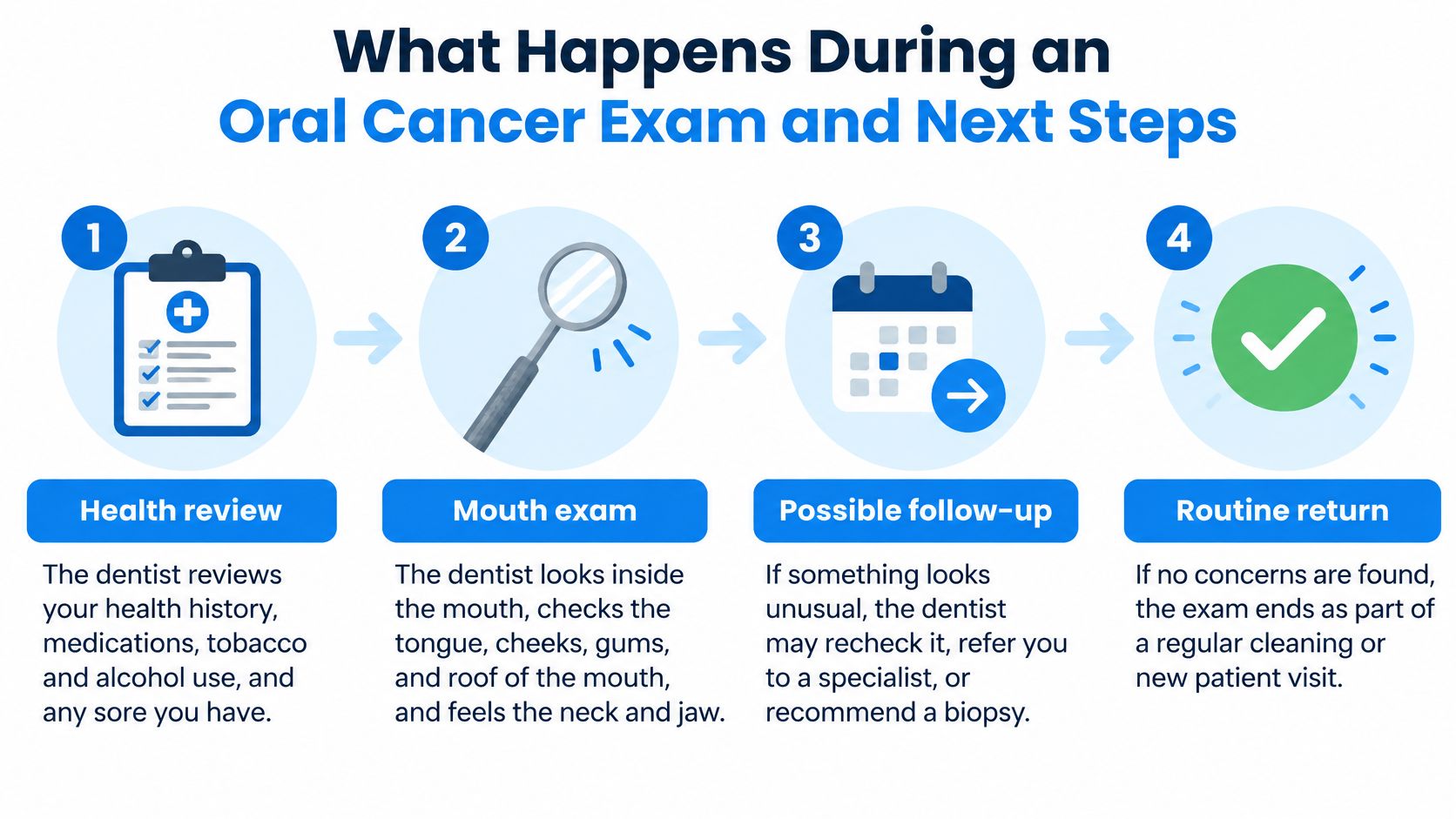
The Visit in Order
- Health review: The dentist reviews health history, medications, tobacco and alcohol use, and any sore the patient has noticed. The home log is useful here.
- Visual inspection: The clinician inspects the face, neck, lips, cheeks, gums, roof of the mouth, tongue including its underside, and the throat, using a mirror and good light.
- Feeling for lumps: Lymph nodes under the jaw and in the neck are felt for firmness or size changes, and suspicious areas inside the mouth are pressed gently.
- Recording findings: If an area looks suspicious, the dentist records its size, color, surface, and whether it feels fixed. A photograph may be taken for comparison at the next visit.
Consider a typical scenario. A patient mentions a white patch found during a monthly check three weeks earlier. The dentist measures it, photographs it, and because it has already passed the two-week mark, arranges referral rather than another round of watching. That sequence is the pathway working as intended.
After Something Suspicious Is Found
A mild change may be rechecked in about two weeks. A persistent or suspicious area leads to referral to an oral medicine specialist, oral surgeon, or ENT clinician. Additional techniques such as staining or brush sampling may supplement the exam, but an abnormal finding from those tools isn't a confirmed diagnosis. A biopsy takes a small tissue sample for a pathologist, and that result decides whether treatment or monitoring follows.
The dental visit is the entry point to detection and coordinated follow up, not a substitute for biopsy. Many findings at an exam turn out to be benign, which is exactly the reason to book rather than wait. Before a biopsy, patients can ask how the sample will be taken, who will read it, and when results will arrive. Bringing photos or notes from earlier visits lets the next clinician compare directly. Trouble breathing or swallowing, or bleeding that won't stop, calls for urgent care through an emergency dentist or urgent medical service instead of a routine appointment.
Book Your Oral Cancer Check in Scottsdale
Readers searching for a dentist in Scottsdale, Arizona or typing dentist near me into a phone usually want one thing, a clear next step. Eric Wiitala DDS offers routine dental checkups in Scottsdale, and an oral cancer check fits naturally into a routine cleaning or new patient exam. General dentistry services there include root canals, crowns, fillings, gum care, and patient education, so a suspicious finding can be discussed alongside everyday dental care needs.
Booking This Week in Four Steps
- Bring the log: Bring the monthly self-check record with the date, size, color, and location of any change, plus phone photos if available.
- Request the check by name: Call the practice or book online and mention any sore, patch, or lump that has lasted longer than two weeks. Readers comparing visit costs first can review what a dentist check-up costs before calling.
- List habits and medications: Bring a short list covering tobacco, alcohol, and medication use so the exam can focus on the right areas.
- Ask about next steps: Ask what the exam covers and what happens if an area needs a closer look, including referral and biopsy timing.
Booking shouldn't wait when a warning sign has lasted more than two weeks, or when there's bleeding, a loose tooth, or trouble swallowing, chewing, or speaking. Those symptoms don't prove cancer, and many turn out to have ordinary causes such as infection, irritation, or a tooth extraction site that's healing slowly. Only an exam can sort that out. If a finding needs further evaluation, the dental team can explain options and what to expect next, calmly and in plain language. For Scottsdale families already due for cleaning and exams, dental x-rays, or restorative dentistry, adding the oral cancer check to that visit is the simplest way to turn monthly home checks into complete care.
Eric Wiitala DDS provides routine dental checkups in Scottsdale, including oral cancer checks as part of cleaning and new patient exams, with calm, plain language explanations of every finding. Readers who have noticed a sore, patch, or lump lasting longer than two weeks can bring their self-check log and get a clear plan for what happens next. Schedule a visit today through Eric Wiitala DDS and ask for an oral cancer check at the next appointment.