
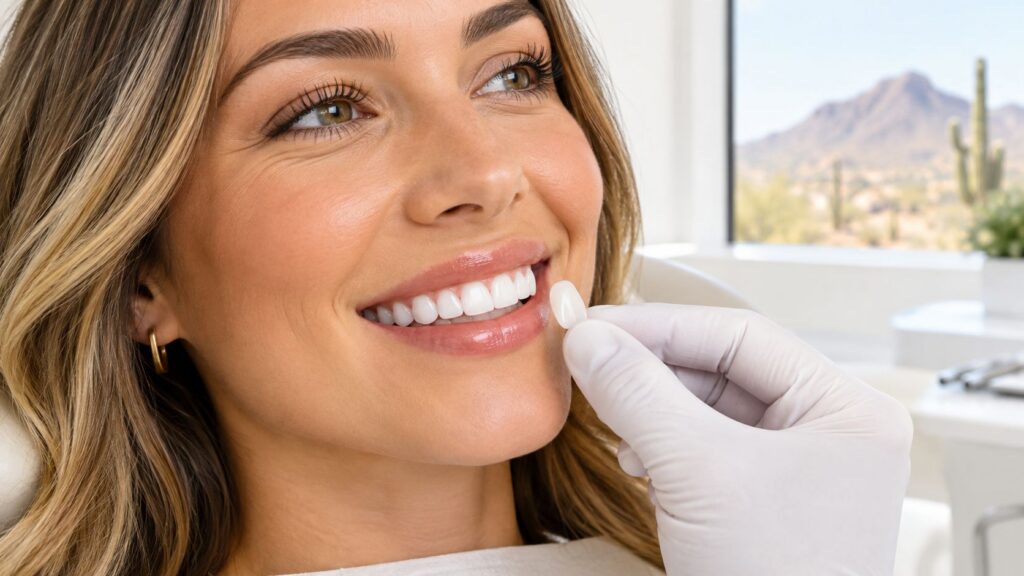
No-prep veneers can be an excellent option for the right patient, and in a 186-patient comparative study they showed a 100% Kaplan–Meier survival estimate in the no-prep or minimally invasive group, while a separate retrospective series reported 97.4% survival and 91.0% clinical success after an average of 43.1 months PMC study. That said, no-prep veneers are a clinical technique, not a universal upgrade over traditional porcelain veneers or bonding.
For many Scottsdale adults, the question starts in the mirror. A tooth looks a little short, a little crowded, a little stained, or a little chipped, and the appeal of changing the smile without drilling is immediate. The better question is whether the teeth, gums, bite, and habits make that approach a smart fit.
Table of Contents
- Why Scottsdale Patients Are Asking About No-Prep Veneers
- What No-Prep Veneers Are
- Who Makes a Good Candidate for No-Prep Veneers in Scottsdale
- No-Prep Veneers Compared to Traditional Veneers and Bonding
- Honest Pros and Cons Worth Knowing Before You Commit
- Treatment Timeline and Aftercare for Lasting Results
- Choosing a Scottsdale Cosmetic Dentist You Can Trust
Why Scottsdale Patients Are Asking About No-Prep Veneers
A lot of people searching for No Prep Veneers Scottsdale are looking for the least invasive way to improve front teeth without committing to a larger dental change. That makes sense. When the front teeth already feel close to acceptable, a conservative option can be more appealing than a treatment that removes enamel up front.
The real appeal is preservation
No-prep veneers fit a simple goal, improve the smile while keeping as much natural tooth structure as possible. That matters to patients who want cosmetic dentistry that feels measured instead of aggressive. It also explains why the conversation usually starts with a close look at the front teeth, not a catalog of veneer types.
Practical rule: if a smile can be improved by adding material without creating a bulky look, no-prep may be worth considering, but the tooth has to have room for that added thickness.
The cautious part comes next. A veneer that works on one smile can look overbuilt on another, especially if the teeth already sit forward or the bite is tight. In Scottsdale consultations, the better discussion is rarely “Should veneers be done?” and more often “Which design matches this mouth without creating new problems?”
What this guide is meant to clarify
Patients usually want three things before booking a consultation, a clear definition, a sense of candidacy, and an honest look at trade-offs. That's the right instinct. The most useful decision framework starts with whether the teeth have enough enamel, enough space, and enough stability for a thin ceramic shell to blend naturally.
A conservative cosmetic option can still be the wrong option if the teeth are crowded, the gums are inflamed, or the bite is doing most of the damage.
That's why the local conversation should stay practical. The issue is not whether no-prep veneers are “better” in general. The issue is whether they're the cleanest solution for that specific smile in that specific mouth.
What No-Prep Veneers Are
No-prep veneers are ultra-thin porcelain shells bonded to the front of the teeth with little or no enamel removed first. A custom shell can work very well here, but only when the tooth shape gives it enough room to sit naturally and the final edges blend cleanly.

The bond matters more than the label
The restoration is held mostly by adhesive resin cement, not by removing tooth structure to create mechanical retention. That is why enamel quality, surface preparation, and bonding technique carry so much weight. The better the enamel available for bonding, the more predictable the result tends to be.
The label matters less than the design. The key question is whether the shell preserves enamel while still creating a smile that looks like it belongs on the face. A tooth that can accept an additive veneer without looking thick may do well with no-prep, while another tooth needs a small adjustment so the final contour stays natural and easy to clean.
Why the terminology gets confusing
In everyday conversation, “no-prep” can sound like a promise that nothing will ever be altered. That is too simple. Even when the surface stays intact, the final shape still has to respect the gumline, the bite, and the way the upper and lower teeth move against each other.
For Scottsdale patients, the useful question is whether the design preserves enamel and still fits the mouth in front of you. A veneer can be thin and conservative, yet still be the wrong choice if the teeth are crowded, the gums are inflamed, or the bite is already under strain.
Design rule: the veneer is only as conservative as the smile design allows. Thin material alone does not guarantee a natural result.
That is why a consultation should focus on fit, not hype. A thin porcelain shell can be a strong cosmetic tool, but only if the tooth underneath is the right canvas.
Who Makes a Good Candidate for No-Prep Veneers in Scottsdale
The strongest candidates usually share one thing, the tooth has room for added thickness without making the smile look heavy. Small teeth, teeth that sit slightly inward, and smiles with mild shape or color concerns often fit that profile best. When the front teeth already have space and the gums are healthy, the result can be subtle and natural.
The tooth position tells part of the story
If teeth already sit forward, are crowded, or are heavily worn in a way that changes the bite, adding material can create a bulky look or hard-to-clean margins. Darker stains can also be difficult when the porcelain has to stay very thin. In those situations, minimal-prep veneers, whitening, bonding, aligner treatment, or a different cosmetic plan may fit better.
The gums matter too. A veneer that looks great at placement can become frustrating if the margins are hard to clean or if the tissues are inflamed. Healthy gum access is part of the design, not an afterthought.
Habits can change the answer
Clenching and grinding put extra stress on any veneer, no matter how conservative the preparation was. Sports contact, hard biting habits, and frequent exposure to staining foods or drinks can also influence whether no-prep is a good long-term choice. Even when the aesthetic result is excellent, a heavy bite can shorten the life of the work.
For a patient evaluating shape and space in a very practical way, veneers for small teeth can be a helpful way to think about why some smiles respond well to additive treatment and others do not.
- Small or slightly inward teeth: Often leave enough room for a thin ceramic shell without overcontouring.
- Healthy gums and enamel: Give the bonding surface a better chance to stay stable.
- Stable bite: Lowers the risk of fracture, edge wear, and repeated adjustments.
If a smile depends on forcing extra thickness into too little space, the problem isn't the veneer. It's the match.
The best candidate is usually the patient whose goals are modest and specific, not the patient expecting one treatment to fix crowding, staining, wear, and bite problems all at once.
No-Prep Veneers Compared to Traditional Veneers and Bonding
No-prep veneers, traditional porcelain veneers, and dental bonding all improve the front teeth, but they do it in different ways. The right choice depends on how much enamel can be preserved, how much correction is needed, and how much maintenance a patient is willing to accept over time. For Scottsdale patients, the most helpful comparison is usually not “Which is best?” but “Which one fits the problem in front of the mirror?”
| Factor | No-Prep Veneers | Traditional Porcelain Veneers | Dental Bonding |
|---|---|---|---|
| Enamel impact | Little to none | Small amount of enamel is usually removed | Usually minimal, but surface conditioning still matters |
| Reversibility | Sometimes described as more reversible, but removal may still leave the tooth changed | Less reversible because enamel is reduced | More adjustable and easier to modify |
| Durability | Good when case selection and bonding are right | Strong long-term option for many smiles | Good for smaller repairs, but usually less durable than porcelain |
| Stain resistance | Better than composite, especially on the porcelain surface | Excellent stain resistance | More likely to stain over time |
| Ideal case | Small, inward, or slightly spaced front teeth | Smiles needing shape change, color change, or more control of contour | Chips, small gaps, minor reshaping, selective repairs |
The evidence on porcelain veneers shows that they can be durable for many years, but they're not permanent. A 2021 systematic review of 25 clinical studies covering 6,500 porcelain laminate veneers estimated a 10-year cumulative survival rate of 95.5%, and it reported 433 failures when fracture, debonding, secondary caries, and endodontic treatment were considered together PMC review. That's useful context because no-prep veneers still live in the same real world of biting forces, stains, and maintenance.
Where bonding still makes sense
Dental bonding is often the most efficient answer for small chips, tiny spaces, and localized contour corrections. It can be the smarter choice when the goal is conservative repair rather than a broader cosmetic redesign. Porcelain becomes more attractive when the patient wants greater color stability and a more durable surface.
For a direct comparison of those two approaches, dental veneers vs bonding is a useful way to think about the trade-offs before a cosmetic appointment.
Simple decision rule: porcelain is usually about shape, strength, and stain resistance. Bonding is usually about speed, selectivity, and easier repair.
No-prep veneers sit in the middle of that conversation. They can preserve enamel beautifully, but they still need enough room and enough bite stability to succeed.
Honest Pros and Cons Worth Knowing Before You Commit
The biggest advantage of no-prep veneers is obvious, tooth preservation. When the case is right, the smile can change without the usual enamel reduction associated with traditional veneers. Patients also like the natural translucency of porcelain and the fact that thin ceramic tends to resist stains better than composite resin.

The good parts are real, but they're not universal
No-prep veneers can feel like a conservative way to upgrade a smile. They often suit patients who want a subtle change and prefer to keep as much natural structure as possible. That's especially attractive when the teeth are already small or slightly inward and the design can stay slim.
The downsides are just as real. If the teeth already protrude, the added thickness can look heavy. If the bite is not evaluated carefully, a conservative veneer can still chip, debond, or wear unevenly. Marketing often describes no-prep as “reversible,” but that word needs context. Even preserved enamel may not return to an untouched state once the tooth has been bonded and altered for the restoration.
The functional risk gets overlooked
A lot of cosmetic conversations stop at appearance. That misses the point for patients who clench, grind, or already have TMJ symptoms. A veneer can look perfect and still fail functionally if the bite wasn't reviewed first.
The clinical literature supports that caution. A 2023-style clinical approach to ultrathin restorations showed very strong short-term results when the bonding protocol was carefully managed, but those results came from a specific cohort and can't be treated as a blanket promise for every mouth PMC protocol study. In practice, that means a night guard, a bite assessment, or a change in treatment plan may matter just as much as the veneer itself.
- Enamel preserved: helpful when the teeth have room and the smile design is straightforward.
- Bulkier feel: possible when too much material is added to already prominent teeth.
- Debonding or chipping: still possible, especially with heavy bite forces or grinding.
- Maintenance reality: “reversible” does not always mean “back to original.”
The right no-prep case should feel easy in the mouth, not just attractive in photos.
For patients who also ask about oral appliances for snoring or sleep apnea, the bite conversation matters even more, because jaw position and long-term appliance use can affect comfort and tooth movement. That's one reason a cosmetic plan should never ignore function.
Treatment Timeline and Aftercare for Lasting Results
A no-prep veneer case should feel deliberate from the first visit. The consultation focuses on tooth position, enamel availability, gum health, and bite. If those pieces fit, the dentist can move into shape and shade previewing before final veneers are made.
What the visits usually involve
The first appointment is for diagnosis and design, not commitment. The teeth are examined, the smile goals are discussed, and the dentist decides whether additive porcelain fits the mouth or whether another cosmetic option makes more sense. A preview or try-in then helps confirm length, contour, and overall balance before bonding.
The last visit is where the veneers are placed, checked against the bite, and polished. After that, follow-up matters. Long-term success depends less on the bonding day than on what happens once the patient goes home.
A practical aftercare plan usually includes:
- Gentle brushing and flossing: keep the gumline clean so the margins stay healthy.
- Night guard use when needed: especially for clenchers and grinders.
- Regular checkups: catch small issues before they become fractures or debonds.
- Careful habits with hard foods: front teeth should not be asked to do the work of molars.
The maintenance advice lines up with the published clinical record on ultrathin restorations. In a retrospective series of 108 veneers, failures were tied mainly to fracture and chipping, with smaller numbers of marginal discoloration and unrepairable fracture. That pattern is why guard wear and hard-food habits matter after placement.
Keep the bite boring. The more predictable the forces on the front teeth, the more likely the veneers are to stay attractive.
Shade planning also needs discipline. Whitening changes natural enamel, but it does not change porcelain, so the surrounding teeth should be matched before bonding rather than corrected afterward. A good result stays in the same visual family only when that sequence is handled in the right order.
Choosing a Scottsdale Cosmetic Dentist You Can Trust
The consultation should feel like a two-way interview. The patient is deciding whether the dentist understands cosmetic design, bite function, and maintenance, and the dentist is deciding whether no-prep veneers are appropriate. That's the right dynamic for a treatment that can change the visible front teeth so dramatically.

Questions worth asking before treatment
A strong Scottsdale cosmetic consultation should cover the basics clearly. How often are no-prep cases placed? How is bonding handled? Is the bite evaluated first, especially if there's clenching, grinding, TMJ discomfort, or a history of snoring appliance use? What happens if a veneer chips or debonds later?
A good question is not “Can veneers be done?” A better one is “What design keeps this smile stable and cleanable five years from now?”
Patients should also ask whether the office can help with whitening, bonding, aligners, occlusal guards, or other support services if no-prep turns out not to be the ideal answer. A thorough approach matters because some smiles need more than one tool. In Scottsdale, Eric Wiitala DDS at 9755 North 90th Street, Suite B250, Scottsdale, AZ 85258 offers cosmetic, restorative, implant, orthodontic, sleep, and TMJ care, along with mercury-free tooth-colored materials and more than two decades in practice.
The workup should still be individualized. A no-prep veneer that looks perfect on a digital mockup can still fail the oral exam if the teeth are too prominent, the gums are inflamed, or the patient has heavy parafunctional habits. The best provider explains those limits directly.
Here's the short version of what to bring to a consultation:
- A clear smile goal: stain, shape, spacing, or chipped edges.
- A history of grinding or jaw discomfort: it changes candidacy.
- Questions about reversibility and repair: important before bonding.
- An openness to alternatives: sometimes bonding, whitening, or aligners fit better.
If the consultation answers those questions well, the patient usually leaves with a real plan instead of a sales pitch.
For patients in Scottsdale who want a careful opinion on no-prep veneers, Eric Wiitala DDS offers cosmetic consultations, conservative smile planning, and treatment options that account for bite, enamel, gums, and long-term maintenance. Visit Eric Wiitala DDS to schedule a consultation and find out whether no-prep veneers, bonding, whitening, or another cosmetic approach fits the smile best.