

Waking up tired after a full night in bed is frustrating. So is being told that the snoring is “just how sleep sounds,” when the underlying issue may be repeated breathing pauses that leave the body working too hard all night.
Adults in Scottsdale often start looking for answers after the same pattern shows up again and again. Loud snoring, morning headaches, dry mouth, and daytime fatigue can feel separate at first, but they often point to the same airway problem. For patients who want a trusted local dentist in Scottsdale, Dr. Eric Wiitala DDS offers a calm, practical place to start, with care that focuses on sleep, airway health, and long-term comfort.
A helpful outside perspective can also matter when tiredness has more than one cause. For some adults, sleepiness overlaps with life-stage changes such as hormonal shifts, and hormonal shifts and tiredness is a useful reminder that fatigue should never be brushed off too quickly.
Table of Contents
- Feeling Tired in Scottsdale? Understanding Sleep Apnea
- Obstructive vs Central Sleep Apnea Explained
- Common Risk Factors and Contributing Conditions
- Getting a Diagnosis Physician and Dentist Collaboration
- Oral Appliance Therapy A CPAP Alternative in Scottsdale
- Your First Visit with Dr Wiitala in Scottsdale
- Take the First Step Toward Better Sleep
Feeling Tired in Scottsdale? Understanding Sleep Apnea
A lot of adults don't think about sleep apnea until the signs get hard to ignore. Maybe a spouse notices loud snoring. Maybe the reader wakes up gasping, or feels worn out by midafternoon even after going to bed early.
That kind of fatigue can make daily life feel heavier than it should. Driving, working, and even enjoying a quiet evening at home can become harder when sleep never feels restorative.
Practical rule: loud snoring plus ongoing tiredness deserves a real evaluation, not guesswork.
Adults often assume poor sleep is only about stress, caffeine, or a busy schedule. Those things can matter, but sleep apnea has a more specific pattern. Breathing repeatedly narrows or stops during sleep, and the body pays the price in the morning.
For Scottsdale patients, the reassuring part is that this problem has identifiable causes and workable treatment paths. Dr. Eric Wiitala DDS focuses on helping adults understand what's behind the symptoms, then connecting that understanding to a plan that fits real life. That matters because the right response depends on whether the issue is mostly airway collapse, anatomy, or another contributing factor.
Not every tired person has sleep apnea, but the symptoms are common enough that they should be taken seriously. If sleep has become something to get through instead of something that restores the body, that's a signal to look deeper. A dental evaluation can be one useful piece of that process, especially when the concern is tied to snoring or a suspected airway issue.
Obstructive vs Central Sleep Apnea Explained
Sleep apnea isn't one single condition. The two main forms are obstructive sleep apnea (OSA) and central sleep apnea (CSA), and the difference matters because the causes are not the same.
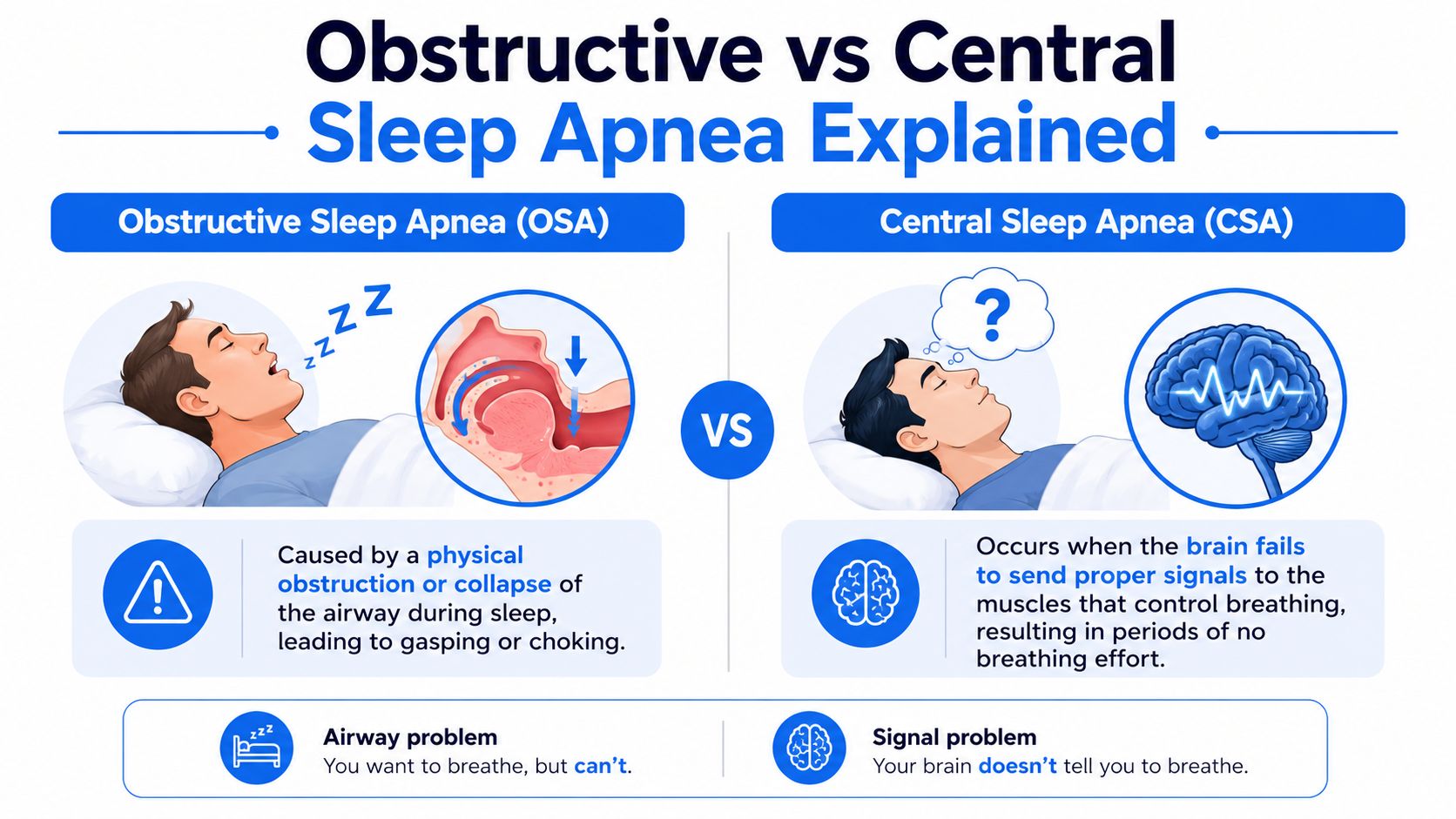
Think of OSA like a hose that gets pinched shut. Air is supposed to move through, but the passage narrows or collapses while the person sleeps. CSA is different, more like a signal problem, where the brain doesn't keep breathing drive steady enough during sleep.
Why OSA is the form dentists most often help with
The dominant adult form is OSA, which is why it gets the most attention in dental sleep care. In the United States, OSA affects about 25% to 30% of men and 9% to 17% of women, and a global estimate places about 936 million adults ages 30 to 69 with mild-to-severe OSA, with about 425 million in the moderate-to-severe range (NIH book chapter).
That doesn't mean every snoring adult has OSA, or that every apnea case is the same. It does mean that airway collapse is common enough that adults shouldn't dismiss it as simple snoring. Dental treatment becomes relevant because the mouth, jaw, and throat shape can influence whether the airway stays open during sleep.
Simple takeaway: if the problem is a blocked airway, a dental appliance may help keep that space open.
CSA still matters clinically, but it usually requires a different medical pathway. In dental offices, the focus is typically on OSA because that's the condition where oral appliance therapy can be part of the solution. That's why sorting out the type of apnea is the first real step toward treatment that makes sense.
Common Risk Factors and Contributing Conditions
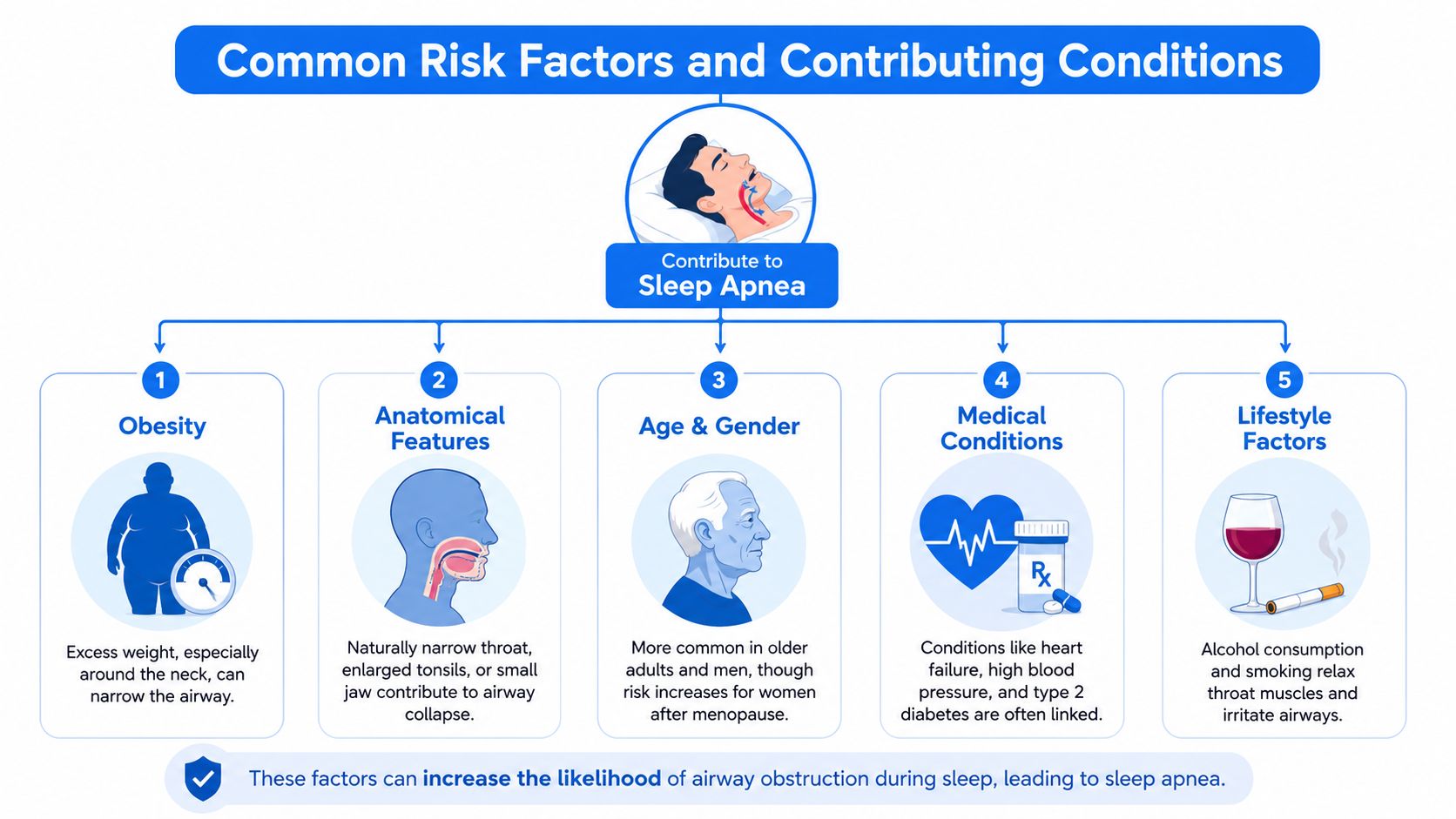
Adult sleep apnea usually develops from a combination of factors. Weight, anatomy, age, sex, smoking, alcohol, and sedative use can all work together, which is why two people with similar symptoms may have very different reasons for struggling at night.
Weight and neck size are major clues
Excess weight is one of the strongest modifiable causes in many adults, because tissue around the neck and upper airway makes collapse more likely during sleep. A measurable large neck is also a warning sign, with greater than 16 inches for women and 17 inches for men noted as risk markers (Cleveland Clinic).
That does not mean every adult with sleep apnea is overweight. It means body weight can add pressure to a throat that is already more likely to narrow when the muscles relax during sleep. For patients looking into a sustainable weight loss method, the important point is that body changes can support treatment, but they do not replace a proper airway evaluation when symptoms are already present.
Anatomy, age, sex, and lifestyle can push the airway toward collapse
A naturally narrow throat, enlarged tonsils or adenoids, a small jaw, or craniofacial structure can all raise risk, and that risk is not limited to body size alone (Stanford). Men are 2 to 3 times more likely than women to have sleep apnea, and smokers are three times more likely than never-smokers (Cleveland Clinic). Mayo Clinic also notes that sex, age, alcohol, sedatives, and nasal congestion can all contribute to the broader pattern (Mayo Clinic).
The airway can be structurally tight, and sleep lowers the muscle support that normally keeps it open. When those two factors meet, obstruction becomes more likely.
Useful rule of thumb: the cause is often a mix, not a single bad habit or one body feature.
For adults trying to understand their own symptoms, that broader picture matters. Weight changes may help some people, but jaw shape, nasal blockage, smoking, and other contributors can still be part of the problem. A careful exam is what separates a general concern from the actual cause.
Getting a Diagnosis Physician and Dentist Collaboration
A real diagnosis starts with a medical clinician, not a guess based on symptoms alone. In adults, the usual path is a sleep study, often called polysomnography, which records breathing and sleep patterns while the person rests.
That step matters because treatment should match the type of apnea. If the issue is OSA, a dentist trained in sleep-related breathing care may become part of the treatment team. If the issue is something else, the medical plan may look different.
What the physician does first
The physician confirms whether sleep apnea is present and helps determine the type. That medical diagnosis creates the foundation for treatment, and it keeps care aligned with the patient's overall health rather than just the symptoms that show up in the bedroom.
Once the diagnosis is in place, a dentist can review how the jaw, bite, and airway fit together. That collaboration is especially useful when a patient is a better fit for oral appliance therapy than for a mask-based approach. The dentist's role is not to replace the physician's diagnosis, but to carry out the dental part of the care plan with precision.
How the collaboration works in a Scottsdale dental setting
At a practice like Dr. Eric Wiitala DDS, the conversation usually stays focused on comfort, safety, and fit. The physician's findings guide the dental work, and the dental appliance is then designed to support the airway during sleep.
This team-based model helps avoid two common mistakes. One is trying to self-diagnose based on snoring alone. The other is assuming that every treatment path is the same for every adult.
A good plan starts with a confirmed diagnosis, then moves to the least disruptive treatment that can still address the airway problem.
That process also gives patients more confidence. They know the problem was evaluated properly, and they know the dental solution is being used in the right situation. For adults who want a local dentist in Scottsdale to be part of the solution, that combination of medical confirmation and dental care is often the most reassuring route.
Oral Appliance Therapy A CPAP Alternative in Scottsdale
For many adults with OSA, a custom oral appliance is the treatment that feels most manageable day to day. It is small, portable, and made to hold the lower jaw in a position that helps keep the airway open during sleep.

Adult sleep apnea often comes down to anatomy and inherited structure. A dental appliance can be a practical option when the problem is airway collapse rather than a brain signaling issue, as noted in Stanford sleep apnea education. A small jaw, a narrow airway, enlarged tonsils, and extra weight around the neck can all raise the chance of blockage, and a device that gently repositions the jaw can create more room for breathing.
The idea is simple. The appliance is custom-made to fit the patient's mouth, then adjusted so it holds the lower jaw slightly forward during sleep. That position helps keep soft tissues from falling back and narrowing airflow, much like propping open a doorway so it does not swing shut.
For readers comparing options, the difference from a CPAP machine usually comes down to comfort and daily use. CPAP can be the right answer for many people, but some adults do better with a device they can wear more naturally. That is one reason the topic of chronic snoring and sleep apnea treatment comes up so often in dental offices.
What makes dental treatment especially useful
Oral appliance therapy can also fit well with other parts of dental care. A patient who grinds teeth, needs restorative dentistry, or wants to protect a healthy bite may benefit from a plan that considers the airway and the teeth together. That wider view is one reason sleep care belongs in a dental setting.
The appliance itself does not solve every cause of sleep apnea. It is not meant for every patient, and it is not a substitute for diagnosis. But when the root problem is airway collapse, it gives Scottsdale adults a realistic, noninvasive path to better sleep.
A helpful video overview can make the process easier to understand before the first appointment.
Your First Visit with Dr Wiitala in Scottsdale
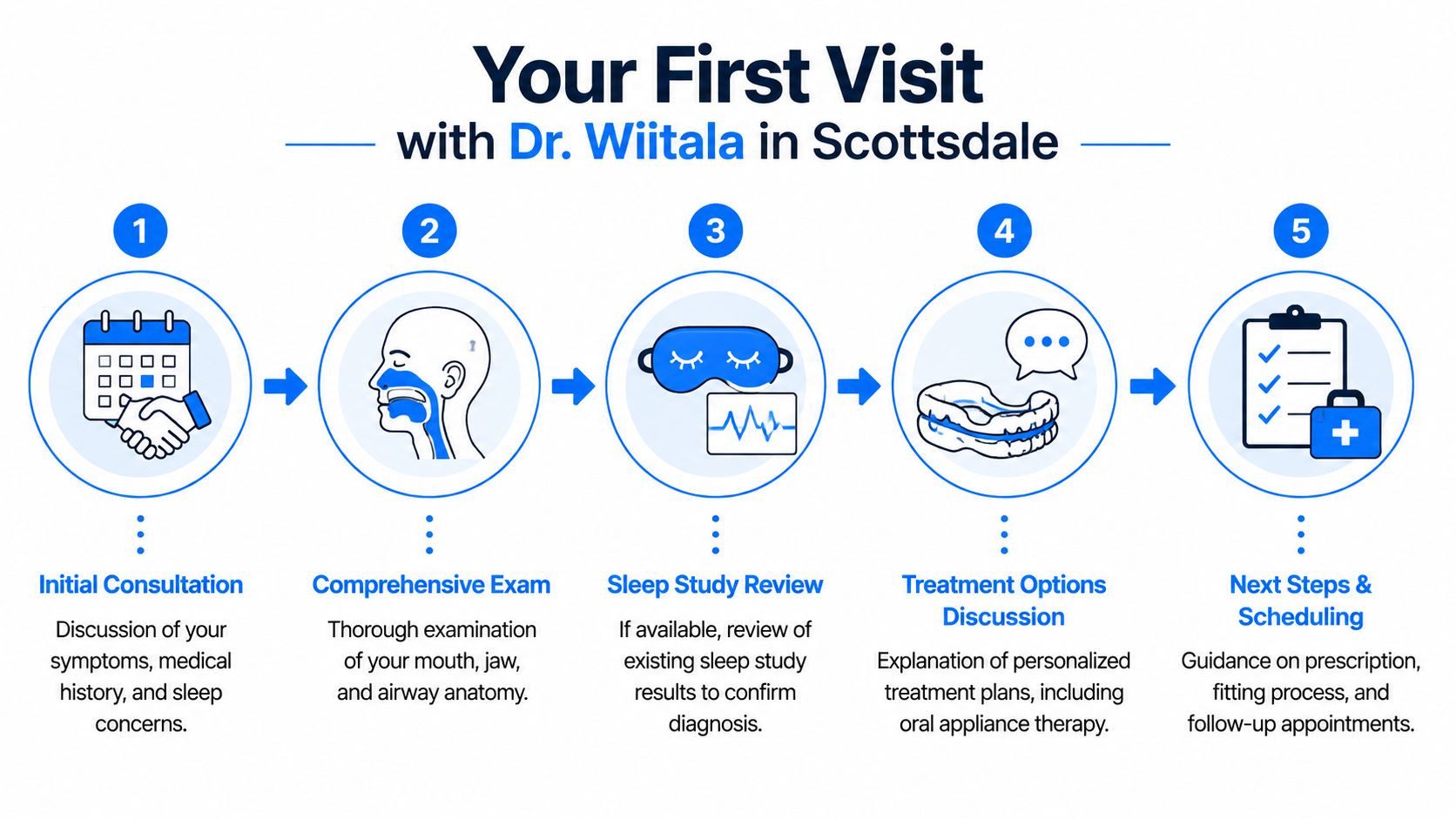
A first sleep apnea visit should feel clear, not rushed. The patient usually starts by talking through symptoms, sleep concerns, and any prior testing, then the office looks at how the mouth, jaw, and airway fit together.
What the visit usually feels like
The appointment often begins with a careful conversation. A patient might describe waking up tired, a partner might have noticed snoring, and the dentist can then connect those details to the jaw and airway exam.
If prior sleep study results are available, they're reviewed as part of the visit. If not, the dentist helps the patient understand what information still needs to come from the medical side before treatment moves forward.
What Dr. Wiitala looks for
During the exam, attention goes to details that can influence airway space and appliance fit. The teeth, bite, jaw position, and oral tissues all matter, because the appliance has to be both comfortable and functional.
The office may also take digital impressions so the appliance can be made to fit the patient closely. That kind of fitting process matters because a loose or poorly matched device won't support the airway the way it should.
What comes next
Once the data is in place, the treatment plan is explained in plain language. The patient learns what the appliance does, how it will be adjusted, and what follow-up looks like after delivery.
For Scottsdale adults who want a smooth, guided experience, the first visit process helps remove a lot of the uncertainty. A patient doesn't have to know every medical detail before coming in. The office handles the fit, the education, and the next steps.
That kind of appointment is often where worry starts to turn into a plan. The symptoms still matter, but they're no longer floating without explanation.
Take the First Step Toward Better Sleep
A tired adult in Scottsdale may start to notice a pattern, snoring at night, choking awake, dry mouth in the morning, and exhaustion that makes the day feel harder than it should. Those signs can point to sleep apnea, and the cause is not the same for everyone. Excess weight can raise the risk of obstructive sleep apnea, but jaw position, airway anatomy, age, sex, smoking, and oral structure can also play a part, which is why a personal evaluation is more useful than a broad explanation.
Good sleep habits can support treatment, especially while a patient is waiting for a medical evaluation or dental visit. A simple evening routine, like the kind described in wind down routines for operators, can make bedtime more predictable and help the body settle before sleep. That said, if snoring, choking awake, or daytime exhaustion are already becoming normal, home habits alone will not address the airway problem.
Dr. Eric Wiitala DDS in Scottsdale helps adults turn those symptoms into a clear plan. During a consultation, the focus is on connecting what the patient is experiencing to possible airway causes, checking whether oral appliance therapy is a fit, and explaining the next steps in plain language. That kind of visit can give a patient a practical path forward, especially when professional care is needed alongside the lifestyle changes recommended by a physician.