
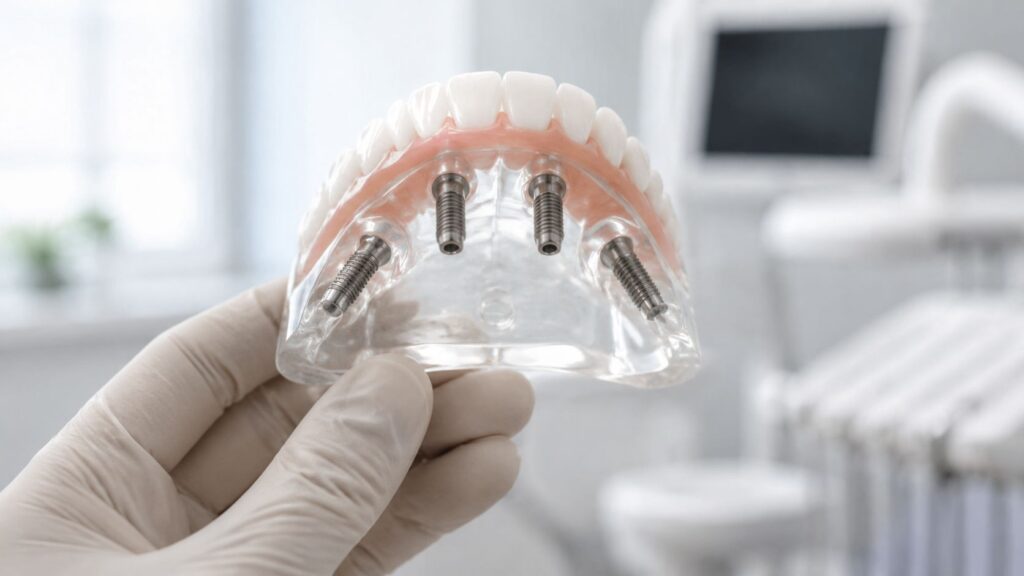
If loose dentures are making meals awkward, if chewing feels like a guessing game, or if smiling has started to feel too self-conscious, it's normal to start searching for a dentist near me or dental implants near me and hope the answer is simple. In Scottsdale, that search often leads people toward a full-arch solution when the teeth in one jaw are failing or missing. All-on-4 dental implants can be a practical way to replace an entire arch with fixed teeth, and a local evaluation helps show whether that path fits the mouth, the bite, and the person's health needs.
For adults who want something steadier than removable dentures, the conversation usually turns to comfort, chewing, and whether treatment can be done in a way that feels manageable. At Eric Wiitala DDS in Scottsdale, the focus is on clear explanations, careful planning, and treatment options that fit real life, not just a brochure. That matters when the next step may involve tooth extraction, implant planning, or a full-mouth restoration plan that needs to make sense from the first visit.
Finding Dental Implants Near Me in Scottsdale
A lot of Scottsdale patients reach the same point in almost the same way. A denture slips during dinner, a back tooth breaks again, or a smile that used to feel easy starts taking effort to hide. That's when the search terms get more specific, because dental implants near me usually means someone is no longer looking for a temporary fix, they're looking for a stable plan.
For people dealing with several missing teeth or a failing full arch, full-arch implant care can feel like a reset. It can restore chewing, support facial structure, and reduce the frustration that comes with constant adjustments or adhesive routines. For many, that's the difference between getting through meals and eating with confidence again.
At a local Scottsdale practice like Eric Wiitala DDS, the first conversation is usually about what's still working, what hurts, and what kind of result feels realistic. That can include preventive care, new patient exams, dental x-rays, restorative dentistry, or a surgical referral path if the mouth needs broader reconstruction. The important part is that the plan starts with the patient's situation, not with a one-size-fits-all answer.
Practical rule: if teeth are failing across an entire arch, the best next step is often not guessing online, it's a consultation that checks bone, gum health, and bite forces before treatment is chosen.
A concerned patient usually wants one clear thing, a fixed smile that doesn't shift. That's where All-on-4 often enters the conversation as a community-minded solution for people who want to stay local, keep care coordinated, and get a treatment plan they can understand.
Understanding All on Four Dental Implants
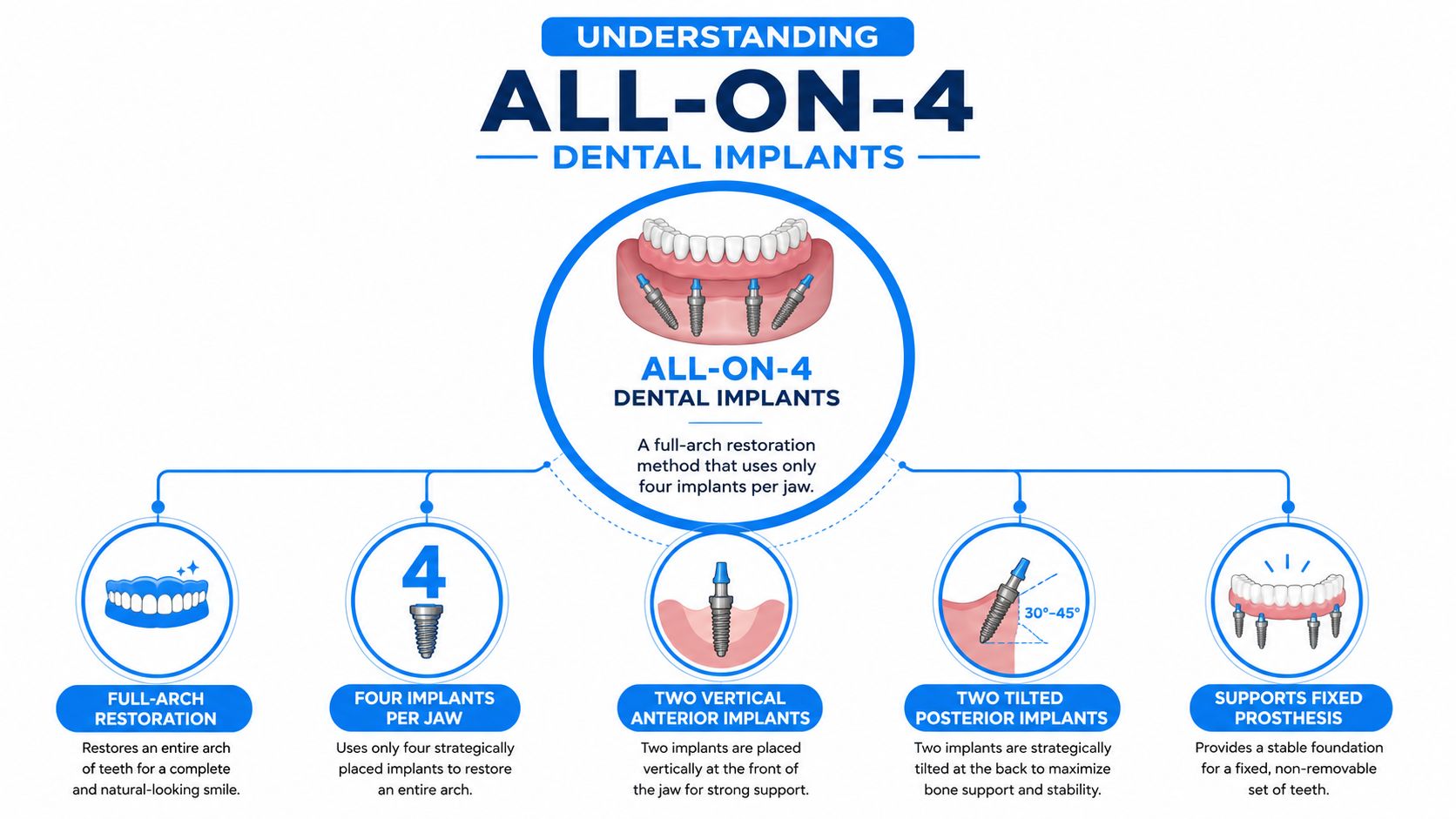
All-on-4 dental implants are a full-arch restoration method that uses four implants per jaw to support a fixed bridge. Two implants are placed more vertically in the front, and two are tilted in the back so they can reach stronger bone and often avoid grafting. In plain language, the system is designed to give a person a full set of fixed teeth without placing an implant for every missing tooth.
The concept was introduced in the modern implant era in the early 2000s and gained attention because it offered a practical path for people with edentulous or near-edentulous jaws. Early evidence was promising, and a 2013 systematic review reported cumulative implant survival of 98.6% at 12 months, 99.1% at 24 months, and 99.0% at 36 months, with prosthesis survival of 100% at 12 and 24 months and 99.9% at 36 months. That same review also reported low average combined bone loss, which helped establish the method as a high-survival full-arch option.
Why the angle of the back implants matters
The tilted posterior implants are not a shortcut, they're a design choice. By angling the back implants, the clinician can engage denser bone farther forward in the jaw and often reduce the need for bone grafting. That can make treatment simpler for the right patient, especially when the goal is to restore function quickly.
The value of All-on-4 is not just that it uses fewer implants, it's that the whole arch is planned as one fixed system.
What people often miss is that the bridge, the implants, and the bite all have to work together. The treatment is best understood as a full-arch system, not just four pieces of titanium.
How the All on Four Procedure Works
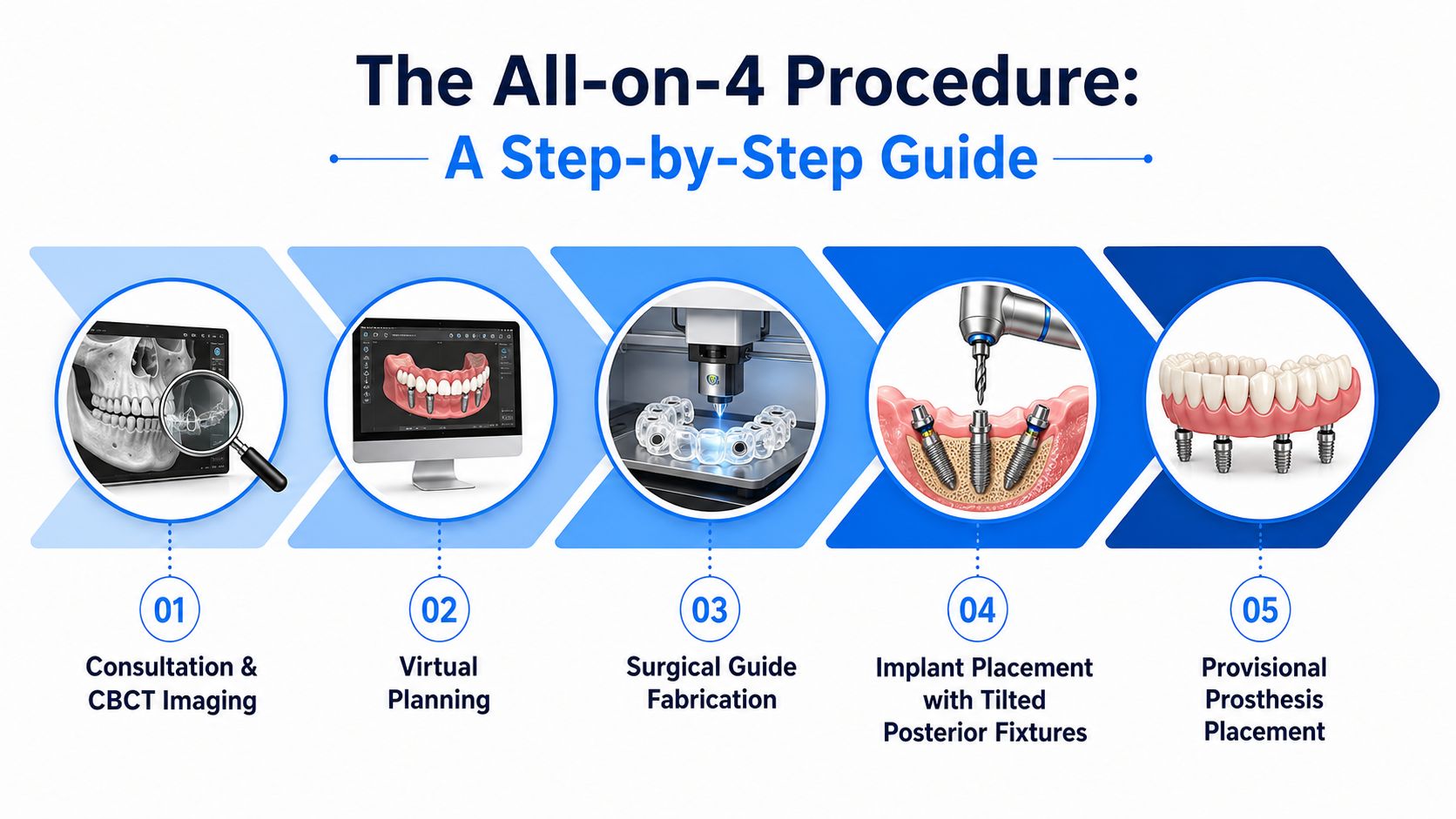
A typical All-on-4 journey starts with a consultation and 3D imaging so the clinician can map bone, bite, and spacing. From there, the team plans implant positions digitally, then uses that plan to guide surgery and the provisional bridge. The goal is to create enough initial stability that the teeth can function right away.
The standard design uses four implants per jaw, and the two back implants are commonly tilted at 30 to 45 degrees to engage denser bone and often avoid bone grafting. That angulation helps preserve support in situations where the back of the jaw has less usable bone. In immediate-load cases, stability is critical, and technical reviews describe achieving final torque above 30 Ncm as a benchmark for primary stability before loading.
What usually happens during treatment
- Consultation and imaging. The mouth is evaluated, then scanned so the plan is based on anatomy rather than estimates.
- Virtual planning. Implant positions are mapped before surgery, which reduces guesswork.
- Guide fabrication. A surgical guide is prepared to help place the implants in the planned locations.
- Implant placement. The four implants are inserted, including the tilted posterior fixtures.
- Provisional prosthesis. A temporary bridge is attached so the patient leaves with fixed teeth.
The most reassuring part for many patients is how straightforward the process is. Fewer implant sites often means fewer surgical areas to heal, and the provisional teeth help people maintain function and appearance while the jaw integrates the implants.
Determining If You Qualify for All on Four
Not every mouth is a good match for All-on-4, and that's not a flaw in the treatment. It just means candidacy matters. Systematic reviews stress that outcomes are strongest in patients without severe bone loss, heavy smoking habits, uncontrolled diabetes, or untreated periodontal disease review of treatment candidates.
That's why a consultation should look beyond the smile and into the health history. Bone volume in the front of the jaw, gum condition, bite forces, and medical stability all play a role. If the jaw has advanced bone loss or if the gums are inflamed and untreated, the plan may need to change before implants can be placed safely.
Signs the treatment may need extra planning
- Severe bone loss: the jaw may need another strategy, or at least a more detailed workup.
- Heavy smoking: healing and implant success can be harder to predict.
- Uncontrolled diabetes: medical control matters before oral surgery.
- Untreated gum disease: infection risk has to be addressed first.
- High bite forces: the prosthesis may need special reinforcement.
A good consult should also answer whether staged treatment, gum therapy, or tooth removal is needed first. For readers comparing options, the clinic's dental implant candidacy guide can help frame the kinds of questions to bring in.
The main takeaway is simple. All-on-4 is a protocol, not a guarantee. A careful exam decides whether the mouth is ready now, needs prep work, or would do better with a different full-arch strategy.
Benefits Compared to Traditional Implants and Dentures
Traditional multi-implant restorations, removable dentures, and All-on-4 all solve tooth loss, but they solve it in very different ways. Traditional implant plans can work well, especially when more support is needed, but they usually involve more fixtures and sometimes a longer treatment path. Removable dentures are simpler to start with, yet they don't anchor to bone and can feel unstable when chewing or speaking.
All-on-4 sits in the middle for many full-arch patients. It can deliver fixed teeth with an efficient implant count, which means fewer surgical sites than a many-implant approach and more stability than a denture. It also fits well when the patient wants a full-mouth plan rather than piecemeal repairs.
A quick way to think about the tradeoffs
| Option | Stability | Chewing | Bone support | Convenience |
|---|---|---|---|---|
| Traditional implants | Strong, but depends on the plan | Often very good | Supports bone where implants are placed | More complex planning |
| Removable dentures | Least stable | Often limited | Doesn't preserve bone the same way | Easiest to remove |
| All-on-4 | Fixed and secure | Better than dentures for many patients | Helps support the jaw through implants | Fewer implants, faster route to fixed teeth |
That comparison is why people searching for cosmetic dentist near me often end up discussing restoration, not just appearance. A fixed arch can improve the look of the smile, but it can also help with comfort, speech, and confidence in daily life.
For patients considering broader rebuilding, a full-mouth reconstruction overview can show how implants, crowns, and other restorative steps may fit together when more than one problem is present.
Risks Recovery and Long Term Outcomes
Recovery after All-on-4 usually includes swelling, soreness, and a period of soft foods while tissues calm down. That part surprises people less than the maintenance piece, which is where realistic expectations matter. The bridge can develop acrylic fractures or detachment of prosthetic parts, so long-term care is not optional even when the implants themselves are stable.
Long-term data for mandibular All-on-4 prostheses are encouraging. In a 10-year longitudinal study of immediately loaded mandibular prostheses, implant-related success was 98.1% at 5 years and 94.8% at up to 10 years, while prosthesis survival remained 99.2% over the same follow-up long-term mandibular outcomes. The same study reported patient-related success of 94.8% at 5 years and 93.8% at up to 10 years, which shows that durable maintenance supports satisfaction over time.
What smooth healing usually depends on
- Following diet instructions: soft foods protect the bridge and implants early on.
- Keeping clean around the bridge: plaque control matters even with fixed teeth.
- Attending follow-up visits: small repairs are easier before they grow.
- Watching for looseness or chips: these are early signs the prosthesis needs attention.
A fixed arch still needs routine care, because the teeth are attached to a system that can wear over time.
The lower jaw often performs better than the upper jaw in long-term studies, so a clinician should discuss jaw-specific expectations openly. That kind of clarity helps patients plan for repair, upkeep, and the kind of ongoing care that keeps the result working for years.
Costs Financing and Maintenance Tips
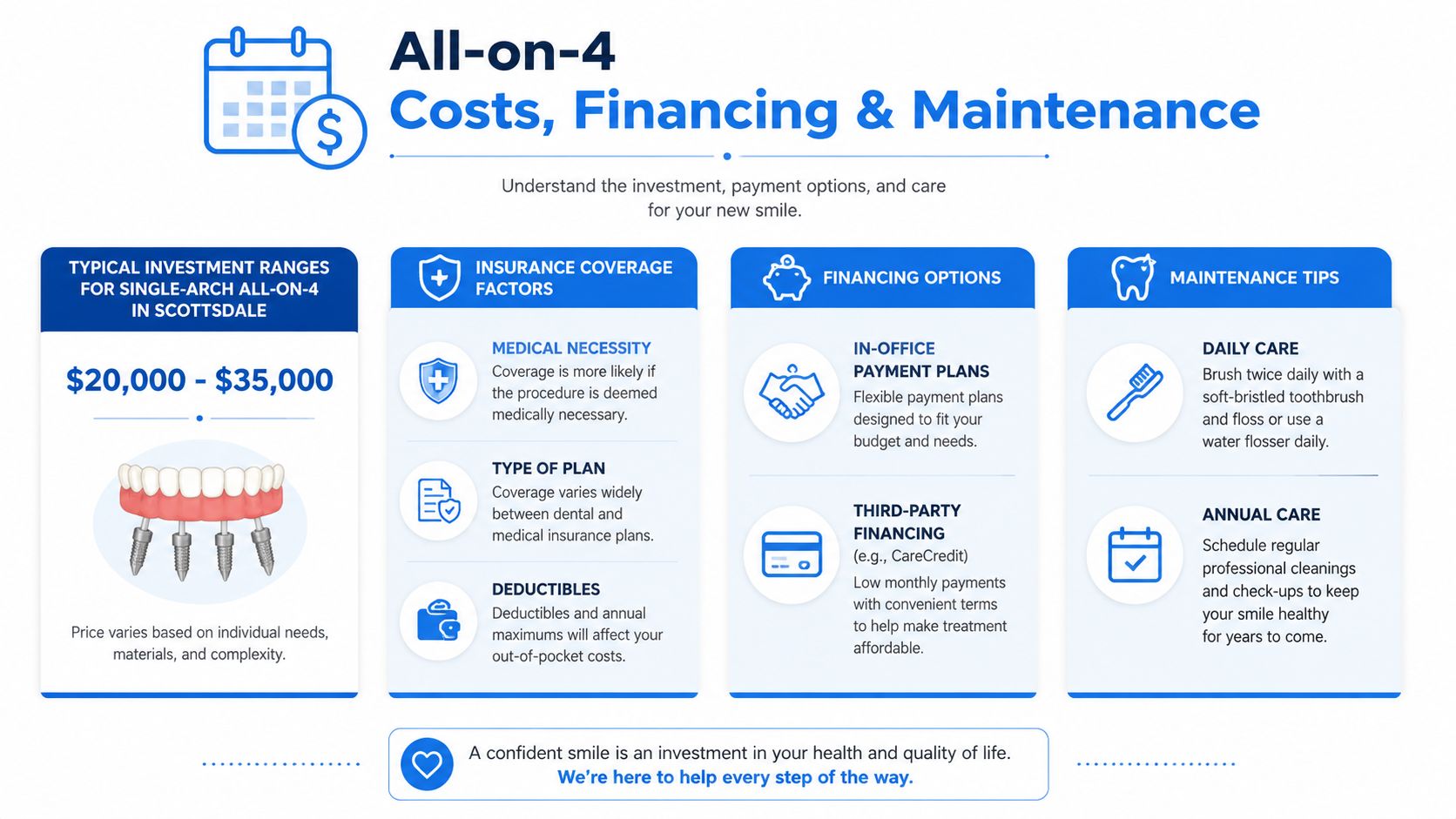
Patients usually want to know whether the investment is manageable before they commit, and that's fair. In Scottsdale, single-arch All-on-4 treatment is commonly discussed as a significant treatment commitment, and the final figure depends on the exam, imaging, extraction needs, prosthetic design, and whether the case is simple or more involved. Insurance coverage varies too, especially when medical necessity, plan type, and deductibles all affect what gets applied.
At the financial level, many offices discuss in-house payment plans and third-party financing so treatment can be spread out over time. That's often helpful for people balancing oral health with everyday budgets. For a local visit at Eric Wiitala DDS, the discussion can also include how the implant timeline fits with other restorative needs, such as extractions, crowns, or periodontal therapy.
Maintenance habits that protect the investment
- Daily care: brush twice daily, then use flossing tools or water flossing to clean under the bridge.
- Annual care: keep professional cleanings and check-ups on the calendar.
- Prosthesis checks: ask whether screws, acrylic, and bite contact need periodic inspection.
A 10-year longitudinal study showed patient-related success of 94.8% at 5 years and 93.8% up to 10 years, which reinforces a simple point, long-term satisfaction depends on maintenance, not luck maintenance and longevity data. Patients who keep regular hygiene visits and report small changes early usually give the restoration its best chance to stay comfortable and functional.
Frequently Asked Questions and Scheduling an Appointment
Many patients ask how soon they can eat normally. The answer depends on healing and the stage of the restoration, because early eating is usually more careful than later eating once the final teeth are in place. Another common question is whether All-on-4 can fail. It can, which is why candidacy, hygiene, and follow-up matter.
Sedation options are usually discussed during consultation, along with the surgical plan and any needed tooth removal. For patients in Scottsdale, the clearest next step is to schedule a consultation so the mouth can be examined, imaging can be reviewed, and the treatment path can be explained in plain language.
A CTA for Eric Wiitala DDS. To ask whether All-on-4 fits the mouth, call (480) 657-6981 or use the online form to schedule a consultation with Eric Wiitala DDS in Scottsdale, AZ.